
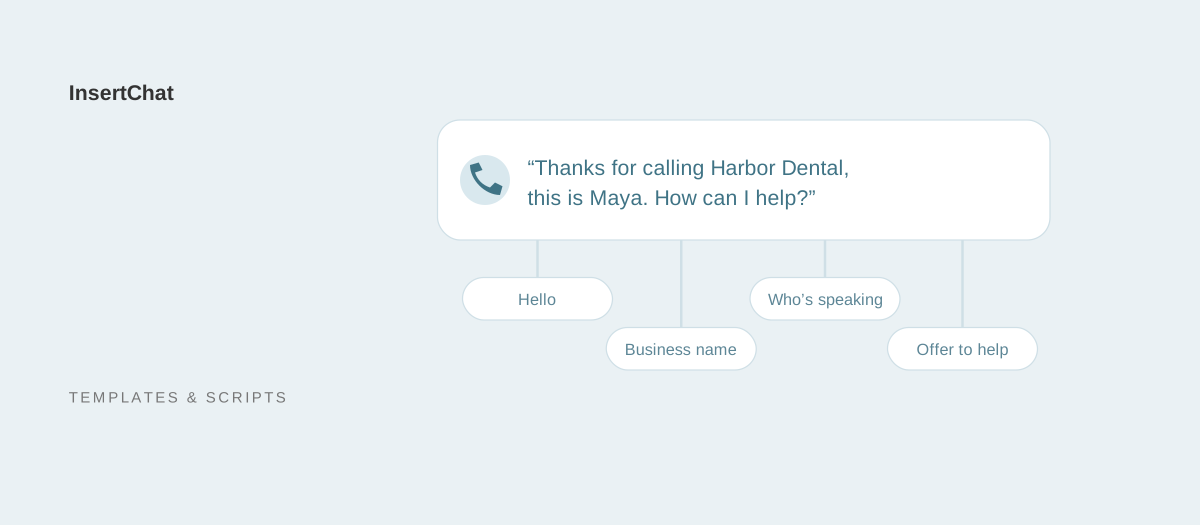
A good business phone greeting does four things in a few seconds: it says hello, names the business, tells the caller who is speaking, and invites them to say what they need. “Thanks for calling Harbor Dental, this is Maya. How can I help you today?” covers all four, and it works for almost any business.
Below are 52 greetings you can copy, grouped by style, industry, and situation, with a short note on when each one fits. Replace anything in brackets with your own details. The last set is written for an AI receptionist: each one fits InsertChat’s 200-character greeting limit and tells callers they’re speaking with an AI.
What should a business phone greeting include?
A business phone greeting should include a hello, the business name, the name of the person answering, and an offer to help. Those four parts confirm the caller dialed the right number, give them someone to talk to, and hand the conversation back to them quickly. Everything else is optional.
| Part | Example | Why it matters |
|---|---|---|
| Hello | “Thanks for calling” or “Good morning” | Signals that a person picked up on purpose |
| Business name | “Harbor Dental” | Confirms the caller reached the right place |
| Who is speaking | “this is Maya” | Gives the caller a name to use and remember |
| Offer to help | “How can I help you today?” | Lets the caller explain why they called |
Two optional parts are worth adding in the right business. A department or location helps when you have more than one, as in “Harbor Dental, Eastside office.” A question that sorts the call, such as “Is this a new problem or an existing job?”, saves time when callers usually need one of two things.
Leave out taglines, long legal names, and anything the caller has to sit through before they can speak. A live greeting should take three to five seconds to say. A recorded greeting can run longer because it also has to give hours or a callback time.
Professional greetings for any business
These six greetings suit almost any business with a person answering the phone. Pick one and have everyone on the team use it, so callers hear the same greeting every time.
- Standard: “Thank you for calling [Business Name], this is [Your Name]. How can I help you today?”
- Time of day: “Good morning, [Business Name], [Your Name] speaking. How may I help you?” Switch to “Good afternoon” after noon, or use the standard greeting all day.
- With a department: “[Business Name] billing, this is [Your Name]. What can I help you with?”
- With a location: “Thanks for calling [Business Name] on [Street or Neighborhood], this is [Your Name]. How can I help?” Useful for businesses with more than one location.
- Formal: “Good afternoon, you’ve reached the offices of [Business Name]. This is [Your Name]. How may I direct your call?” Suits law, finance, and corporate offices.
- Owner answering: “[Business Name], this is [Your Name], the owner. How can I help?” Callers like knowing they reached the person in charge.
Short greetings for busy phone lines
Short greetings work when calls come in fast and callers already know who they called. Keep the business name in every version, because it’s the part that confirms the caller dialed correctly.
- Name and name: “[Business Name], this is [Your Name].”
- Name and offer: “Thanks for calling [Business Name]. How can I help?”
- Shortest complete greeting: “[Business Name], how can I help you?”
- Casual: “Hi, [Business Name], [Your Name] here.”
- Dispatch desk: “[Business Name] dispatch, this is [Your Name]. What’s going on?” Gets a caller with a problem talking right away.
Warm and friendly phone greetings
Friendly greetings fit neighborhood shops, salons, studios, and any business that relies on regulars. Warmth comes from the words and the tone of voice, so smile while you say them.
- Welcoming: “Hi there, thanks for calling [Business Name]. This is [Your Name]. What can I do for you?”
- From the whole team: “Good morning from everyone at [Business Name]. This is [Your Name]. What can I help you with?”
- Helpful: “Hello and welcome to [Business Name]. This is [Your Name]. How can I make your day easier?”
- Signature product: “Hi, you’ve reached [Business Name], home of [Signature Product]. This is [Your Name]. How can I help?”
- Regulars: “Thanks for calling [Business Name], this is [Your Name]. Have you been in to see us before?” The question tells you whether to explain the basics.
Business phone greetings by industry
Industry greetings work best when they include a question that sorts the call. A plumber needs to know about leaks, a practice needs to know if the caller is a patient, and a property manager needs to know if the caller is a resident. Each set below links to a page on how InsertChat answers calls in that industry.
Plumbing, HVAC, and electrical
Trades callers often have a problem in progress. Ask the question that tells you how urgent it is. See how this works for plumbers, HVAC companies, and electricians.
- Sort the job: “Thanks for calling [Business Name] Plumbing and Heating, this is [Your Name]. Is this about a new problem or a job we’re already working on?”
- Safety first: “[Business Name], this is [Your Name]. If you have water or gas where it shouldn’t be, tell me that first. Otherwise, how can I help?”
Dental and medical practices
Practices sort new patients from current ones in the first question. Recorded and AI greetings should also point emergencies to 911. See dental offices and healthcare.
- Patient status: “Good morning, [Practice Name], this is [Your Name]. Are you a current patient or hoping to become one?”
- Recorded or AI greeting: “Thank you for calling [Practice Name]. If this is a medical emergency, please hang up and dial 911. Otherwise, how can we help you today?”
Law firms and accounting firms
Professional firms usually separate current clients from new matters, because each goes to a different person. See law firms and accounting firms.
- Direct the call: “Good afternoon, [Firm Name], this is [Your Name]. How may I direct your call?”
- New or current client: “Thank you for calling [Firm Name]. This is [Your Name]. Are you a current client, or calling about a new matter?”
Salons and spas
Most salon calls are about booking, so offer it in the greeting. See salons and med spas.
- Booking first: “Hi, thanks for calling [Salon Name], this is [Your Name]. Are you looking to book, or can I help with something else?”
- Spa: “Thank you for calling [Spa Name], this is [Your Name]. Would you like to book a treatment, or do you have a question?”
Auto repair shops
Shop callers are either checking on a car that’s already in or describing a new problem. See auto repair.
- Car in the shop: “[Shop Name] Auto, this is [Your Name]. Are you calling about a car that’s here with us, or a new repair?”
- Service desk: “Thanks for calling [Shop Name] service desk, this is [Your Name]. What are you driving, and what’s it doing?”
Property management and real estate
Property managers hear from residents, owners, and prospective renters, and each needs something different. See property management and real estate.
- Who’s calling: “Thank you for calling [Company Name] Property Management, this is [Your Name]. Are you a resident, an owner, or looking for a place to rent?”
- Listings: “[Brokerage Name], this is [Your Name]. Are you calling about a specific listing?”
Restaurants
Restaurant calls are mostly reservations and takeout, and the phone often rings during a rush. See restaurants.
- Two choices: “Thanks for calling [Restaurant Name], this is [Your Name]. Is this for a reservation or a takeout order?”
- During a rush: “[Restaurant Name], this is [Your Name]. We’re in the middle of service. May I put you on a short hold?” Wait for the caller to say yes.
Veterinary clinics and pet care
Pet owners calling a clinic may be worried, so ask about an emergency first. See veterinary clinics and pet grooming.
- Clinic: “[Clinic Name] Animal Hospital, this is [Your Name]. Is your pet having an emergency, or would you like to book a visit?”
- Grooming: “Thanks for calling [Business Name] Grooming, this is [Your Name]. Who are we getting cleaned up today?”
Gyms and fitness studios
Gyms field calls from members and from people thinking about joining. See gyms and fitness studios.
- Members and prospects: “Thanks for calling [Gym Name], this is [Your Name]. Are you a member, or thinking about joining?”
- Class studio: “[Studio Name], [Your Name] here. Can I help you book a class?”
Retail stores and online shops
Store callers usually ask about an order or a product, and order calls go faster when the number is ready. See ecommerce.
- Order or product: “Thank you for calling [Store Name], this is [Your Name]. Are you calling about an order or a product?”
- Customer care: “[Store Name] customer care, this is [Your Name]. Do you have your order number handy?”
Phone greetings for special situations
Special situations need their own message, and most of these are recorded. Update them on the day things change and set a reminder to switch them back.
- Queue or overflow: “Thanks for calling [Business Name]. Everyone is helping other customers right now. Please stay on the line, and the next person will be right with you.”
- Standard voicemail: “You’ve reached [Business Name]. We can’t take your call right now. Leave your name, number, and what you need, and we’ll call you back by [Time].”
- After hours: “Thanks for calling [Business Name]. We’re closed for the day and open again tomorrow at [Time]. Leave your name and number, and we’ll call you first thing.” The after-hours message guide has 30 more.
- Holiday closure: “Happy holidays from [Business Name]. We’re closed from [Start Date] through [End Date] and back on [Day] at [Time]. Leave a message, and we’ll call you when we return.” See the holiday greeting guide for dated versions.
- Lunch break: “Thanks for calling [Business Name]. The team is at lunch until [Time]. Leave your name and number, and we’ll call you back this afternoon.”
- Busy season: “Thanks for calling [Business Name]. This is our busiest week of the year, so if you’re calling to book, the fastest way is online at [Website].”
- Bilingual: “Thank you for calling [Business Name]. Gracias por llamar a [Business Name]. How can I help you? ¿Cómo puedo ayudarle?”
- Emergency line: “You’ve reached the [Business Name] emergency line. Tell me your name, the address, and what’s happening, and I’ll get the on-call technician moving.”
- Returning a call: “Hi, this is [Your Name] from [Business Name], returning your call from [Time]. Is now a good time?”
- New address: “Thanks for calling [Business Name]. We’ve moved to [New Address] as of [Date]. This is [Your Name]. How can I help?”
AI receptionist greetings under 200 characters
An AI receptionist greeting should name the business, say the caller is speaking with an AI assistant, and say what it can do. These six fit within InsertChat’s 200-character limit with a typical business name, and they end with a question so the caller knows it’s their turn.
- General: “Thanks for calling [Business Name]. I’m [Assistant Name], the AI assistant. I can answer questions, book an appointment, or take a message for the team. How can I help?”
- Home services: “Hi, you’ve reached [Business Name]. I’m the AI receptionist. I can book a visit or pass your details to the team. What’s going on at your place?”
- Dental or medical: “Thank you for calling [Practice Name]. I’m [Assistant Name], the office’s AI assistant. I can book or move appointments and answer questions. What can I do for you?”
- Law firm: “Thanks for calling [Firm Name]. I’m the firm’s AI assistant. I can take details about a new matter and set up a consultation. How can I help today?”
- Salon: “Hi, thanks for calling [Salon Name]. I’m [Assistant Name], the salon’s AI assistant. Would you like to book, change an appointment, or ask a question?”
- After hours: “Thanks for calling [Business Name]. The team is off for the night, and I’m the AI assistant. I can book you in or pass a message along. What do you need?”
In InsertChat, the greeting lives in the phone settings under caller experience. Callers hear it before the conversation starts, and you can pick one of 10 voices and test both in a browser call before any customer hears them. The assistant introduces itself by the name you give it and answers in the language the caller speaks, so one greeting covers bilingual callers too.
What phone greeting mistakes should you avoid?
The most common greeting mistakes waste the caller’s first seconds or leave them unsure they called the right place. Most are easy to fix once you hear your own greeting the way a caller does.
- Answering with “Hello?” The caller can’t tell whether they reached a business, a wrong number, or someone’s personal phone.
- Rushing the business name. It’s the part callers listen for, so say it slowly and clearly.
- Stacking a tagline, a promotion, and a menu before the caller can speak.
- Promising a callback “as soon as possible.” Give a time you can keep, like “by 10 a.m. tomorrow.”
- Leaving an old message up. A holiday greeting in January tells callers nobody is minding the phones.
- Putting callers on hold before they speak. Ask first and wait for a yes.
- Letting every person answer differently. Agree on one greeting and post it next to the phone.
How do you test a new phone greeting?
Test a new greeting by calling your own number the way a customer would and listening for the four parts. Then check every path a caller can take, because a greeting that works live can sound wrong on voicemail or after hours.
- Read it aloud and time it. A live greeting should take three to five seconds.
- Call from a mobile phone. Listen to the name and the offer to help from the caller’s side.
- Ask someone outside the business what they learned from the greeting alone.
- Check every route: live answer, voicemail, after hours, holidays, and your AI receptionist if you use one.
- Set reminders to update seasonal greetings before holidays and after they end.
For the rest of the call, the receptionist phone scripts cover bookings, price questions, upset callers, and emergencies, and the guide on how to answer a business phone professionally covers tone, holds, and messages.
Let InsertChat say your greeting on every call
InsertChat’s AI receptionist says your greeting at the start of every call it answers, then keeps going: it answers from your services, hours, and prices, books appointments within your scheduling rules, and passes calls that need a person to your team with the details already written down. Every call lands in the shared inbox with a transcript and a summary.
You decide when it answers. With “AI when unanswered,” your team’s phone rings for 5 to 60 seconds first and the AI picks up only if nobody does. With “AI after hours,” it covers evenings and weekends using your weekly hours and time zone. In the US and Canada you keep your business number with call forwarding; elsewhere you can use a local or toll-free InsertChat number where available.
Plans start at $98 per month with one phone number and 5,000 monthly credits, and you can try Pro free for 7 days with 500 credits (a card is required). Start your free trial, paste your greeting, and place a test call, or explore the demo to see answered calls in a sample workspace first.