
A virtual receptionist is a remote receptionist, either a trained person at a call service or an AI voice agent, who answers your business calls, takes messages, answers routine questions, and books appointments without sitting at your front desk. As of November 2026, 100 three-minute calls a month cost about $400 to $1,200 with a live service, about $70 to $215 with an AI receptionist, and roughly $4,500 for a full-time in-house hire who covers only 40 of the week's 168 hours.
This guide explains what each option does, what it cannot do, how many hours it covers, and what it costs per month on published prices. It also answers the question owners keep asking: is AI replacing receptionists?
What a virtual receptionist is (and the four things people confuse it with)
A virtual receptionist does the job of the person who used to sit by the door: pick up, greet the caller by your business name, answer the easy questions, route the call, and take a message. The only difference is location. The receptionist is not in your building.
The term covers two different things, plus neighbors that get mistaken for it:
| What it's called | Who or what answers | Holds a conversation? | Typical use |
|---|---|---|---|
| Live virtual receptionist | A trained person at a call service, shared across many clients | Yes, from your script | Callers who need a human voice and judgment |
| AI virtual receptionist | Software with a natural voice | Yes, from your business information | Routine calls, booking, after-hours coverage |
| Auto attendant or IVR | A recorded menu ("press 1 for sales") | No, it only routes | Directing callers to extensions |
| Answering service | Often message-taking and after-hours overflow | Limited | Taking a name and number |
Some phone vendors call a menu a "virtual receptionist." Vonage, for example, describes its virtual receptionist as an auto attendant that lets callers choose from a preconfigured menu. That routes calls but does not answer questions. For the full contrast, see our guide to AI receptionists versus IVR menus and our comparison of a virtual receptionist versus an answering service.
A virtual assistant is a different role. An assistant handles admin work such as email, calendars, and travel; a receptionist's main job is answering calls.
What a virtual receptionist actually does
A virtual receptionist answers calls in your business name and handles five jobs: answering, screening, messaging, booking, and routing. What varies is how well each type does each one.
- Answer and greet. Pick up on the first ring or after your team misses it, using a greeting you write.
- Answer routine questions. Hours, prices, service area, directions, what to bring. Live agents work from your script; AI works from your knowledge base.
- Screen calls. Separate customers from sales solicitations and wrong numbers.
- Take messages and capture leads. Name, number, and the reason for the call, sent to you by text, email, or an inbox.
- Book, move, and cancel appointments. In your calendar, if the service connects to it.
- Route urgent calls. Flag an emergency to the right person. Live services can connect the caller to a number you choose; AI services differ, covered below.
Live vs AI vs in-house: what each can and can't do
A live service gives you human judgment and warm transfers at a per-minute or per-call price. An AI receptionist gives you instant 24/7 answers and booking at a fraction of the cost but is weaker with upset or unusual callers. An in-house hire gives you the best caller experience for the hours that person works, and nothing outside them.
| Live virtual receptionist | AI receptionist | In-house receptionist | |
|---|---|---|---|
| Answers after hours | Yes on 24/7 plans (Ruby, PATLive, AnswerConnect, Abby Connect, Smith.ai) | Yes | No, unless you pay for shifts |
| Takes messages | Yes | Yes, with transcript and summary | Yes |
| Books appointments | Yes, sometimes an add-on (Smith.ai charges $1.50 a call) | Yes, if connected to a calendar | Yes |
| Transfers a live call to you | Yes on most plans | Varies: some vendors do, InsertChat does not | Yes |
| Handles upset or unusual callers | Best at it, within the script | Weakest point; hands off to your team | Best at it |
| Cost as calls grow | Climbs with every minute or call | Flat or slow-rising | Fixed, until you need another hire |
| What it can't do | Know your business as deeply as staff; cost scales | Replace human judgment on hard calls | Be there nights, weekends, lunch, and sick days |
Transfer capability is the biggest difference to check. Ruby's FAQ says its receptionists connect or transfer calls to any number you choose, and PATLive lists call screening and transfers on every plan. Among AI services, some advertise warm transfers and some, including InsertChat, do not transfer live calls at all.
How many hours does each option cover?
A week has 168 hours, and one full-time receptionist works about 40 of them, which covers 23.8% of the week before vacation and sick days. Covering all 168 hours with people takes about 4.2 full-time employees.
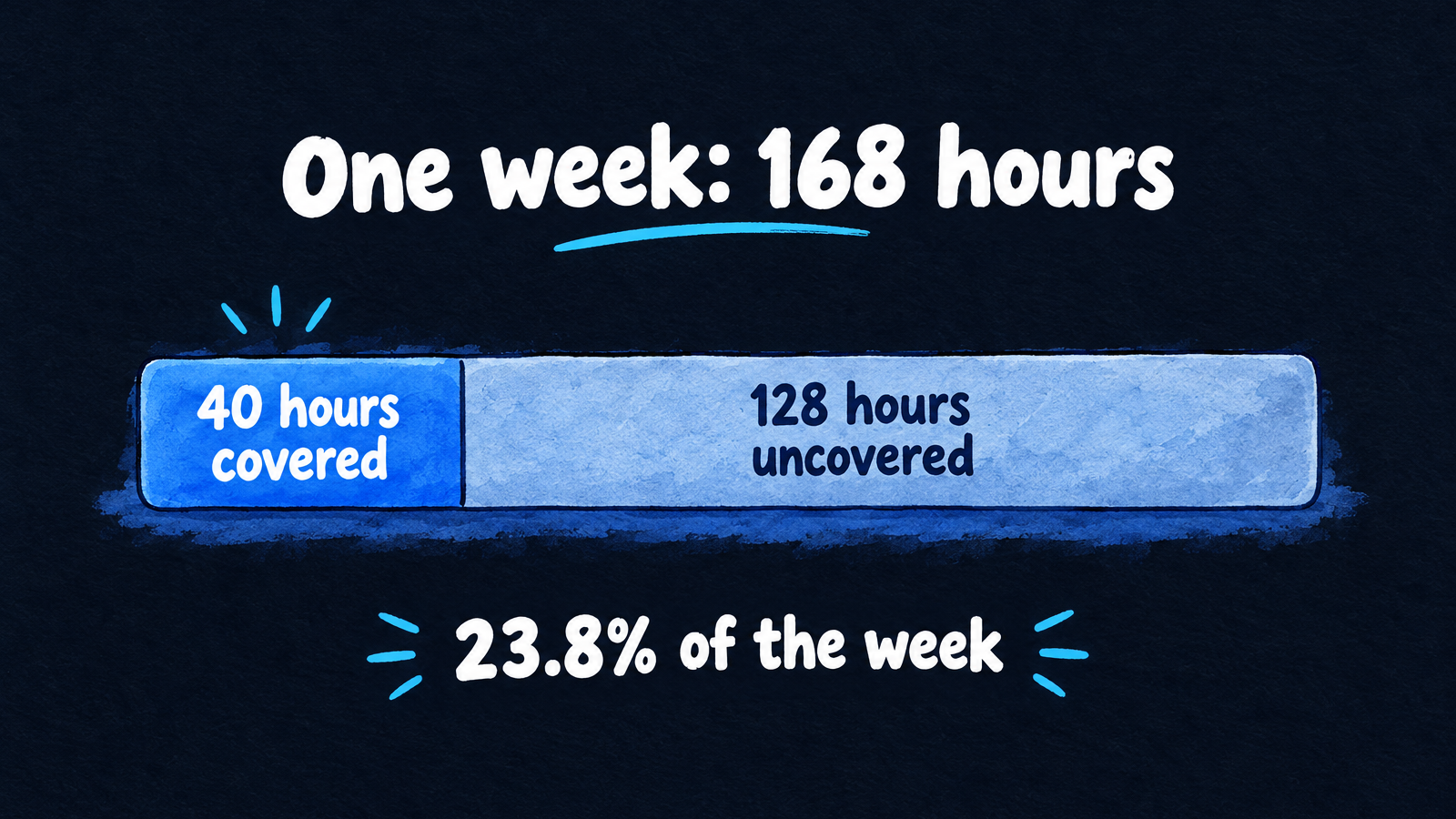
One full-time receptionist covers 40 of the week's 168 hours.
That gap matters because many calls arrive when the front desk is empty: at lunch, after 5, and on weekends. Live services close it by pooling receptionists across clients. Ruby, for example, says it answers 24/7/365, including holidays, though it notes that round-the-clock coverage can raise your minute usage. AI receptionists close it by answering at any hour for the same price.
Hours are worth confirming, because not every service staffs people around the clock. Ask whether live agents answer overnight or whether an automated system takes over.
What a virtual receptionist really costs per month
At 100 three-minute calls a month (300 minutes), a live service costs about $400 to $1,200, an AI receptionist about $70 to $215, and a full-time in-house receptionist about $4,500 loaded with benefits. The in-house figure is the only one that does not fall when your call volume does.
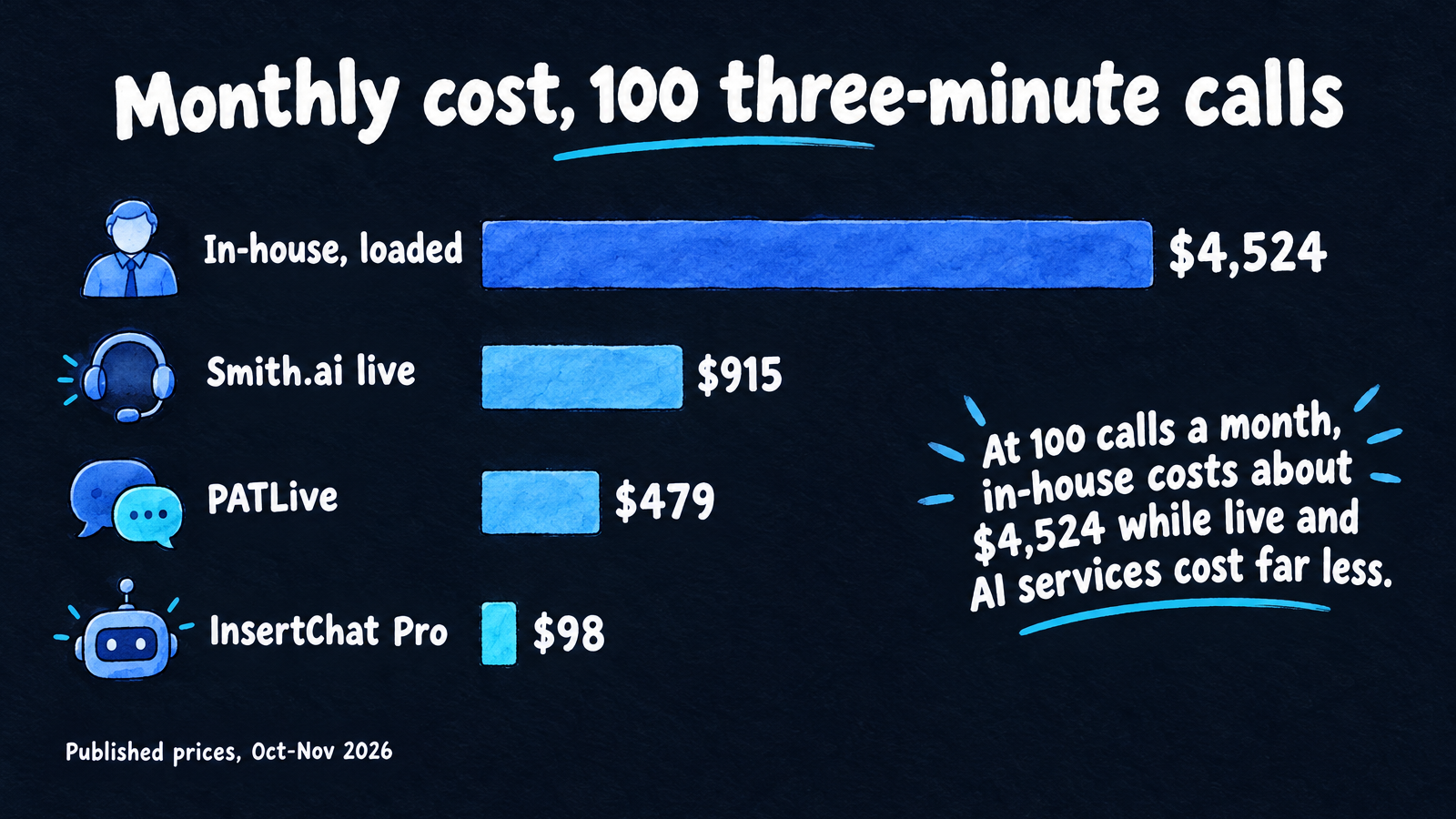
Planning totals for 100 three-minute calls on published plans, November 2026.
The in-house number, worked out
The Bureau of Labor Statistics reports a median receptionist wage of $18.27 an hour, or $38,010 a year, in May 2025 data. Across 2,080 hours that is about $3,167 a month in wages alone.
Benefits and payroll taxes add more. BLS's Employer Costs for Employee Compensation release (June 2026 data, published September 9, 2026) shows benefits are 30.0% of private-industry compensation. Dividing the wage by 0.70 gives about $26.10 an hour, or roughly $4,524 a month. This is a planning estimate: it uses an all-industry benefits share and the national median, so your local wage may be higher. It also leaves out recruiting, training, equipment, and management time.
The live and AI numbers
The table prices 100 calls of three minutes each on published plans checked between October and November 2026. Treat the totals as planning figures, not quotes, and see our AI receptionist pricing guide and live, AI, and hybrid comparison for the full math at 100, 200, and 500 calls.
| Option | Type | How it bills | About per month at 100 calls |
|---|---|---|---|
| In-house, full time | Employee | Salary plus benefits | About $4,524 (wages alone about $3,167) |
| Ruby | Live | Minute bundle: $250 for 50 minutes, $395 for 100, $720 for 200 | About $1,160 with overage |
| Smith.ai human plans | Live | Per call: $810 for 90 calls, $10.50 each after | About $915 |
| PATLive | Live | Minute bundle: $479 for 300 minutes | $479 |
| AnswerConnect | Live | Minute bundle: $395 for 300 minutes | $395 |
| Smith.ai AI Receptionist | AI | Per call: $150 for 75 calls, $2.50 each after | $212.50 |
| InsertChat Pro | AI | Shared credits: $98 for 5,000 | $98 |
| Upfirst and Goodcall | AI | Per call; per unique caller | $69.95 and $79 |
That puts a live call at about $4 to $12 and an AI call at about $0.70 to $2, against about $45 per call for a full-time hire at this volume. The hire only wins on cost when your call volume is high enough to keep that person busy all day.
How live services count minutes
The published price is often not the bill, because services count time differently. Ruby bills in 60-second increments, rounds each call up, and starts the clock when the receptionist answers, including hold time and after-call work, according to its FAQ. It does not publish its overage rate on the pricing page. AnswerConnect rounds each interaction up to the next minute but waives the first 30 interactions under 30 seconds each cycle. PATLive says it bills only live receptionist time, not note-taking, and charges the first minute in full and then in 6-second increments. Smith.ai bills per call and says it does not charge for wrong numbers or spam that arrive with caller ID.
Spam is the most common billing complaint. On Trustpilot, Ruby reviewers describe more robocalls and hang-ups after subscribing, and Ruby's replies point to call screening and an automated attendant. Ask any service whether spam, hang-ups, and short calls count against your plan.
Is AI replacing receptionists?
Not as a direct swap. AI is taking over routine answering, and employment data points to slow shrinkage rather than disappearance, while callers still want a human for high-stakes calls.
BLS's latest outlook projects receptionist employment falling about 2% from 2025 to 2035, from roughly 947,500 jobs to 931,600, yet still projects about 105,000 openings a year from people leaving or changing jobs. BLS attributes the weak outlook to organizations automating or consolidating administrative functions. The wording is paraphrased from the Occupational Outlook Handbook, so check the page for the current figures.
Caller attitudes explain why the answer is mixed:
- In Gartner's 2026 survey of 3,566 customers, 87% said companies using generative AI for customer service must offer access to a human agent.
- A Pegasystems and YouGov survey of more than 4,700 North American and UK consumers found two-thirds prefer human-led support. Pegasystems sells software, and the survey covers customer service broadly, not only phone calls.
- CallRail's 2025 survey of 1,000 US consumers found 50% would use AI to book an appointment. CallRail sells AI voice tools, and the survey does not publish its method.
The pattern: people accept AI for simple tasks like hours and booking, and want a person for anything urgent or emotional. A good setup uses AI for the first group and sends the second to your team. Say plainly in the greeting that it is an AI assistant.
What happens if no one answers at all?
Most callers do not leave a message. CallRail found that 42% of consumers leave a voicemail when a business does not answer, and 21% immediately call another business. Treat vendor surveys with care: the well-known claim that 62% of small-business calls go unanswered traces to a 2016 study of 85 businesses, and Invoca's 2026 benchmark report found 56% of callers across 70 million calls reach a person. Your own call log is the better measure. Multiply missed calls by the share that would have booked and your average job value, or use our missed call calculator.
How to choose: a four-step test
Choose by what your calls need and when they arrive, not by brand. This takes about an hour with 30 days of call logs.
- Sort a month of calls into three buckets. Message only, answer or book, and needs judgment (emergencies, complaints, legal or medical intake).
- Mark the hours. Count calls that arrive outside the 40 hours your staff is present.
- Match the type. Mostly the first two buckets: AI. A large share of the third: a live or hybrid service. Calls only after hours: a service you switch on after hours.
- Price your volume plus 30%. Include overage, add-ons, and spam, then trial it with test calls: a new customer, an emergency, a caller with a hard name, and someone demanding a person.
You do not need to give up your number to try any of this. Most services work by forwarding, and you can ring your own phones first and send only unanswered calls, as our conditional call forwarding guide explains. Our comparison of AI and human receptionists goes deeper on the trade-offs.
Where InsertChat fits
InsertChat is an AI receptionist for calls, plus website chat, texts, email, and WhatsApp from one knowledge base and shared inbox. It suits businesses whose calls are mostly routine questions and bookings and that want every call answered after hours. It is not the right pick if you need the assistant to transfer a live call to your phone.
The AI receptionist answers from your services, hours, and prices, books into the built-in calendar, Google Calendar, Outlook, Calendly, or Cal.com, and answers in the caller's language. You choose when it answers: always, only after hours, only when your team does not pick up within 5 to 60 seconds, or never. Each call lands in the shared inbox with a transcript and summary. When a caller needs a person, it marks the conversation for your team and tells the caller someone will follow up. It does not transfer live calls, take voicemail, record calls, or place outbound calls, and it does not port numbers; you keep a US or Canadian number by forwarding.
Pro is $98 a month with 5,000 credits. At the pricing page's example rate of 12 credits a minute, that covers about 416 call minutes, or about $0.71 for a three-minute call, and calls round up to whole minutes with a one-minute minimum. See the virtual receptionist overview for how it compares with human services. To test it on your own calls, start your 7-day free trial on Pro with 500 credits (a card is required).
Frequently asked questions
Can a virtual receptionist transfer calls to my cell phone?
Live services generally can: Ruby says its receptionists connect or transfer calls to numbers you choose, and PATLive lists transfers on every plan. AI receptionists vary. Some advertise warm transfers, while InsertChat does not transfer live calls. It can ring your phone first for 5 to 60 seconds, or flag the call and tell the caller your team will follow up.
What is the difference between a virtual receptionist and a virtual assistant?
A virtual receptionist's main job is answering your business calls: greeting, screening, taking messages, booking, and routing. A virtual assistant handles broader admin work such as managing email, calendars, and travel. Some people do both, but the skills and pricing differ, and a virtual assistant is usually not set up to answer every call as it comes in.
Is a virtual receptionist HIPAA compliant?
It depends on the vendor. Under HHS guidance, a vendor that creates, receives, maintains, or transmits protected health information for a practice needs a Business Associate Agreement. Ask for one in writing, and confirm which plan includes it, before forwarding patient calls. InsertChat offers a Business Associate Agreement on Enterprise plans only.
Which AI telephone answering service is the best?
No single one is best for everyone. The right choice depends on your call volume, how the vendor bills (per minute, per call, per caller, or shared credits), and whether you need warm transfers. Price two or three services at your real call count, including spam and rounding, then run test calls during the trial.