
Most AI receptionists cost $25 to $500 a month for a small business, and where you land depends less on the sticker price than on how the vendor counts usage. On published prices checked November 8, 2026, 100 three-minute calls cost between about $70 and $213 a month, 300 calls between $129 and $500, and 500 calls between $129 and about $800.
This guide explains the four ways AI receptionists bill (per minute, per call, per unique caller, and shared credits), works out a monthly total for seven of them at 100, 300 and 500 calls, and covers the details that change a bill: minute rounding, spam calls, overages, and automatic plan upgrades. It ends with a 15-minute way to estimate your own number. Every total is a planning figure built from public pricing pages, not a quote.
The four ways AI receptionists bill
AI receptionists charge by the minute, by the call, by the unique caller, or from a shared pool of credits. Each model rewards a different kind of phone line, so the cheapest vendor for a dental office with long calls can be the most expensive for a plumber with short ones.
| Billing model | What you pay for | Costs more when | Examples (published plans) |
|---|---|---|---|
| Per minute | A bundle of minutes, then a rate per extra minute | Calls run long, or many short calls each round up to a full minute | Dialzara: $99 for 220 minutes, then $0.45 a minute. Rosie: $149 for 1,000 minutes |
| Per call | A bundle of calls, then a rate per extra call | You get many short calls or spam that gets counted | Upfirst: $59.95 for 90 calls, then $1.00 each. Smith.ai AI Receptionist: $150 for 75 calls, then $2.50 each |
| Per unique caller | Each phone number counted once a month, however often it calls | Most callers are new, so few repeat | Goodcall: $79 for 100 unique customers, then $0.79 each |
| Shared credits | One monthly pool spent by calls and written conversations | You also run chat, texts and email on the same pool | InsertChat: $98 for 5,000 credits. My AI Front Desk: $99 for 200 minutes plus a credit pool for extras |
A fifth model, a flat monthly fee for unlimited calls, exists but is rare and usually carries a fair-use clause, so ask for the cap in writing. Developer voice platforms are a sixth route: Retell AI, for example, advertises usage pricing from $0.07 a minute, but you assemble the knowledge base, booking and handoff yourself.
The unit matters because it decides what you cannot control. You control the number of calls only loosely, you do not control how long a caller talks, and you do not control how many of them are spam. A per-call plan is exposed to the first and last, a per-minute plan to the second, and a per-caller plan to none of the three, as long as your callers repeat.
What 100, 300, and 500 calls cost on each plan
At 100 three-minute calls a month the cheapest published plans cost about $70 to $80, at 300 calls the range is $129 to $500, and at 500 calls it is $129 to roughly $800. Per-caller and per-call plans stay low as volume grows; per-minute plans with overage and per-call plans on small bundles climb fastest.
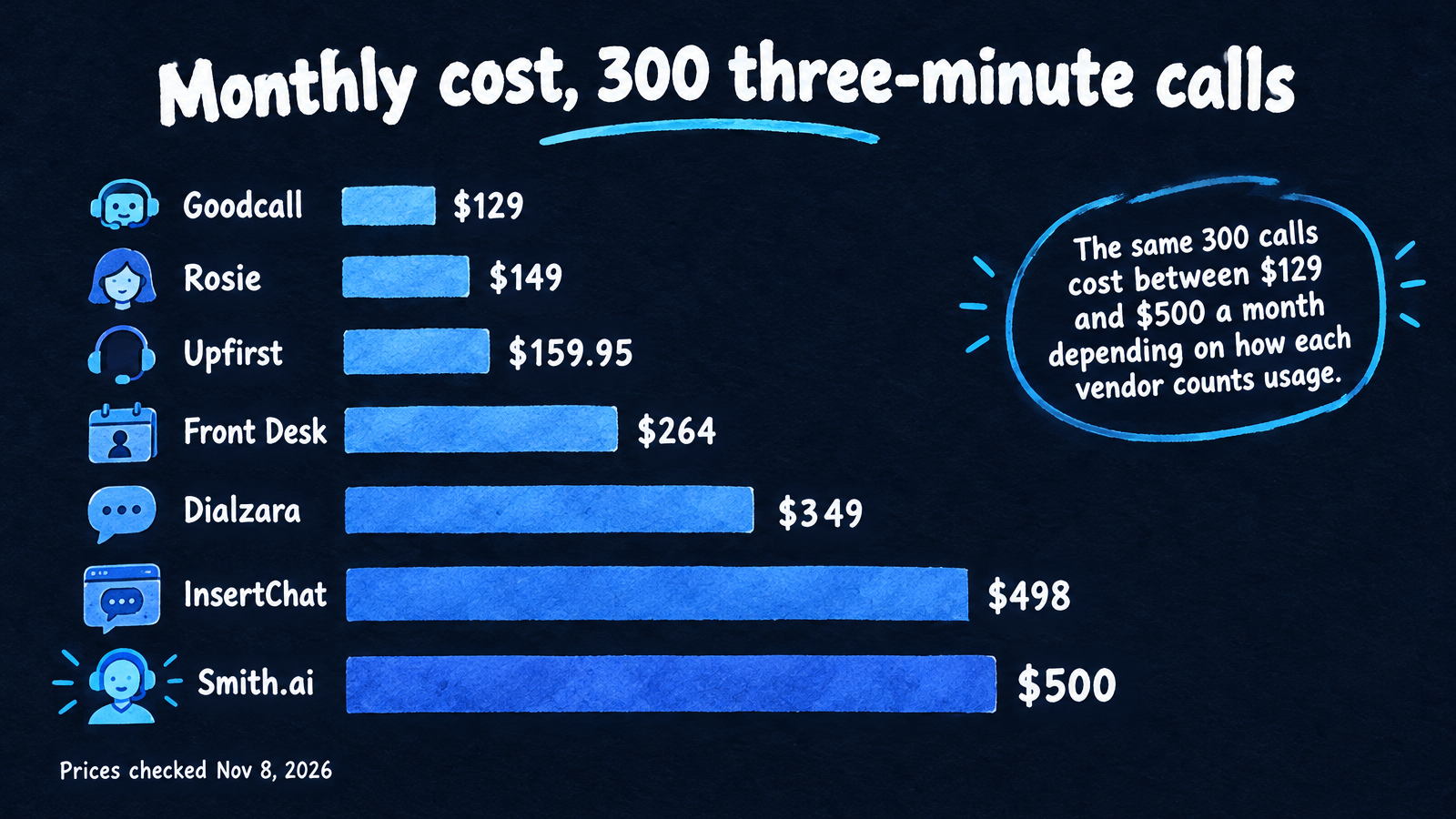
Planning totals from published prices checked November 8, 2026, assuming 300 three-minute calls, all billable.
| Vendor | How it bills | 100 calls (300 min) | 300 calls (900 min) | 500 calls (1,500 min) |
|---|---|---|---|---|
| Upfirst | Per call | $69.95 | $159.95 | $299.00 |
| Goodcall | Per unique caller | $79 | $129 | $129 |
| InsertChat | Shared credits | $98 | $498 | $498 |
| My AI Front Desk | Minutes, then credits | $114 | $264 | $414 |
| Dialzara | Per minute | $135 | $349 | $524 |
| Rosie | Per minute, auto-upgrade | $149 | $149 | $299 |
| Smith.ai AI Receptionist | Per call | $212.50 | $500 | about $800 |
How the totals were worked out
Each total assumes a three-minute average call, every call billable, monthly billing and the cheapest published plan that covers the volume, with overage added where it is cheaper than moving up a plan. Prices come from each vendor's pricing page, read on November 8, 2026, except InsertChat, whose pricing page was last reviewed October 13, 2026.
- Upfirst. Premium ($59.95, 90 calls) plus 10 calls at $1.00 for 100 calls; Pro ($159.95, 300 calls) for 300; Scale ($299, 600 calls) for 500, per its pricing page.
- Goodcall. Goodcall's own pricing says 100 unique customers is about 150 calls, so even if every caller were new, 100 calls fit the $79 Starter plan, and 300 and 500 calls fit the $129 Growth plan (500 customers), per its pricing page. A business whose callers rarely repeat and who needs more than 500 distinct callers would pay $0.26 for each one above.
- InsertChat. At the pricing page's example rate of 12 credits per billable minute, Pro's 5,000 credits cover about 416 minutes, or 138 three-minute calls. Growth's 10,000 credits cover about 277 three-minute calls, so 300 calls (10,800 credits) need Scale's 25,000. The pricing page lists no pay-as-you-go top-up, so these totals price the next plan up. The same credits also pay for chat, texts and email.
- My AI Front Desk. $99 includes 200 minutes; extra minutes cost 25 credits ($0.25) each, and each month includes a 1,000-credit pool, per its billing help article. The totals price credits at $0.01 each, as that article's own example does (350 minutes costing $126.50); its pricing page also describes auto-reload as $10 per 1,000 credits, so a bill that reloads in whole blocks can land a few dollars higher.
- Dialzara. Business Pro ($99, 220 minutes, $0.45 overage) for 300 minutes; Elite ($349, 1,000 minutes) for 900; Elite plus 500 minutes at $0.35 for 1,500, per its pricing page.
- Rosie. Rosie publishes no overage rate. Its terms say exceeding your minutes triggers an automatic upgrade, so 300 minutes lands on Scale ($149, 1,000 minutes) and 1,500 minutes on Growth ($299, 2,000 minutes), per its pricing page.
- Smith.ai AI Receptionist. Pro is $150 for 75 calls with $2.50 overage, giving $212.50 at 100 calls. The 300-call figure is the published Enterprise tier ($500), and the 500-call figure applies the listed effective rate of $1.60 a call, because the tier price is not shown, per its pricing page.
For human services the gap is wide. A full-time receptionist earns a median $18.27 an hour in the US (May 2025 wage data, via O*NET OnLine), about $3,168 a month before benefits and payroll taxes, and human answering services such as Ruby start at $250 a month for 50 minutes. Our answering service pricing guide and live, AI and hybrid comparison price those options at the same call volumes.
How per-minute rounding inflates a bill
Most minute-based vendors round each call up to the next full minute, so the minutes you are billed are always more than the minutes callers spoke. Ruby's terms bill in 60-second increments, rounding each call up to the next 60-second mark, and Rosie's terms say the same. Twilio, a common telephony provider underneath voice products, rounds partial minutes up per call leg.
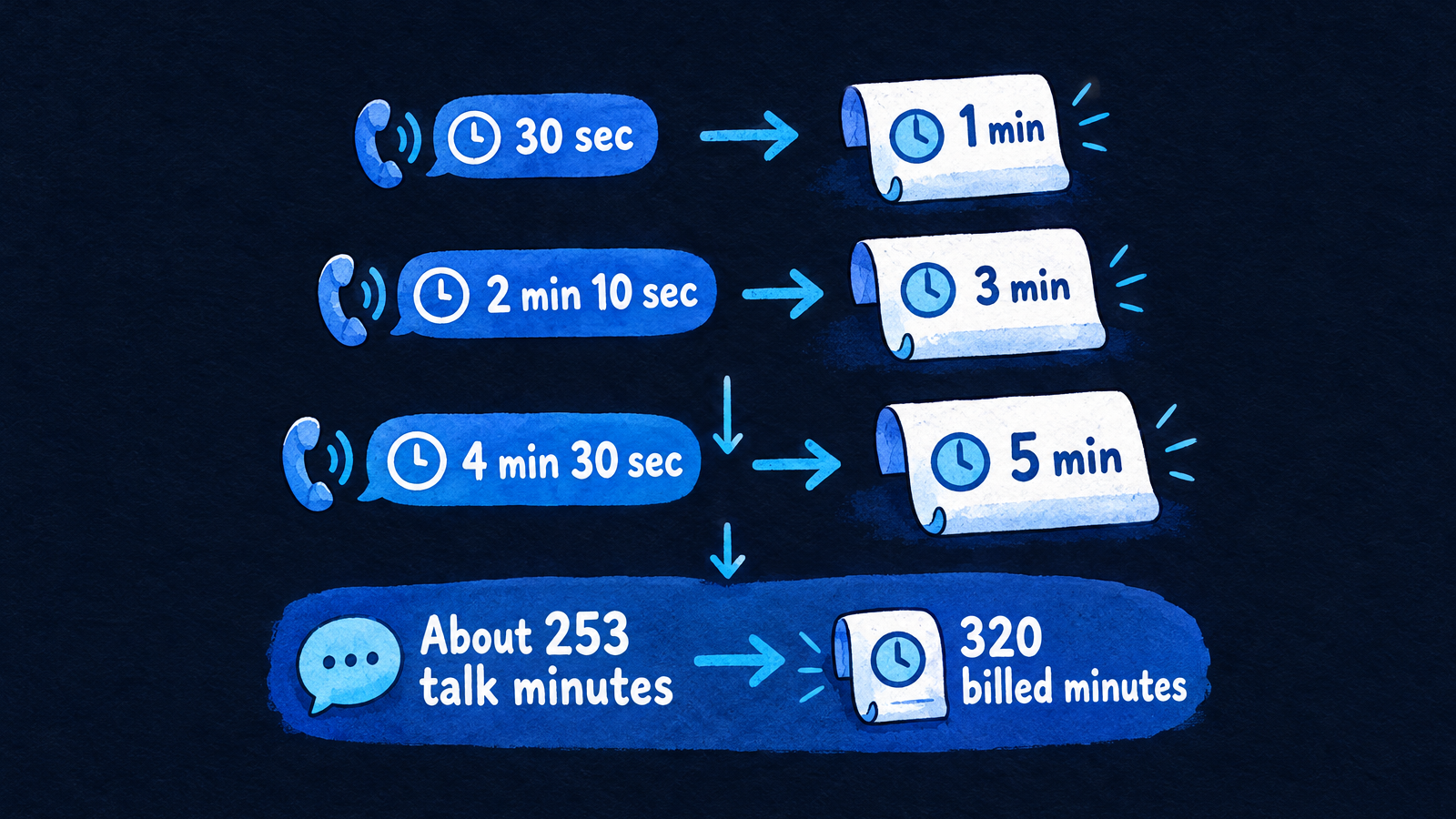
A hypothetical month of 100 calls: callers talked for about 253 minutes but the bill counts 320.
Here is a hypothetical month of 100 calls. Twenty are 30-second wrong numbers or hang-ups, fifty are 2 minutes 10 seconds, and thirty are 4 minutes 30 seconds. Callers talked for about 253 minutes. Rounded up per call, the bill counts 20 minutes, 150 minutes and 150 minutes: 320 billed minutes, or 26% more than were spoken.
Three vendors in this guide state a rounding rule: Rosie and Ruby round up to 60 seconds, and InsertChat rounds each call up to whole minutes with a one-minute minimum. Neither Dialzara's nor My AI Front Desk's pricing pages state one, and both are worth asking about before you rely on a bundle. Per-call and per-caller plans avoid the issue, because a 20-second call and a 12-minute call cost the same.
Does call length change which plan is cheapest?
Yes. Call length moves per-minute and credit plans while leaving per-call and per-caller plans where they are. Raise the same 100 calls from three minutes to five (500 minutes) and the order shifts:
| Vendor | 100 calls at 3 minutes | 100 calls at 5 minutes |
|---|---|---|
| Upfirst | $69.95 | $69.95 |
| Goodcall | $79 | $79 |
| InsertChat | $98 | $198 (Growth) |
| My AI Front Desk | $114 | $164 |
| Dialzara | $135 | $199 |
| Rosie | $149 | $149 |
| Smith.ai AI Receptionist | $212.50 | $212.50 |
How long are your calls? Public data is thin. In a July 2025 report built on call tracking from more than 120 of its own client accounts, the agency Focus Digital measured average call durations of roughly 3 to 6.5 minutes for home services, 2 to 4 minutes for healthcare and 2.5 to 6.5 minutes for legal, depending on the channel (Focus Digital). That is an agency's paid-lead mix, not a census, so treat it as a range and pull your own average from your carrier's call log.
Spam calls: who bills them and who doesn't
Spam and robocalls are the most-complained-about billing item because you cannot predict them, and vendors differ on whether they count. Nationally the volume is large: YouMail counted 52.5 billion robocalls to US consumers in 2025, 57% of them telemarketing or scam calls. No public source gives a spam share for small-business lines, so your call log is the only real measure.
| Vendor | Spam and short calls, per its own pages (checked November 8, 2026) |
|---|---|
| Upfirst | Not billed: spam, robocalls, sales calls, calls under 15 seconds, and calls where the caller never speaks |
| Goodcall | "Spam and wrong numbers don't count"; how spam is detected is not published |
| Smith.ai AI Receptionist | Known spam numbers are filtered before the AI answers; you can also remove up to 10% of calls from the bill each cycle |
| Rosie | Automatic spam detection on every plan; whether spam that reaches the AI uses minutes is not stated |
| Dialzara, My AI Front Desk | Not stated on the pages read |
| InsertChat | Pricing page states a one-minute minimum per call and does not describe spam filtering |
To see why it matters, take a hypothetical 20 spam calls of about 10 seconds each in a month. If counted, that is $50 on Smith.ai's $2.50 overage rate, $9 at Dialzara's $0.45 a minute, and 240 credits (4.8% of Pro's 5,000) at InsertChat's example rate. The money is small per month; the point is that per-call and credit plans penalize a 10-second call as much as a 10-minute one, which is why the exclusions above deserve a question before you forward your line.
Overages and auto-upgrades: what happens when you go over
When you pass your allowance, vendors either charge a per-unit overage, move you to a bigger plan, or pause service, and the difference decides whether a busy month is a $20 surprise or a plan change. Find out which before you sign.
- Per-unit overage. Upfirst charges $1.50, $1.00, $0.75 or $0.70 a call depending on plan; Smith.ai charges $2.50 to $2.10 a call on paid tiers and $3.00 on the free plan; Dialzara charges $0.48 to $0.35 a minute; Goodcall charges $0.79, $0.26 or $0.15 for each unique customer above the plan. Goodcall's own pricing and FAQ describe no penalty rate and no automatic upgrade; it tells you when a bigger plan would cost less.
- Credit reload. My AI Front Desk reloads credits automatically when the monthly pool runs out; with auto-reload off, features pause until the next cycle or until you buy credits.
- Automatic plan upgrade. Rosie's terms (section 3(c)) say it will automatically upgrade you to a higher plan when you exceed your minutes, and the higher plan stays until you downgrade. Going five minutes over on the $49 plan can therefore land you on the $149 plan. Payments are nonrefundable.
- Alerts. Ruby, a live service, sends alerts at 85% and 100% of plan minutes, and its overage rates sit in its help center rather than on the pricing page. Ask any vendor whether alerts exist before you hit the limit.
Cancellation terms deserve the same scrutiny. Smith.ai's AI plans are month-to-month with 30 days' notice to cancel, Rosie's cancellations take effect at the end of the billing cycle, and Dialzara and Upfirst list no long-term contract.
How credit plans work, using InsertChat as the open example
A credit plan gives you one monthly pool that calls, chat, texts and email all draw from, so you pay for total conversation volume instead of buying a separate allowance for each channel. The trade-off is that credits are not a fixed number of minutes, so you need a conversion to predict a bill.
InsertChat's pricing page shows the conversion openly. Calls use credits, round up to whole minutes and have a one-minute minimum. At the estimator's example rate of 12 credits per billable minute, Pro's 5,000 credits cover about 416 call minutes, or roughly $0.71 for a three-minute call if the pool is spent only on calls. That rate is editable in the estimator and varies with the AI model and setup, so it is a planning number, not a guarantee. The 7-day Pro trial includes 500 credits, about 41 call minutes at the same rate.
The model fits you if the same assistant needs to answer your phone, website chat and texts. It is a worse fit if you only want calls and expect more than about 138 three-minute calls a month, because Pro's pool runs out and the next plan, Growth at $198, covers about 277. Every paid plan includes one phone number (extra numbers are $10 a month), website chat, the shared inbox and human handoff. The AI receptionist does not transfer live calls, take voicemail, record calls or place outbound calls, and number porting is not offered; you keep a US or Canadian number by call forwarding.
For a broader look at how chat pricing compares, see our chatbot pricing breakdown, and for a vendor-by-vendor buyer's checklist see the small business AI receptionist guide.
How to estimate your own bill in 15 minutes
You can get a usable estimate from one month of call history. Pull the log from your carrier or phone system and work through these steps.
- Count calls and total minutes. Note the last 30 days, including after-hours calls you missed (voicemail messages and returned calls count too).
- Strip out spam. Remove calls under 10 seconds and obvious robocalls, then note how many you removed. That is the volume you want a vendor not to bill.
- Compute a billed-minute total. Round each call up to the next whole minute and add them. If your average billed call is 3.2 minutes, as in the example above, use that, not your talk-time average.
- Count unique numbers. Divide calls by repeat callers. A business with mostly regulars has far fewer unique callers than calls.
- Price three vendors at your numbers plus 30%. Add a buffer for busy seasons, then check overage, upgrade rules and add-ons such as booking, transfers or Spanish.
- Test during the trial. Place a few calls, including a short wrong-number call, then compare the usage the dashboard shows with what you dialed.
Are AI receptionists worth the monthly cost?
For most businesses with unanswered calls, yes, if one booked call is worth more than a few dollars. The break-even is simple: a $98 plan is covered by one $300 job a month if even one missed call would have booked it. CallRail reports that 28% of inbound calls go unanswered on average across its customers, though that skews toward businesses that already track calls. Your own number matters more, and the missed call calculator turns it into a monthly figure. For a comparison with hiring, see our guide to AI versus human receptionists.
Try the math on your own calls
Billing models, not sticker prices, decide what you pay. If you want one pool for calls, website chat and texts, use the pricing page's estimator with your own call counts and start your 7-day free trial on Pro with 500 credits (a card is required, and Pro starts when the trial ends unless you cancel first). If you only need low-volume calls with a live transfer, one of the per-call vendors above may fit better, and our Smith.ai alternatives guide covers that trade-off.
Frequently asked questions
Is there a free AI receptionist?
A few vendors offer free starting points, but none is full coverage for nothing. Smith.ai's AI Receptionist is free for 25 calls a month, then $3.00 a call. Upfirst's trial runs 14 days or 100 calls without a card; Dialzara and InsertChat offer 7-day trials, and InsertChat's needs a card. Goodcall's free tier is a demo agent that is not connected to a phone number.
Do AI receptionists charge a setup fee?
Usually not. Dialzara and Ruby state there are no setup or activation fees, and none of the pricing pages read for this guide lists one. Done-for-you plans and quote-only vendors are the exception, for example Dialzara's Done for You tier from about $1,500. Ask for the full first-month total, including phone number and add-on charges.
Is building my own AI receptionist with a developer platform cheaper?
Per minute, often, but not in total. Retell AI advertises usage pricing from $0.07 a minute, and Twilio lists inbound US local calls at $0.0085 a minute plus $1.15 a month per number. You then build and maintain the knowledge base, calendar booking, handoff and spam handling yourself, which is why it suits teams with a developer more than a plumber's office.
Why does my AI receptionist bill differ from the plan price?
The plan price only covers the allowance. The gap usually comes from minute rounding, spam or very short calls that were counted, overage past the allowance, an automatic plan upgrade, or add-ons such as booking, transfers, extra numbers and website texting. Check the usage log against your call log in the first month.