
A good business voicemail greeting runs 15 to 30 seconds, names your business, says why you can't answer, asks for a name, number, and reason for calling, and promises a specific callback time. Add one alternative for urgent callers and you have everything the caller needs. Below are 25 scripts you can copy: five for business hours, five for after hours, four for the 2026 holiday closures, eight for specific industries, and three for temporary closures and AI-assisted greetings.
The article also covers a five-part formula for writing your own, the mistakes that cost you messages, and an honest look at when voicemail loses the caller, so you know when a better greeting is enough and when it isn't.
The five parts of a good business voicemail greeting
Every strong greeting answers five questions in order: who the caller reached, why you can't answer, what to leave, when you'll call back, and where to go if it's urgent. Shopify's guide lists the same core elements: your company name, your hours or availability, clear instructions, and alternative contact information for urgent issues.
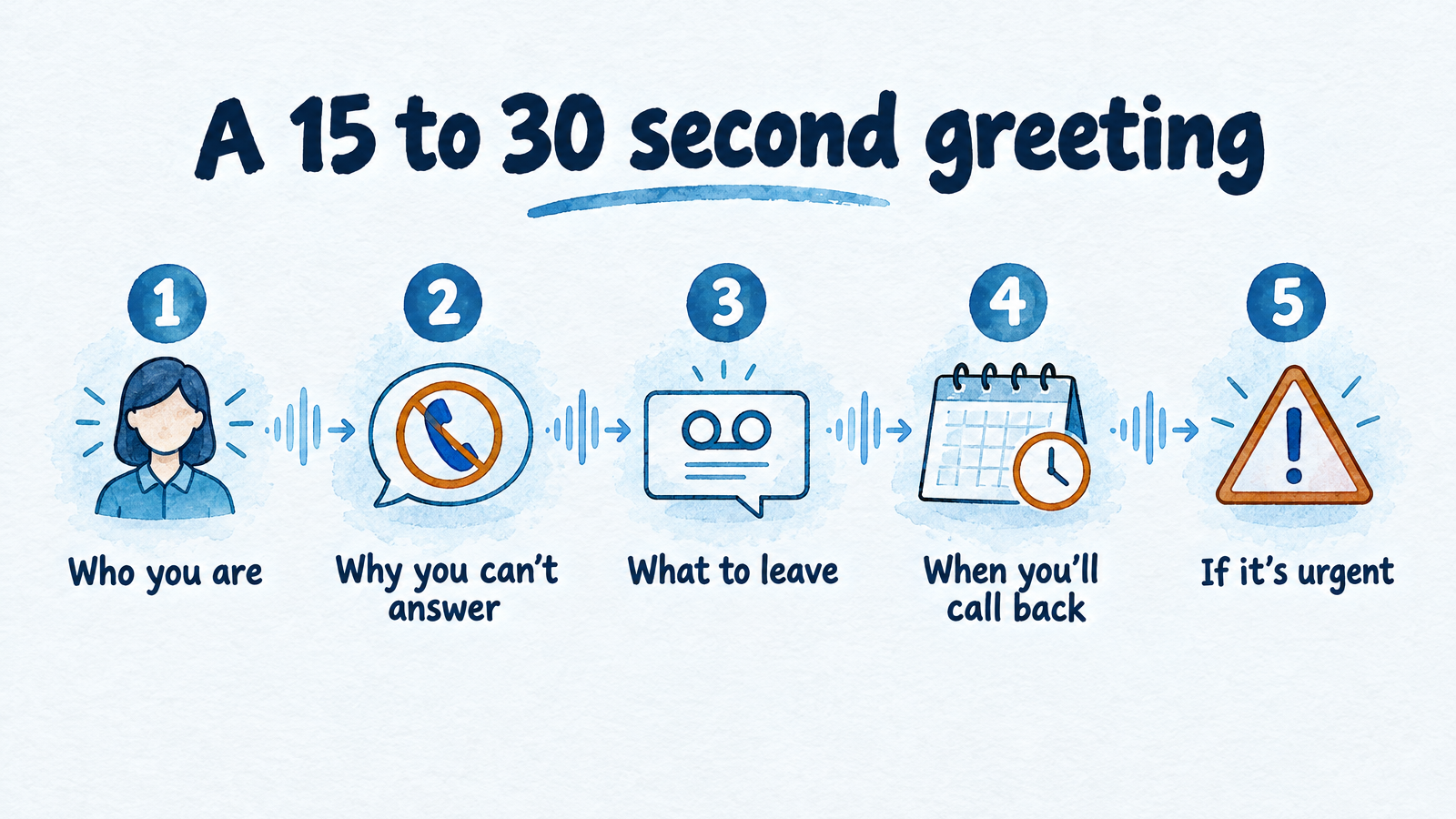
Five parts, in this order, fit inside 15 to 30 seconds.
- Who you are. Start with the business name so callers know they dialed the right number.
- Why you can't answer. One short clause: you're with a customer, you're closed, or you're on a job.
- What to leave. Ask for a name, a number, and the reason for the call. The reason lets you prepare before you call back.
- When you'll call back. Give a real window, such as "within two business hours" or "Monday morning." Telzio's guidance is to avoid vague timelines like "I'll call you back soon" without a real window.
- Where to go if it's urgent. A second number, a website booking link, or "call 911" where safety is involved.
How long should a business voicemail greeting be?
Aim for 15 to 30 seconds. Both Nextiva and Ooma recommend that range. At a conversational pace of roughly 150 words a minute, that is about 40 to 75 words, so each script below fits inside it once you fill in the brackets. Length limits are not the constraint: platforms such as Google Voice allow greetings of a minute or more, so the limit that matters is the caller's patience.
The fill-in-the-blank template
"Thank you for calling [Business name]. [Reason you can't answer.] Please leave your name, phone number, and a short reason for your call, and we'll call you back [specific window]. [For urgent matters, call or visit ___.] Thank you."
Every script below is a variation on this template. Replace anything in [brackets] before you record.
Scripts for business hours: when you can't pick up
During business hours, the greeting's job is to confirm that you're open, that the call matters, and when a person will respond. Keep these short; a caller who has already waited through rings has little patience left.
1. Standard greeting
"Thank you for calling [Business name]. We're helping other customers right now. Please leave your name, phone number, and a short reason for your call, and we'll call you back within [two business hours]. Thank you."
Use this as your default. The callback window is the part most businesses skip and callers most want to hear.
2. Short greeting
"You've reached [Business name]. Leave your name and number, and we'll call you back by [time]. Thanks."
About 15 words, roughly six seconds. Good for a direct line where repeat callers already know what to say.
3. Owner on a job
"This is [Name] with [Business name]. I'm on a job and can't pick up. Leave your name, number, and what you need, and I'll call you back between jobs, within [two hours]. If it's an emergency, call [on-call number]."
Solo operators sound more credible when they explain the absence in one sentence and still give a window.
4. Set callback windows
"You've reached [Business name]. We return calls at [noon] and again at [4 p.m.] every business day. Leave your name, number, and reason for calling, and you'll hear from us at the next window."
If you batch your callbacks, say so. Callers tolerate a wait they can plan around.
5. Text-us option
"Thanks for calling [Business name]. We can't take your call right now. Leave your name, number, and request, or text this number and we'll reply by [time]."
Only use this if the line can receive texts. A landline can't, and a greeting that points callers to a number that won't work is worse than none.
After-hours voicemail greetings
An after-hours greeting should state your hours, say when the first callback happens, and give an urgent route if you have one. These matter more than business-hours greetings, because after-hours callers are the most likely to move on to the next business if the greeting leaves them with nothing.
6. Standard after-hours greeting
"Thank you for calling [Business name]. Our office is closed. We're open [Monday through Friday, 8 a.m. to 5 p.m.]. Leave your name, number, and reason for calling, and we'll call you back the next business day by [noon]."
7. After hours with an emergency line
"You've reached [Business name]. We're closed for the day and open again at [8 a.m.]. For emergencies, call [on-call number]. For anything else, leave your name, number, and request, and we'll return your call tomorrow morning."
Only list an emergency number that someone actually answers. If nobody does, remove the line.
8. Weekend greeting
"Thanks for calling [Business name]. We're closed for the weekend and reopen Monday at [8 a.m.]. Leave your name, number, and reason for calling, and we'll return calls Monday morning in the order we receive them."
9. After hours with online booking
"You've reached [Business name] after hours. You can book an appointment any time at [website]. Or leave your name, number, and request, and we'll call you back by [10 a.m.] tomorrow."
This works when your site has an online scheduler. Say the web address slowly; it's the part callers most often miss.
10. Busy-season notice
"Thank you for calling [Business name]. We're in our busiest season and returning calls within [two business days]. Leave your name, number, and reason for calling. For an emergency, call [number]."
Roofers in storm season and accountants in tax season both use this pattern. It sets the expectation before the caller decides to wait or look elsewhere.
Holiday closure scripts for Thanksgiving, Christmas, and New Year 2026
A holiday greeting needs the closing days, the return day, and an urgent route. Name the weekday as well as the date, because callers remember "Monday" better than "the 30th."
The dates below follow the U.S. Office of Personnel Management's federal holiday schedule: Thanksgiving is Thursday, November 26, 2026; Christmas Day is Friday, December 25, 2026; and New Year's Day 2027 is Friday, January 1. OPM governs federal employees only, and the Friday after Thanksgiving is not a federal holiday, so your own closing days may differ. Adjust the scripts to match your calendar.
11. Thanksgiving closure
"Happy Thanksgiving from everyone at [Business name]. We're closed Thursday, November 26 and Friday, November 27, and we reopen Monday, November 30 at [8 a.m.]. Leave your name, number, and reason for calling, and we'll return your call Monday. For emergencies, call [number]."
12. Christmas closure
"Merry Christmas from [Business name]. Our office is closed Friday, December 25, and we reopen Monday, December 28. Leave your name, number, and reason for calling, and we'll call you back Monday. For urgent matters, call [number]."
If you close early on Christmas Eve, say that in a separate line: "We close at [noon] on Thursday, December 24."
13. Holiday-week reduced hours
"Thank you for calling [Business name]. This week, December 28 through 31, we're open [9 a.m. to 1 p.m.]. Leave your name, number, and request, and we'll call you back the same day if you reach us during those hours, or the next open day if you don't."
Reduced hours cause more confusion than full closures. Say the hours out loud.
14. New Year's Day closure
"Happy New Year from [Business name]. We're closed Friday, January 1, and reopen Monday, January 4 at [8 a.m.]. Leave your name, number, and reason for calling, and we'll call you back Monday. For emergencies, call [number]."
The most common holiday mistake is not the script; it's forgetting to switch it back. Set two calendar reminders when you record: one to record the holiday greeting, one to restore the regular one on the morning you reopen.
Industry-specific voicemail greetings
Industry greetings add the one thing each type of caller needs to hear before they hang up: a safety instruction, a privacy boundary, or an urgent route. The scripts below are templates, not legal or medical advice; check any wording that touches safety, patient information, or legal representation against your own rules.
15. Plumbing
"You've reached [Business name]. If you smell gas, leave the building right away and call 911 from outside. For a burst pipe or sewage backup, call our emergency line at [number]. For anything else, leave your name, number, address, and what's wrong, and we'll call you back within [two hours] during business hours."
The gas instruction follows federal guidance: PHMSA tells people to avoid ignition sources and call 911 from a safe location, and utilities such as DTE Energy say the same. Utility advice differs on whether to touch appliances or open windows, so keep appliance and ventilation instructions out of the greeting. Our plumber answering service guide has burst-pipe intake questions.
16. HVAC
"Thank you for calling [Business name]. If you smell gas or your carbon monoxide alarm is sounding, leave the house and call 911. For a no-heat or no-cooling emergency, call [number]. Otherwise, leave your name, number, address, and what the system is doing, and we'll call you back by [time]."
HVAC calls are seasonal and urgent, so lead with safety, then the emergency route. See the HVAC answering service guide for a no-heat triage script.
17. Dental office
"You've reached [Practice name]. Our office hours are [days and hours]. If you're having a dental emergency, such as severe pain, swelling, or a knocked-out tooth, call our after-hours line at [number]. If this is a medical emergency, hang up and dial 911. Otherwise, leave your name and phone number, and we'll return your call on the next business day."
Notice what this greeting asks for: a name and phone number. It does not ask for symptoms or treatment details. See the dental setup page for how a front desk handles these calls.
18. Medical practice
"Thank you for calling [Practice name]. If this is a medical emergency, hang up and dial 911. For office hours, call back [days and hours]. To reach our on-call clinician after hours, call [number]. Please leave your name and phone number, and we'll return your call. Please do not leave detailed medical information in this message."
The greeting is public, so it should never reveal anything about a patient. The same care applies when you call back: HHS guidance (FAQ 198) says providers may leave messages on answering machines but should limit the information disclosed, for example only the practice's name and number, or the details needed to confirm an appointment.
19. Law firm
"You've reached [Firm name]. Please leave your name and phone number, and we'll return your call during business hours. Leaving a message does not create an attorney-client relationship, and we ask that you not leave confidential details about your matter. If you have a deadline or emergency, call [number]."
Why the wording matters: Virginia's Legal Ethics Opinion 1842 (2008, advisory only) warns that an outgoing greeting asking callers to give as much detail about their case as possible could create a reasonable expectation of confidentiality, and says a disclaimer must be clear enough to defeat that belief. Rules differ by state, so check your state bar's guidance before you record. This is general information, not legal advice. Our guide to the best AI receptionist for law firms covers intake in more depth.
20. Property management
"Thank you for calling [Company name]. For a fire or medical emergency, hang up and call 911. For an urgent maintenance problem such as flooding, no heat, or a gas smell, call our maintenance line at [number]. For leasing and everything else, leave your name, number, and property address, and we'll call you back the next business day."
Residents need to know instantly which calls are emergencies. Putting 911 first removes any doubt.
21. Salon or spa
"Thanks for calling [Salon name]. We're with clients right now. To book or change an appointment, visit [website] or leave your name, number, and the service you want, and we'll call you back by [end of day]. We're open [days and hours]."
A booking link answers most of these calls without a callback.
22. Accounting or insurance firm
"You've reached [Firm name]. Leave your name, number, and a short reason for your call, and we'll return it within [one business day]. To report an insurance claim after hours, call your carrier's claim line at [number]. During tax season, we're open [extended hours]."
For firms with seasonal peaks, naming the carrier or filing deadline up front saves callers a second call.
Temporary closure, vacation, and AI-assisted greetings
These last three cover unplanned closures, owner absences, and a greeting that tells callers they'll reach an AI assistant instead of a recording.
23. Temporary closure (weather or emergency)
"You've reached [Business name]. We're closed today because of [weather / a power outage] and expect to reopen [day]. Leave your name and number, and we'll call you back when we reopen. For emergencies, call [number]. Please check [website or social page] for updates."
Record this the moment you decide to close. Callers assume the worst when a business simply doesn't answer.
24. Owner vacation or out of office
"You've reached [Name] at [Business name]. I'm out of the office until [date]. For help before then, call [colleague] at [number]. Otherwise, leave your name, number, and reason for calling, and I'll call you back the day I return."
Name a person who can help. A vacation greeting without a backup contact is a closed door.
25. AI receptionist greeting
"Thanks for calling Northstar Home Services. I'm an AI assistant and can answer questions, book a visit, or pass your request to the team. How can I help?"
This script is not a voicemail at all: it is a greeting for an assistant that answers the call. It is about 150 characters, inside InsertChat's 200-character greeting limit. Northstar Home Services is InsertChat's fictional demo business, and the line is an illustration, not a customer result. Telling callers up front that they've reached an AI keeps expectations honest.
Mistakes that cost you messages
Most bad voicemail greetings fail in one of six ways, and all are fixable in a single recording session.
- No callback window. "We'll get back to you soon" gives the caller nothing to plan around.
- A stale greeting. A holiday message still playing in January, or old hours, tells callers nobody is paying attention.
- Too long. Anything past 30 seconds invites hang-ups before the beep.
- A full mailbox. If the mailbox can't take messages, your greeting never gets used. Check capacity, and clear old messages weekly.
- An emergency number nobody answers. It sends the callers who need you most to another voicemail.
- Inviting detail where privacy matters. Medical and legal greetings should ask for a name and number, not the story.
Nextiva's guidance adds a tone rule worth keeping: avoid slang, jokes, and background music unless they suit your audience. Quiet, clear audio matters more than any wording.
When voicemail loses the caller
Voicemail works for callers who already know you and expect a callback. It loses callers who are urgent or comparing providers, because most never reach the beep, and the ones who do often wait a long time for a call back.
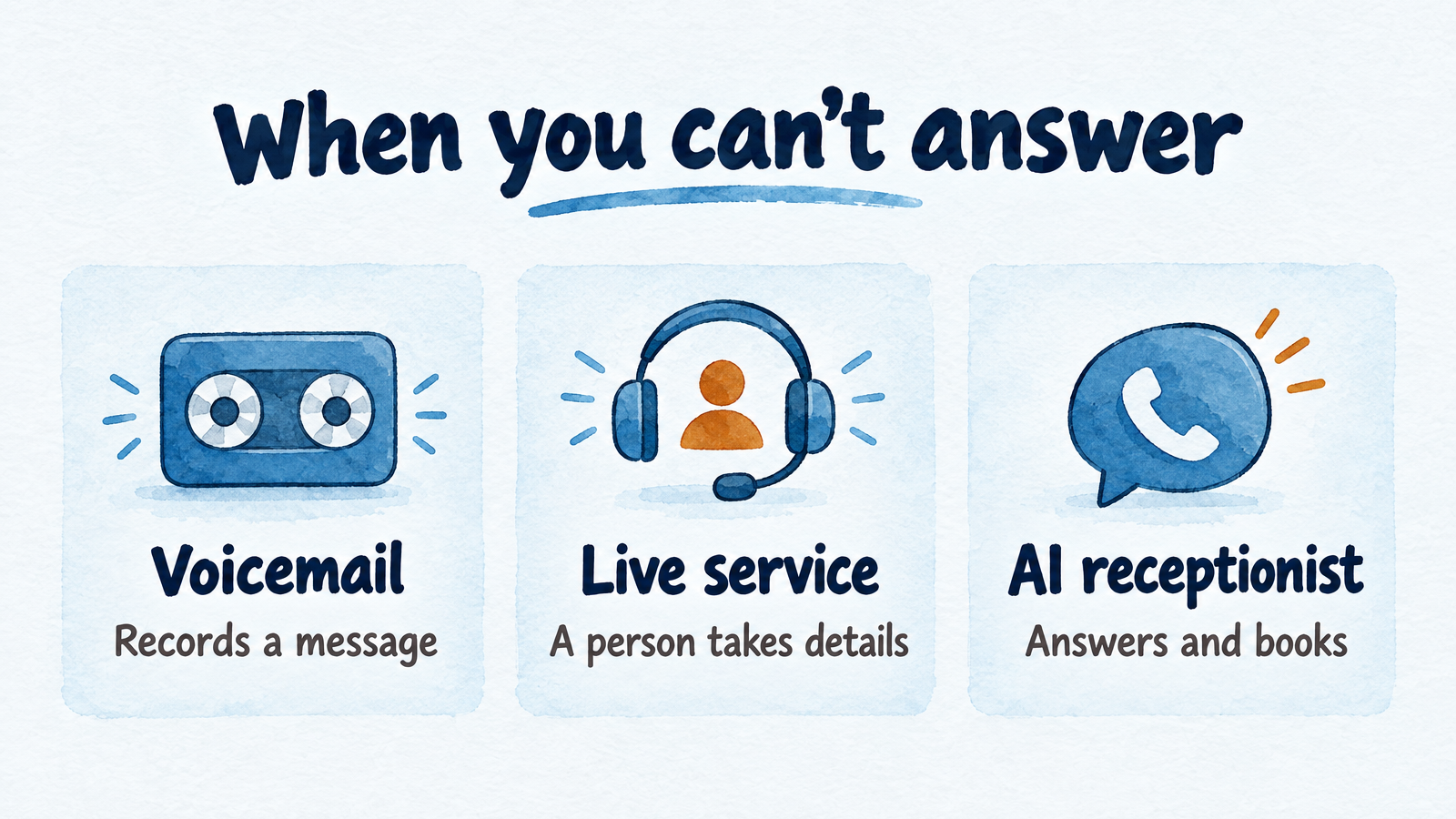
Three ways to handle a call you can't take, and what the caller gets from each.
The measured numbers are low. Invoca reported in May 2024, from its platform data, that less than 3% of callers pushed to voicemail leave a message, and that 27% of calls to home services businesses go unanswered. Quo analyzed more than 18 million missed calls on its platform from July to September 2026 and found 15% of callers left a voicemail: 14% after hours and 16% during business hours. Both are vendor data from their own customers, and neither describes its sample in detail, so treat them as directional. When CallRail surveyed 1,000 US consumers in September 2025, 42% said they leave a voicemail and 21% said they call another business right away, which suggests people overstate how often they leave messages.
Callbacks are the second leak. In its analysis of 16.7 million missed calls, Quo found that 31% were called back within 48 hours and 69% were not (a text reply did not count as a callback in its method, so the true figure is somewhat better).
You will also see claims that 80% or more of callers hang up on voicemail. We could not trace those to a primary source, so we don't use them. Your own call log is the better number. For two weeks, count the calls you miss and the voicemails you receive. In a hypothetical month with 40 missed calls and 10 messages, your greeting is working for a quarter of callers, and the other 30 are the gap.
If that gap is small, spend an hour on a better greeting. If it is large and the missed calls are valuable, such as a burst pipe at 10 p.m., you have three ways to answer instead of record:
| Option | What the caller gets when you can't answer | Best fit | Limit |
|---|---|---|---|
| Voicemail greeting | A recording and a callback later | Non-urgent calls, established customers | No answers, no booking; most callers don't leave a message |
| Live answering service | A person who takes details and may relay urgent calls | Businesses that need a human on every call | Usually billed per call or minute; see our answering service cost comparison |
| AI receptionist | Answers to routine questions, a booked appointment, urgent calls flagged to your team | Repeat questions, after-hours calls, hands-busy trades | Tools differ on live transfer, recording, and voicemail; see our AI receptionist buyer's guide |
For contractors, who miss the most calls while on a job, the contractor answering service guide works through costs at 100, 200, and 400 calls.
How to record, test, and maintain your greeting
Write the script, read it aloud once for timing, record in a quiet room, and test it by calling from a different phone. The whole job takes about 20 minutes.
- Fill in the template. Use one of the scripts above and replace every bracket.
- Time it. Read it aloud at a normal pace. Over 30 seconds, cut a sentence.
- Record it in a quiet room. Hold the phone steady, speak at a natural pace, and smile; it shows in your voice. If you'd rather not record your voice, many phone systems offer text-to-speech.
- Test it from another phone. Call your own business line, listen to the whole greeting, and leave a message to check that the mailbox works and notifications arrive.
- Put maintenance on the calendar. Review hours and contact numbers each quarter, and set reminders to change the greeting before and after every closure.
Where InsertChat fits, and what it doesn't do
InsertChat doesn't take voicemail. It replaces the voicemail step with an AI receptionist that answers the call, so a caller gets an answer or a booking instead of a recording. If you want callers to leave a message at a beep, use your phone provider's voicemail and the scripts above.
If you'd rather answer, here is what the AI receptionist does. It answers from your services, hours, and prices, books appointments in the built-in calendar, Google Calendar, Outlook, Calendly, or Cal.com, captures the caller's name, number, and request, and flags urgent calls to your team with a transcript and summary in the shared inbox. You write a greeting of up to 200 characters, choose from 10 voices, and it answers in the caller's language.
You control who answers first. "AI when unanswered" rings your team for 5 to 60 seconds before the AI picks up, so your staff keeps the calls they can take and the AI catches the rest. In the US and Canada, you keep your number by forwarding it from your carrier; porting isn't offered. Our call forwarding glossary entry explains how forwarding unanswered calls works, and carrier settings vary.
The limits matter. InsertChat does not transfer live calls, record calls, or place outbound calls. When a caller needs a person, it takes the details, flags the conversation, and tells the caller your team will follow up. Calls use credits that round up to whole minutes with a one-minute minimum; at the pricing page's example of 12 credits per minute, Pro's 5,000 credits cover about 416 call minutes, or roughly $0.71 for a three-minute call. Usage varies, so treat that as an example, not a promise. To estimate what missed calls cost you, try the missed call calculator.
Pro is $98 a month ($81.67 a month billed annually) and includes the AI receptionist, one phone number, website chat, the shared inbox, and human handoff. You can start your 7-day free trial with 500 credits (a card is required) and run a test call before you decide.
Frequently asked questions
Is there a free business voicemail greeting generator?
You don't need one. The template and 25 scripts above are free to copy. Many business phone systems also include text-to-speech, which turns typed text into a recorded greeting, so check your provider's settings. Whichever route you use, read the finished greeting aloud, keep it under 30 seconds, and test it from another phone.
Should I use my name or my business name?
Use the business name on a shared or main line, because callers want to know they reached the right company. Add your own name on a direct line or if you're a solo operator, as in "This is Dana with Dana's Plumbing." Staff behind the company line don't need personal names in the greeting.
Can a business voicemail greeting be funny?
It can, if your callers expect it, but the risk is higher than the reward for most businesses. Nextiva advises avoiding jokes and slang unless they suit your audience, and a joke wastes seconds that should state your callback window. If you use humor, keep the information in the first ten seconds and the joke in the last five.
How often should I update my voicemail greeting?
Update it whenever hours, contact numbers, or availability change, and review it every quarter even if nothing has. Change it before every planned closure and restore it the day you reopen. A stale holiday or hours message is the most common reason callers think a business has stopped paying attention.
Should I record my own voice or use text-to-speech?
A recording in your own voice sounds warmer and works well for owner-operated businesses. Text-to-speech is faster and avoids retakes, which helps when you change the greeting for every holiday. Either works if the audio is clear and under 30 seconds. Pick the one you will actually keep up to date.