
A small business with a few hundred chats a month usually pays about $20 to $150 a month for an AI website chatbot on a flat or credit-based plan. The same volume on a per-resolution tool can cost $200 to $350, because you pay a seat fee plus a charge for every chat the AI resolves. The billing unit matters more than the sticker price, so this guide sorts today's plans by pricing model and then runs the same three monthly volumes through each one.
Every price below was read from the vendor's own page on October 28, 2026, in US dollars, and prices change often. Confirm the figure on the vendor's page before you buy.
What do small businesses actually pay for a chatbot?
Expect roughly $0 to $50 a month for a free or entry plan, $100 to $300 a month once you have real chat volume, and more only when seats or per-resolution fees stack up. Those ranges come from the worked totals later in this guide, not from an industry average.
Chatbot cost guides range from "$0 to over $10,000 a month" (Amio) to custom builds that cost tens of thousands of dollars. Most of that spread is custom development and enterprise contracts. A small business buying a ready-made website chatbot is shopping in the lower range, where the real differences are how the vendor counts usage and what they charge when you go over.
The four chatbot pricing models
Chatbot vendors bill in four ways: a flat tier with a usage allowance, a price per seat, a price per resolved conversation, or a base plan plus usage credits. Many tools combine two of them, so check each one separately.
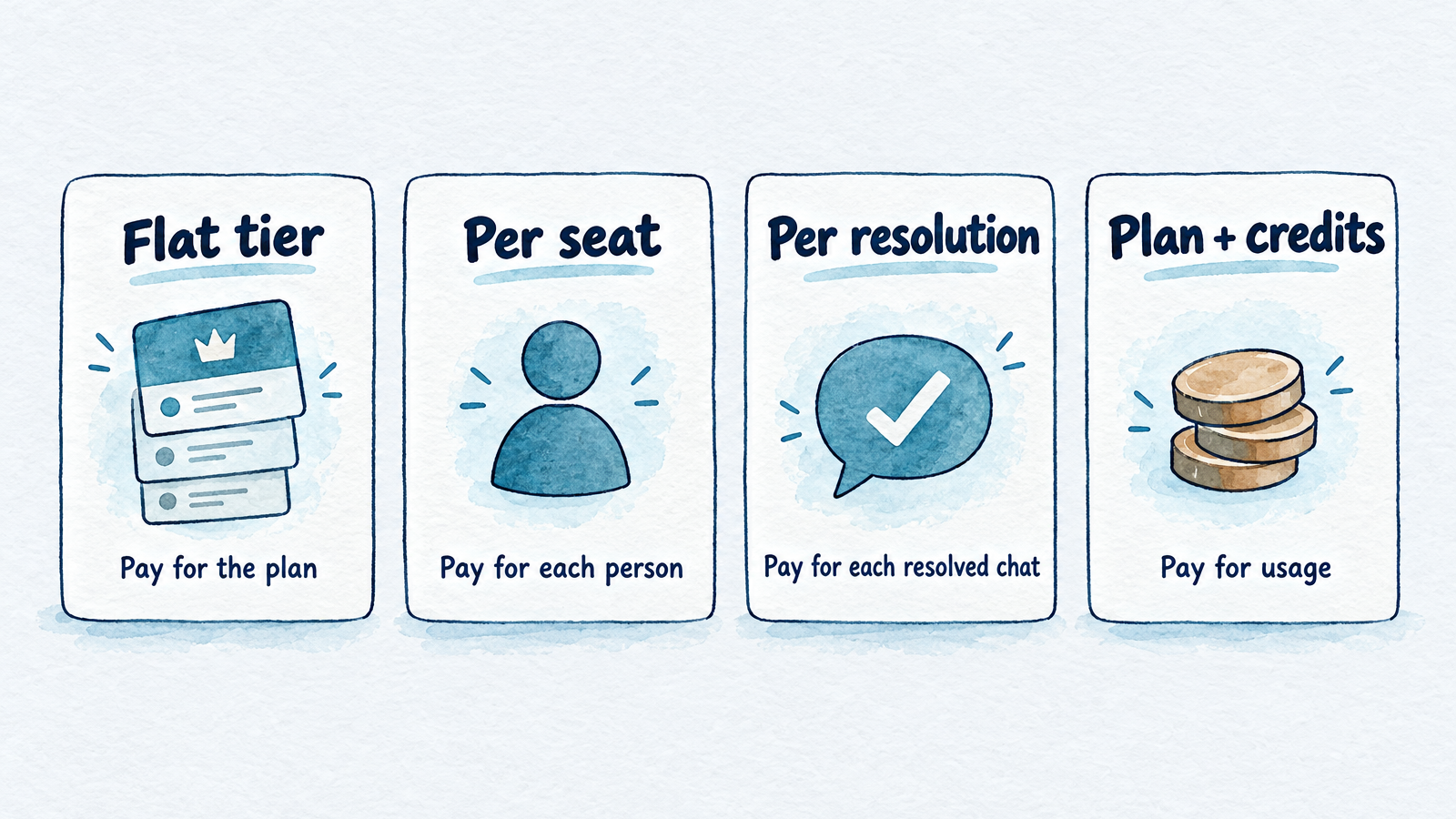
Each model bills a different unit, so the first cost to rise differs by model.
| Model | You pay for | Examples (October 2026) | What raises the bill first | Fits best |
|---|---|---|---|---|
| Flat tier | A plan with a message or query allowance | Botsonic, SiteGPT, CustomGPT.ai | Hitting the allowance and buying add-on packs | Steady, predictable volume |
| Per seat | Each team member who logs in | Zendesk, Intercom, ChatBot.com | Adding people | Support teams with several agents |
| Per resolution | Each conversation the AI resolves | Intercom Fin, Zendesk AI agents | Chat volume and resolution rate | High-value chats, low volume |
| Base plan plus credits | A plan plus metered usage | Chatbase, Crisp, Botpress, InsertChat | Stronger models and longer chats | Variable volume, multiple channels |
Flat tier with a usage allowance
A flat tier gives you a fixed monthly price for a set number of messages, queries or conversations, and the plan stops or sells you a pack when you run out. It is the easiest model to budget.
Botsonic lists Starter at $19 a month for 1,000 messages and Professional at $49 for 3,000, with extra messages at $25 per 2,000 (Botsonic pricing). SiteGPT's Starter is $59 monthly or $39 billed yearly for 4,000 messages on a lighter model (SiteGPT pricing). CustomGPT.ai starts at $99 a month for 1,000 queries and has no per-query overage: agents stop answering at the limit (CustomGPT.ai pricing).
The trap is what counts as one message, covered below.
Per seat
Per-seat pricing charges for each person who uses the dashboard, whether or not the AI is busy. It suits a support team and punishes a one-person shop that only wants a bot.
Zendesk's Support Team plan is $19 per agent a month billed annually, or $25 billed monthly (Zendesk pricing). ChatBot.com's Essential plan is $19 per user a month billed annually, or $25 monthly (ChatBot.com pricing). Intercom's Essential seat is listed at about $29 a month, with a promotional $19 for new customers, and Advanced and Expert seats are $85 and $132 (Intercom pricing).
Per resolution
Per-resolution pricing charges only when the AI resolves a conversation, so a quiet month costs less. Intercom's Fin AI Agent is $0.99 per outcome (Fin pricing). Zendesk's pricing page lists automated resolutions at $1.50 committed or $2.00 pay-as-you-go.
Two cautions apply. First, "resolved" is the vendor's definition. Intercom counts a resolution when the customer confirms the answer or stops asking after Fin replies, and deducts it if the conversation is reopened (Intercom's outcomes article). Second, Zendesk's help center says that from May 18, 2026 it moved to resolution tiers with a per-seat dollar allowance (Zendesk help center), so get the exact rate in writing.
Base plan plus usage credits
Credit pricing sells a plan with a monthly pool of credits, and each AI action spends some. The pool is shared, so one busy channel can use what another needed.
Chatbase's monthly tiers are $40, $150 and $500 (20% less billed yearly) with 700, 4,000 and 15,000 message credits, and extra credits cost $40 per 1,000 (Chatbase pricing). Crisp includes AI credits with its paid plans, starting at $45 a month for Mini (Crisp pricing). Botpress's Plus plan is $150 a month billed annually with 250 conversations and $25 of AI spend included (Botpress pricing). InsertChat's Pro plan is $98 a month with 5,000 credits shared by calls and written conversations.
Worked monthly totals at 100, 500, and 1,500 AI conversations
At 100 AI conversations a month the cheapest plans cost $19 to $40, at 500 they cost $49 to $326, and at 1,500 they range from $99 to $920, depending on the model. The spread widens fast because per-resolution and credit models scale with volume while flat tiers step up in chunks.
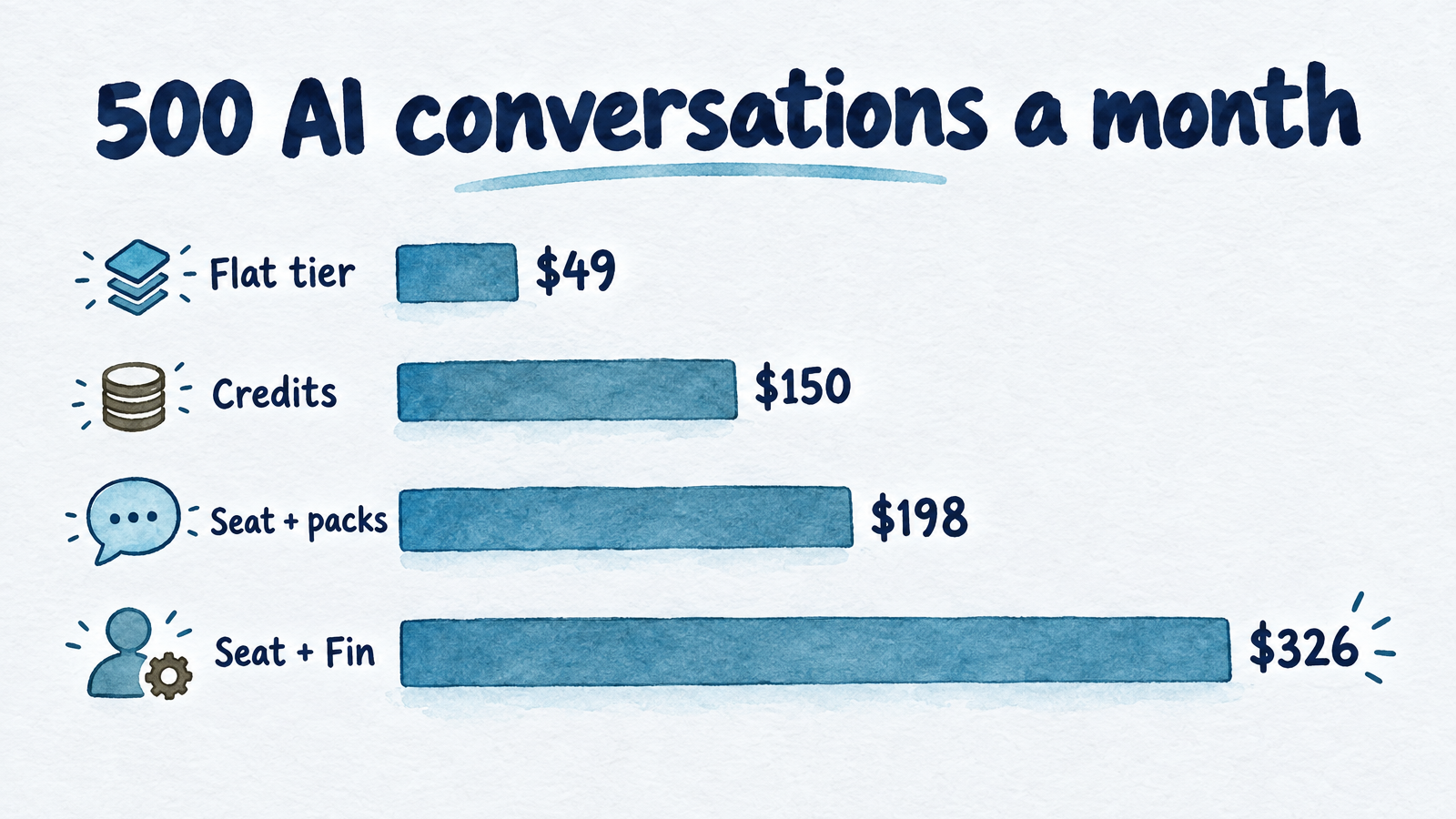
Same 500 conversations, four billing models, a $277 spread. Hypothetical totals at list prices.
These totals are hypothetical and use these assumptions:
- Each conversation has 4 AI replies, so 100, 500 and 1,500 conversations are 400, 2,000 and 6,000 replies.
- The AI resolves 60% of conversations: 60, 300 and 900 resolutions.
- One team seat, list prices, billed monthly, before tax.
- Botsonic counts one message per reply on its base model, which is our reading of its documentation, as it does not define "message" precisely.
| Plan and model | 100 conversations | 500 conversations | 1,500 conversations |
|---|---|---|---|
| Botsonic, flat tier | $19 (Starter) | $49 (Professional) | $99 (Professional plus two 2,000-message packs) |
| Chatbase, credits at 1 credit per reply | $40 (Hobby) | $150 | $230 ($150 plus 2,000 extra credits) |
| Chatbase, credits at 4 credits per reply (stronger model) | $150 | $310 | $860 (top tier plus 9,000 extra credits) |
| ChatBot.com, seat plus resolution packs | $74.50 (Essential plus one 50-pack) | $198 (Growth plus two 50-packs) | $792 (Growth plus fourteen 50-packs) |
| Intercom Essential seat plus Fin | $88.40 | $326 | $920 |
The per-resolution rows are sensitive to your resolution rate. If the AI resolves only 30% of chats, the Intercom total at 500 conversations falls from $326 to about $177.50, because you pay for 150 resolutions instead of 300. If it resolves 80%, it rises to about $424. Ask any vendor for the average resolution rate for stores like yours before you trust a per-resolution forecast.
The credit rows are sensitive to your model. Chatbase's docs say one reply costs 1 credit on most models and 4 or 5 on the strongest, so the same traffic can cost four times as much. The yearly rates are lower: Botsonic Starter is $16, ChatBot.com Growth is $79, and Chatbase is 20% off.
InsertChat is not in the table because its credits are not a fixed number of messages, and consumption varies by model and action. Pro is $98 a month with 5,000 credits, and Growth is $198 with 10,000. The pricing page estimator lets you enter your own volume. Its default example, 1,000 credits of written conversations plus 60 billable call minutes at 12 credits a minute, uses 1,720 of Pro's 5,000 credits.
How many conversations will you get?
A small site gets far fewer chats than most people guess, so estimate from your own traffic before you price anything. In a 2024 study of 175,438 accounts and about 4.78 billion visits, Smartsupp found that 0.84% of visitors used live chat, and the average e-shop handled about 75 conversations a month without a chatbot and about 440 with chatbots or automation (Smartsupp). It is vendor data on e-commerce only, so treat it as a starting range.
At that 0.84% rate, 10,000 monthly visits is roughly 84 chats, 50,000 is about 420, and 150,000 is about 1,260. Most small businesses land in the 100 and 500 columns above.
What message and credit allowances actually buy
A message or credit is a vendor-defined unit, not a customer chat, and the same allowance can cover very different amounts of traffic. Convert every allowance into conversations before you compare plans.
- Chatbase: a reply costs 1 credit on most models, 2 on some Gemini models, 3 on Claude Sonnet and Grok 3, 4 on Grok 4 and GPT-5.5, and 5 on Claude Opus. The 700 credits in Hobby can be 700 replies or fewer than 200 (Chatbase FAQ).
- Botsonic: GPT-4o mini counts as 1x, GPT-4o as 2x and GPT-4 as 10x, so Starter's 1,000 messages become 1,000, 500 or 100 replies (Botsonic docs).
- CustomGPT.ai: a plain chat message uses a query credit, and actions such as lead capture use extra (CustomGPT.ai limits).
- Crisp: Mini's $5 of included AI credit is about 90 automated conversations by Crisp's estimate of $0.05 to $0.10 per handled conversation (Crisp help center).
- Botpress: it counts a conversation as an exchange with at least two end-user messages in a billing month, and each includes $0.10 of AI usage.
- InsertChat: credits cover calls, chat and other work, round calls up to whole minutes, and are not a fixed number of messages.
The practical test: take a real week of questions, count the replies a typical chat needs, and multiply by the vendor's credit rate for the model you plan to use.
Hidden costs that don't show in the plan price
The plan price is rarely the bill. Five add-ons account for most of the gap.
- AI add-ons on top of the chat plan. Tidio's Starter plan is $24.17 a month billed annually, and its Lyro AI Agent is sold separately from $32.50 a month for 50 conversations. Its free plan has 50 billable conversations and only a one-time 50 Lyro conversations. Tidio meters billable conversations, Lyro conversations and Flows visitors separately (Tidio pricing).
- Overage and auto-recharge. Chatbase's auto-recharge adds $40 per 1,000 credits when your balance drops, so cost is uncapped if it is on. Without it, the agent stops. Crisp's AI stops answering when credits run out unless pay-as-you-go is on. Zendesk's overage defaults to "allow", though you can switch it to pause the AI agent.
- Extra seats and agents. Botsonic charges $25 a month per extra seat, and Chatbase lists extra agents at $300 a year each.
- Branding removal. Removing the vendor badge costs $16.67 a month on Tidio's Growth column, $49 a month on Botsonic and about $1,188 a year on Chatbase, as its page read when we checked. Several vendors sell it only as an add-on.
- Channel fees. WhatsApp is billed by Meta. Since July 1, 2025 Meta charges per delivered business-to-user message, with 1,000 free service messages a month per number, and service messages beyond that are charged from October 1, 2026 (Meta). Your chatbot vendor may bill this separately.
Reviews show where these bite. Tidio reviewers on Trustpilot describe unexpected price changes and needing upgrades to make Lyro work (Trustpilot). Intercom reviewers cite the cost of a full seat for inbox access (G2). Both are small samples, so treat them as pointers to check rather than verdicts.
If you run a Shopify store, check what is free first. Shopify's Inbox app is listed free in the App Store (Shopify App Store), though Shopify has not published pricing for its Inbox agent, and Shopify plans start at $39 a month (Shopify pricing).
What it costs to cover chat, email, texts, and phone
Buying one tool per channel usually costs more than one shared credit pool, but only if the pool is large enough for all channels. The more channels you add, the more separate subscriptions, seats and inboxes you pay for.
Here is a hypothetical store that wants website chat at about 500 conversations plus phone answering. Chatbase's $150 tier covers the chat. Goodcall's Starter plan covers 100 phone customers for $79, with 79 cents per extra customer (Goodcall pricing). That is about $229 a month for two tools, two dashboards, and no shared inbox, before email or text. Human answering services cost more per call: Smith.ai's Starter plan is $300 a month for 30 calls (Smith.ai pricing).
InsertChat's Pro is $98 a month and includes the AI receptionist, one phone number, website chat, the shared inbox and human handoff, with credits shared across calls and written conversations. See our comparison of answering services by monthly cost for the phone side in detail.
What matters is how many credits your volume uses. A chat-only store with 100 conversations will pay less at $19 to $40 elsewhere. A store that also needs calls, email and texts is where one pool earns its price.
Limits to know: InsertChat's AI receptionist does not transfer live calls, take voicemail, record calls or place outbound calls. It flags the team and arranges a follow-up. Phone usage beyond the included number, extra numbers at $10 a month and connected services such as SMS or WhatsApp can add charges.
Agencies reselling chatbots face the same math per client, covered in our white label chatbot guide for agencies.
How to compare chatbot quotes in six steps
A fair comparison takes about ten minutes once you convert every quote to the same monthly volume.
- Estimate your monthly conversations from visits, using roughly 0.8% of visitors as a starting point.
- Count replies per conversation from a week of real questions.
- Ask what one message, credit, conversation or resolution means, and which model that assumes.
- Price the plan that fits your volume and the one above it, so you see the step cost.
- Add seats, branding removal, extra agents, channel fees and any AI add-on.
- Check what happens at the limit: a hard stop, an auto-recharge, or an overage bill.
Then run the cheapest two through a trial with your own content. Accuracy matters as much as price, and a bot trained on your pages and documents beats a cheaper one that guesses. InsertChat's website chat and knowledge base trains on your pages and documents, and the guide to adding a chatbot to your website walks through installation. The Shopify integration covers store-specific setup.
Where InsertChat fits
InsertChat suits owners who want chat, calls, email and texts answered from one knowledge base without paying per seat or per resolution. Pro is $98 a month, or $81.67 a month billed annually, which costs ten monthly payments paid upfront. It includes 3 assistants, 3 team seats and 5,000 credits.
It is not the cheapest option for a chat-only site with light traffic, and credits make the monthly total less predictable than a flat message count. The usage estimator on the pricing page helps you check your volume. Website chat installs on Shopify, WordPress, Wix, Webflow, Squarespace, WooCommerce, Framer, BigCommerce, Ghost and Duda.
New customers can try Pro free for 7 days with 500 credits, and a card is required. Start your 7-day free trial and see your own credit use before you commit.
Frequently asked questions
Is an AI chatbot free to use?
Partly. Free plans exist but cap usage. Tidio's free plan includes 50 billable conversations and a one-time 50 Lyro AI conversations, and Shopify's Inbox app is listed free in the App Store. Once you pass the limits, the chatbot stops answering or you upgrade. Free plans work for testing, not for a business that depends on chat.
Why do some AI chatbot plans cost more than $200 a month?
Three things stack: seats, per-resolution fees and volume. Intercom's Essential seat plus Fin at 900 resolutions a month totals about $920 in our worked example, and Zendesk bills per agent plus per automated resolution. Credit plans also jump when stronger AI models use several credits per reply. Plans under $200 usually have fixed allowances.
Is annual billing cheaper than paying monthly?
Usually, by about 17% to 20%. Chatbase's yearly price is 20% lower, Tidio advertises two months free on annual billing, and ChatBot.com says up to 24%. InsertChat's annual plan costs ten monthly payments, paid upfront. Annual billing also commits you for the year, so run a trial first.
Does a chatbot price include WhatsApp messages?
Not always. Meta bills WhatsApp Business per delivered business-to-user message, and rates depend on message type and country. Each number gets 1,000 free service messages a month, and charges beyond that start October 1, 2026. Chatbot vendors may pass the charge through or add their own, so ask for the WhatsApp line item.
Can I cap how much a chatbot costs me?
Sometimes. Zendesk lets you switch overage to pause the AI agent, Crisp's AI stops when credits run out unless you enable pay-as-you-go, and CustomGPT.ai agents stop at the query limit. Chatbase's auto-recharge keeps answering and keeps billing. Look for a hard-stop setting and turn auto-recharge off while you learn your volume.