
An AI receptionist usually costs a monthly fee plus usage, and the unit a vendor meters shapes most of the bill. Vendors charge by the minute, by the call, by the unique caller, or through a monthly allowance, so the same month of calls can price very differently from one provider to the next.
This guide explains each pricing model with examples from vendors’ public pricing pages, shows how InsertChat prices its plans, and walks through an estimate you can redo with your own numbers. InsertChat details are current as of October 2026, and each vendor example carries the date it was listed.
How do AI receptionists charge?
AI receptionists charge in five main ways: per minute of talk time, per call, per unique caller, a flat monthly fee with allowances, and, for chat-first tools, per seat, per conversation, or per resolved outcome. Most pair a monthly base with an overage rate once you pass what’s included.
| Pricing model | What’s metered | Easiest to predict when | Ask about |
|---|---|---|---|
| Per minute | Talk time, usually sold in monthly bundles | Calls are short and similar in length | Rounding and overage rates |
| Per call | The number of calls | Call lengths vary a lot | Whether hang-ups and spam count |
| Per unique caller | The number of different people who call | The same customers call repeatedly | How a repeat caller is counted |
| Flat monthly with allowances | Set amounts of minutes, chats, or messages | Volume is steady month to month | What happens when an allowance runs out |
| Per seat or per outcome | Team seats, conversations, or resolved conversations | Chat and email are the main channels | Whether phone is included or billed separately |
Here is how those models appear on public pricing pages. The quoted wording is each vendor’s own, and prices change, so check the page before you compare.
- Per minute: Dialzara’s pricing page lists “Minute plans: $29 for 60, $99 for 220, $199 for 500, or $349 for 1,000 minutes” with “overage from $0.48 down to $0.35 per minute” (as listed on September 27, 2026). Rosie’s pricing page lists “Minute bundles: $49 for 250, $149 for 1,000, or $299 for 2,000 minutes” (as listed on September 27, 2026).
- Per call: Upfirst’s pricing page lists “Call bundles: $24.95 for 30, $59.95 for 90, $159.95 for 300, or $299 for 600 calls” (as listed on September 27, 2026). Smith.ai’s pricing page lists its AI Receptionist as “Free for 25 calls; Pro from $150 for 75–300 calls; Enterprise from $500” (as listed on September 27, 2026).
- Per unique caller: Goodcall’s pricing page lists “$79, $129, or $249 per agent per month” and meters “Unique customers (100, 250, or 500 included, then $0.50 each); minutes are not metered” (as listed on September 27, 2026).
- Flat monthly with allowances: My AI Front Desk’s pricing page lists “$99 per month, or $79 per month billed annually, with per-channel allowances” and describes them as “Per-channel allowances: 200 voice minutes, 100 chats, 400 SMS, and 500 email drafts; overage at $0.25 per minute and $0.04 per SMS” (as listed on September 27, 2026).
- Per seat and per outcome: among chat-first tools, Intercom Fin’s pricing page lists “Per-seat plans at $29, $85, or $132 (billed annually), plus $0.99 per Fin outcome; a Fin-only plan has a monthly minimum” (as listed on September 27, 2026), and Chatbase’s pricing page meters “Message credits; an extra 1,000 cost $40” (as listed on September 27, 2026).
Our alternatives pages compare several of these vendors with InsertChat, using the same dated sources.
Which pricing model costs the least for your calls?
The cheapest model depends on three things: how long your calls run, how often the same people call back, and how many channels you need answered. Run your own numbers through each model before you compare headline prices.
- Short, frequent calls, such as questions about hours or quick bookings, suit per-minute pricing, as long as the rounding is fair.
- Long calls, such as detailed intake or troubleshooting, suit per-call or per-caller pricing, where length doesn’t change the price.
- Repeat callers, such as clients checking on an order, suit per-unique-caller pricing, which counts people instead of calls.
- Several channels suit a plan that covers calls, chat, and messages from one allowance instead of a separate add-on for each.
Spam calls and hang-ups matter too. A call that lasts a few seconds can still count as a full call, or as a full minute where there is a one-minute minimum, so ask each vendor how it counts them.
How does InsertChat price its AI receptionist?
InsertChat sells monthly plans with included credits: Pro at $98, Growth at $198, Scale at $498, and Enterprise from $998 per month. Calls use credits, round up to whole minutes, and have a one-minute minimum. Each paid plan includes one phone number.
| Plan | Price per month | Credits each month | AI assistants | Team seats |
|---|---|---|---|---|
| Pro | $98 | 5,000 | 3 | 3 |
| Growth | $198 | 10,000 | 20 | 5 |
| Scale | $498 | 25,000 | 50 | 10 |
| Enterprise | From $998 | 50,000 | 100 | 25 |
Here is how usage is metered:
- Credits: one monthly allowance covers calls, written conversations, knowledge processing, and tools. How many credits a minute of calling uses depends on the AI model you select, so credits don’t convert to a fixed number of minutes.
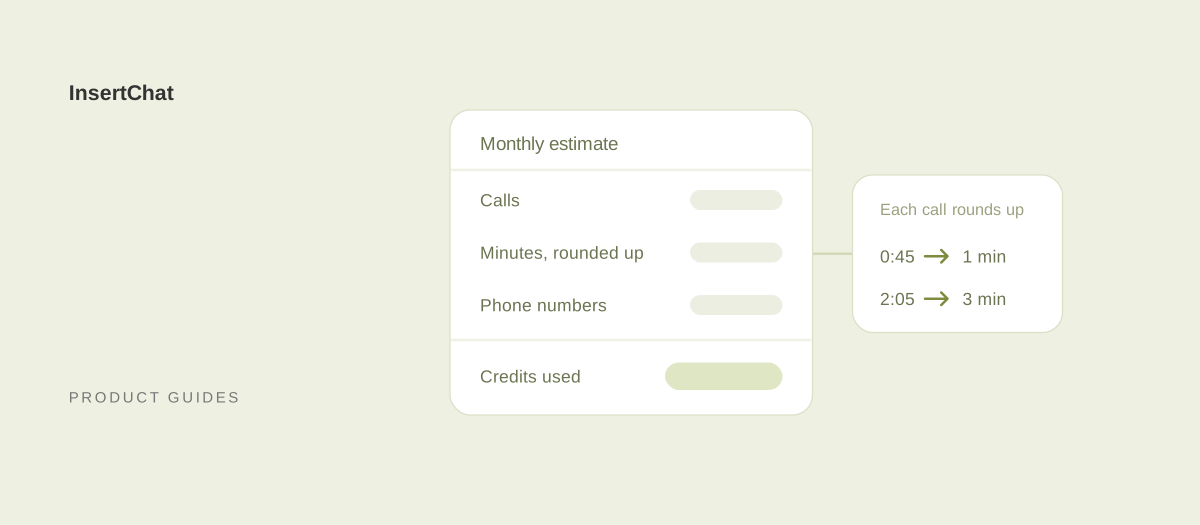
- Rounding: each call rounds up to the next whole minute, with a one-minute minimum. A 45-second call counts as one minute, and a call of 2 minutes 5 seconds counts as three.
- Phone numbers: one number comes with each paid plan, and additional numbers cost $10 per month each.
- Connected services: SMS, WhatsApp, and other connected services can carry their own charges.
- Annual billing: a year paid upfront costs ten monthly payments, so Pro billed annually is $980 for the year. Enterprise prices are starting prices.
Every plan includes the shared inbox and human handoff. Growth, Scale, and Enterprise add API access, and Scale and Enterprise add conversation analytics and analysis reports. The pricing page has the full comparison and a summary of channel costs.
How do you estimate your monthly usage?
Estimate in minutes first: count the calls the AI will answer, multiply by their average length, and allow for rounding. Then convert minutes to credits using the rate for your AI model, which you can set in the usage estimator.
The example below uses hypothetical inputs. Swap in your own numbers at each step.
- Count the calls the AI will answer. Hypothetical input: 200 calls a month reach the assistant. If you use the “AI when unanswered” or “AI after hours” routing mode, count only the calls your team doesn’t take.
- Find the average length. Hypothetical input: 3 minutes per call. Your phone provider’s call log gives you the real figure.
- Multiply. 200 calls at 3 minutes each is 600 minutes. Treat that as the minimum.
- Allow for rounding. Each call rounds up on its own, so a call of 2 minutes 10 seconds bills as 3 minutes and one of 3 minutes 5 seconds bills as 4. Rounding adds less than a minute per call, which caps the extra at 200 minutes here, so plan for 600 to 800 billable minutes.
- Convert to credits. Multiply billable minutes by the credits per minute for the model you choose. Rates vary by model, so this example stops at minutes. In the estimator, the example rates are editable assumptions, and the result is an estimate rather than a quote.
- Add your other channels. Website chat, email, SMS, and WhatsApp conversations use the same credits. The estimator counts them as non-call conversations.
- Choose a plan and add fixed costs. Compare the total with each plan’s monthly credits, then add $10 per month for each extra number and any SMS or WhatsApp charges.
The estimator rounds the average length you enter up to a whole minute, so entering 3 shows the low end of this range and entering 3.5 shows the high end.
To compare vendors, count the same hypothetical month in each one’s unit:
| Pricing model | How the hypothetical month counts |
|---|---|
| Per minute, billed by the second | 600 minutes |
| Per minute, rounded up per call, as InsertChat bills | 600 to 800 minutes |
| Per call | 200 calls |
| Per unique caller | However many different people made those 200 calls |
| Flat monthly with allowances | Whether those minutes fit the voice allowance, plus overage if they don’t |
Then multiply each count by the price on that vendor’s current pricing page.
What hidden costs should you check?
Check the costs that sit outside the headline price: rounding and per-call minimums, overage, extra phone numbers, texting, add-on channels, carrier charges for forwarding, compliance tiers, and your team’s time. Ask every vendor the same questions, including us.
- Rounding and minimums: is talk time billed by the second or rounded up per call, and is there a minimum per call? InsertChat rounds each call up to whole minutes with a one-minute minimum.
- Overage: what does each extra minute, call, or caller cost past the allowance, and what happens to calls when you run out?
- Phone numbers: how many are included, and what does each extra one cost? InsertChat includes one and charges $10 per month for each additional number.
- Texting: Smith.ai’s pricing page notes “SMS and email start on Pro” for its AI Receptionist (as listed on September 27, 2026), and Dialzara’s pricing page lists “SMS is a $19 add-on plus $0.05 per message; chat is $39 standalone or included with voice” (as listed on September 27, 2026). On InsertChat, SMS and WhatsApp can carry their own charges.
- Add-on channels: Rosie’s pricing page lists “web texting is $50 for 25 conversations, then $1 per conversation” (as listed on September 27, 2026). Ask whether website chat, email, or messaging costs extra.
- Carrier charges: if you keep your number through call forwarding, your phone provider may count forwarded calls against your plan.
- Seats: under per-seat pricing, count everyone who reviews conversations. InsertChat plans include from three to 25 seats.
- Compliance tiers: a Business Associate Agreement may sit on a higher plan. Upfirst’s pricing page states “A BAA is offered only on the Custom plan” (as listed on September 27, 2026). InsertChat Enterprise plans can sign a BAA.
- Your team’s time: someone reviews the inbox, returns callbacks, and keeps the knowledge current. Budget for that time, since it never appears on an invoice.
- Taxes and terms: check checkout for taxes, and ask how annual billing and cancellation work.
When do you need InsertChat’s Enterprise plan?
You need Enterprise if the AI receptionist will handle protected health information, because Enterprise is the InsertChat plan that can sign a Business Associate Agreement (BAA). It starts at $998 per month and raises the limits to 50,000 monthly credits, 100 AI assistants, and 25 team seats, with a dedicated support agent.
On other plans, keep protected health information out of the assistant. Leave patient details out of its knowledge, limit booking questions to a name, contact details, and a preferred time, and route clinical questions to your staff. A BAA is a contract, so review it with your compliance advisor.
Enterprise also suits larger rollouts that outgrow Scale’s 50 assistants and 25,000 monthly credits. If you need a BAA or want to plan a rollout, contact us.
How does the cost compare with a human answering service?
Human answering services usually bill for operator time, by the minute or by the call, often in monthly bundles. For example, Ruby’s pricing page lists “Receptionist from $250 for 50 minutes; chat from $143 for 10 chats” (as listed on September 27, 2026).
Price per minute is only part of the comparison. People bring judgment and empathy, and many services can put a call through to your staff. An AI receptionist answers from your knowledge, books within your rules, and covers whatever hours you route to it. The AI receptionist vs answering service guide explains when each fits and how to combine them, and the small business guide covers setup.