
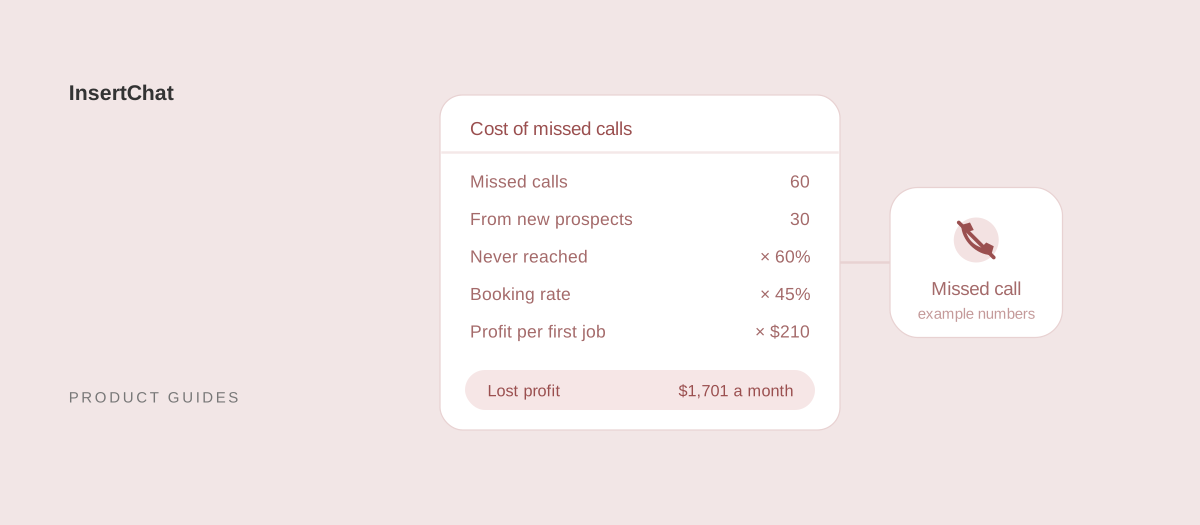
The cost of a missed call is the profit you lose from callers who never reach you and book elsewhere, plus the time spent chasing them. To calculate it, take your missed calls from potential new customers, multiply by the share you never reach later, your booking rate, and your gross profit per first job, then add repeat business if you want the fuller picture.
There’s no honest single number for every business, because job values, booking rates, and caller behavior differ widely. This guide gives you a six-step method you can run on your own phone log, a worked example with every assumption labeled, a table showing how much the assumptions matter, and a spreadsheet layout you can copy.
What does a missed call cost?
A missed call costs the gross profit of the work that caller would have booked, multiplied by the chance they would have booked and the chance you never reach them again. For businesses with repeat customers, add the profit from their future visits. The core formula:
Monthly cost of missed calls = missed calls from new prospects × share never reached × booking rate × gross profit per first job
Each input comes from your own records: the call log, your callback notes, your booking history, and your job costs. The steps below show where to find each one.
Why is there no single cost-of-a-missed-call number?
Published figures for the cost of a missed call vary enormously, and most come from vendors selling call answering. The cost really does vary: a missed call is worth far more to a roofer than to a coffee shop, and a business that calls back within minutes recovers more callers than one that calls back tomorrow.
Your own numbers are the only ones that matter for your decision. Two weeks of call logs and a few notes on what happened to each caller will tell you more than any industry average.
How to calculate the cost of missed calls
Calculate the cost in six steps: count missed calls, remove the ones that weren’t opportunities, estimate how many you never reached, apply your booking rate, apply your gross profit per job, and optionally add repeat value and callback time. The free missed call calculator runs the core math with your own numbers.
Step 1: Count your missed calls
Pull a call log for a recent month from your phone provider or phone system. Most business phone services show answered and unanswered calls; with a basic line, ask your provider for a call detail report. If you can’t get a log, tally answered and missed calls by hand for two weeks.
Include calls that went to voicemail, calls during lunch, and calls after hours and on weekends. After-hours calls are easy to forget and often the ones nobody returns until the next day.
Step 2: Remove calls that weren’t opportunities
Take out robocalls and spam, wrong numbers, vendors and sales calls, and calls from existing customers. Count existing customers separately; they matter, but they behave differently from new prospects. What’s left is the number of missed calls from potential new customers.
If you can’t identify every number, look up a sample of 20 or 30 and apply the proportions to the rest.
Step 3: Estimate how many callers you never reached
Some missed callers call back, answer your return call, or text you later. Others call the next business on the list. For each missed prospect in your sample, check whether you eventually spoke to them. The share you never reached is your loss rate.
Your loss rate depends heavily on how fast you return calls, which is why the speed-to-lead guide is worth reading alongside this one.
Step 4: Apply your booking rate
Your booking rate is the share of answered calls from new prospects that turn into a booked job or appointment. Use the rate from calls you did answer, over the same period. If you don’t track it, count a sample of answered new-customer calls and how many booked.
Step 5: Apply gross profit per first job
Use gross profit, not revenue: the average first-job price minus the direct costs to deliver it, such as materials, parts, and the technician’s time. Revenue overstates the loss, because some of that money would have been spent doing the work.
Step 6: Add repeat value and callback time (optional)
For businesses with repeat customers, add the profit from the share of new customers who come back within a year. Then add the time your team spends returning calls: callback attempts × minutes per attempt × hourly labor cost.
Worked example: a plumbing company
This example uses a fictional plumbing company. Every number is an assumption chosen to show the method, not a benchmark or a measured result. Replace each one with your own.
| Input | Assumption | Source to use for your business |
|---|---|---|
| Missed calls in the month | 60 | Phone provider call log |
| Spam, wrong numbers, and vendors | 16 | Sample of looked-up numbers |
| Existing customers | 14 | Contact list match |
| Missed calls from new prospects | 30 | 60 − 16 − 14 |
| Share never reached | 60% | Callback notes |
| Prospects never reached | 18 | 30 × 60% |
| Booking rate on answered prospect calls | 45% | Booking history |
| Average first-job price | $350 | Invoices |
| Direct costs per first job | $140 | Materials and labor |
| Gross profit per first job | $210 | $350 − $140 |
The core calculation:
- Lost bookings: 18 prospects × 45% = 8.1 jobs a month.
- Lost first-job profit: 8.1 × $210 = $1,701 a month.
The optional additions, with their own assumptions:
- Repeat value: if 30% of new customers come back within a year with $150 of gross profit each, that’s 8.1 × 30% × $150 = about $365 a month of future profit.
- Callback time: if the team makes 42 callback attempts a month at 4 minutes each, that’s 2.8 hours. At $18.27 an hour, the May 2025 median hourly pay for receptionists from the Bureau of Labor Statistics, that’s about $51 a month before payroll costs.
Total: about $2,117 a month, or about $25,400 a year, for this fictional company under these assumptions. The first-job profit alone is about $20,400 a year.
How much do the assumptions matter?
The two assumptions that move the result most are the share of callers you never reach and your booking rate. The table keeps the fictional company’s 30 prospect calls a month and $210 gross profit per first job, and changes only those two inputs.
| Share never reached | 30% booking rate | 45% booking rate | 60% booking rate |
|---|---|---|---|
| 40% | $756 a month | $1,134 a month | $1,512 a month |
| 60% | $1,134 a month | $1,701 a month | $2,268 a month |
| 80% | $1,512 a month | $2,268 a month | $3,024 a month |
The share never reached is the input you control most directly. Returning calls faster, or answering calls that would have been missed, moves you up the table.
Copy-ready spreadsheet layout
Set up a sheet with these rows, enter your own numbers in column B, and the formulas fill in the rest. Row numbers assume you start in row 1.
| Row | Label (column A) | Value or formula (column B) |
|---|---|---|
| 1 | Missed calls this month | Your number |
| 2 | Spam, wrong numbers, vendors | Your number |
| 3 | Existing customers | Your number |
| 4 | Missed calls from new prospects | =B1-B2-B3 |
| 5 | Share never reached | Your percentage |
| 6 | Booking rate | Your percentage |
| 7 | Gross profit per first job | Your number |
| 8 | Lost first-job profit per month | =B4*B5*B6*B7 |
| 9 | Share of customers who return | Your percentage |
| 10 | Repeat profit per returning customer | Your number |
| 11 | Lost repeat profit per month | =B4*B5*B6*B9*B10 |
| 12 | Callback attempts per month | Your number |
| 13 | Minutes per attempt | Your number |
| 14 | Hourly labor cost | Your number |
| 15 | Callback time cost per month | =B12*B13/60*B14 |
| 16 | Total monthly cost | =B8+B11+B15 |
| 17 | Total yearly cost | =B16*12 |
What does it cost to answer those calls instead?
Compare your monthly missed-call cost with what it costs to cover the hours you miss. The options are more staff time, an answering service, or an AI receptionist, and each fits a different pattern of missed calls.
- More staff time: a part-time receptionist working 20 hours a week at the BLS median of $18.27 an hour costs about $1,583 a month in wages before payroll taxes and benefits, and covers only those 20 hours.
- An answering service: usually billed per minute or per call. The AI receptionist vs answering service guide compares how they work.
- An AI receptionist: InsertChat starts at $98 per month with one phone number and 5,000 monthly credits; calls round up to whole minutes. The AI receptionist cost guide explains the pricing models, and the usage estimator gives an estimate for your call volume.
If your losses are concentrated after hours, coverage for evenings and weekends may be enough. If calls slip through during the day, ringing your team first with a backup for unanswered calls fixes the problem without replacing anyone.
How do you reduce missed calls?
Reduce missed calls by deciding in advance who or what answers each call your team can’t get to, during busy hours, breaks, evenings, weekends, and holidays. Then return the calls you still miss within minutes, not hours.
- Find the pattern. Use the call log from step 1 to see when calls are missed.
- Ring your team first, with a backup. Forward unanswered or busy calls instead of sending them to voicemail.
- Cover after hours. The after-hours message examples include voicemail scripts and AI greetings.
- Return calls fast. Give missed calls an owner and a target time.
- Answer well. The guide on how to answer a business phone professionally covers greetings, messages, and follow-up.
- Recalculate monthly with the same spreadsheet.
Stop paying for missed calls with InsertChat
InsertChat’s AI receptionist answers the calls your team can’t: it answers from your services, hours, and prices, books jobs within your scheduling rules, and takes complete details when a person needs to follow up, with every call in the shared inbox. With “AI when unanswered,” your phone rings for 5 to 60 seconds first; with “AI after hours,” it covers the hours outside your weekly schedule. In the US and Canada, you keep your number with call forwarding, including forwarding only unanswered or busy calls where your provider supports it.
New customers can try Pro free for 7 days with 500 credits (a card is required). Start your free trial, then rerun the spreadsheet after a month, or explore the demo to see answered calls in a sample workspace.