TL;DR
- Complete a white label chatbot migration in five stages: inventory, map, pilot, cut over, and verify.
- Copying a logo and replacing a widget is insufficient. Sources, answer rules, roles, actions, handoffs, records, reporting, and ownership must also pass.
- Run the current and replacement platforms in parallel when contracts, privacy controls, routing, and budget permit it—and when doing so materially reduces cutover risk.
- Hold when a critical portability path, entitlement, governing term, or approval lacks current evidence.
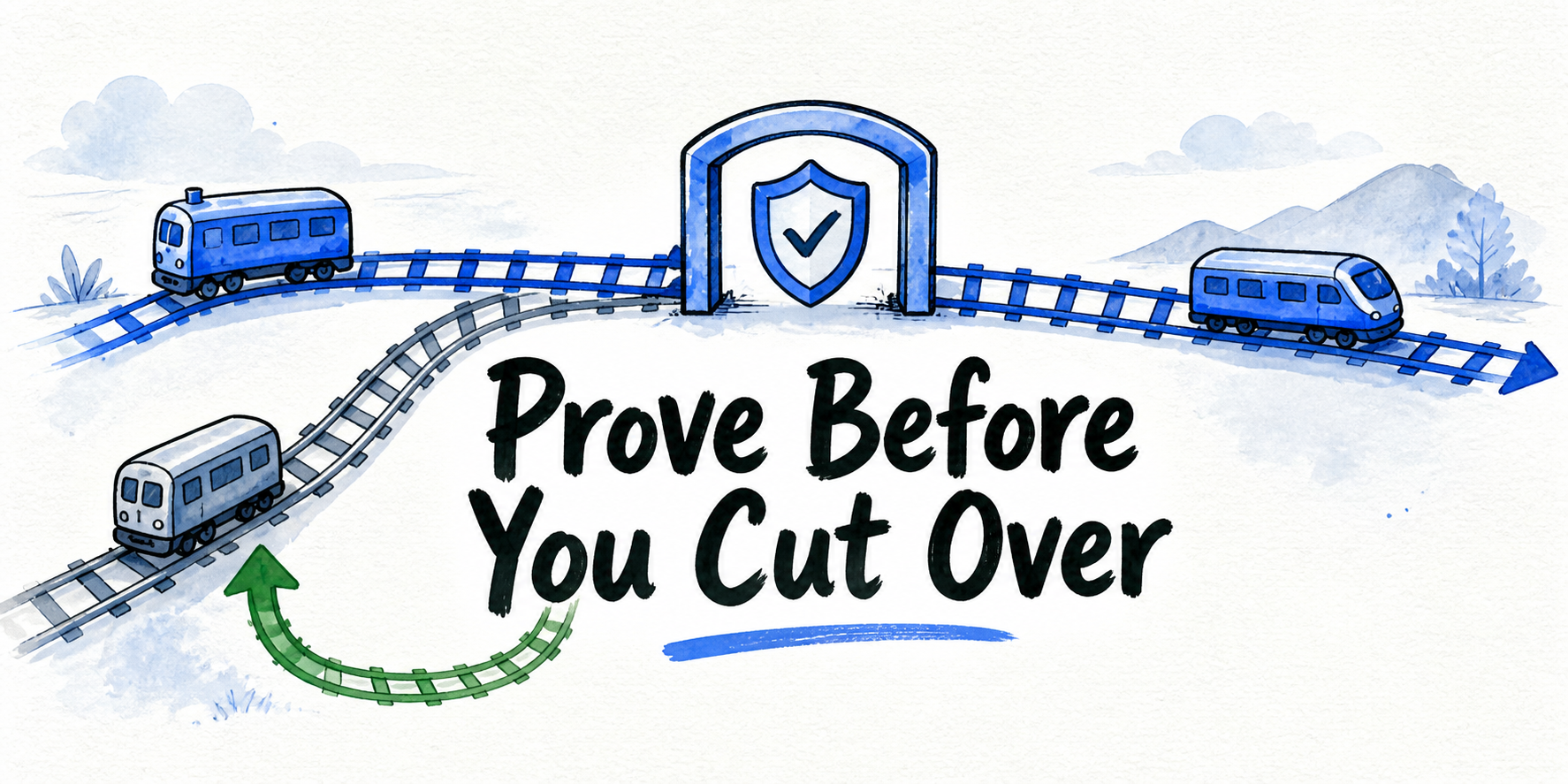
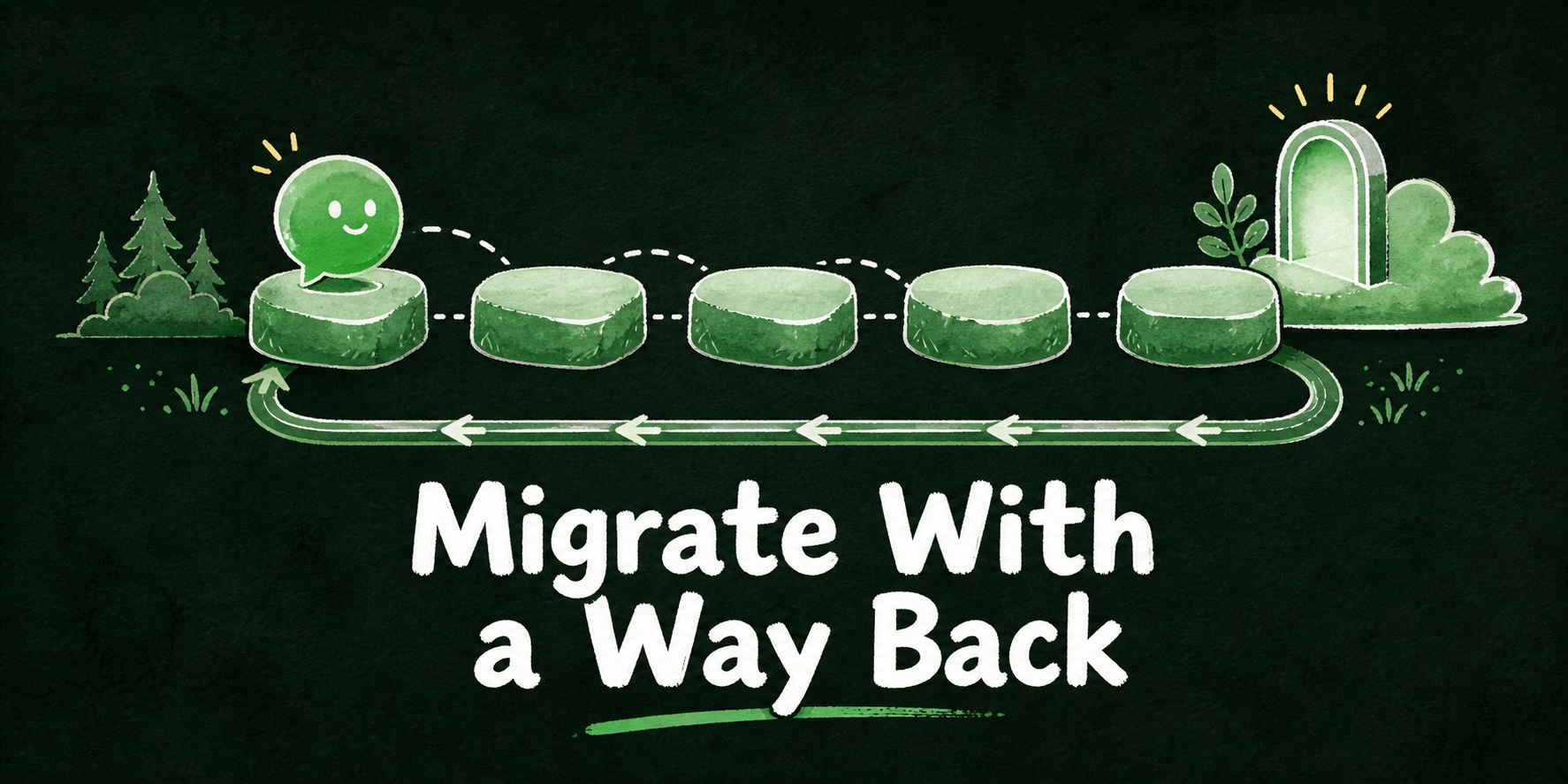
- Roll back when a critical client-facing acceptance gate fails or the agreed fallback becomes unreliable.
A white label chatbot migration transfers a governed client service from the current platform—the system serving clients today—to a replacement platform—the system proposed to take over. That service includes its answers, actions, ownership, records, and fallback behavior, not merely its appearance. A replacement can look correct while losing a required citation, exposing the wrong workspace, forgetting active context, or sending a support request to an unattended destination.
Key Takeaways
- Service parity matters more than feature-count parity.
- Historical conversations, leads, reports, and audit records may require approved archival treatment rather than transfer.
- A representative pilot must exercise meaningful dependencies, not merely the easiest assistant to rebuild.
- Temporary dual-platform cost can buy evidence and reversibility when parallel operation is permitted.
- One failed critical gate overrides an attractive aggregate result.
1. Define the service being migrated
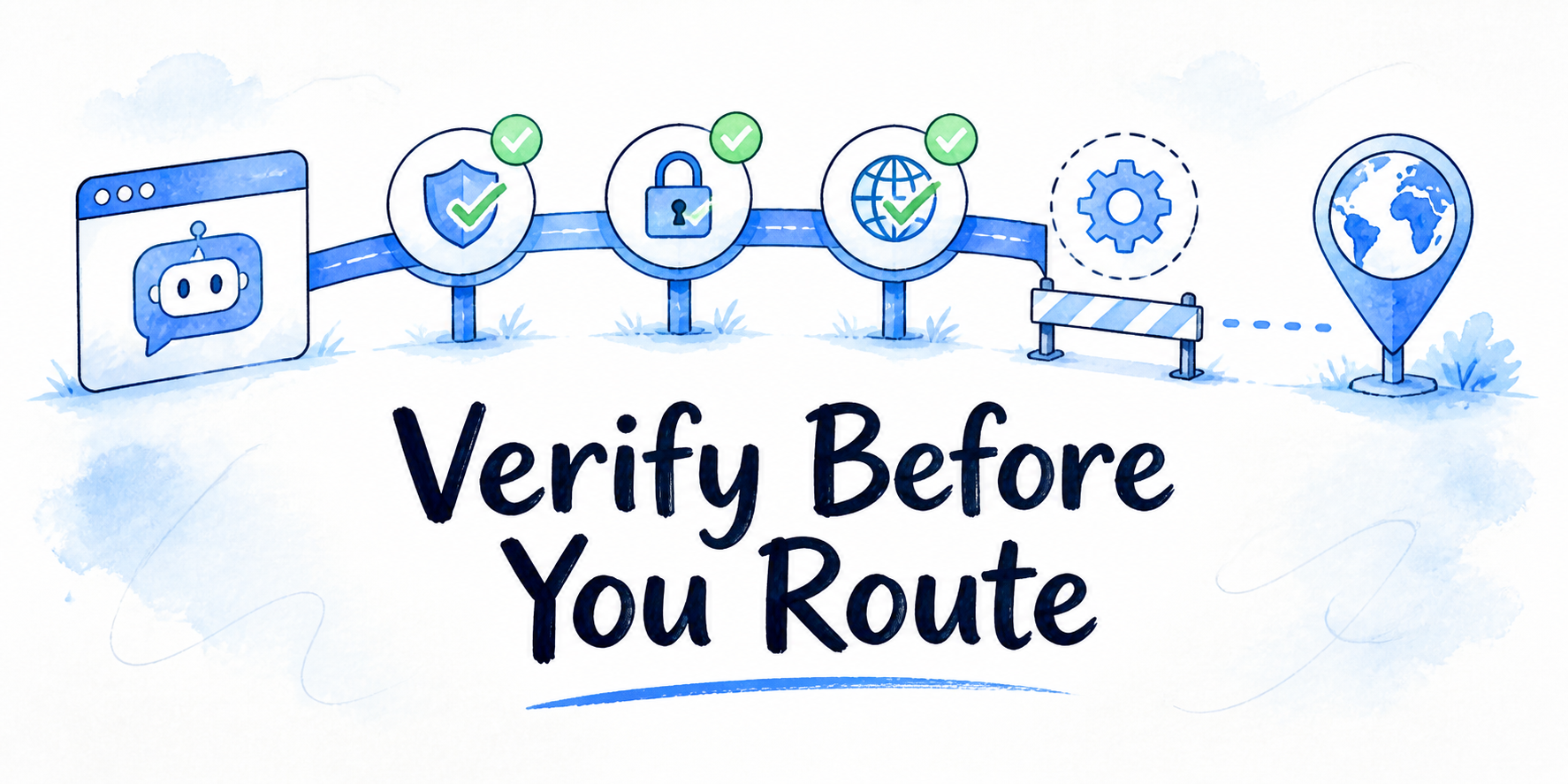
The direct migration sequence is: inventory the live service, map each dependency to a target state, pilot a representative assistant, cut over in dependency order, and verify the result under live conditions. Each stage must produce evidence for the next decision.
Begin with an entity map. Name the current platform, replacement platform, agency or SaaS operator, and each client workspace. Connect every workspace to its assistants, approved sources, prompts, branding, custom domains, and deployment surfaces, including widgets, embeds, hosted pages, or other active channels.
Extend the map through conversations, leads, teammates, roles, credentials, integrations, human-handoff destinations, analytics, billing, and governing documents. The objective is to expose relationships that can break: a domain controlled by a client, a webhook maintained by engineering, an inbox owned by an external support team, or a billing account held by a former administrator.
Separate the evidence supporting each relationship:
- Operator-owned evidence: live configuration records, screenshots, role assignments, contracts, DNS records, credential owners, destination records, invoices, and representative conversations.
- Vendor-documented evidence: current official material describing capabilities, entitlements, export and import methods, retention, deletion, security controls, or limitations.
- Observed test evidence: transcripts, access tests, webhook events, destination records, deployment checks, and acceptance results produced during the migration.
- Unresolved questions: required facts for which none of the above evidence exists.
Use the same evidence standard for both platforms. An API, integration listing, familiar interface, or successful visual recreation does not establish cross-platform portability. If official documentation is unavailable, keep the dependency unresolved and assign an owner to obtain written confirmation.
Potential losses include source structure, prompt behavior, refusal rules, permissions, credentials, visitor identity or memory, active-conversation context, historical transcripts, lead metadata, reports, audit records, domain control, integration state, and contractual evidence. Some items can be imported; others must be rebuilt, reauthorized, run in parallel, archived, or abandoned with explicit approval.
2. Build the migration control register and portability matrix
Create one editable control register with client-specific rows. Shared templates are useful, but domains, integrations, permissions, contractual obligations, and approval paths can differ by client.
| Field | What to record |
|---|---|
| Dependency | The source, prompt, domain, role, credential, integration, record, action, or route at risk |
| Owner | The person or organization controlling it |
| Current state | How the dependency works now |
| Target state | How it must work after migration |
| Evidence source and status | Official documentation, operator record, observed test, assumption, or unresolved question |
| Acceptance owner and test | Who decides and what observable result constitutes a pass |
| Cutover order | Dependencies that must change before or after this row |
| Rollback action | The route, configuration, credential, or deployment to restore |
| Blocker | Missing evidence, approval, access, entitlement, or technical capability |
| Final disposition | Proceed, narrow, hold, reject, rollback, or archive |
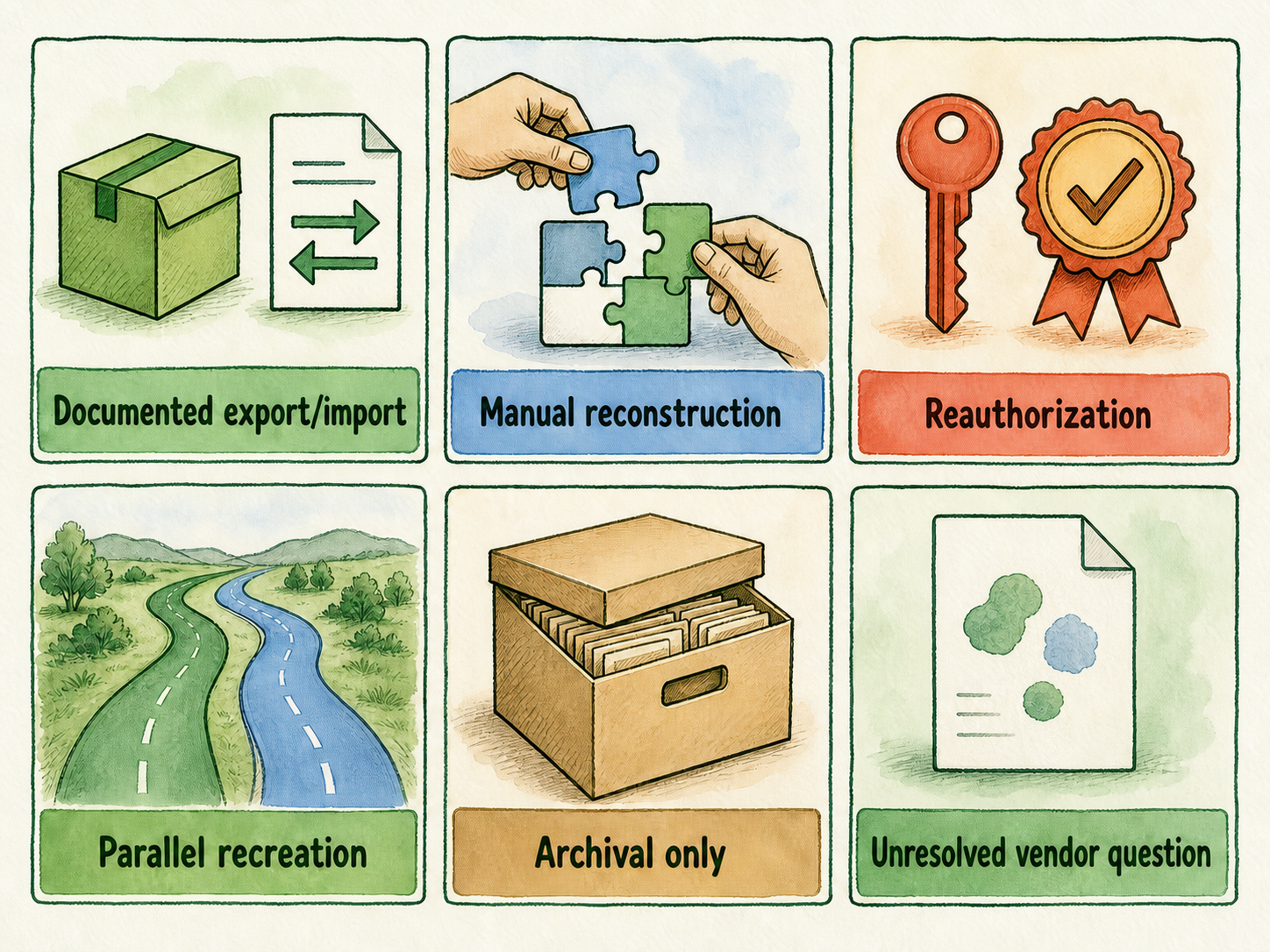
Assign a portability class to every dependency:
| Portability class | Meaning |
|---|---|
| Documented export/import | Both platforms document a compatible path for the required object and scope |
| Manual reconstruction | The target result can be recreated, but the configuration must be rebuilt |
| Reauthorization | The connection can be recreated only with new credentials, consent, or ownership approval |
| Parallel recreation | The replacement must be built and tested while the incumbent remains intact |
| Archival only | The record remains in an approved archive and is not operationally imported |
| Unresolved vendor question | Current documentation or account-specific written confirmation is missing |
Cover sources, prompts, conversations, leads, analytics, reports, credentials, domains, phone assets, integrations, and audit records. InsertChat documents conversation records containing transcripts, page context, source usage, metadata, feedback, and handoff status in its conversation inbox documentation. That supports a target-state conversation gate; it does not prove that every incumbent transcript, status, or metadata field can be imported.
Likewise, InsertChat documents CRM, support, ecommerce, calendar, webhook, and owned-destination workflows on its integrations page, with a broader searchable integration directory. These sources support testing a required destination. They do not establish that incumbent credentials, mappings, workflow state, or history will transfer.
The InsertChat API overview documents surfaces for assistants, sources, chats, messages, tools, statistics, feedback, webhooks, access controls, and custom deployments. Use that evidence to identify objects that can be created or managed and then test the required operation. Do not interpret API availability as proof of a compatible importer or lossless migration.
For example, classify a lead-capture webhook as parallel recreation when the operator owns the destination but must issue a new secret. Engineering creates the replacement connection; revenue operations verifies a test event and destination record; the current endpoint remains the rollback route until acceptance. Historical transcripts may instead be archival only when export rights, compatible import support, or approved retention treatment cannot be established.
Record contractual notice requirements, client approval paths, outage tolerance, the permitted parallel-running period, rollback authority, and the event after which rollback is no longer acceptable. These are operator-owned requirements. A technically possible transfer must remain on hold if a critical contractual or privacy condition is unknown.
3. Set service-parity gates and decision rules
A replacement passes only when it preserves the client service that matters. Establish gates for:
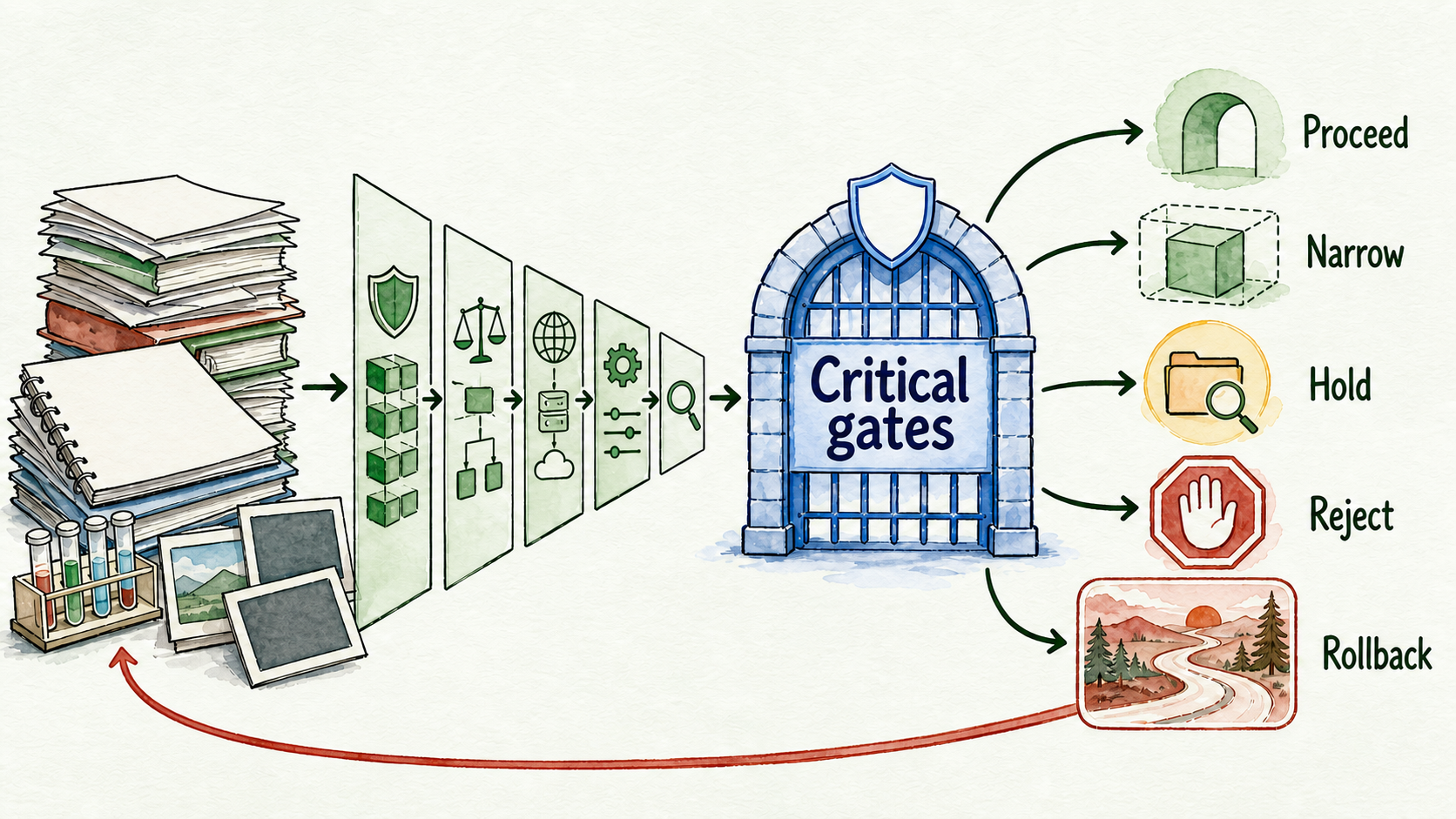
- Brand presentation across every required surface
- Approved-source coverage and required citations
- Answer, refusal, disclosure, and fallback rules
- Workspace, teammate, client, and role boundaries
- Visitor identity or memory where the workflow depends on it
- Booking, lead, support, ecommerce, or other workflow actions
- Human-handoff routing and preserved context
- Analytics capture and client reporting
- Support ownership, privacy obligations, security controls, and governing documents
For every gate, record the requirement, current-platform evidence, replacement-platform evidence, observed test, acceptance owner, severity, and rollback consequence. A visual pass cannot compensate for missing citations, excessive access, or a broken handoff.
After the entity map is complete, vendor documentation can define replacement-side tests. InsertChat documents branding across widgets, embeds, hosted pages, and custom-domain launches on its branding page. Its channel documentation describes widget, embed, hosted-page, custom-domain, and API-oriented launch paths. Its knowledge-base documentation covers approved website and file sources, refresh, citations, and weak-source review, while its team-workspace documentation describes role and client-scoped access patterns. Each documented capability still needs an observed test for the intended client workflow.
Apply the same discipline to data and governance gates:
- Conversations: Use the conversation inbox documentation to test required transcripts, context, statuses, search, handoff details, and review controls. Keep historical import coverage separate and unresolved until documented.
- Integrations: Use the integrations documentation to test the exact CRM, helpdesk, ecommerce, calendar, webhook, or owned destination. Recreate credentials and mappings unless a supported transfer path is proven.
- API: Use the API documentation to test required object management, authentication, messaging, webhooks, and custom surfaces. API coverage alone does not prove data portability.
- Privacy: InsertChat's privacy documentation describes account and usage data, encryption in transit and at rest, privacy-rights paths, restrictions on using customer content for foundation-model training, and purpose-based retention. Confirm how those terms apply to the intended deployment and required records.
- DPA: The InsertChat DPA covers controller and processor responsibilities, subprocessing, rights assistance, breach response, impact assessments, audits, transfer safeguards, and deletion or return. The acceptance owner must determine whether those terms satisfy the client's governing requirements.
- Security: InsertChat's security documentation describes encryption, access controls, private deployments, regional options, provider-key choices, conversation review, feedback history, log visibility, and governed integrations. Verify the precise hosting, retention, access, logging, and procurement requirements for the proposed account rather than treating a general security page as universal approval.
Use explicit decisions:
- Proceed: All critical gates pass, and the acceptance owners approve the remaining defects and residual risks.
- Narrow: A smaller workflow, channel, or client scope passes without concealing what failed.
- Hold: A critical question lacks current evidence, entitlement confirmation, contractual approval, or acceptance.
- Reject: A required capability, ownership boundary, governing term, or recovery condition cannot be met.
- Rollback: A critical live check fails or confidence in the agreed recovery path falls below the approved condition.
The incumbent must receive the same fair assessment. No current incumbent documentation or operator-observed strength was supplied here, so a concrete strength comparison remains unresolved and cannot support approval. Capture at least one material incumbent strength from current official documentation or observed live behavior—for example, a required export, stable handoff, proven access boundary, or accepted report—before deciding that the replacement preserves it.
4. Pilot one representative assistant in parallel
Choose the pilot by dependency coverage, business consequence, and similarity to the wider portfolio. Convenience alone is insufficient. The pilot should exercise enough sources, roles, deployment surfaces, actions, handoffs, and reporting to expose migration risk without widening production exposure unnecessarily.
A bounded first scope could be a website FAQ and lead-capture assistant on one controlled page. Keep the incumbent route available, recreate the approved sources and answer rules, apply the client brand, connect a test destination, and restrict access to the intended roles.
Run an operator-approved question set on both platforms. Include high-risk edge cases and refusals without turning the migration into a general prompt-writing exercise. Test workflow actions, human handoffs, mobile presentation, widget or embed behavior, hosted or custom-domain routes where required, roles, client access, visitor context where applicable, and analytics capture.
Preserve acceptance evidence:
- Inputs and approved questions
- Configuration records
- Screenshots of desktop and mobile surfaces
- Full transcripts and required citations
- Destination records from leads, bookings, support, or webhook actions
- Role and client-access results
- Analytics records
- Observed outcome, unresolved items, and final decision
Parallel operation is useful when it enables comparison and keeps rollback executable. It is unsuitable when it would duplicate bookings or leads, create conflicting routes, exceed an approved privacy scope, confuse visitors, violate a contract, or impose unacceptable cost. Use an internal preview, controlled page, limited audience, or scheduled test window when live dual operation is inappropriate.
Consider a hypothetical application. An agency pilots an FAQ-and-lead assistant because it covers approved sources, required citations, client branding, a website embed, a lead action, two roles, and reporting. The agency rebuilds it on a controlled page, runs approved questions, verifies test leads in the owned destination, and records both platforms' results. A successful outcome supports “proceed for this workflow,” not approval for the full portfolio.
The agency then tests an integration-heavy assistant with booking, webhook, custom-domain, email, role, and historical-data requirements. Booking and routing pass, but the required entitlement and historical treatment remain undocumented. The proper result is narrow or hold. The first pilot does not prove that the more complex assistant is portable.
5. Cut over in dependency order—and keep rollback executable
Write the production sequence from the control register before changing traffic. The exact order depends on the recorded dependencies, but it should address:
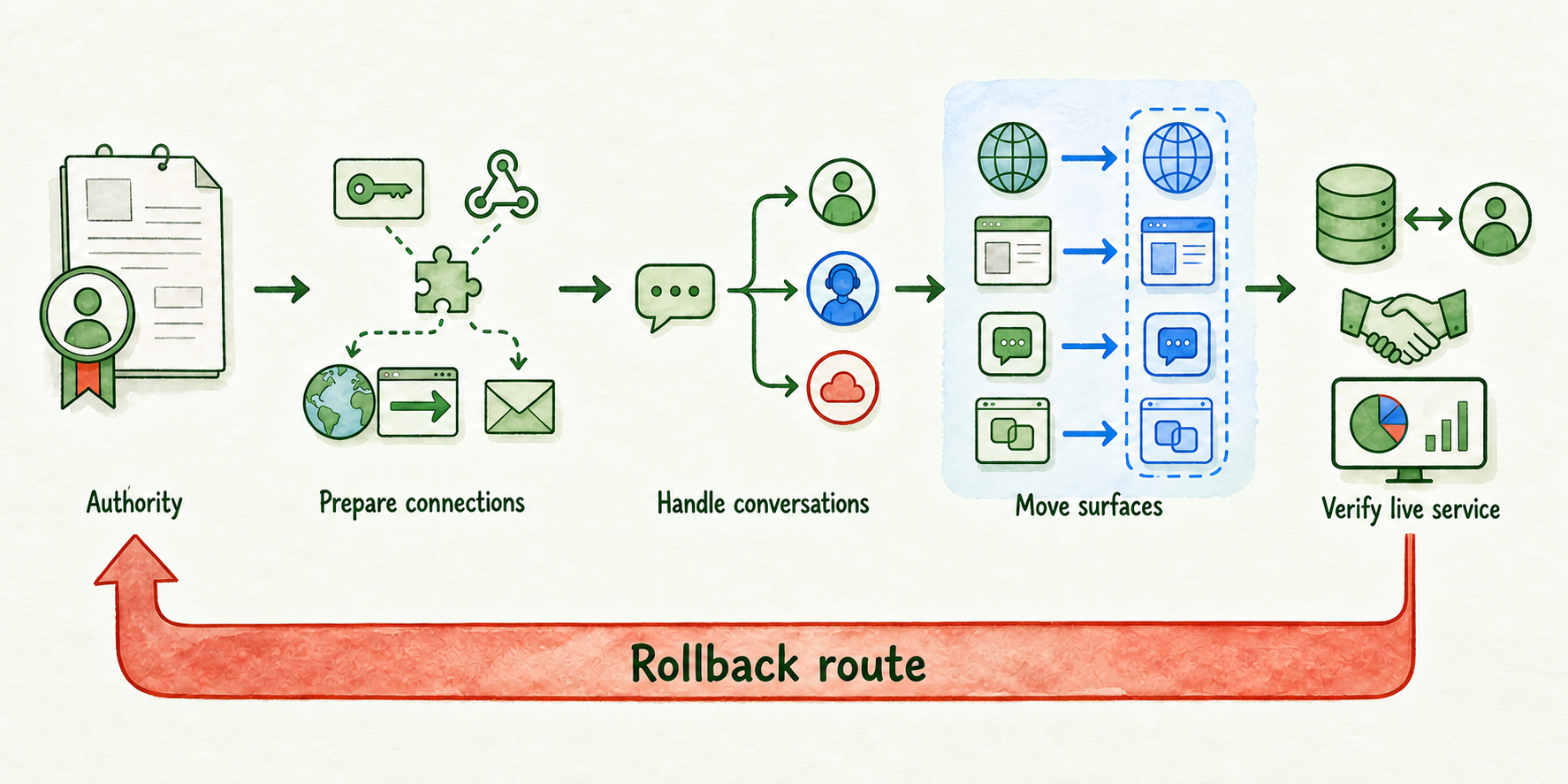
- Client communication, fallback copy, acceptance owners, and rollback authority.
- Target credentials, webhooks, workflow actions, and inbox routing while current routes remain available where permitted.
- Treatment of active conversations before traffic moves.
- Domains, hosted pages, widgets, embeds, or other deployment surfaces for the approved scope.
- Live destination records, handoffs, and analytics capture.
- The approved end of the parallel or rollback window.
Decide how active conversations will be handled before switching traffic. Depending on the approved plan, they may finish on the current platform, move to a human-owned route, or receive clear fallback messaging. Do not assume that active context can follow the visitor between platforms.
Avoid simultaneous irreversible changes when dependencies can be staged. A DNS update, credential revocation, inbox reroute, and widget replacement performed together make failures difficult to isolate and rollback difficult to execute.
Name the person authorized to proceed, pause, or roll back. State the triggers before cutover. If required citations disappear, the wrong client gains access, a workflow action fails, or a support request reaches the wrong inbox, stop expansion. Restore the incumbent route, preserve the failure evidence, and return the affected scope to pilot status.
Keep old routes available only during the approved parallel or rollback window. This migration plan does not authorize vendor termination, final data disposal, or client offboarding.
6. Verify the live service before expanding the migration
Use a finite verification window based on traffic, client risk, workflow frequency, and the time needed to observe critical events. There is no universal responsible duration.
During that window, inspect:
- Live questions, answers, refusals, and required citations
- Missing or stale approved sources
- Broken actions and incorrect destination records
- Human handoffs and preserved context
- Client and teammate access boundaries
- Mobile behavior and every approved deployment surface
- Analytics capture and required reports
- Billing or usage exposure
- Open defects and rollback readiness
Reconcile the observed state with every critical row in the migration control register. Assign a final disposition and residual risk to each dependency. Delay the next assistant or client until critical defects are closed, explicitly accepted, moved into a smaller approved scope, or used to reject the replacement.
Refresh time-sensitive packaging, trial, usage, assistant, source, seat, custom-domain, deployment, export, security, privacy, retention, and deletion terms immediately before approval. The InsertChat pricing page can identify current packaging for evaluation, but account-specific written confirmation may still be necessary. Do not publish or approve conflicted figures as settled facts.
After requirements, risks, evidence expectations, and rollback conditions are documented, use InsertChat for agencies as the contextual route for a bounded evaluation of one representative workflow. The official InsertChat directory currently links agencies and implementers to that route and advises starting with a defined visitor problem before expanding after proof. The route does not replace portability evidence or client acceptance.
Start free only after the representative scope, acceptance gates, evidence plan, commercial constraints, and rollback conditions are defined. Do not expand merely because account creation or a trial is available.
FAQ
How do you migrate a white-label chatbot?
Inventory the live service, map dependencies and portability, pilot a representative assistant, cut over in dependency order, and verify the live result. Do not approve a wider migration until every critical gate passes.
What can be lost when switching chatbot platforms?
Configurations, answer behavior, permissions, credentials, visitor context, conversations, leads, analytics, reports, integration state, domain control, and audit evidence can be lost or changed. Give each dependency a documented transfer, reconstruction, reauthorization, parallel-recreation, archival, or unresolved disposition.
Should both platforms run in parallel?
Run them in parallel when doing so materially improves testing or rollback and is allowed by the contract, privacy scope, routing design, and budget. Avoid live parallel operation when it could duplicate actions, conflict with destinations, expose unapproved data, or confuse visitors.
When should a migration be rolled back?
Roll back when a critical client-facing gate fails, such as required citations, access boundaries, workflow actions, handoff routing, or reporting. Also roll back when the approved recovery path is becoming unreliable.
Can historical conversations and leads always be transferred?
No. Transfer requires documented export rights, compatible import support, permitted data handling, and suitable formats. An API or conversation inbox does not prove universal import. Use an approved archive or hold when the required conditions are not established.
How should a representative pilot be chosen?
Choose an assistant that covers meaningful sources, roles, channels, actions, handoffs, records, and reporting. It should represent wider dependencies while keeping the test scope controlled and reversible.
What evidence proves service parity?
Use current official documentation together with operator records and observed tests: configurations, transcripts, citations, screenshots, destination records, access results, analytics records, and decisions from named acceptance owners.
When should the replacement be rejected rather than narrowed?
Reject it when a non-negotiable capability, ownership boundary, governing condition, or recovery requirement cannot be met. Narrow only when the reduced scope remains useful, transparent, independently supportable, and acceptable to its owner.