
TL;DR
- A product recommendation chatbot is a conversational product finder that uses shopper inputs and approved catalog guidance to narrow eligible options, explain suggestions, and escalate unsupported requests.
- Apply hard constraints before soft preferences: required size, compatibility, verified availability, or delivery conditions can remove a product before color or style affects ranking.
- Support every explanation with approved evidence. When information is absent, stale, or contradictory, clarify, return no match, or hand off instead of guessing.
- Test one bounded product family before expansion, using ordinary, incomplete, conflicting, unavailable, exceptional, and sensitive cases.
A shopper asks for a jacket in a required size that can arrive before a trip. The catalog describes its style, but variant records are incomplete, availability changes frequently, and the shipping policy does not promise arrival by a particular date. A fluent response could still produce a poor recommendation. Before automating this decision, the store needs explicit eligibility rules, dependable catalog and policy sources, and a clear point at which a person takes over.
Key Takeaways
- Constraints remove; preferences rank. A required size or compatibility condition determines eligibility. A preferred color orders products that already qualify.
- Freshness and ownership are part of answer quality. Each decision-critical product field, rule, and policy needs an accountable owner and review date.
- Changing availability, variants, shipping conditions, and policies must be verified when they affect a recommendation—or excluded from the answer.
- Human judgment remains necessary for sensitive requests, unresolved contradictions, policy exceptions, and questions without an approved answer.
- Expansion should follow repeated evidence of stable behavior in the bounded workflow, not an assumed benchmark.
If product discovery is not yet the selected workflow, first map the ecommerce chatbot customer journey by need, then return to this framework once the team has chosen a bounded recommendation use case.
What Is a Product Recommendation Chatbot?
A product recommendation chatbot is a conversational product finder that uses shopper inputs and approved catalog guidance to narrow eligible options, explain its suggestions, and escalate requests its evidence or rules cannot support.
That definition makes recommendation a controlled decision rather than an open-ended writing task. The operating model includes:
- the product catalog, including names and approved descriptions;
- product attributes and variants used to determine eligibility;
- availability, treated according to how current and verifiable it is;
- size, fit, or compatibility guides;
- shipping and returns policies;
- shopper constraints and declared recommendation rules;
- citations that identify the approved evidence behind explanations;
- handoff paths for unsupported or judgment-heavy requests;
- conversation review for failures and corrections; and
- content-gap analysis for questions the current sources cannot answer.
Ownership should also be explicit:
- Merchandising owns product information, exclusions, and ranking guidance.
- Ecommerce or operations owns availability and other changing commerce data.
- Product, fit, or technical specialists own size and compatibility guidance.
- Support or operations owns shipping and returns policies, exceptions, and handoff routes.
- A recommendation owner approves eligibility rules, uncertainty wording, and permitted next actions.
- Content or quality owners review citations, conversations, corrections, and unanswered questions.
A catalog field and a business decision are not interchangeable. A product page may provide a material or dimension, but it cannot authorize an undocumented policy exception.
What Information Does the Chatbot Need?
A product recommendation chatbot needs current product identities, meaningful attributes, complete-enough variant records, eligibility rules, and the guides or policies required to explain a suggestion. Before configuration, check:
- product names and descriptions;
- attributes used for filtering or ranking;
- variant combinations and identifiers;
- size, fit, or compatibility guidance;
- availability and any known update delay;
- shipping rules relevant to the decision;
- returns guidance and documented exceptions;
- products, situations, or claims that must be excluded;
- contradictions across pages, files, feeds, and policies; and
- a named owner and freshness date for every decision-critical source.
Organize the information into four layers:
- Source-backed facts: approved descriptions, materials, dimensions, care instructions, guides, and policies.
- Changing commerce data: availability, active variants, and shipping conditions that may require current verification.
- Connected actions: opening an approved product page, passing a selected option to another system, or routing a request.
- Human-owned judgment: sensitive suitability questions, undocumented exceptions, unresolved conflicts, and decisions requiring specialist review.
InsertChat’s knowledge-base documentation describes approved product data, website pages, documents, FAQs, guides, and policies as possible source inputs. It also describes refreshing sources and showing citations. Its integration documentation names Shopify and WooCommerce as ecommerce contexts, but a store must verify the actual data, permissions, update timing, and actions available in its own setup before relying on them.
Coverage creates tradeoffs. A broad catalog offers more apparent choice but introduces more variants, exceptions, and ownership paths. A narrow product family with cleaner information is easier to govern. Faster answers are useful only when the underlying data is sufficiently current. Personalization should be limited to information needed for the present decision; collecting unrelated personal details does not repair weak recommendation rules.
Absent or conflicting approved guidance cannot be fixed with confident wording. Correct the source, narrow the eligible set, qualify the answer, or move the decision to a person.
Write the Recommendation Contract Before the Prompt
A recommendation contract records how one bounded product-discovery workflow is allowed to behave. Complete this editable structure with the store’s actual rules:
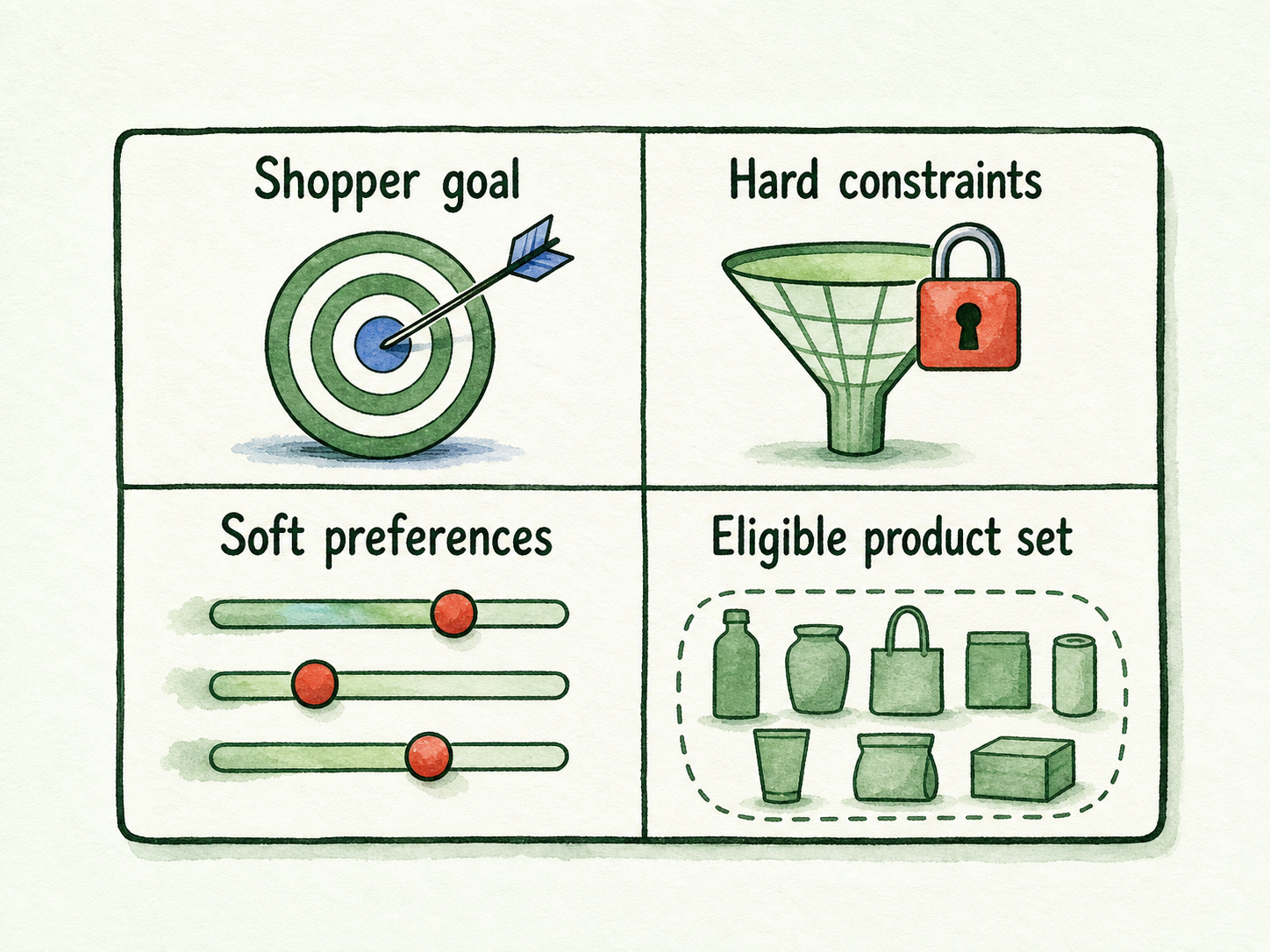
| Field | What to record |
|---|---|
| Shopper goal | The job, occasion, or outcome the shopper describes |
| Hard constraints | Conditions that determine eligibility |
| Soft preferences | Factors used only to rank eligible products |
| Eligible product set | The product family or collection in scope |
| Exclusion rules | Products, variants, claims, or situations that must be removed |
| Ranking factors | Ordered reasons one eligible option appears before another |
| Supporting source | Approved catalog page, guide, policy, or verified data source |
| Uncertainty wording | What to say when evidence is incomplete or conditional |
| CTA or next action | A permitted step, such as viewing an option or requesting help |
| Handoff trigger | Conditions that require a person |
| Owner | The person accountable for the rule and its correction |
| Freshness date | When the source or rule was approved and when review is due |
This contract is editorial methodology for making a recommendation boundary inspectable. It is not evidence that any particular store deployment has passed testing.
Use a Constraint-First Decision Flow
The runtime sequence should be visible and repeatable:
- Capture the shopper’s intended use or goal.
- Ask a follow-up only when a missing hard constraint could change eligibility or make the answer unsafe or unsupported.
- Exclude products and variants that violate a hard constraint.
- Rank the remaining options with the declared soft preferences.
- Explain each suggestion using approved evidence.
- Use explicit uncertainty language when evidence is incomplete or conditional.
- Offer only a permitted next action.
- Preserve the shopper’s wording, constraints, prior answers, products considered, and supporting sources if a person takes over.
A human handoff is appropriate when there is no supported answer, an unresolved source conflict, a sensitive request, a policy exception, or a judgment-heavy decision. Assistant rules can define source use, fallbacks, refusals, escalation guidance, and controlled next-step paths, but those controls should implement the recommendation contract rather than substitute for it.
Hypothetical apparel application: A shopper wants a casual jacket, prefers blue, requires a particular size, and needs delivery to a destination before a trip. Size, an eligible variant, and any verified delivery condition are hard constraints. Color and style are soft preferences. The chatbot removes variants that fail the hard constraints, ranks what remains, cites approved product and size guidance, and offers the qualifying product pages.
If the catalog omits the required size from its variant data while another approved page suggests that size exists, the chatbot should not infer eligibility or availability. It can clarify whether another size is acceptable, provide carefully qualified information without claiming a match, or send the conflict to a person.
Hypothetical skincare application: A shopper describes a texture preference and asks for products whose approved descriptions match it. The chatbot may narrow and explain options from approved non-medical product guidance. If the shopper asks about an allergy, diagnosis, treatment, reaction, or unsupported suitability claim, the chatbot should avoid making that judgment and route the request to a qualified person.
These examples demonstrate the decision method; they do not represent observed catalog performance or customer outcomes.
Test the Recommendation Before Shoppers See It
Test the chatbot against the recommendation contract on a controlled surface. For each case, record the shopper input, expected behavior, observed response, source used, failure found, correction owner, and retest result.
The pre-launch set should include:
- a straightforward eligible match;
- a missing hard constraint requiring a focused question;
- no eligible product;
- conflicting approved sources;
- an unavailable product or variant;
- a policy exception;
- a sensitive request; and
- an explicit human-handoff case.
Review recommendation completion, clarification frequency, no-match outcomes, source use, unanswered questions, corrections, handoffs, and permitted downstream actions. No universal acceptance threshold is established here. Use the store’s observed cases and qualitative blocking conditions instead of inventing a benchmark.
InsertChat’s conversation inbox can retain transcripts, page context, source usage, metadata, feedback, and handoff status. Its analytics documentation describes reviewing questions, answer outcomes, source use, handoffs, no-answer moments, and content gaps. These records can reveal a missing or weak answer, but the responsible owner must still correct or approve the underlying content or rule.
Use five decision gates:
- Pilot when the bounded flow, sources, rules, owners, and handoff route are ready.
- Revise when a fixable source, wording, ranking, or routing problem appears.
- Narrow when catalog breadth creates unstable rules or unreliable data.
- Pause when source conflicts, sensitive claims, missing owners, or unverified changing data remain.
- Expand only after repeated review shows stable behavior in the bounded workflow.
No controlled real-store catalog, correction log, or retest record is available to establish an observed result here. Before treating the framework as validated for a store, run it against that store’s actual or properly anonymized product fields, variants, policies, recommendation rules, failures, corrections, and retest outcomes.
Apply the Framework to One Bounded Pilot
A practical first pilot uses one assistant, one product family, and one controlled surface. Connect only approved catalog content and product guidance. Configure source rules, fallbacks, uncertainty wording, handoff triggers, and controlled next-step paths from the recommendation contract.
Use commerce integration details only where the relevant product or availability information has been verified for the intended store. Review conversations with the shopper’s wording, cited sources, recommendation state, and handoff reason intact. Track unanswered questions, source use, and content gaps, then correct the responsible source or rule before retesting.
For a Shopify implementation, use the on-page Shopify integration readiness checklist before enabling changing catalog claims or connected actions.
Shopify Integration Readiness Checklist
Before relying on Shopify context in a recommendation:
- identify the exact product and variant data the bounded workflow needs;
- verify that each required value is available to the intended implementation;
- confirm who owns product, variant, availability, shipping, and returns information;
- document how current each changing value must be for the recommendation;
- test missing, conflicting, and unavailable-item cases;
- verify the permitted next action and the context passed with it;
- define a fallback when required commerce data cannot be verified; and
- repeat the eight-case test after any source, rule, or integration change.
This checklist does not assume particular fields, permissions, synchronization behavior, or actions. Those details must be confirmed for the intended store.
When the bounded sources, rules, owners, tests, and handoff path are ready, review the current pricing and trial terms before choosing Start for Free or committing to a wider rollout. Do not base the pilot decision on unverified plan details.
FAQ
What should happen when no product qualifies?
Return a transparent no-match result. As described in the constraint-first flow, explain which supported hard constraint removed the options and offer an approved alternative or human handoff without silently relaxing the requirement.
Can a chatbot recommend from incomplete catalog data?
Only within the facts and rules that remain supported. If a missing field could change eligibility, follow the information-readiness rules: clarify, narrow the answer, return no match, or hand off.
How often should sources and rules be reviewed?
Set review timing according to how often each source changes, with a named owner and freshness date. Review sooner when products, variants, policies, or recommendation rules change or conversation review reveals a conflict.
Should availability be treated as a product fact or live data?
Treat availability as changing commerce data unless the implementation verifies that it is current enough for the promised next action. A static description cannot support a current-availability claim.
Can skincare recommendations be automated?
Bounded, non-medical discovery based on approved product descriptions can be automated. Allergy, diagnosis, treatment, reaction, and unsupported suitability questions should be handed to a qualified person, as shown in the hypothetical skincare application.
How do teams preserve context during handoff?
Pass the shopper’s original wording, stated constraints, prior answers, products considered, supporting sources, uncertainty, and reason for escalation. The person taking over should not have to restart the discovery process.