TL;DR
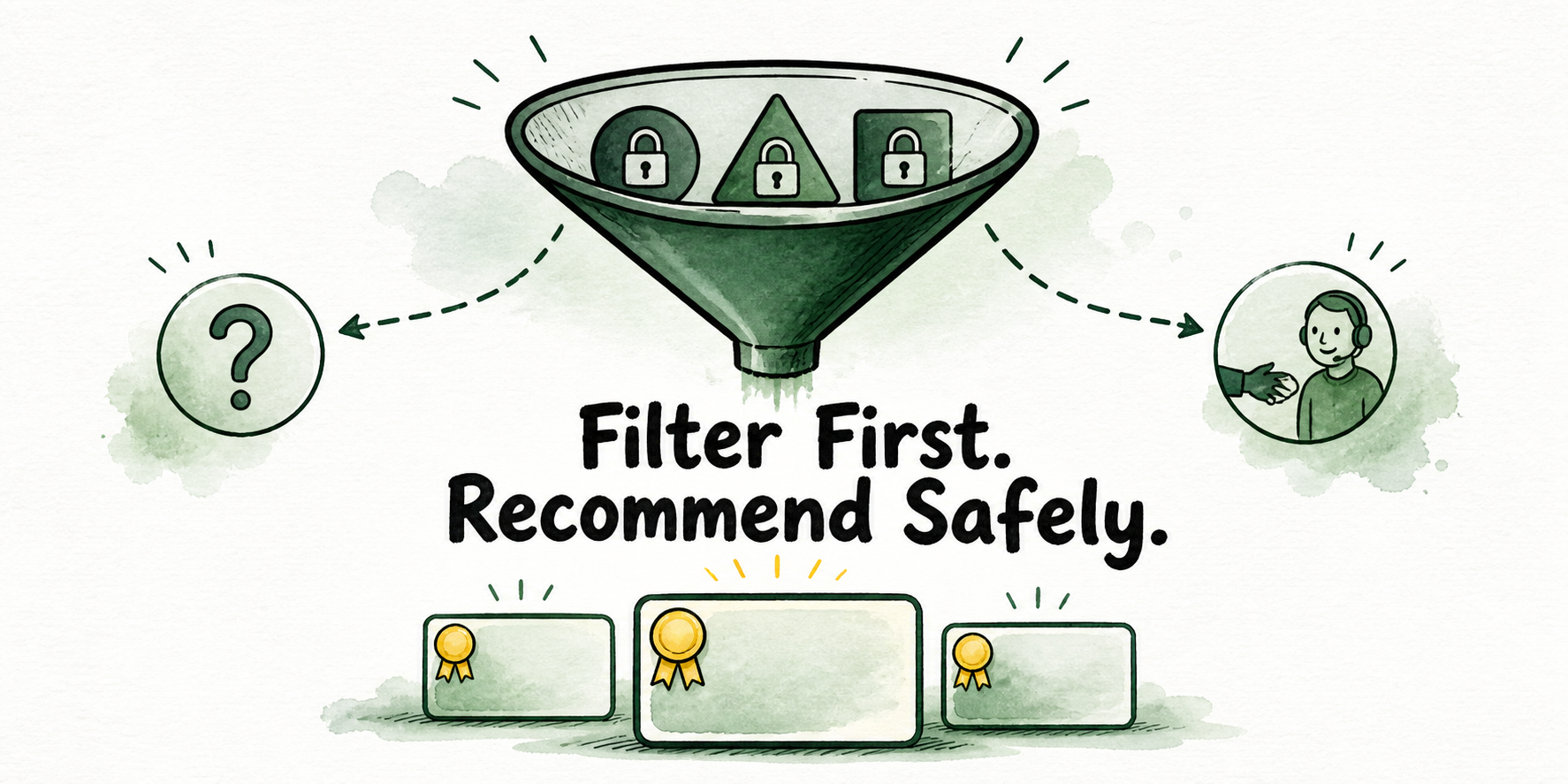
- A cart abandonment chatbot helps around a stalled cart or checkout by identifying the blocker, answering from approved store information, suggesting a permitted next step, or handing the conversation to a person.
- Ask what stopped the shopper before offering an incentive. Abandonment alone does not reveal whether the issue is product fit, shipping, price, payment, technology, or simple distraction.
- Offer an incentive only when a current, approved promotion applies to the known context and store rules permit the offer.
- Escalate payment failures, repeated technical problems, disputed policies, and exception requests. Do not collect sensitive payment details in free-form chat.
- Stop when assistance is not permitted, permission is withdrawn, the shopper declines help, the request is out of scope, or safe handling is not possible.
- Measure diagnosed blockers, resolved questions, handoffs, checkout actions, opt-outs, complaints, and corrections without inventing benchmarks or assuming chat caused every later purchase.
A shopper who leaves two items in a cart has signaled a stalled journey, not a proven reason for stopping or an automatic invitation for more outreach. A blanket discount prompt may misread a delivery question, payment error, technical problem, or decision to buy later. Effective recovery begins only when assistance is permitted and starts by identifying the obstacle; the resulting evidence determines whether the chatbot should answer, clarify, act, hand off, or stop.
Key Takeaways
- Ask first: Use a brief, neutral invitation such as “What stopped you from completing checkout?” or “What can I help with?”
- Offer incentives conditionally: Present only store-approved promotions confirmed as applicable to the known cart context.
- Stop cleanly: End the attempt after a refusal, opt-out, withdrawal of permission, completed action, request for a person, or unsupported path.
- Measure the whole workflow: Review diagnostic coverage, answer quality, safe routing, downstream actions, opt-outs, complaints, and corrections by blocker category.
- Keep people accountable: Policy, commerce, support, payments, analytics, and technical owners remain responsible for exceptions and higher-risk cases.
What a cart abandonment chatbot is—and what it should own
A cart abandonment chatbot is a conversational assistant used around a stalled cart or checkout to identify a blocker, provide approved help, route a permitted next action, or hand the conversation to a person.
The chatbot coordinates the conversation, but it should not become the authority for every fact or decision involved. Ownership should remain with the system or team that can maintain and verify each area:
- Cart and checkout state: The commerce system owns item, quantity, availability, subtotal, and checkout-state data.
- Shopper permission: Store-approved consent and outreach rules determine whether a conversation may begin or continue. Applicable states and channels require qualified review.
- Shipping policy: The operations or fulfillment owner maintains destinations, methods, costs, restrictions, and delivery guidance.
- Returns policy: The policy owner maintains return windows, conditions, exclusions, and published remedies.
- Promotions: Marketing or commerce operations controls eligibility, codes, combinations, dates, and permission to present an offer.
- Payment failures: The payment provider and payments team own verified failure states and approved retry paths.
- Technical errors: Ecommerce engineering owns checkout faults, incident status, workarounds, and fixes.
- Human handoffs: Support or sales operations owns routing, availability, response expectations, and exception handling.
- Recovery measurement: Analytics or ecommerce operations owns event definitions, reporting, attribution limits, and corrective action.
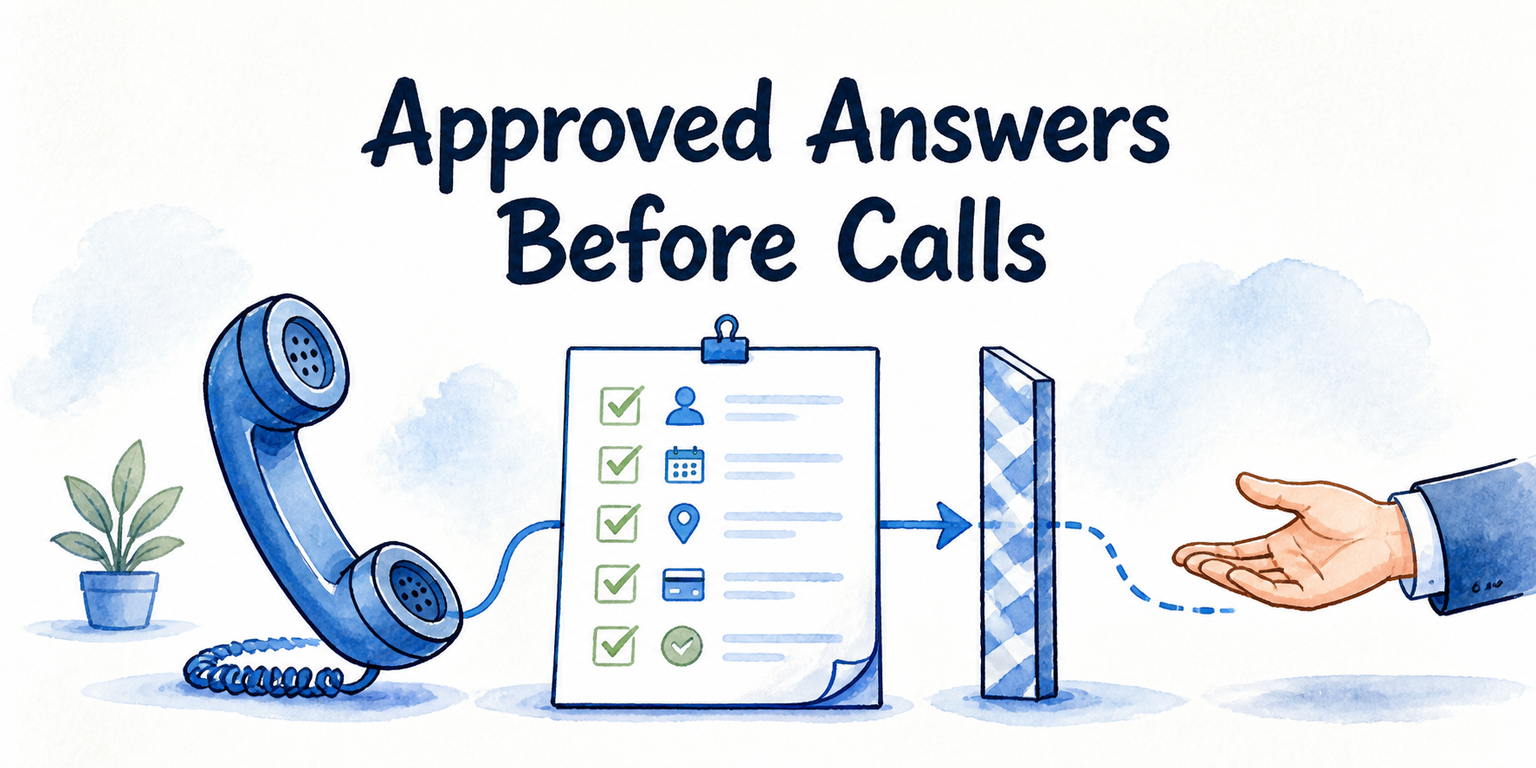
The chatbot may repeat static approved information, use live context exposed through an authorized connection, or initiate a specifically permitted action. A human should decide ambiguous eligibility, policy exceptions, complaints, and cases in which the available evidence cannot support a safe answer.
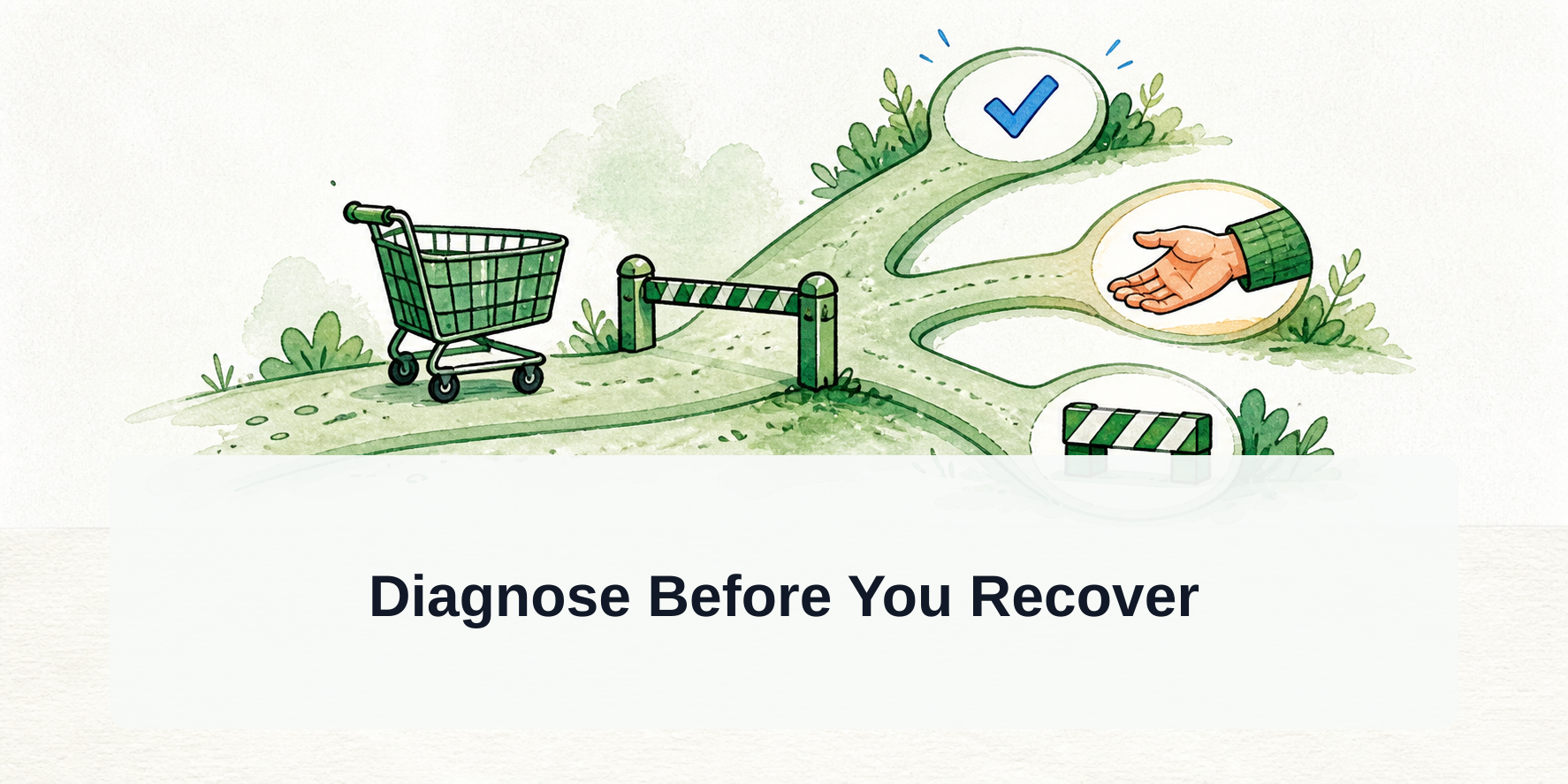
Diagnose the blocker before choosing a recovery action
Start with a neutral question: “What stopped you from checking out?” If the shopper has already stated the issue, do not make them repeat it. Ask only for the missing detail needed to choose a supported path.
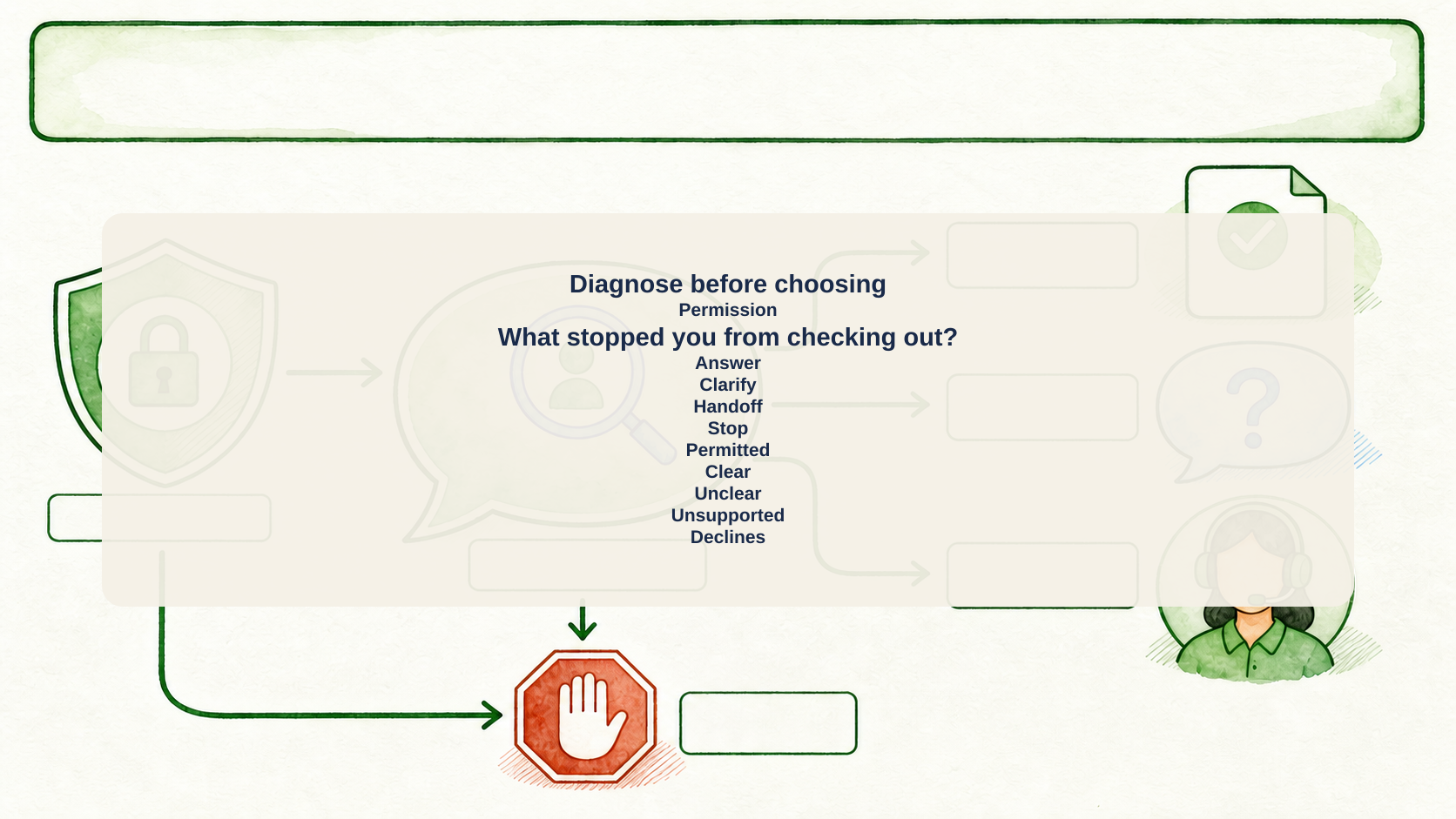
Classify the response into one of these operational categories:
- Product uncertainty: Answer a specific question about fit, compatibility, size, ingredients, availability, or options from approved product information. Route broader product-selection needs to the store’s dedicated recommendation process rather than improvising a ranking.
- Shipping or returns question: Clarify location or item context only when necessary, then answer from the current policy. Do not promise an exception.
- Price or promotion question: Verify the displayed cart context and applicable promotion rules. Do not treat abandonment as proof of price resistance or promotion eligibility.
- Payment failure: Provide only an approved retry or alternative-payment path. Avoid sensitive payment details and hand off when the approved path fails.
- Technical failure: Capture non-sensitive context, offer an approved workaround when available, and route repeated or incident-like failures to the technical owner.
- Simple distraction or no requested help: Respect the shopper’s decision and stop instead of manufacturing urgency.
- Unknown or mixed blocker: Ask one focused clarification question. If the category remains unclear, offer a person or end the interaction.
Abandonment behavior alone does not prove any category. The shopper’s answer and reliable, authorized context determine whether the chatbot should answer, clarify, hand off, or stop.
Build the recovery decision table
Turn the taxonomy into a shared operating table before writing conversation copy. Record a source owner and freshness check for every changing source; an expired promotion or outdated returns policy cannot support a reliable answer.
| Trigger | Permission state | Known context | Clarification question | Approved source | Permitted action | Stop condition | Owner | Measurement |
|---|---|---|---|---|---|---|---|---|
| Product uncertainty | Help is permitted | Relevant cart item | “Which detail are you unsure about?” | Current product information | Answer a factual question or route selection help | No supported answer or shopper declines | Merchandising | Category, resolution, handoff |
| Shipping or returns question | Help is permitted | Item and approved location context | “Where would this need to ship?” | Current shipping or returns policy | Explain the published rule | Source missing or exception requested | Operations or policy owner | Resolution, handoff, correction |
| Price or promotion question | Offer presentation is permitted | Cart total and verified eligibility context | “Are you asking about the price or a code?” | Current pricing and promotion rules | Explain the total or present an applicable approved offer | Eligibility is ambiguous | Commerce operations | Answer, offer shown, checkout action |
| Payment failure | Support is permitted | Non-sensitive failure state | “Would you like the approved retry steps or a person?” | Approved payment-provider guidance | Give a safe retry path or hand off | Sensitive details appear or retry fails | Payments or support | Handoff, downstream action, complaint |
| Technical failure | Support is permitted | Page, step, and safe error context | “Which checkout step failed?” | Current troubleshooting guidance | Suggest an approved workaround or escalate | Repeated failure or suspected incident | Ecommerce engineering | Error category, handoff, correction |
| Simple distraction | Contact remains permitted | No blocker established | “Would you like help with anything before you go?” | Not required | Respect the answer or use an approved cart-preservation feature | Shopper declines or does not engage | Commerce operations | Opt-out or no-action outcome |
| Unknown or mixed | Help is permitted | Limited or conflicting context | One question separating the likely categories | Relevant approved sources | Clarify once, then answer or route | Still unknown after clarification | Support operations | Unclassified outcome, handoff |
No row should run when its required permission state, context, current source, source owner, or exception owner is missing. Offer an incentive only when an approved promotion applies to the known context and store rules permit its presentation; never invent or improvise a discount.
Worked flow: clarify, answer, act, or hand off
The following scenario is illustrative. Its trigger, permission state, policy answers, payment path, and escalation rules must be replaced with verified store-specific inputs.
A shopper is offered assistance on the checkout page under the store’s approved permission rules. The chatbot asks, “What can I help with before you check out?” The shopper replies, “I’m not sure this will arrive in time.”
The flow classifies the blocker as shipping uncertainty, not price resistance. Because the destination is unknown, the chatbot asks for the minimum approved location detail needed to consult the current shipping policy. If that policy supports a clear answer, the chatbot provides it and offers the permitted next step back to checkout. It does not add a discount because no applicable approved promotion has been established.
The shopper returns to checkout but then reports a payment error. The flow changes categories. The chatbot does not request a card number, security code, bank balance, or other sensitive payment information. It provides the approved retry guidance or offers a human handoff.
The handoff packet contains the shopper’s question, the known approved context, the answer already given, the attempted checkout step, and the help requested. The conversation stops if the shopper declines further help, withdraws permission, requests a person, completes the permitted action, or reaches a path the store has not approved.
Set hard rules for incentives, policy exceptions, payment, and pressure
Set these controls before activating a recovery path:
- Never invent a discount, code, eligibility rule, expiry date, or ability to combine offers.
- Never create an unsupported shipping or returns exception. Explain the published policy or route the request to its owner.
- Never continue applying pressure after a refusal, opt-out, or withdrawal of permission.
- Never request or process sensitive payment details in a free-form conversation.
- Never diagnose why a card was declined or promise a payment outcome without verified evidence.
- Escalate disputed policies, ambiguous eligibility, repeated technical failures, complaints, and other high-stakes requests.
- Stop when the shopper declines, opts out, withdraws permission, completes the permitted action, requests a person, or reaches an unsupported path.
Use store-approved consent, privacy, outreach, and payment rules for each market and channel. Those requirements need qualified review; a chatbot configuration does not establish a universal legal basis for contacting a shopper.
Measure recovery as a quality-and-outcome funnel
Start with conversations initiated and started, separated by trigger and approved permission state. Then track blocker categories, including unknown and unclassified cases, to see whether the opening question produces usable routing information.
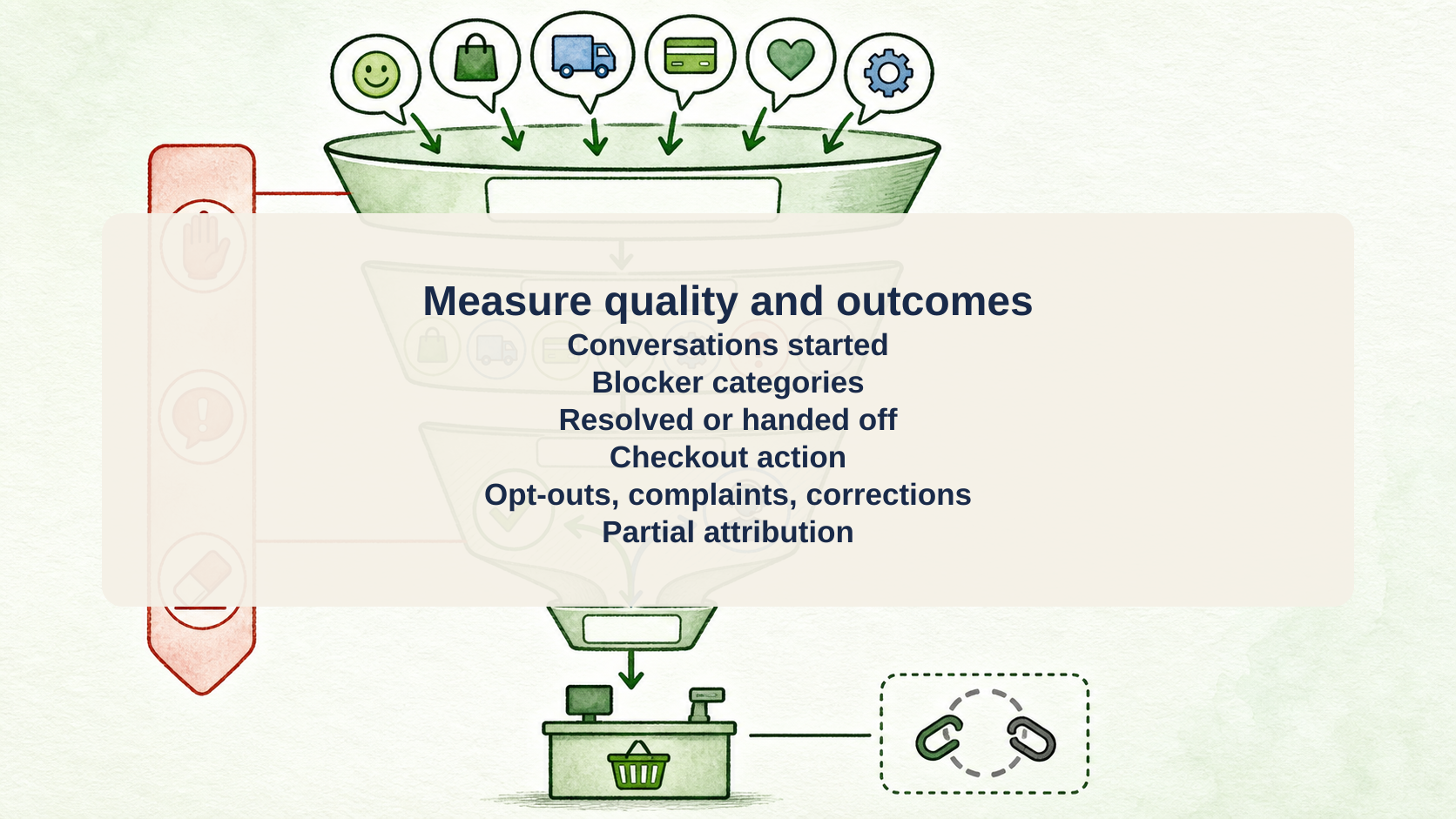
Record resolved questions, human handoffs, and observed downstream checkout actions such as returning to checkout or taking another permitted step. Track opt-outs, complaints, and corrections alongside those events. Also record source gaps and stale-source findings so each problem can reach the owner able to correct it.
Do not report a downstream checkout action or later purchase as chatbot-caused revenue unless the attribution method supports that conclusion. Label incomplete attribution as partial. Use no borrowed benchmark or guaranteed uplift: establish a store-specific baseline, review results by blocker category, and select one corrective action per review cycle, such as updating a source, rewriting a clarification question, tightening a stop rule, or improving a handoff route.
Launch the smallest recovery path you can govern
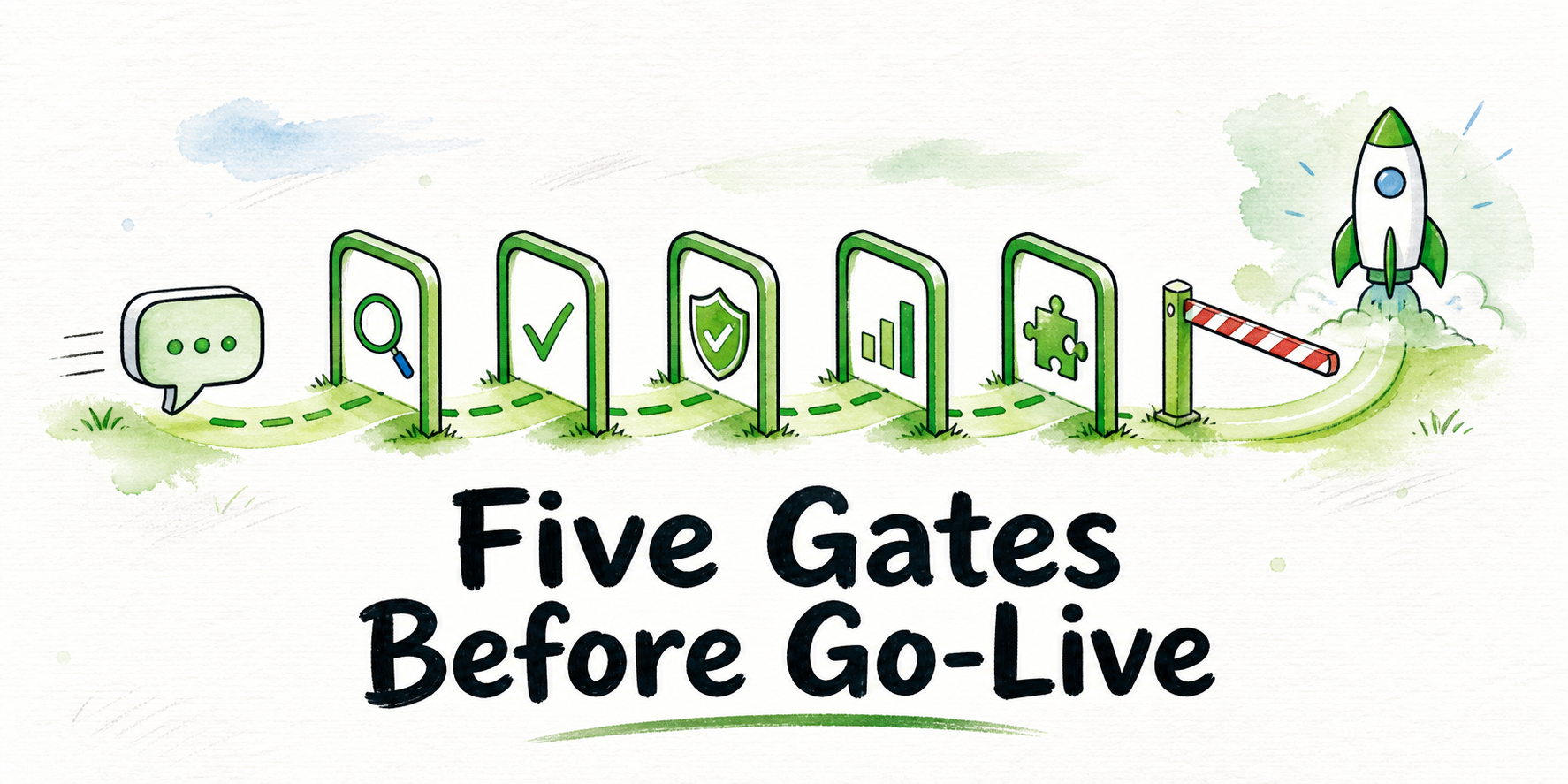
Start with one controlled, non-sensitive cart-recovery path. Confirm its trigger, approved permission states, current policies, promotion rules, source owners, exception owners, handoff route, stop conditions, and observable events before activation. Test representative blocker, refusal, opt-out, unsupported-answer, payment, and technical-escalation cases, then review real conversations before expanding.
InsertChat can be evaluated for a bounded workflow using approved business content, configurable operating rules, human escalation, conversation review, and outcome reporting. Capabilities such as source citations, preserved-context handoffs, analytics, and administrative review should be confirmed against the selected implementation before they become workflow dependencies. If the store has a suitable bounded test path with no sensitive free-form data collection, Start for Free and evaluate it under controlled conditions.