TL;DR
- Treat an AI chatbot for agencies as a service-line decision before it becomes a build.
- Choose among five paths: one-off implementation, managed retainer, client starter use case, internal workflow asset, or white-label and SaaS resale consideration.
- Start client work where there is approved source content, a clear visitor or user need, and a defined next step.
- Use discovery to decide whether to proceed, narrow the idea, delay the work, or decline the opportunity.
- Reporting supports retention only when it points to useful client action, not when it adds dashboard volume.
Your agency may already have clients asking for AI chat, support automation, website answers, or lead capture. The harder decision is not whether a chatbot can be built. It is which offer fits the account, who owns the work, what risk must be screened before scope, and when the project should become an ongoing service instead of a one-time implementation.
Key Takeaways
An agency AI chatbot offer should start with path selection. A one-off build, managed retainer, starter use case, internal workflow asset, and resale path each create different sales promises and delivery risks.
Client use cases need a business next step. A chatbot that only answers broad questions is harder to position than one tied to lead qualification, support routing, ecommerce assistance, content guidance, or website visitor answers.
Discovery comes before scope. If the client has no approved source content, no handoff owner, or no idea how success will be judged, the responsible next step is to narrow the opportunity before promising implementation.
Scope should protect the first build. The cleanest starting point is one workflow, one source set, one entry point, one follow-up path, and one launch standard.
Reporting supports retention when it shows what should change next. Usage, handoffs, leads, unanswered questions, and content gaps can guide monthly work, but they should not be used to imply results the agency cannot prove.
Choose The Chatbot Service Path Before You Pitch The Work
The same client request can become several different agency offers. A website redesign client may need a chatbot to answer visitor questions from approved content. A support-heavy client may need handoff logic. A content client may need an internal assistant for research or content operations. An agency with repeated demand may eventually consider resale or white-label options.
Choose the path before writing the proposal. That choice affects ownership, risk, delivery time, reporting, and whether the client should expect ongoing work.
| Service path | Best fit | Main owner | Main risk | Next action |
|---|---|---|---|---|
| One-off implementation | A client has one clear workflow and wants a defined launch | Delivery lead or technical producer | The project ends before the assistant improves from real conversations | Scope the workflow tightly before build |
| Managed retainer | The client expects ongoing updates, content changes, monitoring, and reporting | Account lead plus delivery owner | Monthly work becomes vague if reporting does not drive action | Study retainer packaging only after the path is justified |
| Client starter use case | The agency needs a low-risk first project for an account | Strategist or account lead | The first pitch is too broad or lacks a next step | Match the use case to a real client pain |
| Internal workflow asset | The agency wants to learn delivery constraints before selling externally | Operations or delivery lead | Internal value is assumed but not measured | Pick one internal workflow and define the user |
| White-label or SaaS resale consideration | The agency sees repeatable demand across accounts | Agency owner or partnerships lead | Support, ownership, and account management burden arrive before delivery is proven | Delay until delivery patterns are clear |
This table is not a pricing model or package list. It is a decision filter. If your agency cannot name the path, it is too early to promise the client a finished offer.
Match Client Use Cases To A Real Next Step
Client use cases are strongest when the chatbot helps a visitor or user move from a question to a defined action. For agency work, credible categories often include lead capture, support handoff, ecommerce assistance, content workflow, and website visitor answers.
The common thread is the next step. A lead capture assistant should know when to collect details and route the conversation. A support handoff assistant should know when the answer is not enough and who should receive the issue. An ecommerce assistant should help a shopper compare options or find policy information from approved content. A content workflow assistant should help a team find, reuse, or structure information without pretending to replace editorial judgment.
Start with the use case closest to the first real question the user asks. If the client has repeated service questions, support handoff may be more credible than a sales assistant. If the site has product pages, policies, and buying guides, ecommerce assistance may be more useful than a generic FAQ bot. If the client has a large content library but weak navigation, website visitor answers may create a clearer first project.
Use caution when the client wants a broad assistant with no source content, owner, or follow-up path. That request may sound bigger, but it is often harder to sell responsibly. For client-type and business-pain pitch depth, use the cluster support page on first client use cases rather than turning this pillar into a pitch menu.
Use Discovery As The Gate Between Interest And Scope
Discovery is the gate between a promising idea and a project your agency can scope. It should answer a small set of strategic questions before anyone writes implementation details.
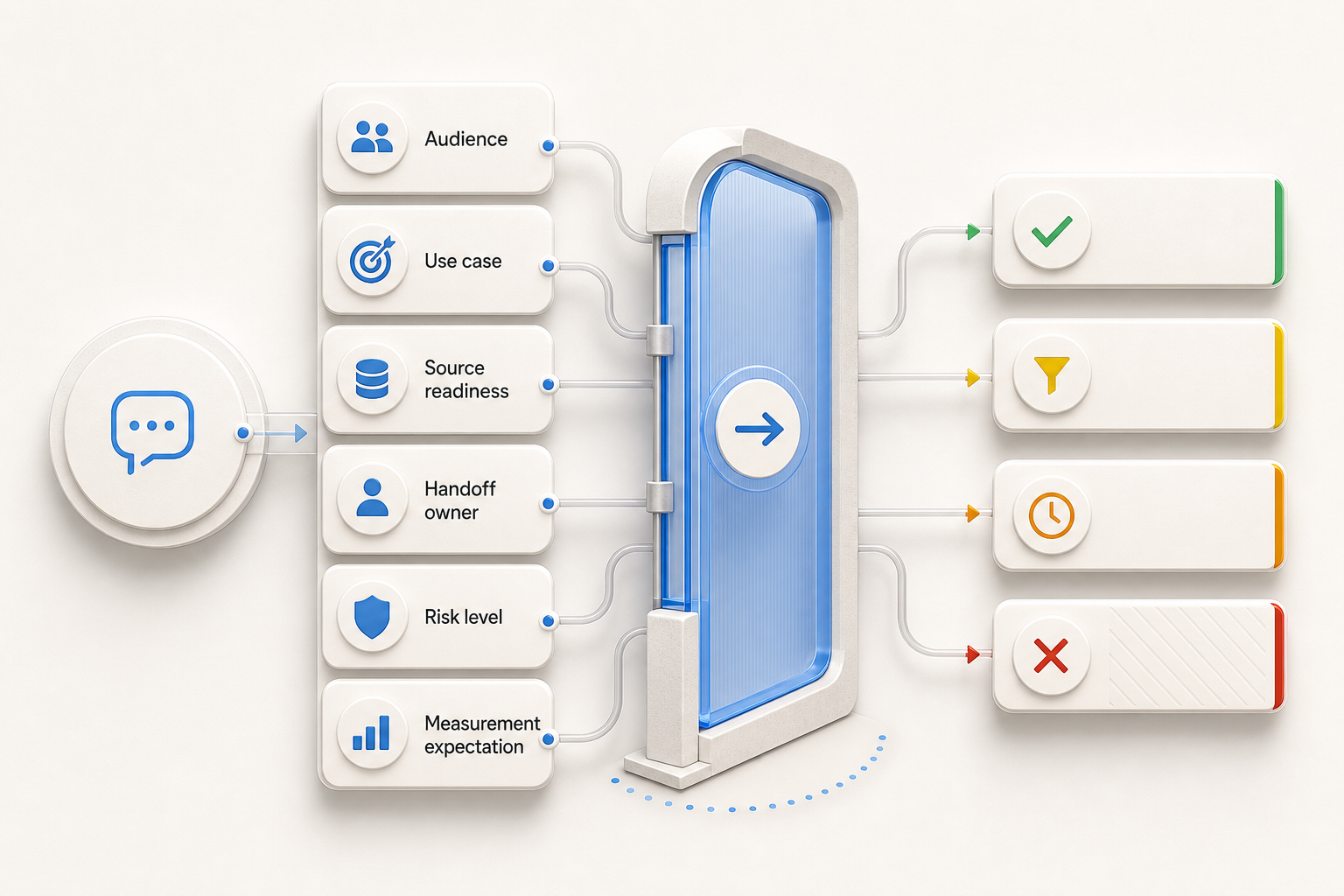
At overview level, discovery should cover the audience, the use case, source readiness, handoff path, risk level, and measurement expectation. The decision is simple: proceed, narrow, delay, or decline.
Proceed when the client can name the user, the situation, the source content, and the follow-up owner. Narrow when the idea is useful but the first version is too broad. Delay when the client needs to prepare content, assign ownership, or decide how handoffs work. Decline when the chatbot would be expected to answer sensitive, unsupported, or high-risk questions without the right review process.
Client demand alone is not enough. If the client says, “We need an AI chatbot,” the agency still needs to know what the assistant is allowed to answer, where the answers come from, and what happens when it cannot complete the task.
Keep the pillar decision at this level: discovery decides whether the opportunity is ready for scope. The detailed intake questions belong in the discovery support guide.
Scope The First Build Around One Bounded Workflow
A good first build is narrow enough to test in real use and clear enough for the client to approve. The safest boundary is one approved workflow, one known source set, one entry point, one handoff path, and one launch standard.
That does not mean the assistant can never grow. It means the first version should not carry every future idea. A website visitor assistant might begin with service pages and contact routing. An ecommerce assistant might begin with product guidance and policy answers. A support assistant might begin with common account or service questions and a handoff path for unresolved issues.
Broad assistants create delivery risk when the client has not approved the content, the team has not defined follow-up, or the agency has no standard for launch readiness. They also make acceptance harder because nobody can tell whether the first version is finished.
The scope decision should define what the assistant will handle at launch and what remains outside the first build. Keep that boundary strategic in the first proposal. Detailed scope language, exclusions, launch checks, and change-control guidance belong in the scoping support guide.
Decide When Reporting Becomes A Retention Loop
Reporting turns a chatbot from a launch asset into an improvement service only when the report drives decisions. A useful agency report should help the client decide what content to update, where handoffs fail, which leads need review, which questions remain unanswered, and which workflow changes deserve attention.
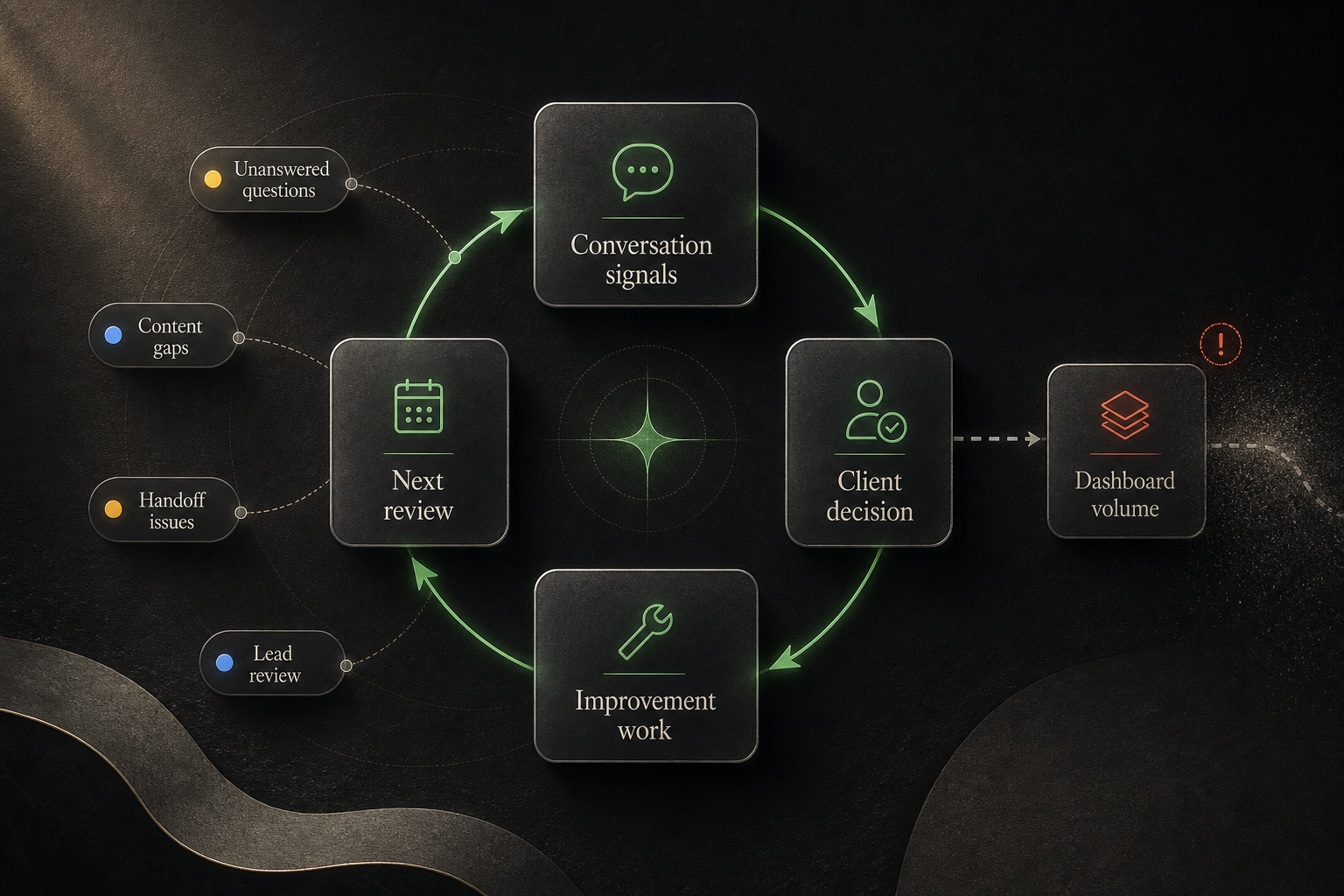
The retention logic is practical. If conversations reveal repeated content gaps, unclear answers, poor routing, or new visitor questions, the agency has a reason to propose ongoing improvement. If usage is low, handoffs are rare, and no meaningful content gaps appear, a monthly retainer may be harder to justify.
Avoid overstating attribution. A chatbot can contribute to lead capture, support routing, or visitor experience, but the agency should be careful about claiming revenue impact unless the client’s systems and tracking support that claim. Plain limits build trust.
The goal is not a thick dashboard. The goal is a useful client conversation: what happened, what it suggests, what should change, and who owns the next action. The full reporting model belongs in the metrics support guide.
Place White-Label And SaaS Resale After Delivery Fit Is Proven
White-label and SaaS resale decisions fit later in the agency sequence. They make more sense after the agency has seen repeated demand, proven delivery boundaries, and understood support ownership across more than one account.
The key question is not only “Can we resell this?” It is also “Can we support the expectations that come with it?” Resale can add account management, client training, billing questions, support requests, and platform ownership questions. If the agency has not yet proven which use cases it can sell and deliver, resale may add operational weight too early.
This article does not cover exact resale terms, ownership models, margins, pricing, platform comparisons, integrations, security certifications, or white-label contract structure. The supplied context does not support those claims, and those decisions deserve their own evidence.
Use resale as a later decision point. First prove the service path, use case fit, discovery gate, scope boundary, and reporting logic.
Scenario: A Content Agency Chooses The Right Chatbot Path
A content and website agency manages a client with a large service site. The client receives repeated questions about service fit, process steps, required documents, and booking next steps. The client asks for “an AI chatbot for the whole website.”
The agency does not start with a managed retainer or resale plan. It chooses a client starter use case with a possible one-off implementation: answer repeated visitor questions from approved service pages and route qualified conversations to the client’s intake owner.
Discovery stays focused. The agency confirms who the assistant is for, which pages are approved as source material, which questions should trigger handoff, who receives those handoffs, and what the client wants to learn from the first month of conversations.
The scope is bounded. The first build uses approved website content, appears on selected service pages, answers common process and fit questions, and sends qualified conversations to one named owner. It does not cover every service line, write custom advice, or answer questions from unapproved documents.
After launch, reporting decides the next move. If unanswered questions cluster around missing service details, the agency can recommend content updates. If handoffs are high but poor quality, the agency can revise qualification prompts or routing language. If usage is low, the agency may need to revisit placement or the use case before proposing ongoing work.
Only after these signals repeat does the agency consider a retainer. The retainer is justified by recurring content updates, conversation review, and workflow improvement, not by the fact that a chatbot exists.
Where Workflow Research Fits In The Agency Decision
InsertChat fits the research and starting-point stage for agencies comparing possible assistant workflows. The available positioning is simple: browse 600,000 assistant workflow pages across marketing, support, ecommerce, content, lead capture, handoff, and website visitor experience.
For an agency, that can help frame a first conversation around a concrete workflow instead of a vague chatbot idea. Marketing, digital, content, ecommerce, and agency teams can look for starting points tied to approved website content, branded answers, leads, support, and insight.
Keep the product role specific. Use workflow browsing to sharpen use-case selection and client conversations. Do not treat it as proof of pricing, outcomes, margins, security certifications, or competitor differences unless those facts are supplied and verified elsewhere.
Use The Support Guides When The Decision Turns Tactical
Use this pillar to choose the path. Then move to the support guide that owns the detailed work.
- Read Client Use Cases for AI Chatbots Agencies Can Sell First when you need to match client pain to a credible first pitch.
- Read AI Chatbot Discovery Questions for Agency Client Calls when the opportunity is interesting but not ready for scope.
- Read How to Scope an AI Chatbot Project Without Overpromising when the first workflow needs boundaries before build.
- Read How Agencies Can Turn AI Chatbots Into a Retainer Service when reporting and client needs support ongoing service.
- Read AI Chatbot Metrics Agencies Should Report to Clients when you need the full reporting model for client-facing measurement.
FAQ
What is the best first AI chatbot service for an agency to sell?
For most agencies, the best first service is a bounded client starter use case or one-off implementation. It should solve one clear problem, use approved source content, and have a defined handoff or next step. A retainer can follow when reporting shows recurring improvement work.
When should an agency avoid pitching a chatbot?
Avoid pitching when the client has no approved content, no named owner for follow-up, no clear user need, or no way to judge whether the assistant helped. In those cases, discovery should narrow or delay the project before scope is promised.
Can chatbot work become a monthly retainer?
Yes, but only when there is real monthly work to do. Retention is easier to justify when conversation data points to content gaps, unanswered questions, handoff issues, lead review, or workflow changes. A chatbot launch by itself is not enough.
Where do white-label and SaaS resale options fit?
Treat them as later decisions. They fit better after the agency has proven repeatable delivery, support ownership, account management expectations, and client use-case demand. Do not build the resale offer before the service path is tested.
What should an agency do next after choosing a path?
Move one step deeper. If the issue is client fit, read the use-case guide. If the issue is qualification, run discovery. If the idea is qualified, scope the first workflow. If the chatbot is live and active, use reporting to decide whether ongoing service makes sense.