TL;DR
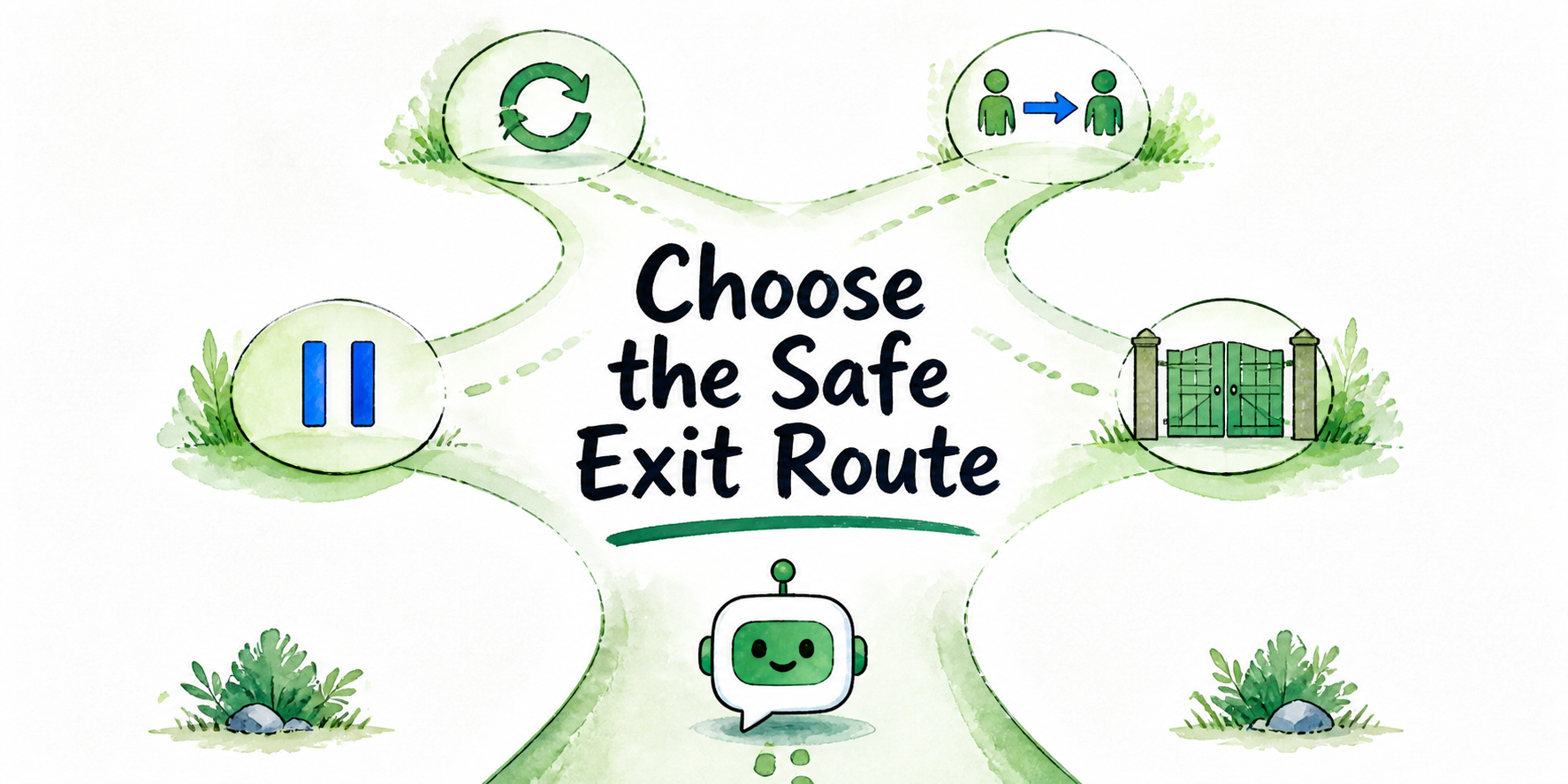
- Route every objection to one of four moves: answer now, verify first, test a bounded pilot, or disqualify.
- Accuracy, data security, maintenance workload, cost, brand voice, human handoff, and project fit objections each need different proof.
- Do not promise perfect answers, invisible maintenance, fixed savings, or security controls you have not verified.
- Use proof artifacts such as approved sources, QA logs, vendor documentation, handoff rules, maintenance ownership, and pilot criteria.
- The best answer names what is known, what is unverified, and which decision comes next.
A client who asks hard questions about an AI chatbot may be giving you the exact proof gap that decides the project. The agency risk is answering too quickly because the concern sounds familiar. A vague answer can create delivery debt before scope is clear, especially when the objection involves accuracy, security, cost, or human review.
Key Takeaways
- AI chatbot client objections should change the next step, not trigger a generic rebuttal.
- Answer now only when the fact is already verified for that client, website, and workflow.
- Verify first when the answer depends on vendor documentation, source quality, access rules, cost assumptions, or team capacity.
- Use a bounded pilot when the concern is valid and testable, such as answer quality for one workflow or handoff quality for one lead path.
- Disqualify when the client wants sensitive, unsourced, high-risk, or unowned work that cannot be narrowed.
- Avoid false certainty by naming what is known, what is unverified, which proof artifact will settle it, and which decision follows.
Start With The Objection Route, Not A Rebuttal
The useful question is not how to overcome the objection. The useful question is what kind of response the objection requires.
The Four Objection Routes
- Answer now
Use only when the answer is already verified for this client workflow.
- Verify first
Use when the answer depends on source quality, vendor docs, ownership, access rules, or cost assumptions.
- Bounded pilot
Use when the risk is real but measurable inside one narrow workflow.
- Disqualify
Use when the requested scope lacks sources, controls, ownership, or responsible limits.
Use four routes. Answer now when the answer is already known for the selected client workflow. Verify first when the answer depends on evidence you have not checked, such as security controls, data handling, source freshness, access permissions, support assumptions, or cost drivers. Test a bounded pilot when the risk is real but measurable, such as accuracy for one workflow or lead handoff quality for one path. Disqualify when the objection exposes a project that should not be sold as scoped, such as legal advice, answers from missing source content, or operation without an owner.
This model keeps the conversation honest and protects the agency from turning a client concern into an unsupported promise.
Use This Objection Matrix During The Client Conversation
Use this matrix as a call-side decision aid. It is not a script, proposal section, demo agenda, or readiness checklist. It helps you decide what can be answered, what needs proof, and what next decision the objection enables.
Objection Proof Matrix
| Objection | Proof artifact | Next decision | |
|---|---|---|---|
| Accuracy | Will it make things up? | Approved source list, QA log | Proceed, run QA, or pilot risky path |
| Security | Is our data safe? | Vendor documentation, security answer record | Verify, escalate, or pause sensitive scope |
| Workload | Who maintains this? | Maintenance ownership note | Assign ownership or narrow scope |
| Cost | What will it cost? | Cost assumption list | Quote later, narrow, or test support load |
| Brand voice | Will it sound like us? | Tone examples, review notes | Approve rules or test one workflow |
| Handoff | Will users get stuck? | Handoff rules, lead fields | Approve handoff or narrow workflow |
| Fit | Is this a good fit? | Fit note, pilot criteria | Narrow, test, or stop |
| Client concern | Route | Responsible answer | Verify | Proof artifact | Next decision |
|---|---|---|---|---|---|
| "Will it make things up?" | Verify first or pilot | Accuracy depends on approved sources, limits, testing, and review. Do not promise perfect answers. | Source quality, stale pages, out-of-scope questions, QA results | Approved source list, QA log | Proceed, run QA, or pilot the risky path |
| "Is our data safe?" | Verify first | Known project facts can be answered. Vendor controls and data handling need documentation. | Data exposure, vendor docs, access, retention, policy requirements | Vendor documentation request, security answer record | Verify, escalate, or pause sensitive scope |
| "Who maintains this?" | Answer now or verify first | The assistant needs an owner for source updates, conversation review, and fixes. | Update frequency, owner availability, review responsibility | Maintenance ownership note | Proceed, assign ownership, or narrow scope |
| "What will it cost?" | Verify first or pilot | Cost depends on setup effort, support load, usage assumptions, and workflow scope. | Build effort, support assumptions, usage exposure, change frequency | Cost assumption list | Quote later, narrow scope, or test support load |
| "Will it sound like us?" | Verify first | Brand voice needs approved examples and review against real visitor questions. | Tone examples, forbidden phrases, review owner | Tone examples and review notes | Approve rules or test voice in one workflow |
| "Will users get stuck without a person?" | Answer now or verify first | Handoff rules should define when the assistant captures a lead, routes to a person, or stops answering. | Escalation triggers, contact paths, lead fields | Handoff rules, lead capture fields | Approve handoff or narrow the workflow |
| "Is this a good fit?" | Pilot or disqualify | Fit depends on approved content, a clear owner, and acceptable risk. | Source availability, owner, goal, risk level | Short fit note, pilot criteria | Narrow, test, or stop pursuing the project |
Chat With is relevant when the client use case is a content-rich website assistant that needs grounded answers, branded behavior, lead capture, handoff, and workflow automation. That does not remove the need for verification. It clarifies the kind of workflow the product is meant to support.
Answer Accuracy Objections With Source And QA Proof
Accuracy objections usually sound like fear of public embarrassment: "What if it gives a wrong answer?" "What if it invents a policy?" "What if it uses old content?"
A responsible answer starts with boundaries:
"We should not treat the assistant as correct because it sounds confident. We need to limit it to approved sources, test likely visitor questions, and log misses before launch. If the source content is stale or contradictory, the chatbot will inherit that problem."
Verify which pages, documents, FAQs, policies, or help content are approved sources. Identify stale or contradictory pages. Name questions that should receive a limit response or handoff. Test likely prompts and record weak, unsupported, or overconfident answers.
The proof artifact is an approved source list and a QA log. The source list shows what the assistant may use. The QA log shows what was tested, what failed, what changed, and what still needs human review. For deeper testing work, use the AI Chatbot QA Checklist Before Client Launch. In the objection conversation, keep the answer at decision level: proceed if the client accepts a bounded use case, verify if source quality is unknown, or pilot if answer quality needs evidence from a narrow workflow.
If the client needs near-zero tolerance for wrong answers in a regulated, medical, legal, financial, or safety-sensitive context, a general website assistant may not be the right first scope. Narrow the assistant to navigation, content discovery, or handoff instead of direct advice.
Route Security Objections To Facts, Vendor Docs, Or Escalation
Security objections should slow the conversation down. That is the correct route when the answer depends on controls, policies, or documentation outside the agency's current facts.
A client may ask what visitor data is stored, who can see conversations, whether sensitive information can be blocked, how long logs are retained, or whether the setup meets internal policy. Separate known project facts from unverified platform or legal claims.
A responsible answer:
"For this project, we can define which website sources the assistant uses and which topics it should not answer. For platform-level data handling, access, and retention details, we need vendor documentation before we make a claim. If your security team has requirements, we should route those questions to documentation and review before scope is approved."
Do not improvise a security policy or claim a control exists unless you have verified it. The proof artifact can be a security answer record: the question asked, the known project fact, the vendor documentation needed, and the owner who will verify it. If the client needs fuller security detail, route them to How Agencies Should Explain AI Data and Security to Clients. The next decision is usually verify first or escalate. If no one can approve a sensitive data path, narrow or pause the project.
Turn Maintenance And Cost Objections Into Ownership Decisions
Maintenance and cost objections often arrive together: "Will this become another thing our team has to manage?" "What happens when our services change?" "What are we paying for after launch?"
Do not answer with vague reassurance. Ongoing work depends on ownership.
A responsible answer:
"The workload depends on how often the source content changes, who reviews conversations or missed questions, and who approves fixes. We should identify the maintenance owner before we talk as if this is low effort. If support load or usage is uncertain, we can test that assumption in a bounded scope."
Verify who owns source updates when services, prices, policies, hours, or offers change. Confirm who reviews weak answers or repeated unanswered questions. Name who approves changes to assistant behavior. Identify which support assumptions affect cost and whether usage or volume could change operating cost.
The proof artifacts are a maintenance ownership note and a cost assumption list. Keep both short. The point is not to write the maintenance plan during the objection conversation. The point is to stop the agency and client from pretending the work has no owner.
If the client already has a content owner and a support review habit, the objection may be answerable. If no one can own updates, verify first. If support burden is unknown, use a bounded pilot. For post-launch operating detail, use How to Maintain an AI Chatbot After Launch.
Cost objections are not always budget objections. Sometimes the client has money available but no confidence that the ongoing work is defined.
Use Brand Voice And Human Handoff As Boundary Tests
Brand voice objections are practical, not cosmetic. The client is asking whether the assistant will represent the business well when a visitor is confused, annoyed, or close to buying.
Avoid promising that the assistant will simply sound like the brand. Tie voice to examples and review.
"We need approved tone examples, language to avoid, and a review pass against real visitor questions. Voice is also what the assistant refuses to answer, when it asks for details, and when it hands off to a person."
Human handoff objections need the same treatment. Verify approved tone examples, claims or phrases the assistant should avoid, questions that should trigger lead capture, questions that should route to support or sales, and conversations that should stop with a limit response.
The proof artifact is a set of tone examples plus handoff rules. This can include lead capture fields, escalation triggers, and contact paths, but keep the artifact at decision level during the objection conversation.
If the client already has approved tone examples and handoff paths, answer now and proceed to testing. If they cannot explain when a human should take over, verify first. If they need evidence that visitors will accept the handoff path, pilot one workflow.
Brand voice cannot compensate for unclear offers, weak website content, or a missing support path. If the client's site does not explain the answer well, the assistant may not have enough approved material to represent the brand safely.
Disqualify Only When The Objection Reveals A Bad Fit
Disqualification should be rare, specific, and tied to the requested scope. It is the route when a concern exposes a chatbot project that cannot be made responsible with narrower boundaries.
Examples that may require narrowing or disqualification include no approved source content, sensitive advice without human review, no owner for updates or review, guaranteed performance expectations without evidence, or replacing a human judgment step that should remain human.
The responsible answer is direct:
"As scoped, I would not recommend selling that workflow. We can narrow it to approved website content, lead qualification, content navigation, or handoff. If that narrower scope does not solve a real business problem for you, we should not force the chatbot project."
The proof artifact is a short fit note: requested use case, missing requirement, risk, and possible narrower scope. Do not turn this into a full readiness checklist. The goal is to decide whether the objection can be answered, verified, tested, or whether the project should stop as scoped.
Scenario: A Stalled Client Call Moves To The Next Decision
A web design agency is discussing an AI chatbot with a B2B services client. The client has a deep resource library, several service pages, and a contact form, but the sales lead is skeptical.
The client says, "I do not want this making up answers about our process." The agency routes the concern to verify first: approved sources and testing need to come before any accuracy promise. The first possible pilot is narrow: help visitors find the right service page and hand off when the answer is not supported.
The client then asks, "What about data? Are conversations stored? Who sees them?" The agency does not guess. It can answer the project boundary, such as sources and topics, but conversation handling, access, and retention need vendor documentation before approval.
The operations manager says the team has no time to manage another tool. The agency routes that to ownership: one owner is needed for source updates and one review path is needed for missed questions. If that is not available, the assistant should be narrowed to lower-change content or paused.
The marketing director asks whether the assistant can sound like their consultants and capture qualified leads. The agency answers partly and verifies partly: lead capture and handoff can be part of the workflow, but voice needs approved examples and testing against real visitor questions.
The call does not end with a broad promise. It ends with a decision: verify vendor documentation, approve the first source set, name a maintenance owner, and test one content-navigation plus lead-handoff workflow. If those items cannot be completed, the project narrows or stops.
FAQ
What are the most common ai chatbot client objections?
The most common ai chatbot client objections are accuracy, data security, maintenance workload, cost, brand voice, human handoff, and project fit. Accuracy needs source and QA proof. Security needs verified documentation. Maintenance and cost need ownership and assumptions. Brand voice and handoff need rules. Project fit may need narrowing, a pilot, or disqualification.
How should an agency answer accuracy concerns?
Say that accuracy depends on approved sources, boundaries, testing, and review. Do not promise perfect answers. Ask which sources are approved, identify stale or conflicting content, test likely visitor questions, and keep a QA log. If the client needs evidence before committing, test one bounded workflow.
When should an agency verify instead of answering on the call?
Verify when the answer depends on facts you have not checked: vendor security documentation, data retention, access controls, source quality, usage-based cost, client ownership, or support workload. A useful response is, "I do not want to guess on that. Here is the document or owner we need before we answer."
When should an agency walk away from a chatbot project?
Walk away, or narrow first, when the client wants the assistant to answer from missing sources, handle sensitive advice without review, replace human judgment, or operate without an owner. The issue is that the requested scope lacks the facts, controls, or ownership needed to support it responsibly.
What proof helps client objections move forward?
Use proof that answers the specific objection: approved source lists for accuracy, QA logs for answer quality, vendor documentation for security claims, maintenance ownership notes for workload, cost assumption lists for budget concerns, tone examples for brand voice, handoff rules for escalation, and pilot criteria for uncertain fit.