
TL;DR
- An AI chatbot agency price floor is the lowest price that covers the bounded engagement’s costs plus your chosen contribution-margin requirement.
- Calculate setup and recurring floors separately. Setup work and monthly operating work belong to different cost periods.
- Include labor, client-attributable platform and provider exposure, shared overhead, payment or tax treatment, and an exception reserve.
- Allocate shared platform cost by expected usage, operating burden, and reserved headroom. Never divide the subscription by the advertised assistant allowance.
- Test an expected month and a stress month before choosing one action: approve, raise the price, narrow scope, use a paid pilot or change order, or decline.
A proposed retainer can look healthy until a source update, a review queue, and an integration exception arrive in the same month. This calculation begins after you have selected the service unit, bounded the workflow, and chosen a commercial model. Its job is narrower: produce a dated minimum price for one client engagement without relying on competitor rates or an optimistic share of a platform subscription.
Key Takeaways
- A clean client-facing price still needs detailed internal cost tracking.
- Every material value needs a status, owner, date, and update trigger.
- A missing value should block a firm price when a plausible change could reverse the quote decision.
- Higher utilization of a shared plan can improve cost recovery, but consuming all available headroom leaves the agency exposed to spikes.
- A competitive price is not defensible when it cannot fund the work and operating risk the agency has accepted.
Build a dated input ledger before calculating
Start with one worksheet for one client. Give each row a value or formula, evidence status, owner, verification date, and update trigger. Use four statuses:
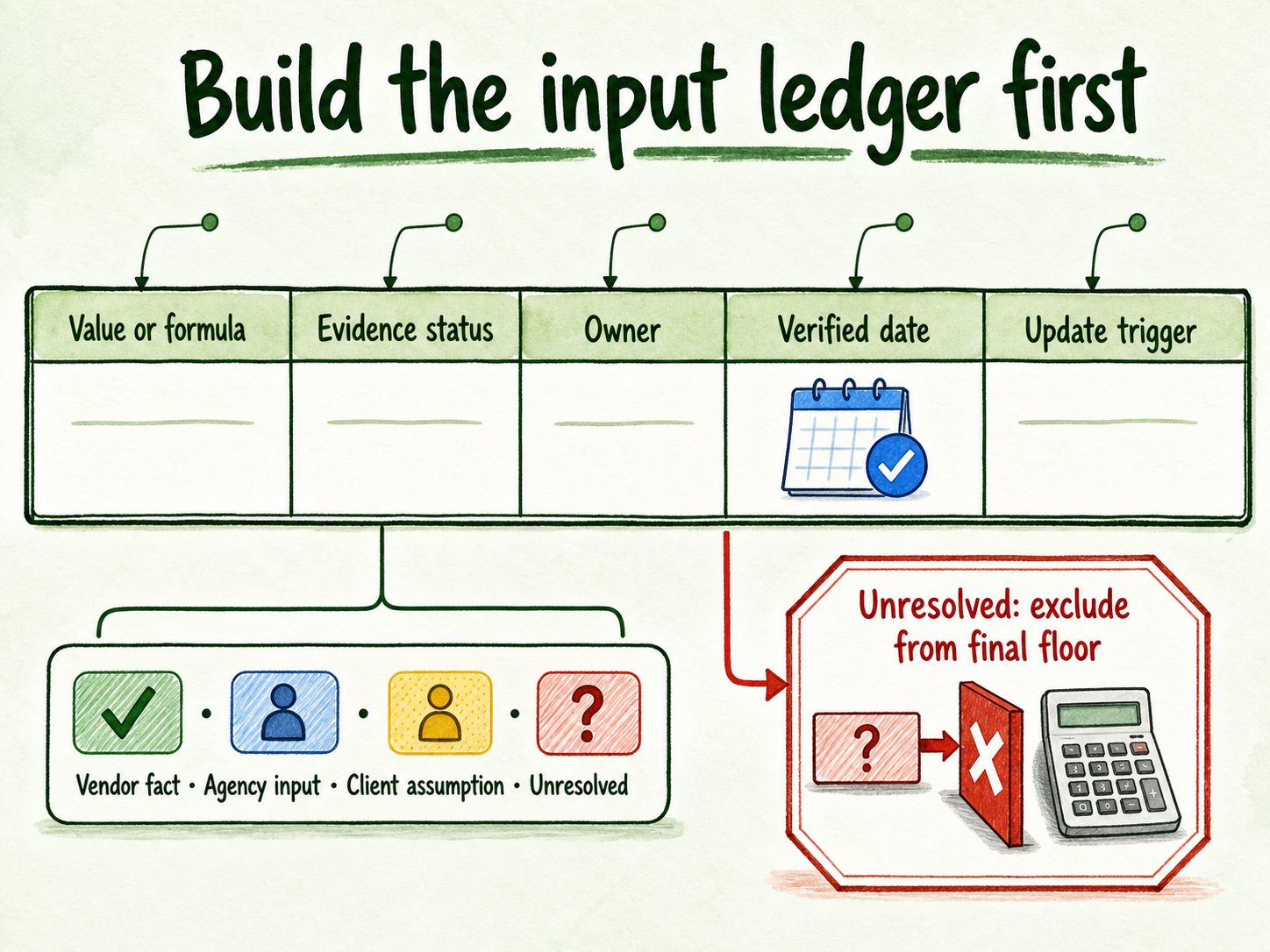
- Verified vendor fact: A current price, inclusion, limit, or commercial term supported by primary vendor material.
- Agency-specific input: A loaded labor rate, overhead rule, support policy, payment fee, tax treatment, exception reserve, or required contribution margin approved by the agency.
- Client-specific assumption: Expected usage, source-change frequency, review volume, escalation demand, stakeholder count, or integration workload for this engagement.
- Unresolved item: A value that is unknown, disputed, or insufficiently documented and cannot yet enter a final calculation.
The ledger should cover the full delivery burden, not just software and build time. Setup rows may include discovery handoff, source preparation, assistant configuration, branding, controlled deployment, answer testing, integration setup, permissions, and launch handoff. Recurring rows may include source maintenance, conversation review, content changes, reporting, meetings, support, account management, human escalations, and integration monitoring.
InsertChat’s official feature pages confirm that source preparation and refresh, assistant behavior, workflow routing, integrations, conversation review, analytics, and client-scoped access are distinct operating surfaces. Their availability does not make the associated agency work free or fixed. The hours depend on the agreed client workflow. See the current product evidence for knowledge sources, workflows, and conversation review.
Vendor facts need special handling because they can change. On July 29, 2026, InsertChat’s official pages contained conflicting Agency price presentations, even though the current plan card and agency material aligned on several other packaging details. Before publication or quoting, reconcile the current price, credits, assistant and source limits, seats, upload limits, white-label inclusions, custom-domain entitlement, annual terms, trial terms, usage treatment, upgrades, and overages against the current pricing page. Verify agency and white-label packaging against the agency page and branding page as well.
Do not choose the favorable value when official descriptions conflict. Record the term as unresolved, name the person responsible for confirmation, and exclude dependent numbers from the floor. The same rule applies to provider costs. Bring Your Own Key can create separate provider billing, but it does not remove the platform subscription.
Agency finance or operations should own labor rates, overhead, margin, tax, and allocation policy. The account owner should own client workload assumptions. A product or editorial owner should recheck vendor terms on the publication date and whenever packaging changes.
Calculate separate setup and recurring floors
Agencies price AI chatbot services by calculating the cost of the bounded work, adding an appropriate reserve for plausible exceptions, and applying their own contribution-margin requirement. The result is an internal minimum, not a recommended market price.
Keep the equations separate:
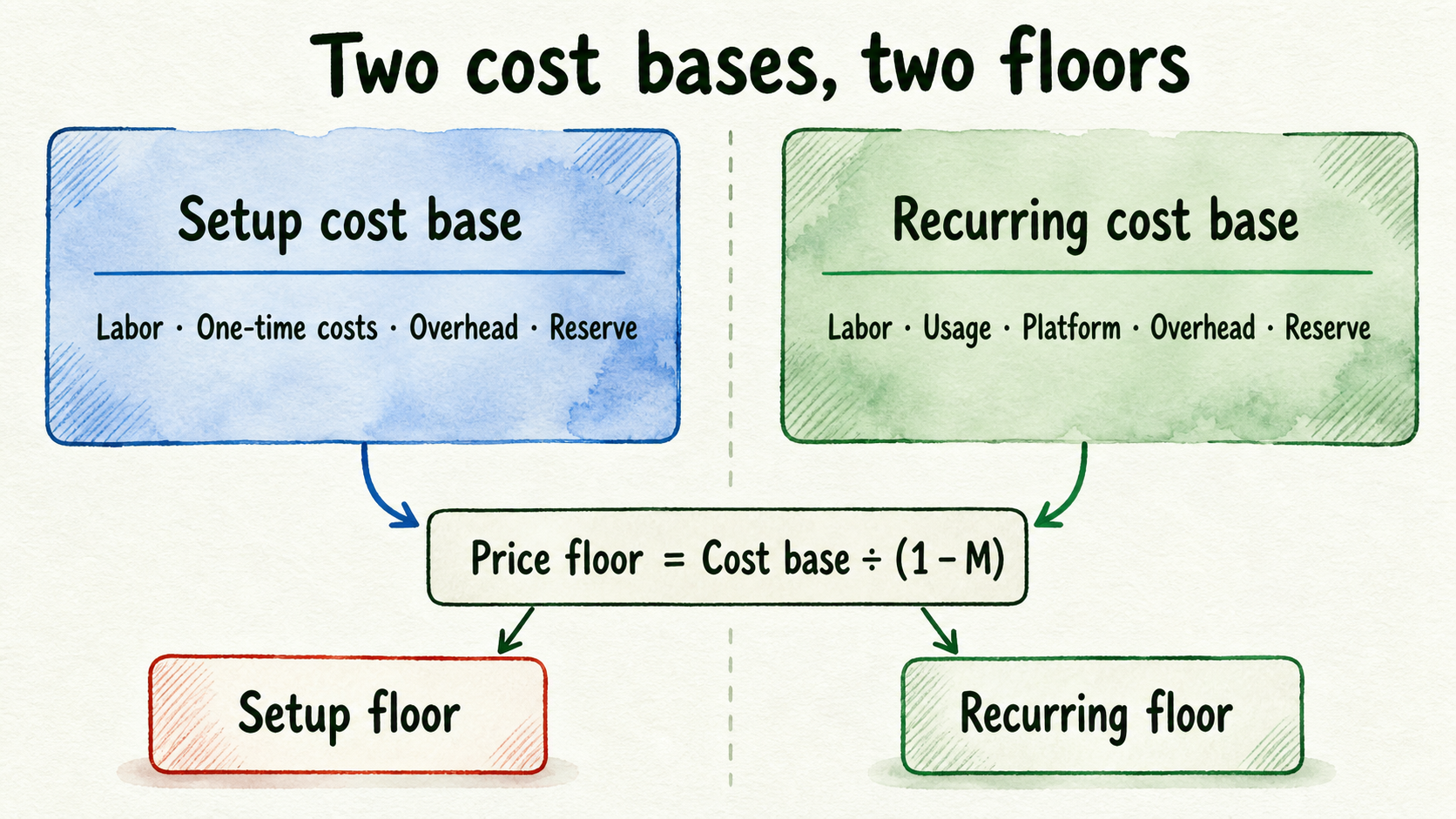
Setup cost base
Setup labor + one-time vendor or provider costs + setup overhead allocation + setup exception reserve
Recurring monthly cost base
Recurring labor + client-attributable usage and provider exposure + shared platform allocation + recurring overhead allocation + recurring exception reserve
Then apply the agency’s chosen contribution-margin rate:
Price floor = Cost base ÷ (1 − required contribution-margin rate)
If the agency requires a contribution-margin rate of M, the setup floor is Setup cost base ÷ (1 − M). The recurring floor uses the same structure with the recurring cost base. The agency supplies M; there is no defensible universal rate.
Loaded labor should reflect the agency’s approved accounting method. A worksheet might use separate role rates for source preparation, implementation, QA, account management, and specialist integration work. If the agency uses one blended rate, document what that rate includes. Do not mix salary-only costs with fully loaded rates across rows.
Handle payment fees and taxes according to the agency’s actual treatment. Some amounts may belong inside the cost base, while others may be added to the client invoice or handled outside contribution margin. The worksheet should follow the agency’s accounting policy rather than a generic formula copied from another business.
The separation matters. Folding setup into a low monthly price can leave source preparation, testing, and deployment unpaid if the engagement ends early. Treating recurring review as part of setup creates the opposite problem: the monthly service begins without funding the work that keeps it supportable.
Allocate shared platform cost by burden
A shared subscription should not be divided by the number of assistants a plan advertises. That method assumes every slot can be sold, every client uses equal credits, and every account creates equal support demand. None of those assumptions is reliable.
Use a documented allocation rule with three components:
- Expected client usage: The client’s forecast share of measurable platform or provider consumption.
- Operating burden: The account’s expected share of review, support, integration, permission, and exception work tied to the shared environment.
- Reserved headroom: Capacity deliberately kept available for usage spikes, clustered changes, and support events.
A practical internal formula is:
Client platform allocation = attributable variable exposure + weighted share of allocable fixed platform cost
The weighted share can use agency-selected usage and burden factors. For example, the worksheet may assign U as the client’s expected usage share and B as its operating-burden share. If the agency allocates fixed cost using weights Wu and Wb, then:
Allocation score = (U × Wu) + (B × Wb)
Apply that score only to the portion of platform cost the agency has chosen to allocate after preserving headroom. Document the weights and replace provisional assumptions with observed data after launch.
This creates a real tradeoff. Allocating nearly all shared cost across current clients may improve apparent utilization, but it can leave no credit or support room for a stress month. Holding too much in reserve can make current engagements carry too little platform cost. The right balance comes from the agency’s observed variability and risk tolerance, not the vendor’s maximum assistant count.
If credit consumption, overage treatment, or upgrade behavior is not precise enough to estimate exposure, the recurring floor remains conditional. Narrow usage, obtain written clarification, or price the uncertainty through a bounded paid test. Do not hide it inside a favorable average.
Test two engagements under expected and stress conditions
The following applications are illustrative calculation structures. Their symbols and workload units are placeholders, not customer results, agency benchmarks, or recommended prices.
Application A: website FAQ and lead capture
The bounded engagement uses approved website FAQs, one lead-capture path, one controlled deployment page, scheduled source updates, and human handoff for unsupported questions.
Setup cost base:
Source preparation hours × source rate
+ configuration and branding hours × implementation rate
+ answer testing and deployment hours × QA rate
+ one-time overhead and exception reserve
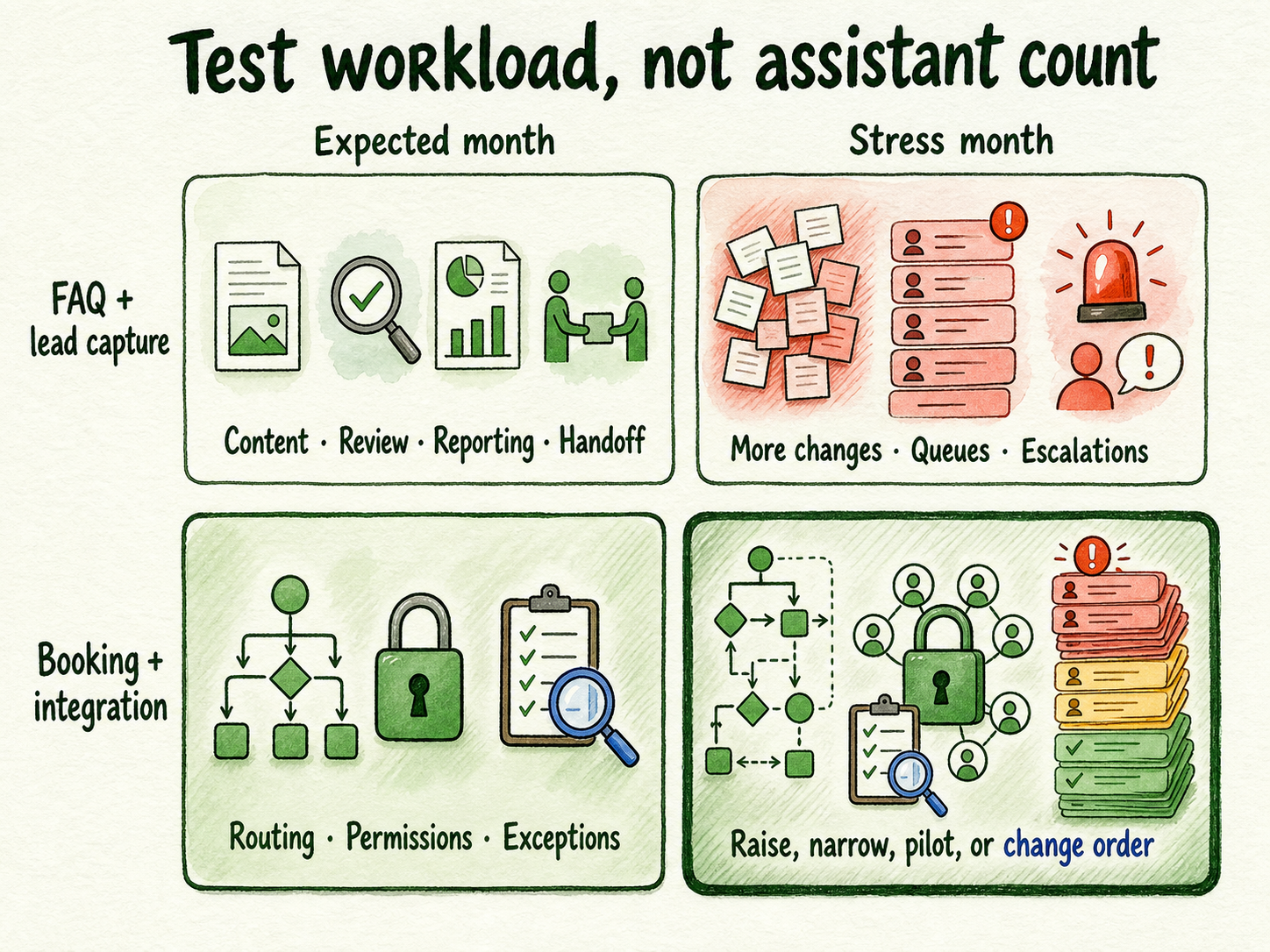
The expected month includes scheduled content review C1, conversation review R1, reporting P1, and handoff support H1. Its recurring labor is:
(C1 × content rate) + (R1 × review rate) + (P1 × reporting rate) + (H1 × support rate)
Add expected usage exposure, the burden-based platform allocation, overhead, and the recurring reserve. Divide the resulting cost base by 1 − M to obtain the expected recurring floor.
For the stress month, replace those workload values with C2, R2, P2, and H2, where content changes, review queues, or escalations are higher. Recalculate rather than multiplying the expected floor by an arbitrary buffer. If the proposed retainer clears the expected floor but fails the stress floor, the agency must decide whether the stress exposure is included, capped, or handled separately.
Application B: booking or integration engagement
This client requires booking plus CRM or webhook routing, client-scoped access, monthly reporting, and more exception review. The client-facing experience may still look like one assistant, but the cost base has more components.
Setup adds integration mapping, destination testing, permission configuration, failure handling, and stakeholder approval time. Recurring delivery adds integration checks, access changes, reporting preparation, exception investigation, and coordination when a booking or routing event fails.
Use the same formula, but add integration labor I, permission work A, and exception review E:
Recurring cost base = standard recurring labor + (I × specialist rate) + (A × admin rate) + (E × review rate) + platform/provider exposure + overhead + reserve
In the expected month, I, A, and E reflect the bounded operating assumption. In the stress month, test a usage increase, several content changes, a larger review queue, and more escalations. Change only assumptions that could reverse the quote decision.
Suppose the proposed retainer remains above the FAQ engagement’s stress floor but falls below the integration engagement’s expected floor. The visible assistant is not the deciding factor. Routing, permissions, review, reporting, and specialist dependence create the difference. The second quote must rise, lose included work, or move uncertain integration effort into a paid pilot or change order.
Bundling routine recurring work can keep the client price simple. New source libraries, workflows, channels, integrations, or approval cycles should remain outside that bundle unless their expected burden is already included in the cost base.
Choose a quote gate and act on it
Use five economic gates after calculating both views:
| Gate | Use it when | Required action |
|---|---|---|
| Approve | The proposed setup and recurring prices clear their floors, including the agreed stress exposure | Record the dated assumptions and move the approved number forward |
| Raise price | Scope is sound, but the proposed price falls below the required floor | Increase the price until the calculation clears |
| Narrow scope | Removable sources, reviews, integrations, channels, or reporting obligations cause the failure | Remove the work, recalculate, and confirm the narrower client outcome still works |
| Paid pilot or change order | A bounded uncertainty can be measured or isolated without committing to the full burden | Charge for the real setup, testing, and review needed to replace assumptions with evidence |
| Decline | The engagement cannot clear the agency’s requirement or depends on work the agency cannot support | Do not quote the full engagement |
Raise the quote or reduce scope whenever the expected calculation fails. Take the same action when the stress case fails and the agency has promised to absorb that stress. Keep the quote conditional when an unresolved value, such as usage exposure or integration effort, could reverse the result.
A lower pilot price is not automatically safer. The pilot must still recover its source preparation, configuration, testing, deployment, review, and reporting effort. Its advantage is a smaller uncertainty boundary, not permission to ignore costs.
A passed price floor does not prove demand, client value, legal sufficiency, or agency-wide delivery capacity. Use the separate workload framework to plan agency capacity by workload. Once the number and fit are defensible, assemble the chatbot proposal using the approved economic decision.
Complete the worksheet with actual agency and client inputs, resolve every item that could change the gate, and choose one action. Only then should the number enter client-facing proposal work.
FAQ
Is a price floor the same as the final sell price?
No. The floor is the internal minimum required by the agency’s verified costs, allocation method, reserve, and contribution-margin rule. The final price may be higher based on the agency’s commercial judgment and the client’s buying decision, but it should not be lower unless scope or costs change.
What if vendor usage or packaging terms remain unclear?
Do not use the disputed value in a final numeric floor. Keep the quote conditional, narrow the dependent workflow, obtain current written confirmation, or isolate the uncertainty in a paid pilot. Recheck volatile vendor facts on the publication date and whenever pricing, limits, or packaging change.
Can one shared-cost rule be used for every client?
The agency can use one allocation method for consistency, but each client needs its own usage and burden inputs. Revisit the method when observed consumption, support effort, or reserved headroom no longer matches the assumptions.
How often should the worksheet be refreshed?
Refresh it before each firm quote and whenever labor costs, overhead policy, tax treatment, support commitments, platform terms, client scope, or observed workload changes. A dated worksheet is useful because it shows exactly which facts supported the decision at that time.