
TL;DR
- Calculate the minimum viable price for one defined client account, not an average client or an entire service line.
- Separate implementation cost from recurring platform allocation, usage, review work, reporting, support, account management, overhead, and commercial costs.
- Test the proposed fee twice: once under expected conditions and once under adverse usage, workload, and exception conditions.
- Quote only when the relevant cases meet your agency’s chosen contribution rule. Otherwise narrow, pilot, separate variable work, pass usage through, or decline.
- Replace estimated usage and effort with observed account data at a scheduled post-launch review.
A monthly fee can cover the visible software charge and still lose money once source corrections, QA, escalations, client meetings, payment costs, and a usage spike arrive. The useful number is therefore not the lowest price a prospect might accept. It is the lowest price at which one scoped account remains supportable under both normal and adverse conditions.
Key Takeaways
- Reserved capacity has a cost. An allocation method should not make a client look cheaper simply because committed platform capacity went unused that month.
- Recurring work should be observable. Price source changes, QA, escalations, meetings, reports, and account management as events with a frequency and loaded effort.
- The adverse case controls admission. A promising expected case is insufficient when plausible integration, handoff, source, or usage pressure breaks the agency’s contribution requirement.
- Simple client pricing can sit above a detailed internal model. The client may see one clear fee while the agency monitors multiple cost drivers.
- Actual account behavior should replace estimates. A scheduled variance review turns early assumptions into a better allowance, reserve, and re-quote rule.
Define the account before calculating its price
This calculation starts after the agency has selected a commercial structure. If that choice is still open, first choose a white-label AI pricing model. The price-floor worksheet does not compare fee structures. It tests whether the proposed fee for one account is viable within the structure already chosen.
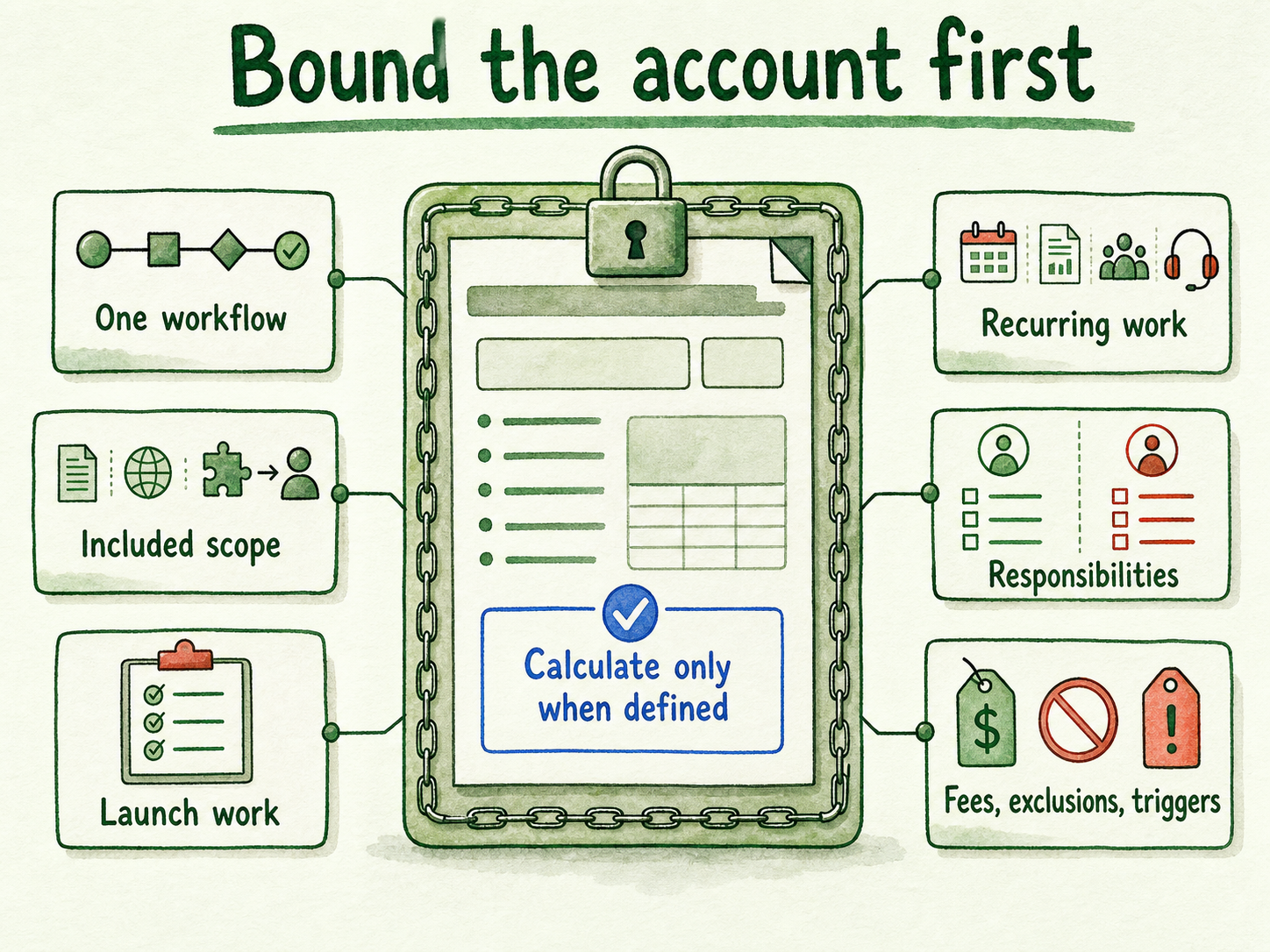
Give the worksheet a fixed boundary:
- One client and one defined workflow
- Included sources, channels, integrations, and handoff paths
- One-time launch obligations
- Recurring reviews, reports, meetings, and support
- Client-owned inputs and approval responsibilities
- Excluded work and change triggers
- The proposed implementation and recurring fees
Use an existing service definition to define the service scope and exclusions, then set scope and change-control rules. Do not calculate a firm floor for an account whose workflow, source set, integration, or support promise is still changing.
This boundary matters because every unbounded promise becomes a pricing variable. “Source updates included” is not measurable. “One approved source change per month, followed by focused QA of the affected answers” can be estimated and later compared with actual work.
The agency must supply its own financial inputs: loaded labor costs, overhead method, payment costs, sales-cost allocation, desired contribution, expected usage, and historical exception frequency. These are account and agency facts, not market benchmarks. If they are unknown, leave them visible as unresolved inputs or use a paid pilot to collect evidence.
Build the price-floor worksheet in separate layers
Keep one-time implementation cost apart from recurring cost. Combining them can hide whether the launch fee covers launch work or whether the monthly fee is quietly repaying an implementation shortfall.
| Worksheet layer | What to enter | Input source |
|---|---|---|
| One-time implementation | Discovery carried into delivery, source preparation, configuration, integration setup, QA, revisions, approval, and launch | Scoped tasks × loaded effort × loaded labor cost, plus direct expenses |
| Shared platform allocation | The account’s portion of the platform plan and relevant shared add-ons | Reserved-capacity allocation rule |
| Usage exposure | Expected metered cost or internal allowance beyond the base allocation | Vendor rules and client behavior |
| Recurring operating work | Source changes, focused QA, escalation review, support, meetings, and reports | Event frequency × effort × loaded labor cost |
| Account management | Coordination, approvals, status handling, billing questions, and commercial administration | Expected events or allocated account time |
| Non-delivery overhead | Finance, management, internal systems, and other costs assigned under agency policy | Agency’s stated allocation method |
| Payment and sales cost | Payment processing and any account-level sales-cost recovery | Agency records and commercial terms |
| Exception reserve | Infrequent work that is included but absent from normal workload | Historical frequency × expected cost, with an adverse-case adjustment |
Prevent double counting. If provider usage is already included in the usage reserve, do not add it again to platform allocation. If a monthly source review is in recurring workload, reserve only for unusual remediation beyond that normal event.
Allocate shared platform cost without making unused capacity free
Dividing the platform bill by the number of active clients creates an unstable result. The first client appears to carry the entire plan; later clients appear progressively cheaper. It also assigns no cost to capacity the agency has committed but cannot sell twice.
Use a reserved-capacity rule:
Account platform allocation = shared platform cost × account reserved units ÷ total saleable reserved units
A reserved unit should follow a real constraint, such as an internally defined share of assistants, credits, sources, seats, or another limiting resource. Use one primary unit unless a material add-on needs a separate allocation.
For example, suppose an agency defines a clearly hypothetical ten-unit internal pool and reserves two units for a client. The account receives 20% of the shared platform cost, even if it consumes less during a quiet month. The remaining units are not free. Their cost remains attached to the saleable pool and informs the agency’s wider pricing policy.
Review the denominator when the platform plan, client mix, or true constraint changes. This is a management convention, not a universal accounting standard. Its value comes from being explicit, consistent, and tied to capacity the agency actually reserves.
Turn usage and delivery events into recurring cost
Platform access and account consumption are different. Allocation pays for committed access to shared capacity. A usage allowance handles variability in the client’s actual consumption.
For InsertChat, the live pricing page verified on July 29, 2026 says credits budget usage across conversations, sources, and tools. It also says BYOK customers continue paying for the platform while provider usage is billed separately. Verify the current price, credits, limits, trial terms, annual terms, add-ons, and plan inclusions again on publication day and before sending a firm quote, because these inputs can change. Review current InsertChat pricing.
Set four account-specific usage fields:
- Expected usage: the best estimate supported by client traffic, comparable account data, a pilot, or early observations.
- Included allowance: the amount the quoted fee is designed to absorb.
- Warning threshold: the observed level that prompts review before the allowance is exhausted.
- Commercial trigger: the condition that causes a re-quote, plan change, narrower scope, or pass-through charge.
Do not invent a universal percentage for any field. A new account without usable history should receive a conservative, clearly provisional allowance and an early review date. A paid pilot is useful only when it records enough conversations, credits, tool activity, handoffs, and delivery work to price the next phase.
Client-facing simplicity still matters. One clear monthly fee can be easier to approve, but the internal model must expose variable usage. The published reseller-pricing guidance likewise treats recurring platform cost, variable usage, implementation labor, support ownership, and overage handling as inputs required before a firm quote. See the pricing-risk comparison.
Recurring human work should be event based:
Monthly event cost = Σ(event frequency × loaded effort × loaded labor cost)
Use account-level events such as source changes, focused QA reviews, escalations, client meetings, and reports. Draw frequencies from observed workload events and exception demand, then translate only this client’s events into cost. For the operating cadence itself, use the separate guidance on post-launch maintenance workload and client reporting requirements.
The recurring cost base becomes:
Recurring cost base = platform allocation + usage allowance + event-based labor + account management + overhead + payment and sales cost + exception reserve
If the agency requires a fixed contribution amount:
Recurring price floor = recurring cost base + required contribution amount
If it uses a contribution rate based on client revenue:
Recurring price floor = recurring cost base ÷ (1 − contribution rate)
Adjust the formula if percentage-based payment costs have not already been included. Use the agency’s finance policy consistently. Contribution here means revenue remaining after the costs defined in this worksheet. It is not automatically net profit.
Calculate the expected floor with expected usage, normal event frequency, and the normal exception reserve. Calculate the adverse floor with plausible usage pressure, extra escalations, weak-source remediation, integration changes, or increased handoffs. The proposed fee should then be compared with both floors.
Stress-test two client workflows
The following figures are hypothetical inputs for showing the method. They are not agency-rate benchmarks, customer results, or recommended contribution targets. Both workflows use the same agency-selected calculation policy.
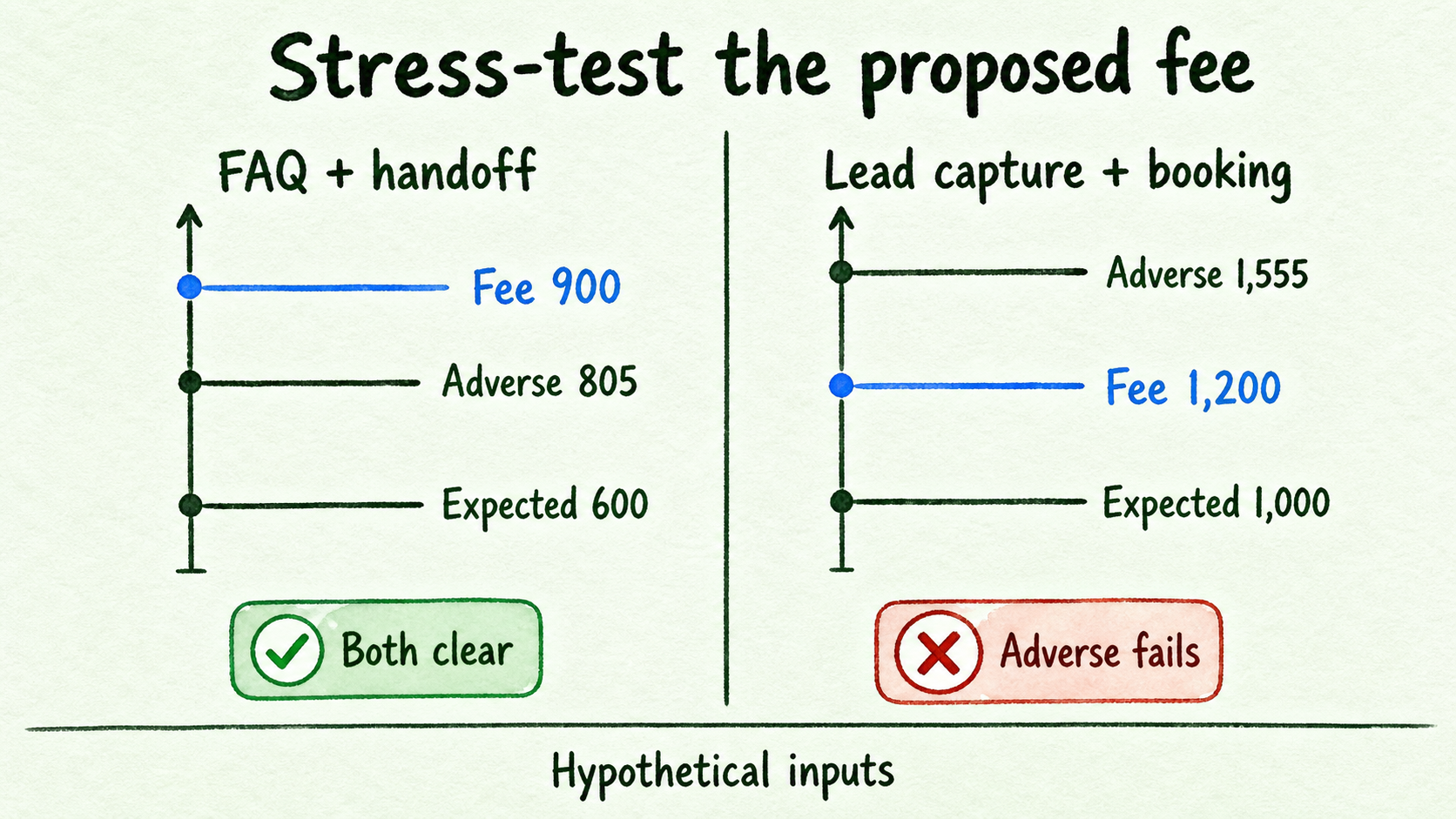
| Monthly input | FAQ and human handoff | FAQ adverse | Lead capture and booking | Booking adverse |
|---|---|---|---|---|
| Platform allocation | 45 | 45 | 70 | 70 |
| Usage allowance or exposure | 35 | 65 | 85 | 180 |
| Recurring operating labor | 150 | 220 | 260 | 480 |
| Account management and reporting | 90 | 115 | 140 | 210 |
| Overhead, payment, and sales allocation | 55 | 65 | 85 | 105 |
| Exception reserve | 50 | 120 | 110 | 260 |
| Recurring cost base | 425 | 630 | 750 | 1,305 |
| Agency-selected contribution requirement | 175 | 175 | 250 | 250 |
| Illustrative price floor | 600 | 805 | 1,000 | 1,555 |
| Proposed monthly fee | 900 | 900 | 1,200 | 1,200 |
| Decision | Clears | Clears | Clears | Fails |
The FAQ and handoff account uses approved sources, a bounded answer job, one human route, and predictable review events. Its adverse case includes extra source work and handoffs, but the proposed fee remains above the illustrative floor.
The lead-capture and booking account looks acceptable in the expected case. Its adverse case fails because integration changes, escalations, and usage rise together. A competitive headline price does not remove that work. The agency now has a specific problem to solve rather than a vague concern about margin.
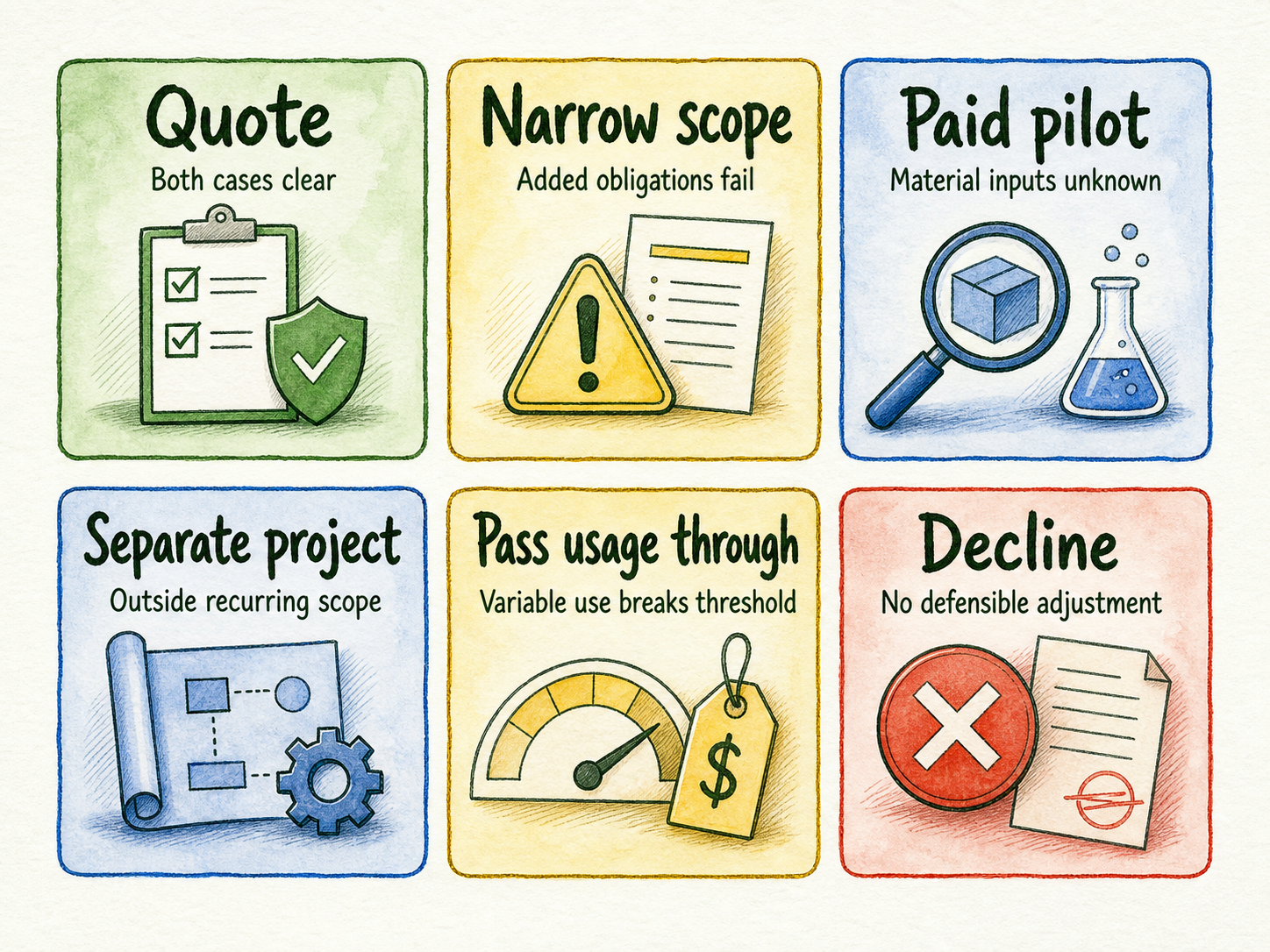
Possible remedies follow the failed variable. Separate source remediation or a substantial integration change into project work. Narrow the booking workflow or included handoff logic. Pass through verified variable usage when the client accepts that billing treatment. If behavior remains unknown, run a paid pilot that measures it. If no reasonable boundary lets the adverse case clear the agency’s requirement, decline the account at the proposed economics.
Apply the admission rule and review variance
Use one account-admission rule:
- Quote when the proposed fee clears the required expected and adverse cases with verified platform assumptions.
- Narrow scope when extra workflows, sources, channels, or handoff obligations cause the failure.
- Run a paid pilot when real demand exists but usage, escalation frequency, source quality, or integration effort cannot yet be estimated responsibly.
- Use a separate project for source remediation, new integrations, major workflow changes, or other work outside the recurring boundary.
- Pass usage through when verified variable consumption can materially break the contribution rule and the client accepts transparent variable billing.
- Decline when no defensible scope, allowance, reserve, or fee restores the agency’s chosen threshold.
Schedule the first variance review before launch. Assign an agency finance or operations owner to compare planned and observed usage, event frequency, effort, exceptions, payment costs, and account-management work. Thin early data may justify another bounded observation period rather than a confident trend claim.
At the checkpoint, replace estimates with actual account records. Update the allowance, warning threshold, exception reserve, and commercial trigger. Keep the fee when observed behavior fits the tested range. Narrow or re-quote when material variance persists. Route newly requested integrations or remediation into a separate estimate.
The immediate next action is concrete: complete this worksheet for one scoped account, select one admission outcome, record exclusions and change triggers, and schedule the variance review before drafting the proposal. If a bounded trial is the chosen route, confirm the latest platform costs and limits first so the trial captures the usage and workload evidence the ongoing quote needs.
FAQ
Should unused platform capacity really be charged to clients?
Unused reserved capacity still has a cost to the agency. Assigning it no cost makes active accounts appear cheaper and can leave the agency carrying committed capacity without a recovery method.
The allocation should remain reasonable and consistent. Tie it to a real constraint, disclose the internal rule to decision-makers, and reconcile it when the platform plan or client mix changes. It does not need to appear as a separate client invoice line.
What if there is no client usage history yet?
Use the best client-specific evidence available, label the allowance provisional, test an adverse case, and set an early review. Do not convert an unsupported estimate into a permanent bundled allowance.
If usage, handoffs, or integration effort could materially change the fee, use a paid, bounded pilot. The pilot should record the variables needed for the next decision, not merely demonstrate that the assistant can answer sample questions.
Implementation recovery can remain separate or follow the commercial structure already chosen. The worksheet’s job is to show the full implementation cost and any recovery assigned to the recurring fee, not to prescribe how every agency must bill it.
When a vendor changes prices, credits, limits, or inclusions, update the platform allocation and usage assumptions, rerun both cases, and apply the agreed change trigger. Product packaging is an input to the method, never a substitute for the account calculation.