TL;DR
- An AI chatbot proposal template should turn a defined offer into client approval language, not rebuild the offer from scratch.
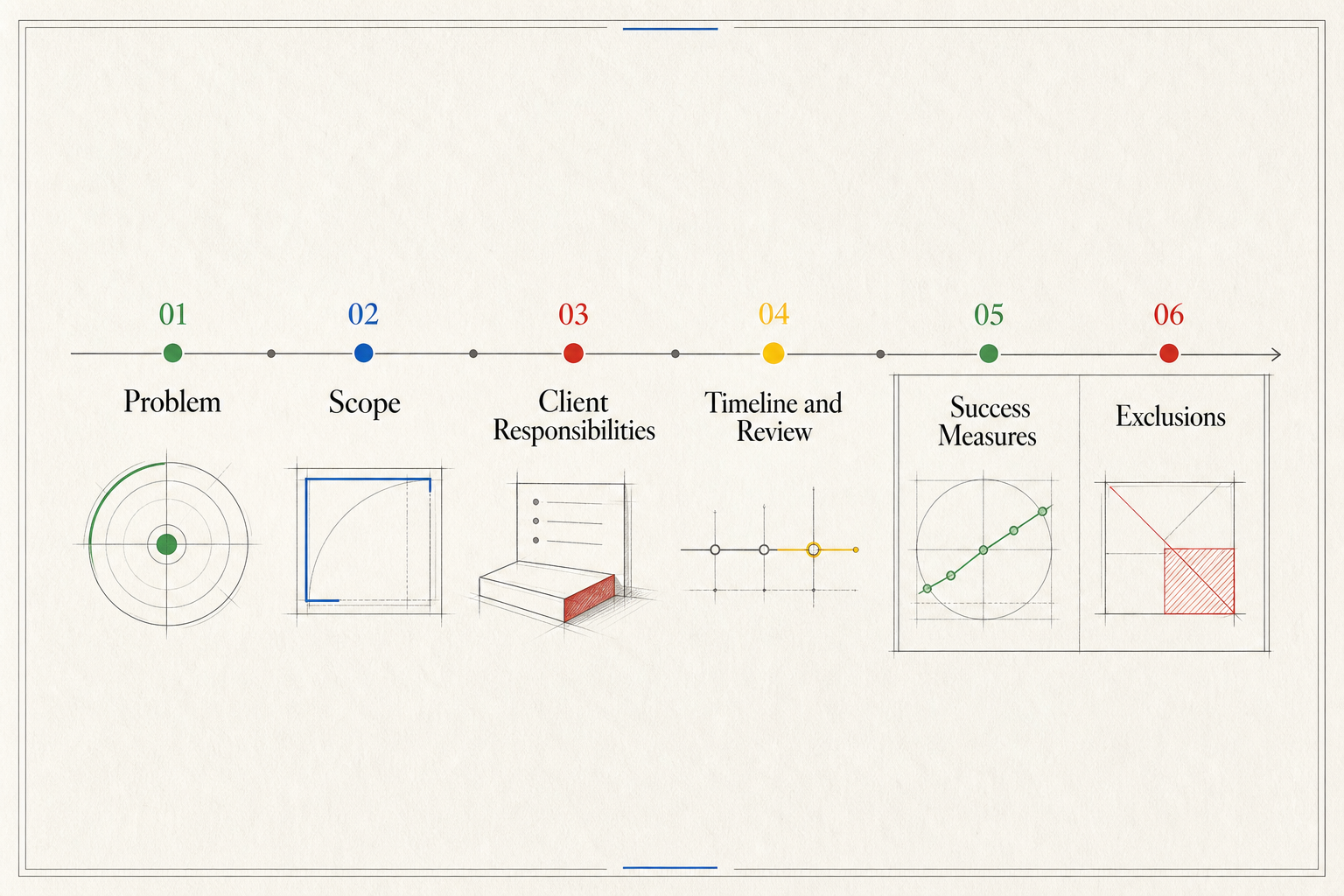
- The core sections are executive problem statement, scope and deliverables, client responsibilities, timeline and review process, success measures, and exclusions.
- Put client responsibilities before the timeline so dates depend on clear inputs, reviews, and approvals.
- Treat pricing as a short placeholder, such as commercial terms to be added after scope confirmation.
- Use exclusions to prevent the proposal from being read as open-ended implementation, reporting, support, or legal work.
You already know the client wants some version of a white-label chatbot service. The hard part is writing a proposal that the buyer can approve without later arguing about what was included, who owned the content, when review was due, or what counted as a finished launch.
Key Takeaways
A strong agency chatbot proposal sells the outcome first, then the work needed to deliver it. The client should understand the problem being solved before they see deliverables.
Scope and deliverables should come from an offer you have already bounded. If the offer still needs tier design, review limits, setup inputs, or support boundaries, finish that work first. A proposal should not be the place where package structure gets invented. If you need that upstream step, use the guide to package white-label AI chatbots without custom scope creep before writing the proposal.
Client responsibilities belong near the middle of the proposal, before timeline commitments. If the client must provide approved pages, FAQs, policies, product details, or an approval owner, the proposal should say that before it promises a launch window.
Success measures should be written as acceptance criteria, not as a full reporting program. The proposal can say what must be true at launch, such as approved sources connected, test questions reviewed, lead details captured where relevant, and unresolved questions routed through the agreed path. Monthly reporting and optimization can be separate work.
Exclusions protect both sides. They make clear that unsupported content, unapproved integrations, extra review rounds, legal review, custom workflows, or post-launch reporting are not included unless added later.
Start With the Client Problem the Proposal Must Solve
The executive problem statement is not a company background section. It is the short answer to this question: what specific client problem is the chatbot being approved to solve?
Keep it close to the buyer's operating issue. Do not start with AI capabilities, model choices, or platform language. Start with the situation the client recognizes.
Use this prompt:
| Proposal field | What to write |
|---|---|
| Current problem | What visitors, leads, customers, or staff struggle to get today |
| Business impact | What that creates for the client, without invented numbers |
| Proposed outcome | What the chatbot service is meant to improve |
| Approval boundary | What this proposal asks the client to approve |
Sample phrasing:
"Website visitors are asking repeat questions about services, eligibility, booking steps, and policies, but the answers are spread across several pages and internal documents. This proposal covers a branded website assistant that answers from approved client content, captures lead details where relevant, and routes unresolved questions to the agreed follow-up path."
That wording does three useful things. It names the pain, names the approved answer source, and avoids promising a broad support transformation. The buyer can approve it because the work is tied to a specific website experience.
If you cannot write this section in two or three sentences, the use case may still be too loose. Pause before you add deliverables. A vague problem statement turns every later section into guesswork.
Turn the Bounded Offer Into Scope and Deliverables
The scope section answers: what will the agency provide, and what is included in this proposal?
This is where many proposals become too broad. A client-facing scope should translate your existing offer into plain nouns. It should not introduce new tiers, custom options, or implementation promises that were not already decided.
A practical scope section can use four blocks:
| Scope block | Example proposal language |
|---|---|
| Assistant type | "A branded website assistant for visitor questions about approved service, policy, and FAQ content." |
| Included sources | "Approved website pages, FAQs, policy pages, docs, and other client-approved sources listed before setup." |
| Included deliverables | "Assistant configuration, source connection, brand-aligned presentation, test conversation review, and launch-ready embed guidance." |
| Out of scope | "New content writing, custom software development, unapproved integrations, legal review, and recurring reporting unless added separately." |
Keep deliverables observable. A client can approve "assistant configured with approved sources" more easily than "AI knowledge system setup." Exact nouns reduce disagreement.
If you mention a product in this section, keep the claim narrow and supported. For example, InsertChat can be referenced as a branded AI assistant builder for a website assistant trained on owned content. That is enough context for a proposal scenario. You do not need to add pricing, performance claims, competitor comparisons, or proof that was not supplied by the client or platform.
A good scope section should also separate assumptions from deliverables. Approved source material, client access, and a named reviewer are usually assumptions. The assistant configuration, test review, and launch-ready handoff are deliverables.
Name Client Responsibilities Before the Timeline
A timeline built before client responsibilities is usually false precision. The client may approve the proposal, then take two weeks to send content, identify a reviewer, or answer source questions. The proposal should make those dependencies visible.
Keep this section at proposal level. Do not turn it into an onboarding checklist. The goal is to show the buyer what they must own for the project to move.
Include these responsibility fields:
| Client responsibility | Proposal-level wording |
|---|---|
| Content ownership | "Client will provide or approve the source pages, documents, FAQs, policies, and other materials the assistant may use." |
| Approval owner | "Client will name one primary approver for answer quality, source selection, and launch approval." |
| Review participation | "Client will review test conversations and provide consolidated feedback within the agreed review window." |
| Content accuracy | "Client remains responsible for the accuracy and currency of approved source content." |
| Late inputs | "Timeline dates may move if required content, access, or feedback is delayed." |
This language avoids a common mismatch. The agency is responsible for building and configuring the assistant inside the agreed scope. The client is responsible for the material and approvals that make the assistant accurate enough to launch.
Do not bury this in fine print. If the buyer does not understand their responsibilities before approving the timeline, the proposal is not ready.
Set a Review Process Clients Can Follow
The review process should be simple enough for a non-technical client to follow. It should answer what the client will see, when they will give feedback, and what approval means.
A clean review path can look like this:
| Step | Proposal wording |
|---|---|
| Draft assistant review | "Agency will prepare a draft assistant based on approved sources for client review." |
| Test conversations | "Client will review representative test questions and identify inaccurate, missing, or unclear answers." |
| Consolidated feedback | "Client will provide one consolidated feedback set per review window." |
| Revision and approval | "Agency will make agreed revisions within scope and submit the assistant for launch approval." |
| Launch readiness | "Launch proceeds after source approval, answer review, and final client approval are complete." |
Avoid exact review counts unless your offer already includes them. If you do include a number, treat it as part of your package boundary, not as a casual promise.
Timeline language should be conditional:
"Estimated delivery dates depend on receipt of approved source materials, access where required, and timely consolidated feedback from the client. If client inputs are delayed, the delivery schedule will be updated."
That is not legal advice. It is plain project language. It helps the client understand that review is part of delivery, not an optional afterthought.
Define Success Measures and Exclusions Together
Success measures should tell the client what counts as an acceptable launch. Exclusions should say what the proposal does not promise. Write them together because each one clarifies the other.
For a proposal, success measures are acceptance criteria. They are not a recurring report, benchmark study, or optimization roadmap.
Use measures like these when they fit the approved scope:
| Success measure | Matching exclusion |
|---|---|
| "Assistant answers test questions using approved source content." | "The proposal does not include creating or rewriting client source content unless separately approved." |
| "Assistant captures agreed lead details where the workflow requires it." | "The proposal does not include custom CRM logic or unapproved integrations." |
| "Unresolved questions are routed through the agreed handoff path." | "The proposal does not guarantee that every visitor question can be answered automatically." |
| "Client completes test review and launch approval." | "The proposal does not include unlimited review rounds." |
| "Assistant is ready for the agreed website placement." | "The proposal does not include broader website redesign or custom application development." |
This pairing prevents overclaiming. It also helps sales. Buyers are often more comfortable approving a proposal when they can see what is not being promised.
Do not add conversion lift, deflection rates, revenue impact, or response-time targets unless the client has approved those targets and the method for measuring them. Unsupported metrics create risk and distract from the proposal's real job: approving a defined launch.
Proposal Template: The Sections to Fill In
Use this structure as the working AI chatbot proposal template. Keep it client-facing, short, and specific.
| Section | Fill in |
|---|---|
| Executive problem statement | The client problem, visible impact, proposed chatbot outcome, and approval boundary. |
| Proposed solution | The assistant type, target user, main workflow, and approved answer boundary. |
| Scope | What the agency will configure, connect, review, and prepare for launch. |
| Deliverables | The specific outputs the client receives, such as assistant setup, approved source connection, test review, and launch-ready placement guidance. |
| Client responsibilities | Source materials, content accuracy, approval owner, review participation, feedback timing, and access where needed. |
| Timeline and review process | Draft review, test conversations, consolidated feedback, revisions within scope, and final approval. |
| Success measures | Launch acceptance criteria tied to approved sources, intended workflow, lead capture or handoff where relevant, and client approval. |
| Exclusions | Unsupported content, extra review rounds, custom integrations, legal review, pricing strategy, recurring reporting, and post-launch optimization unless added separately. |
| Commercial terms | "Commercial terms to be added after scope confirmation." |
The commercial terms field is intentionally plain. If pricing is unresolved, do not use the proposal to compare pricing models, calculate margin, or explain software costs. Put a placeholder there and resolve pricing through the appropriate sales process.
The same restraint applies to legal terms. A proposal can state proposal boundaries and exclusions. It should not pretend to be a contract or replace legal review when legal terms are needed.
Scenario: Turn a Website Assistant Offer Into Proposal Language
Assume an agency has already defined one offer: a branded website assistant for service businesses with question-heavy websites. The assistant will answer visitor questions from approved content and capture lead details when a visitor is ready for follow-up.
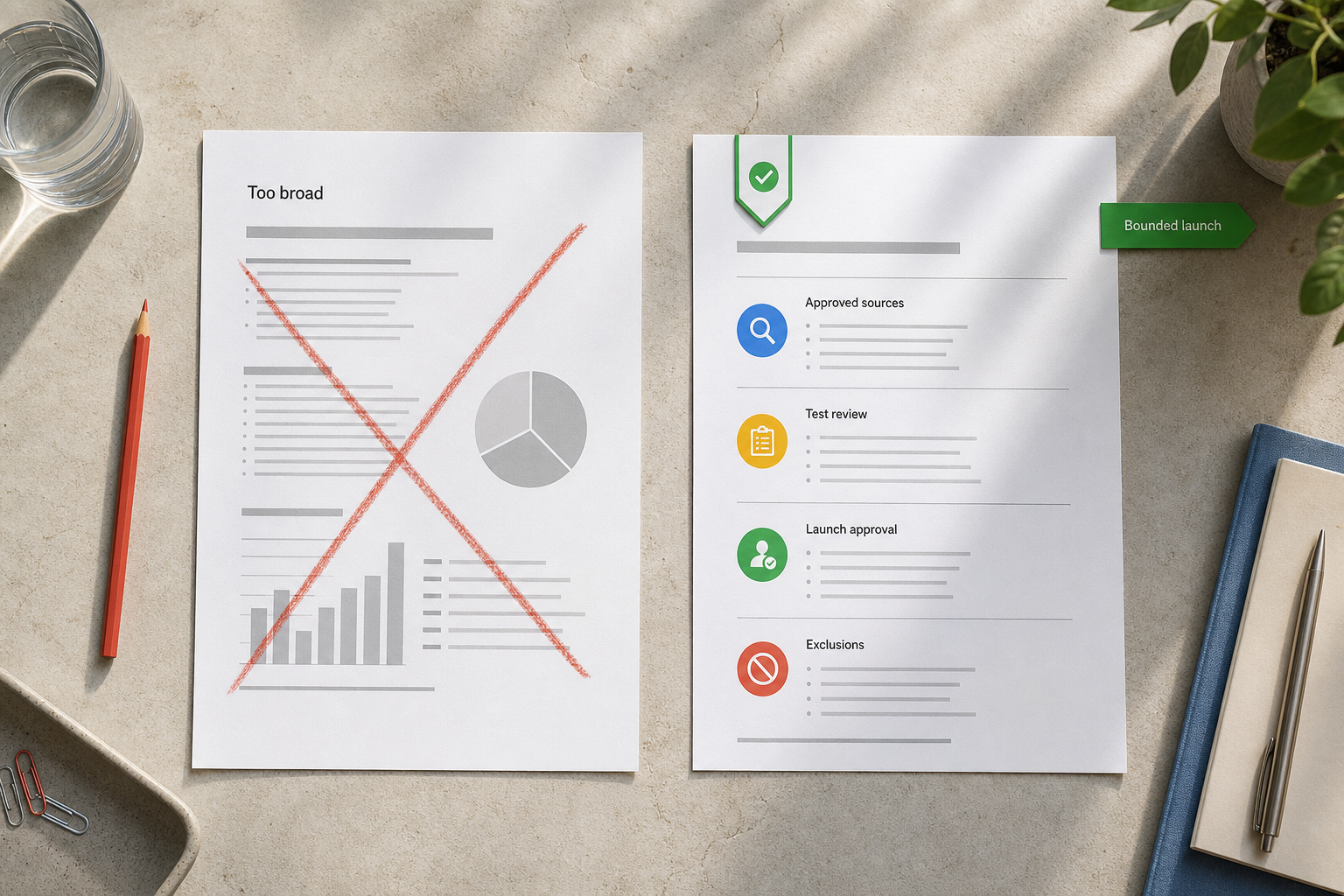
The agency should not send a proposal that says, "We will build an AI chatbot for your business." That is too broad. It invites the client to imagine support automation, sales automation, content creation, CRM updates, reporting, and custom workflows all at once.
A better proposal version looks like this:
| Proposal section | Client-facing example |
|---|---|
| Executive problem statement | "Visitors are asking repeat questions about services, requirements, policies, and booking steps. Answers exist, but they are spread across website pages and internal documents. This project will create a branded website assistant that answers from approved content and captures lead details for follow-up when relevant." |
| Scope and deliverables | "Agency will configure one branded website assistant, connect approved source materials, prepare representative test questions, revise answers within the agreed review process, and provide launch-ready placement guidance." |
| Client responsibilities | "Client will provide approved pages, FAQs, policy content, and one approval owner. Client will review test conversations and provide consolidated feedback during the review window." |
| Timeline and review | "The project moves through source approval, draft assistant review, test conversation review, revisions within scope, and final launch approval. Dates depend on timely client inputs and review." |
| Success measures | "The assistant is ready for launch when it answers representative test questions from approved sources, captures agreed lead details where relevant, routes unresolved questions through the approved path, and receives final client approval." |
| Exclusions | "This proposal excludes new content writing, custom website development, unapproved integrations, legal review, recurring reporting, and ongoing optimization unless added separately." |
This scenario works because each line gives the client a decision. They can approve the problem, approve the sources, approve the workflow, name their reviewer, and understand what is not included.
It also keeps the agency out of vague promises. The agency is not claiming the assistant will answer every possible question, replace a support team, or produce a specific revenue outcome. It is proposing a bounded launch that can be reviewed.
When a Proposal Template Is Not Enough
A template helps only when the underlying decisions are clear. Pause before sending the proposal if any of these conditions apply:
| Warning sign | What to do before sending |
|---|---|
| The use case is unclear | Narrow the workflow before writing deliverables. |
| No one owns the source content | Get a client content owner before promising dates. |
| The client expects the chatbot to answer from unapproved material | Define approved sources and unsupported topics first. |
| The pricing model is unresolved | Keep commercial terms as a placeholder until scope is confirmed. |
| The buyer wants legal, regulated, or liability-heavy language | Get legal review instead of writing contract language inside the proposal. |
| The client expects reporting or ongoing optimization | Separate launch acceptance from recurring reporting and support work. |
The template should clarify decisions, not hide missing ones. If a section feels hard to write, that is usually a signal. The proposal may need a shorter scope, a clearer source boundary, a named client owner, or a separate legal or commercial review before it is sent.
FAQ
What should an AI chatbot proposal include?
It should include an executive problem statement, proposed solution, scope, deliverables, client responsibilities, timeline, review process, success measures, exclusions, and a commercial terms placeholder if pricing is not final.
Should the proposal include exact pricing?
Only if scope and commercial terms are already approved. If not, use a short placeholder such as "commercial terms to be added after scope confirmation." Do not use the proposal to compare pricing models or calculate the quote.
How detailed should client responsibilities be?
Detailed enough for the client to know what they must provide and approve. Name source content, approval owner, review participation, feedback timing, and the effect of delayed inputs. Save detailed intake steps for onboarding.
How should exclusions be phrased?
Use plain nouns. For example: "This proposal excludes new content writing, custom integrations, extra review rounds, legal review, recurring reporting, and post-launch optimization unless added separately." Adjust the list to match the approved scope.
When should a proposal get legal review?
Get legal review when the proposal becomes a contract, includes liability terms, handles regulated claims, or commits to legal obligations. The proposal structure here is for client-facing scope clarity, not legal advice.