TL;DR
- Build seven assets before the first serious pitch: offer one-pager, demo script, proposal scope, security FAQ, onboarding checklist, reporting sample, and renewal narrative.
- Tie each asset to one client objection so your collateral answers the buyer's real concern instead of repeating product features.
- Use vendor-verification notes in every asset before you promise integrations, data handling, compliance, uptime, pricing, usage limits, or outcomes.
- Keep security, pricing, scope, and reporting language bounded. The sales pack should reduce risk, not replace legal review, pricing strategy, project planning, or monthly analytics work.
Your agency may already know how it wants to position a white-label AI or chatbot offer. The sales problem starts when a client asks what they are buying, what the demo proves, what their team must provide, what happens to their content, and how value will be reviewed after launch. A credible collateral pack answers those questions before the pitch stalls.
Key Takeaways
- White label ai sales collateral should prove that the agency has a sellable, bounded offer before a client asks for details.
- The offer one-pager defines the package, the demo script proves one workflow, and the proposal scope protects delivery from vague expectations.
- The security FAQ should route unknowns to vendor documentation instead of guessing about retention, compliance, access, or data handling.
- The onboarding checklist shows what the client must provide after approval, while the reporting sample and renewal narrative explain what happens after launch without promising revenue or retention outcomes.
- Any claim about pricing, integrations, white-label presentation, deployment, usage limits, analytics, security controls, or model behavior should be verified with the vendor before it appears in client-facing collateral.
Map Each Client Objection To One Sales Asset
The fastest way to audit agency AI sales assets is to ask which client objection each asset answers. If every PDF, slide, and call note says the same broad claim, the pack will still fail under buyer questions.
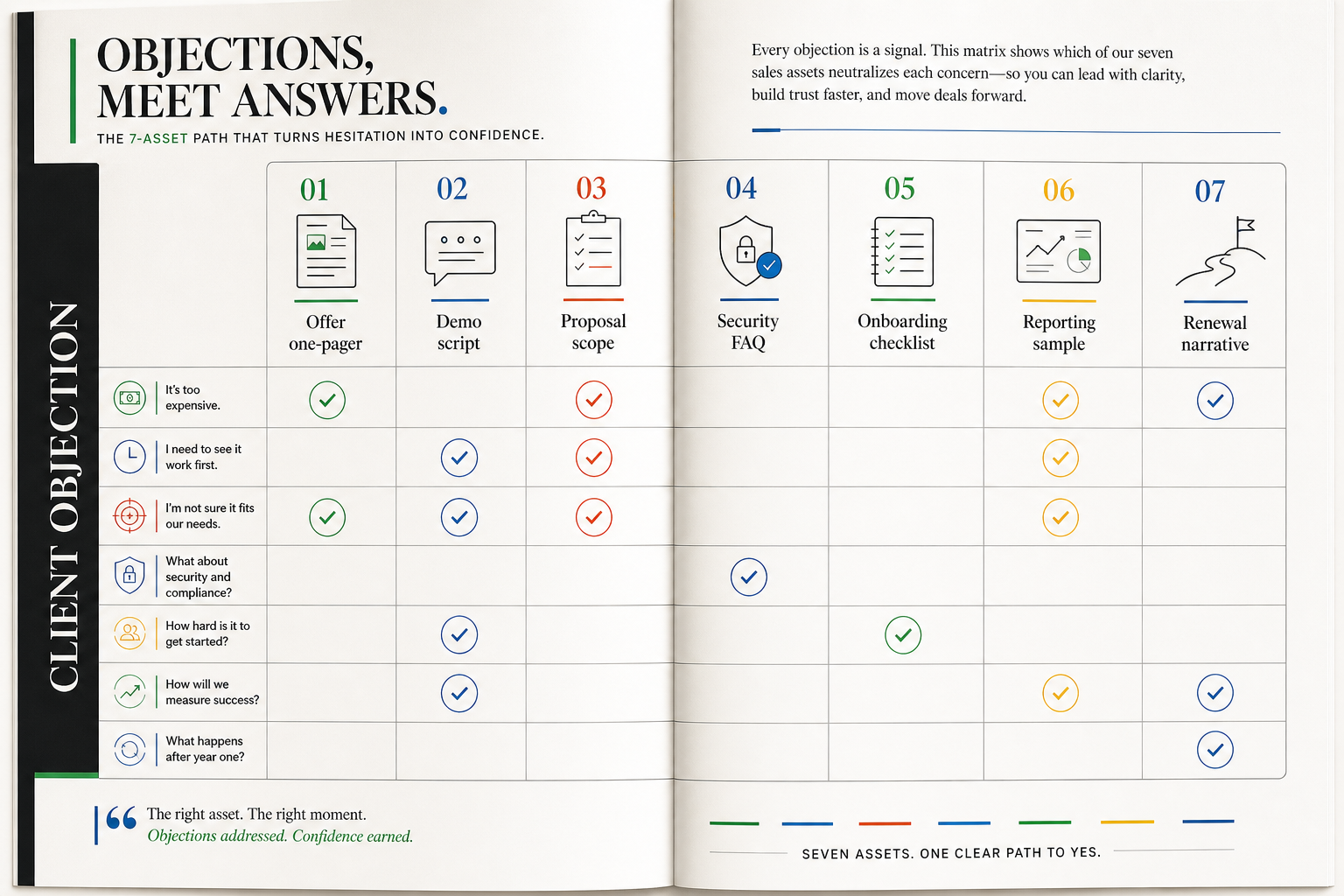
Use this map before writing the assets:
| Client objection | Best sales asset | What the asset should settle |
|---|---|---|
| What exactly are we buying? | Offer one-pager | The bounded package, buyer fit, workflow, launch surface, and ownership language |
| Will this work for our visitors? | Demo script | One realistic workflow using approved client sources and a visible next step |
| What is included, and what costs more later? | Proposal scope | Included work, client inputs, exclusions, review owner, and change request placeholder |
| What happens to our content and visitor questions? | Security FAQ | Questions the agency can answer, questions the vendor must verify, and escalation points |
| How much work will our team need to do? | Onboarding checklist | Required source approvals, brand inputs, handoff owners, access, and launch page details |
| How will we know whether it is useful? | Reporting sample | The fields the client can expect to review after launch without overclaiming attribution |
| Why would this continue after launch? | Renewal narrative | Ongoing updates, unanswered question review, handoff tuning, and content recommendations |
This map does not replace discovery, pricing, or delivery planning. It keeps the sales conversation from drifting into unsupported claims. If a client has not chosen whether the offer should be white-label, client-branded, or managed-service led, route them to White Label AI vs Client-Branded Chatbots before rewriting the collateral.
A useful rule: every asset needs three small fields behind the scenes, even if those labels never appear in the final PDF. Write what the asset includes, what it must not promise, and what must be verified with the platform or vendor first.
Build The Seven Assets With Include, Avoid, And Verify Fields
The seven assets below form the minimum credible pack for a white-label AI or chatbot pitch. They are not long documents. They are decision tools for a buyer who is close enough to ask practical questions.

| Asset | Include | Avoid | Verify before using in sales |
|---|---|---|---|
| Offer one-pager | Buyer fit, target audience, primary workflow, source set, deployment surface, handoff path, ownership language, pricing field if already verified | ROI claims, reseller economics, unlimited usage, custom integration promises, certification claims | Branding controls, source limits, assistant limits, usage rules, current pricing, deployment surfaces, white-label presentation details |
| Demo script | Starting page, approved source example, three test prompts, lead capture or handoff moment, fallback answer, next step | Presenting a scripted path as production performance, claiming perfect accuracy, hiding fallback behavior | Model choice, source behavior, tool access, handoff options, integration behavior, analytics visibility |
| Proposal scope | Included workflow, approved sources, launch surface, client inputs, review owner, exclusions, change request placeholder | Full project plan, acceptance test depth, pricing model education, broad custom development language | Embed limits, custom domain availability, API access, integrations, data handling, support boundaries |
| Security FAQ | Approved source language, sensitive-data caution, access owner, conversation log questions, vendor documentation path | HIPAA, SOC 2, GDPR, retention, encryption, subprocessor, or legal compliance claims without verified documentation | Security documentation, data processing terms, retention, access controls, subprocessors, escalation path |
| Onboarding checklist | Source approvals, brand inputs, tone, welcome message, suggested prompts, handoff inbox or CRM owner, review contact, launch page | No-effort setup language, skipped approvals, vague ownership | Supported source formats, builder controls, embed process, custom domain needs, integration requirements, seats or roles |
| Reporting sample | Conversations, lead captures, handoffs, unclear questions, missing content, suggested updates | Revenue attribution, guaranteed support reduction, complete analytics strategy | Available analytics fields, export options, conversation review access, handoff visibility, source-gap reporting |
| Renewal narrative | Source updates, answer review, prompt or behavior adjustments, handoff tuning, reporting review, content recommendations | Retainer pricing models, income claims, guaranteed renewals | What can be edited after launch, reporting cadence, tool changes, assistant limits, vendor support boundaries |
The offer one-pager should be the simplest asset in the pack. A client should be able to read it and understand the shape of the offer without asking for a platform tour. Use exact nouns: assistant name, target visitor, supported workflow, approved sources, launch location, handoff owner, and post-launch review. If the agency uses InsertChat, platform-specific language can mention approved pages, docs, videos, FAQs, policies, branding controls, deployment surfaces, integrations, handoff, and analytics only when those details match the chosen setup. For platform specifics, point the writer or sales owner to InsertChat features before a claim becomes client-facing.
The demo script should be written around one client workflow, not a feature tour. For example: a visitor lands on a product information page, asks a pre-sale question, receives an answer grounded in approved content, asks a follow-up, then either submits a lead form or reaches a handoff path. Include one fallback moment where the assistant does not know or needs to route the visitor. That fallback is useful because it shows the client that the offer has boundaries.
The proposal scope should be short enough to sell and clear enough to protect delivery. It should name the workflow, approved source set, launch surface, client review owner, and excluded requests. Exclusions matter most when the buyer assumes that any future integration, department, brand, language, or site section is included. Do not turn this section into an implementation guide. The proposal only needs enough detail to prevent the client from buying a vague promise.
The security FAQ belongs in the collateral pack because clients will ask trust questions during sales. Keep it narrow. Include questions such as: Which sources will train the assistant? Who approves those sources? Should sensitive data be included? Who can review conversations? What vendor documentation is available? Which questions need IT, legal, or vendor review? For deeper treatment, use how agencies should explain AI data and security to clients. In this sales pack, the goal is to avoid guessing.
The onboarding checklist should show the client that launch requires their input. Even with a no-code builder or a simple embed path, the client still needs to approve sources, supply brand assets, choose tone, name a handoff owner, confirm the launch page, and review test prompts. This checklist helps account leads avoid a common sales mistake: making setup sound automatic, then discovering after signature that no one has approved the content or handoff path.
The reporting sample should preview what the client will see, not promise business results. A responsible sample might include conversation count, lead captures, handoffs, unclear questions, missing content themes, and recommended source updates. That gives the buyer a concrete view of post-launch review without claiming revenue attribution or guaranteed support reduction.
The renewal narrative should exist before the first pitch because it shapes the offer language. Do not wait until month two to explain why the work continues. The sales version can say that the agency reviews unanswered questions, updates approved sources, adjusts prompts or behavior, tunes handoff paths, and recommends content improvements. Keep pricing, margins, and renewal probability out of this article's scope. The point is ongoing usefulness, not an income claim.
Scenario: A First Pitch Collateral Pack For One Client
Assume a small agency is preparing to pitch a white-label assistant to a content-rich B2B software client. The client has a large help center, product pages, several comparison pages, and a sales team that wants cleaner lead capture from website visitors.
The agency starts with the offer one-pager. It names the first workflow as "answer pre-sale product questions and route qualified visitors to sales." The one-pager lists the approved source set as product pages, help center articles, FAQs, and policy pages selected by the client. It names the first deployment surface as the website widget on three high-intent pages. It leaves pricing as a verified proposal field, not a published claim.
Next, the agency writes the demo script. The script opens on a product page. The first test prompt asks what the product does for a specific role. The second asks a feature-fit question that should be answered from the approved product page. The third asks for a next step, which triggers lead capture or handoff to the sales inbox. The demo also includes one question outside the source set, so the assistant can show a bounded answer instead of pretending to know.
The proposal scope stays compact. It includes one assistant, one approved source set, one launch surface, one review contact, one handoff path, and one reporting sample after launch. It excludes custom CRM workflows, additional departments, compliance claims, new source creation, and extra launch surfaces unless added later.
The security FAQ does not claim certifications or retention periods. It says the client approves sources before launch, sensitive internal documents should not be added without review, access and conversation review permissions must be confirmed, and vendor documentation is needed for detailed data handling questions. That gives the sales lead a useful answer without making a legal promise.
The onboarding checklist asks the client for source URLs, brand colors, assistant name, welcome message, suggested prompts, handoff inbox, CRM owner if relevant, review stakeholder, and launch page approval. The reporting sample shows sample rows for conversations, handoffs, lead captures, unclear questions, and missing content themes. The renewal narrative says the agency will review real questions, recommend source updates, adjust the assistant's behavior within the approved setup, and tune handoff paths.
This pack gives the agency enough to pitch with confidence. It does not require a full implementation plan, a pricing model explanation, a security white paper, or a monthly analytics strategy. It gives the buyer enough concrete material to decide whether the offer fits.
FAQ
What sales collateral does an agency need before pitching white-label AI?
Build at least seven assets: offer one-pager, demo script, proposal scope, security FAQ, onboarding checklist, reporting sample, and renewal narrative. The pack is ready when each asset answers a distinct client objection and names the claims that require vendor verification.
Should pricing appear in the one-pager?
Only as a verified field. The one-pager can show where pricing belongs, but it should not explain pricing models, margins, reseller terms, income claims, or competitor pricing. If current pricing or usage rules are not verified, leave the number out of client-facing collateral.
What should a demo script prove?
It should prove one bounded client workflow. Use approved sources, realistic prompts, a visible handoff or lead capture step, and a fallback answer. A demo should not imply production accuracy, full coverage, or custom integrations that have not been tested.
What security claims should agencies avoid before vendor verification?
Avoid claims about HIPAA, SOC 2, GDPR, encryption specifics, retention periods, zero data sharing, subprocessors, legal compliance, or access controls unless the vendor documentation supports the exact wording. Put those questions in the security FAQ as verify or escalate items.
How much product detail should the collateral include?
Include enough detail to make the offer believable: source types, branding controls, deployment surface, handoff path, integrations if relevant, analytics preview, and ownership language. Do not list every platform feature. The buyer needs to understand the offer they are buying, not memorize the software.
When should an agency link to the branding model or security guide?
Use the branding model guide when the buyer is still unsure who should own the client relationship, presentation, and delivery responsibility. Use the security guide when the buyer asks detailed questions about data, access, retention, vendor documents, or escalation rules. This article's job is the sales collateral pack, not those broader decisions.