TL;DR
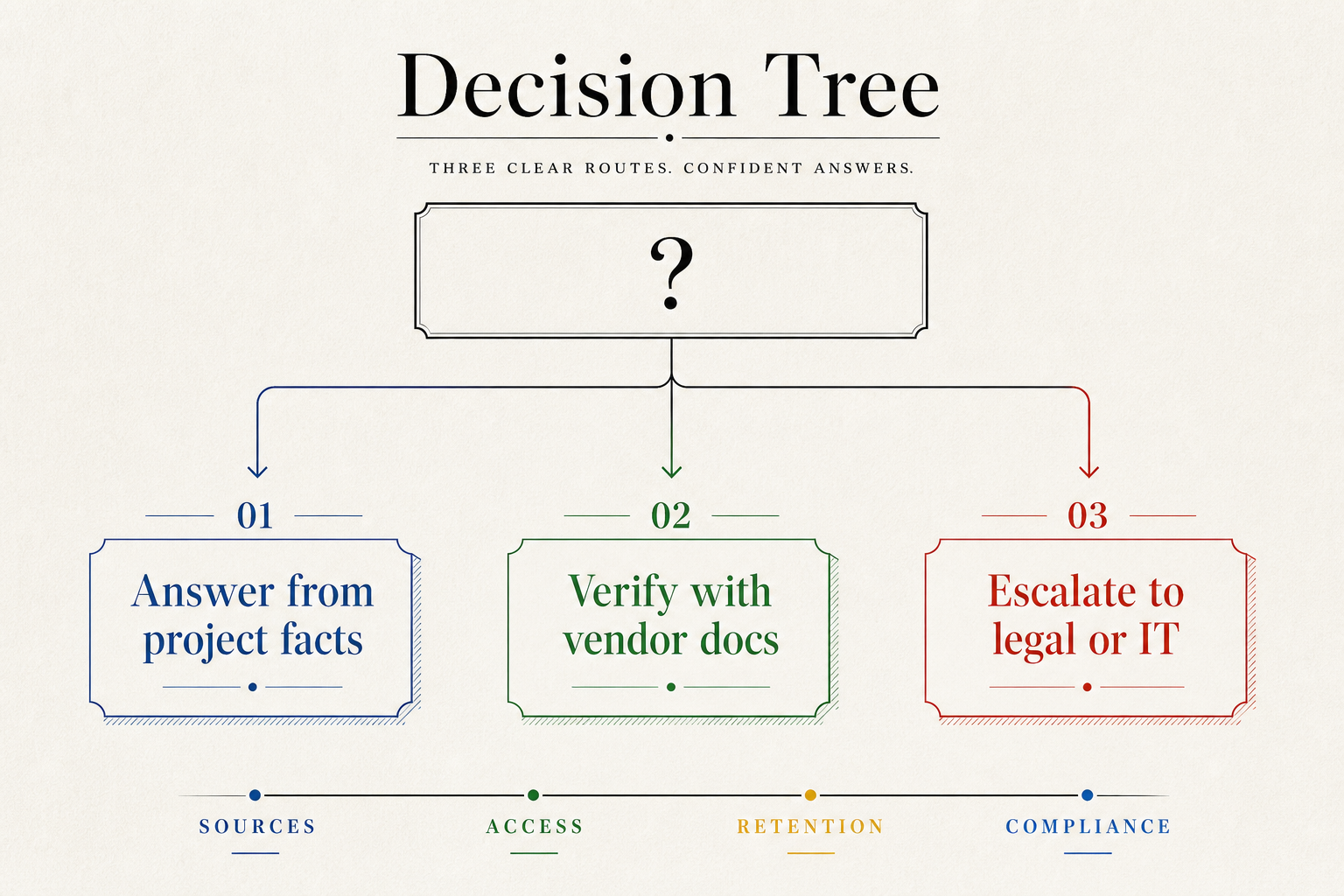
- Treat client security questions as a routing problem: answer project facts, verify vendor claims, and escalate legal or IT decisions.
- Start with the data sources the chatbot will use, then mark excluded sensitive data before launch.
- Do not promise certifications, access controls, retention terms, deletion windows, or compliance outcomes unless vendor documentation and client approval support the claim.
- Keep a simple record of who owns each answer: agency, client, vendor, client legal, or client IT.
- When a client asks about regulated data, internal policy, procurement review, or contractual risk, bring in their legal or IT team before implementation moves forward.
A client can like the chatbot demo and still pause the project when procurement asks where the data comes from, who can see chats, how long logs stay available, and what security documentation exists. The agency needs a way to answer ai chatbot security questions clients ask without turning a sales reply into an unsupported security claim.
Key Takeaways
- The agency should answer only what the project facts prove: approved sources, excluded sources, intended workflow, handoff path, and current project boundaries.
- The vendor should verify platform facts: data handling, access settings, retention behavior, subprocessors, deletion process, security documentation, and any claimed controls.
- The client should approve what belongs to the business: source permissions, sensitive data exclusions, internal policy rules, and who may review conversations or leads.
- Client legal or IT should review questions about regulated data, compliance labels, procurement requirements, contract terms, system access, and internal risk tolerance.
- Ownership model matters because the party facing the client may change. For model context, use the separate guide to white-label AI vs client-branded chatbots, then return to the security question owner for this specific project.
Start With The Data The Chatbot Will Use
The first client security question is usually practical: what will the chatbot read?
Do not start with platform claims. Start with the proposed source list. For an agency chatbot project, that list might include approved website pages, help center articles, product information, policy pages, FAQs, listings, documents, videos, or other client-approved materials. InsertChat website context describes assistants grounded in approved website content and source material, but the agency still needs the client to confirm what belongs in the project.
Create a short source register before replying to procurement or the client sponsor:
| Source type | Owner | Approved for chatbot use? | Notes |
|---|---|---|---|
| Public website pages | Marketing lead | Yes or pending | Confirm stale pages are excluded |
| Help center articles | Support lead | Yes or pending | Confirm which categories apply |
| Product documents | Product owner | Pending | Remove internal-only notes |
| Policy pages | Legal or operations | Pending | Review before use |
| Customer records | Client IT or legal | No unless approved | Treat as sensitive until reviewed |
This keeps the conversation grounded. If the client asks, “Will the chatbot use our internal files?” the agency can answer, “Only the sources the client approves for this project. We are separating public, approved, pending, and excluded sources before launch.”
The tradeoff is simple. A broader source set can improve answer coverage, but it raises the review burden. A narrower source set may answer fewer questions, but it is easier to approve and easier to explain.
Separate Useful Sources From Sensitive Data
Useful content and sensitive data are not the same thing. Agencies should make that distinction early, before a source list becomes a promise.

Sensitive data categories depend on the client, industry, and internal policy. Do not define the law for the client. Use plain prompts that help the client route the decision:
- Does this source include customer records, account details, private support history, or lead data?
- Does it include patient, employee, student, financial, legal, contract, or HR information?
- Does it include internal-only pricing, sales notes, vendor contracts, or operational policies?
- Does it include documents that only certain client employees are allowed to view?
- Will the chatbot collect names, emails, phone numbers, account details, uploaded files, or free-text messages from visitors?
The output should be an exclusion list, not a debate. For example: “Phase one excludes customer records, employee files, private case documents, internal contracts, and any source the client has not approved.”
This protects the agency from a common overclaim: treating every client document as safe because the chatbot is “only answering questions.” If a source contains sensitive material, the client should decide whether it belongs in the knowledge base, whether it needs redaction, or whether it should stay out entirely.
Caution applies when the chatbot connects to app data, CRM records, ecommerce systems, support tools, or handoff workflows. The project may still be valid, but the security conversation needs a narrower scope and more explicit approval.
Answer Access Questions By Owner, Not Guesswork
Clients will ask who can see source files, chats, lead submissions, handoff notes, and assistant settings. The wrong answer is a confident guess. The right answer assigns each question to the owner who can prove it.
| Client question | Agency can answer | Vendor must verify | Client legal or IT decides |
|---|---|---|---|
| Which sources will the chatbot use? | Project source list and exclusions | How sources are stored or processed | Whether each source is approved |
| Who can update the chatbot content? | Planned agency and client roles | Available access controls and permissions | Who should receive access |
| Who can view chat logs or leads? | Intended workflow and handoff owner | Platform log access behavior | Internal policy for log review |
| Can the assistant connect to CRM or support tools? | Proposed handoff path | Integration data handling | System access approval |
| Can we claim a compliance standard? | No, unless documented and approved | Current vendor documentation | Whether the documentation satisfies the client |
This table is not a platform evaluation checklist. It is a client conversation tool. It prevents the agency from answering a vendor-control question as if it were a project-management question.
For example, the agency may know that the sales team should receive qualified lead notifications. That does not prove who can access stored chat transcripts inside the platform. The agency may know which client pages will be used as sources. That does not prove retention behavior or storage location. Those claims need vendor documentation.
Ask Retention And Conversation Log Questions Before Launch
Retention questions often arrive late, after the demo feels approved. Bring them forward before launch because they affect scope, client review, and vendor verification.
Ask about each data type separately:
- Source files: Are uploaded documents retained, reindexed, deleted, or replaced when sources change?
- Chat transcripts: Are visitor conversations stored, and for how long?
- Lead records: Where do names, emails, phone numbers, and form answers go?
- Handoff notes: Are summaries or tickets stored in a support tool, CRM, inbox, or internal system?
- Analytics: Are top questions, content gaps, lead signals, or source usage reports available, and what data do they include?
The agency should not invent deletion windows, storage regions, log availability, or retention controls. If the vendor documentation does not answer the question, say that it is pending verification.
A useful proposal note is short and clear: “Retention for source files, chat logs, lead records, and handoff records will be confirmed against vendor documentation and client policy before launch. The agency will not approve regulated or internal-only data for chatbot use without client review.”
This may slow the timeline. That is better than launching with assumptions that later conflict with procurement, legal, or IT requirements.
Request Vendor Documentation Before You Promise Controls
When a client asks about security, compliance, privacy, or procurement review, the agency needs documentation, not sales memory.
Request only the documents needed to answer the client’s current questions:
- Security overview or security page
- Privacy policy
- Terms of service
- Data processing agreement, if available
- Subprocessor list, if available
- Data handling notes for source files, chat logs, lead data, and integrations
- Access-control documentation, if available
- Retention and deletion documentation, if available
- Audit, logging, or reporting documentation, if available
- Support or escalation contact for security questions
Treat terms like HIPAA, SOC 2, GDPR, audit trails, role-based access, data isolation, and zero data sharing as verification categories unless you have current approved documentation. Do not repeat them as facts about a product just because a snippet, sales page, or demo mentioned them.
The agency’s job is to collect evidence and route it. The client’s legal or IT team decides whether the evidence is enough for their policy, contract, industry, or procurement process.
A practical evidence folder can include the client source list, excluded-source list, vendor documentation, open questions, and the named approval owner for each unresolved item. That is enough to move the conversation forward without turning the agency into the client’s compliance advisor.
Use A Client-Safe Talk Track When You Do Not Know Yet
Agencies lose trust when they answer beyond the evidence. They also lose momentum when every security answer sounds vague. Use a three-part response pattern: known, verifying, owner.
Example client-safe language:
- “For this project, the chatbot will use only the sources you approve. We are keeping private records and internal-only documents out unless your team reviews and approves them.”
- “We can confirm the proposed workflow and handoff path. We are asking the vendor to verify platform-level data handling, retention, and access details before we repeat those claims.”
- “That question touches your internal policy, so your legal or IT owner should approve the answer before launch.”
- “We should not describe the chatbot as compliant with a specific standard unless the vendor documentation and your review support that wording.”
- “We can move forward with public approved sources while the sensitive-data and procurement questions are reviewed.”
This keeps the sale active without pretending every risk is already resolved. It also gives the client a cleaner internal path: project facts from the agency, platform facts from the vendor, policy approval from the client.
For InsertChat-related agency work, keep product language close to verified positioning: branded assistants can answer visitor questions from approved website content, and workflow pages span marketing, support, ecommerce, content, lead capture, handoff, and website visitor experience. Do not add security guarantees unless approved documentation supports them.
Scenario: A Client Sends Security Questions After The Demo
An agency demos a website support and lead capture chatbot for a professional services client. The sponsor likes the experience, then forwards questions from operations and IT:
- What website pages and documents will the chatbot use?
- Will it include client files, contracts, or private case notes?
- Who can view chat conversations and lead submissions?
- How long are chats and lead records kept?
- What security documentation can the vendor provide?
- Can we say the chatbot meets our compliance requirements?
The agency should not reply with one broad assurance. It should split the response.
First, the agency answers project facts. The chatbot will start with approved public website pages, selected FAQ content, and reviewed service descriptions. It will exclude private client files, contracts, internal case notes, employee records, and any source not approved by the client owner.
Second, the agency marks vendor verification items. Access behavior, retention, deletion, data handling, subprocessors, and any security-control claims need vendor documentation. The agency requests those materials and keeps the client updated on which items are confirmed and which remain open.
Third, the agency routes policy decisions. The client’s legal or IT team reviews whether the proposed source list, lead capture fields, chat log handling, vendor documents, and any compliance wording satisfy internal requirements.
The outcome is not “approved to launch” by default. The outcome is a cleaner project boundary: approved source list, excluded sensitive data, pending vendor documentation, and named client reviewers. The project can proceed only where those boundaries are clear.
Decision Checklist: Answer, Verify, Or Escalate
Use this checklist before replying to the client.
| Question type | Answer now | Verify with vendor | Escalate to client legal or IT |
|---|---|---|---|
| Data sources | Approved source list, source owner, excluded sources | How sources are processed, stored, updated, or deleted | Whether sources are allowed for chatbot use |
| Sensitive data | Project exclusions and capture limits | Platform handling of submitted data | Whether regulated, private, or internal data can be used |
| Access | Intended agency and client roles | Available permissions, log access, admin access, integration access | Who should receive access under client policy |
| Retention | Project requirement or open question | Retention periods, deletion process, export options | Whether retention meets policy or contract needs |
| Vendor documentation | Documents requested and received | Accuracy and current status of vendor materials | Whether evidence is sufficient for approval |
| Compliance claims | Do not claim without evidence | Vendor certifications or control documentation, if available | Whether wording can be used in procurement or contracts |
| Escalation rules | Named agency contact and client sponsor | Vendor security contact or support path | Legal, IT, procurement, privacy, or security owner |
A strong client reply does not have to answer every question immediately. It has to show control over the next action. If the agency can answer from project facts, answer. If the answer depends on the platform, verify. If the answer affects legal, compliance, procurement, or internal policy, escalate.
FAQ
Can an agency answer chatbot security questions without involving legal or IT?
Yes, for project facts the agency owns. That includes proposed data sources, excluded sources, workflow boundaries, lead capture fields, handoff path, and which questions are still pending. Involve client legal or IT when the answer depends on regulated data, internal policy, system access, procurement requirements, contract terms, or compliance wording.
What should we do when a client asks about HIPAA, SOC 2, or GDPR?
Do not interpret the requirement or claim coverage unless approved documentation and client review support it. Treat the term as a verification item. Ask the vendor for current documentation, then route the answer to the client’s legal, privacy, security, or IT owner.
What vendor question should we ask first?
Start with the data path: what happens to source files, chat messages, lead data, integrations, and logs. Then ask about access, retention, deletion, subprocessors, and available security documentation. Keep the request tied to the client’s actual project rather than a broad platform review.
How do we avoid overpromising security during sales?
Use evidence boundaries. Say what the client has approved, what the agency is configuring, what the vendor has documented, and what remains unresolved. Avoid labels like compliant, secure, isolated, audited, or certified unless the wording is backed by current documentation and approved by the client’s review owner.
Does white-label resale change who answers security questions?
It can change who faces the client, but it does not remove the need for proof. In a white-label model, the agency may carry more of the client-facing explanation. In a client-branded or managed-service model, the client or vendor may be more visible. Either way, project facts, vendor facts, and legal or IT decisions should stay separate.