TL;DR
- White-label AI resale means the agency presents the assistant offer under its own brand and takes more ownership of the client relationship.
- A client-branded assistant keeps the client visible while the agency may configure the assistant, sources, handoff, and brand settings.
- Managed service delivery means the agency stays responsible for ongoing care, updates, review, and client communication.
- The right model depends on who owns branding, setup, content sources, support, billing assumptions, reporting expectations, and ongoing changes.
- Pricing, reseller terms, platform evaluation, security verification, proposal assets, and retainer design should be handled after the model is clear.
An agency comparing white label AI vs client-branded chatbot options is usually past the basic question of whether an AI assistant could help. The harder decision is commercial and operational: who should appear to own the assistant, who explains it to the client, who controls the source content, who answers support questions, and who is expected to keep it useful after launch. Those answers determine whether the opportunity is best framed as white-label AI resale, a client-branded assistant implementation, or managed service delivery.
Key Takeaways
Model selection is mostly about responsibility. The same assistant can be described with similar branding language, but the operating model changes when the agency owns the client relationship, the client owns the visible brand, or the agency owns ongoing care.
White-label AI resale gives the agency more control over how the offer is presented. It also raises expectations that the agency can explain the tool, set support boundaries, and handle client communication.
A client-branded assistant works best when the end user should experience the assistant as part of the client's own website, brand, content, and visitor workflow. The agency may still configure and implement it, but the client's brand remains front and center.
Managed service delivery fits when the client lacks internal capacity to maintain sources, review unanswered questions, adjust behavior, or coordinate handoff rules. This article treats managed service as an ownership model, not as a retainer package or pricing plan.
Before choosing any model, separate the model decision from later questions about pricing, reseller terms, vendor evaluation, security verification, sales collateral, and launch readiness.
Define The Three Models By Who Owns The Relationship
White-label AI resale means the agency presents an AI assistant product or offer under the agency's own brand. The client may not see the underlying platform as the primary relationship. The agency becomes the visible owner of the offer and usually carries more responsibility for explaining what the assistant does, what is included, and where support begins and ends.
A client-branded assistant implementation means the assistant is configured for the client's brand, content, tone, sources, and website workflow. The client remains the visible brand to its own visitors. The agency may handle setup, source connection, brand configuration, handoff paths, and implementation decisions, but the assistant should feel like part of the client's own experience.
Managed service delivery means the agency is not only setting up or reselling the assistant. It is also taking responsibility for some level of ongoing care. That can include keeping approved sources current, reviewing unclear questions, coordinating changes, or managing client communication about the assistant's behavior. The exact scope belongs in a separate agreement, but the model is defined by continued operational responsibility.
These labels can overlap. A client-branded assistant may use white-label presentation. A white-label AI offer may include managed service. A managed service may be delivered on top of a client-branded assistant. The useful distinction is not the label in the proposal. It is who owns the relationship and which responsibilities the client will assume the agency has accepted.
For agencies comparing tools, a branded AI assistant builder can support client-branded implementation when the work centers on owned website content, brand settings, and visitor questions. That product fit is separate from deciding whether the agency is reselling, implementing, or managing the service.
Use A Responsibility Table Before You Choose A Model
Use the model table before you talk about packages or sales language. It keeps the decision tied to responsibility instead of surface branding.
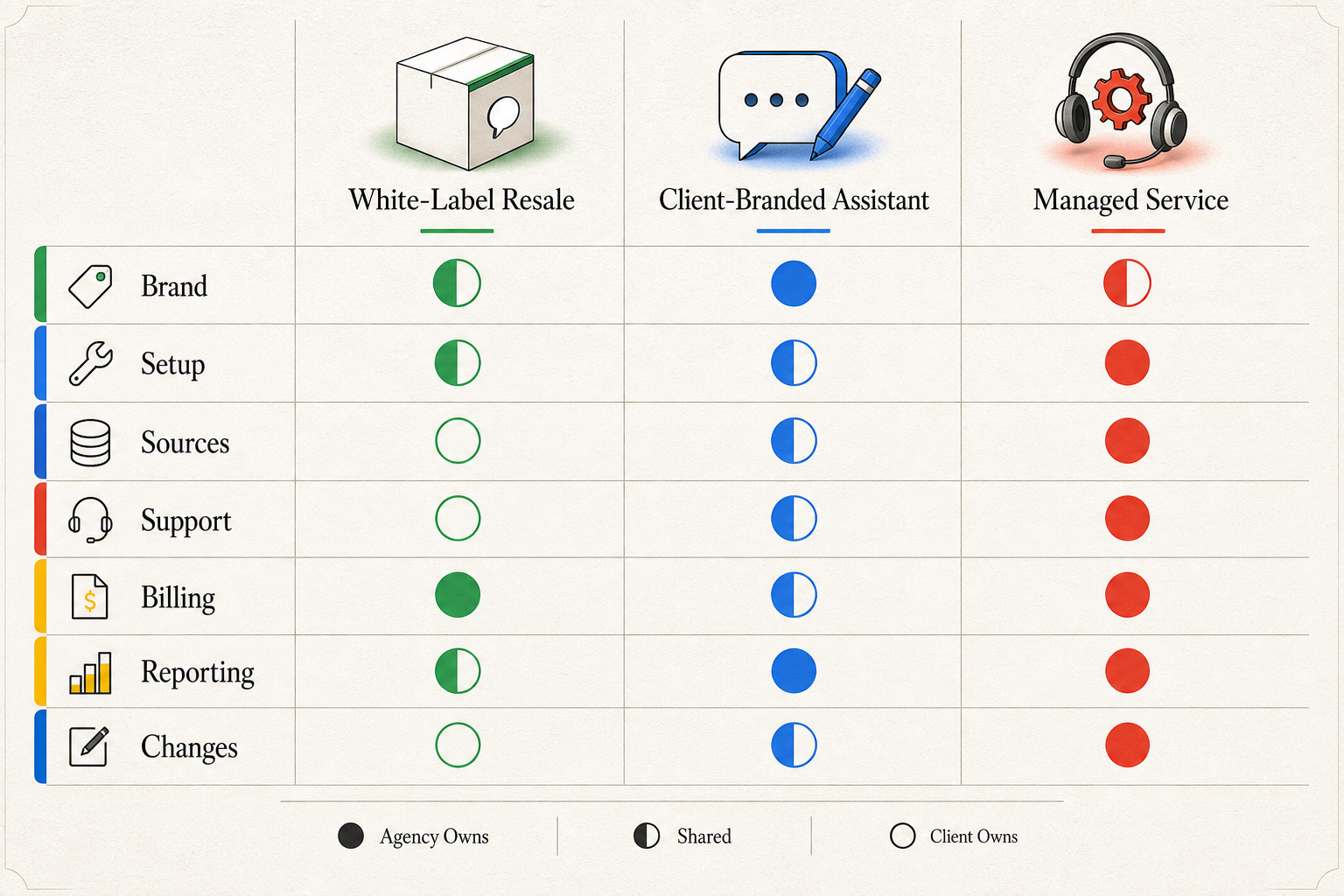
| Responsibility | White-label AI resale | Client-branded assistant implementation | Managed service delivery |
|---|---|---|---|
| Brand presentation | Agency brand leads the offer. | Client brand leads the visitor experience. | Client or agency brand may lead, depending on the underlying model. |
| Setup | Agency usually owns setup enough to deliver the promise. | Agency configures the assistant for the client's site, content, tone, and workflow. | Agency may own setup plus later changes. |
| Content sources | Client may provide approved sources, but agency must explain source limits clearly. | Client usually owns content approval. Agency connects or organizes sources. | Agency may help maintain or update sources over time. |
| Client communication | Agency is often the first point of contact. | Shared: agency handles implementation, client handles internal approval. | Agency often handles recurring communication about assistant behavior and changes. |
| Support | Agency needs clear support boundaries before selling. | Support depends on whether the issue is setup, content, platform, or client approval. | Agency may absorb more support coordination. |
| Billing assumptions | Agency may carry more commercial exposure. Verify terms separately. | Client billing exposure depends on the agreement and platform setup. | Ongoing effort must be accounted for separately. |
| Reporting expectations | Client may expect agency-level explanation of performance. | Reporting may focus on whether the assistant answers visitor questions and routes next steps. | Reporting expectations can become recurring, so ownership must be defined. |
| Ongoing changes | Agency may be expected to manage change requests unless excluded. | Changes may be shared between client approval and agency implementation. | Agency is more likely to own update coordination. |
This table is not a vendor checklist. It does not answer security, billing mechanics, data handling, partner terms, or commercial availability. Those questions matter, but they belong after the agency knows which relationship model it is trying to operate.
Choose White-Label Resale When The Agency Can Own The Offer
White-label resale fits when the agency wants to bring an AI assistant offer to market under its own brand and has enough capacity to own the client-facing promise. The agency is not just configuring a widget. It is putting its name on the offer.
That changes the client's expectations. If the assistant gives an unclear answer, fails to route a lead correctly, or needs a source update, the client may come to the agency first. If the client asks how the assistant works, what content it uses, or what support is included, the agency needs a responsible answer.
This model can be a fit when the agency already has a strong client relationship, a defined support process, and a clear view of what it can and cannot own. It can also fit when the agency wants to standardize how it presents AI assistant work across multiple clients.
Use caution when the agency is mainly attracted to the branding control but has not verified reseller terms, platform permissions, billing mechanics, support obligations, or security claims. White-label presentation does not automatically mean the agency has the right commercial structure to resell, nor does it remove the need to verify vendor documentation.
The decision rule is simple: choose white-label resale only when the agency is prepared to be treated as the owner of the offer in the client's eyes.
Choose A Client-Branded Assistant When The Client Should Stay Visible
A client-branded assistant fits when the assistant should look and sound like part of the client's own website. The client wants visitors to interact with its brand, its content, its tone, and its next-step workflow. The agency's role is to implement the assistant so that the client's brand remains visible.
This model is common when the client already has useful website content, FAQs, policies, docs, or service pages, and wants visitors to find answers faster. The agency may configure the assistant name, colors, welcome message, suggested prompts, tone, sources, handoff, and integrations. The client still needs to approve the content and own the brand decisions.
InsertChat describes this type of product context through white-label AI assistant features that include training on approved sources, branding the assistant, publishing it, and learning from visitor questions. In that use case, the agency can focus on implementation and workflow fit without pretending it owns the client's brand.
The main caution is boundary clarity. A client-branded assistant can still create agency support expectations if the client assumes the agency owns every update, unanswered question, or content gap. Before choosing this model, define who approves sources, who handles website changes, who answers stakeholder questions, and who decides whether the assistant's behavior needs adjustment.
Choose this model when brand visibility belongs to the client and the agency's value is implementation, configuration, and workflow judgment.
Choose Managed Service When The Agency Owns Ongoing Care
Managed service delivery fits when the client wants the assistant to stay useful but does not have the internal capacity to maintain it. The client may have approved content and a clear visitor workflow, yet still need help reviewing unanswered questions, updating sources, coordinating handoff rules, or explaining changes to stakeholders.
The agency's responsibility is broader than implementation. It may become the party that watches for recurring content gaps, coordinates updates, and keeps the assistant aligned with the client's current website and workflow. That can be useful for clients with changing services, frequent content updates, or limited internal ownership.
This model needs caution because ongoing care can expand quickly. If the client treats every new question, source edit, integration request, or reporting request as included, the agency can absorb work it never priced or staffed. That is why managed service should be selected only when the agency is willing to own ongoing responsibility and define its limits separately.
This article does not design the retainer, deliverables, reporting cadence, or monthly optimization process. The point here is narrower: managed service is the right model only when the agency is intentionally accepting continued operational responsibility.
Scenario: One Client, Three Possible Models
Consider an agency with a client that has a question-heavy website. The client has approved pages, service information, FAQs, and policies. It wants an AI assistant to answer visitor questions, capture leads when needed, and route conversations to a person or workflow when the assistant should not handle the next step alone.
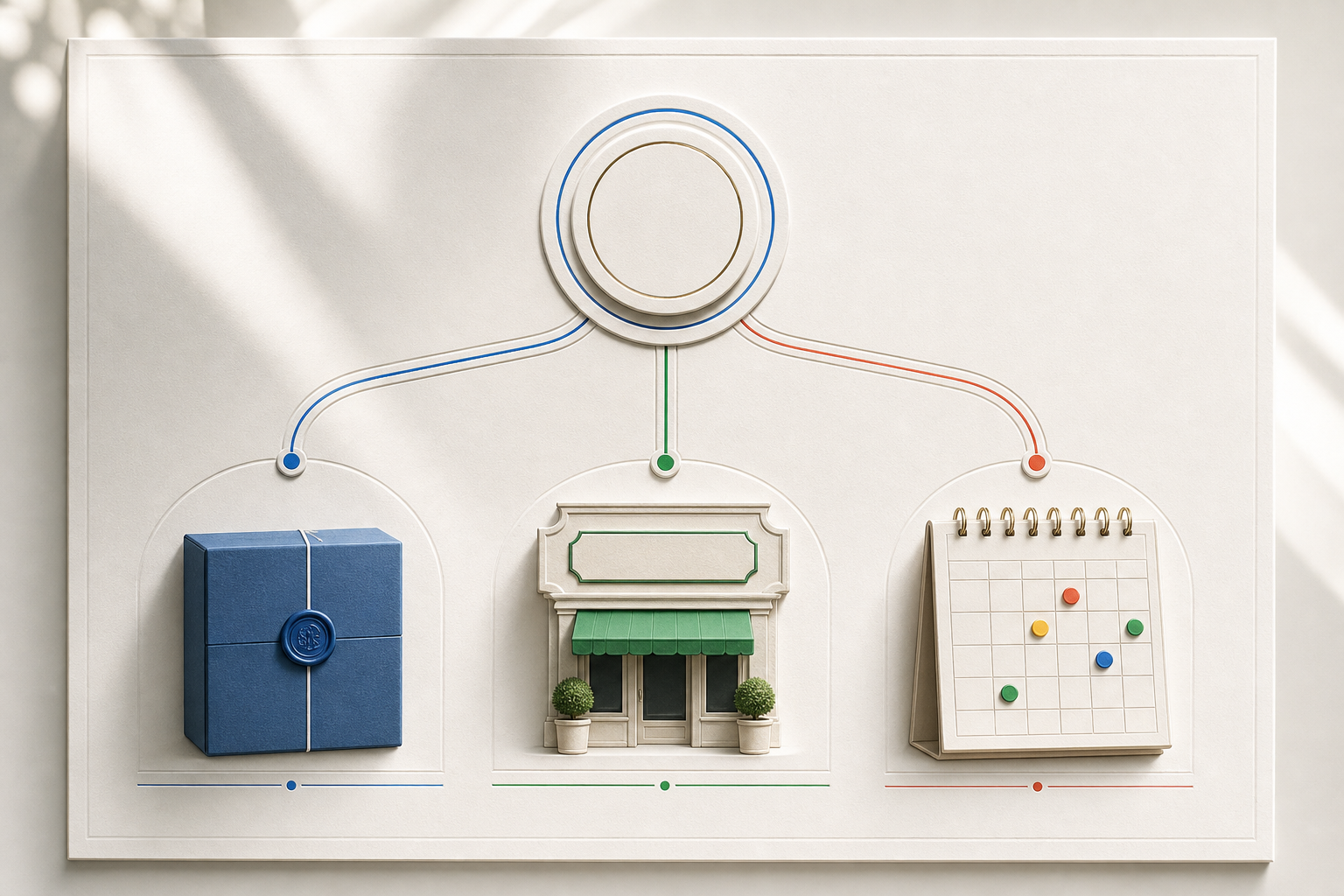
The opportunity could point to three different models.
If the agency wants to create its own branded AI offer and repeat it across clients, white-label resale may fit. The agency would present the assistant as part of its own service line and would need to own the client communication around what is included. It would also need to verify reseller terms, platform permissions, support obligations, and billing mechanics before selling the offer.
If the client wants the assistant to feel like part of its own site, client-branded implementation may fit better. The agency can help configure the assistant around the client's brand, approved content, visitor questions, lead capture path, and handoff rules. The client remains the visible brand, and the agency's role is to make the implementation work cleanly.
If the client says it does not have time to maintain sources, review unclear questions, or coordinate changes after launch, managed service may fit. The agency would then be accepting a continued role in keeping the assistant useful. That can be the right choice, but only if ongoing ownership is intentional and bounded.
The same client can justify different choices based on agency capacity and client readiness. A strong agency brand and support process points toward white-label resale. A client that wants its own brand to lead points toward client-branded implementation. A client without operational capacity points toward managed service.
Decision Checkpoint: What To Verify After The Model Choice
Once the model is clear, the next questions become easier to place. Do not try to answer all of them inside the model decision.
If the agency chooses white-label resale, the next work is to verify reseller terms, platform permissions, billing mechanics, support obligations, and what claims the agency can make. If the agency chooses client-branded implementation, the next work is to define content approval, implementation scope, access, handoff ownership, and change responsibility. If the agency chooses managed service, the next work is to define service boundaries, ongoing effort, reporting expectations, and how changes are requested and approved.
Security, privacy, compliance, legal, and vendor certification claims require separate verification from current vendor documentation and the client's own requirements. Pricing, package structure, proposal collateral, broad white-label strategy, and launch readiness are also separate decisions.
Use this checkpoint before committing to a go-to-market path:
- Can the agency support the model it wants to sell?
- Does the client need its own brand to stay visible?
- Who controls approved content sources?
- Who answers client and stakeholder questions?
- Who handles unclear answers, handoff issues, and change requests?
- Which assumptions affect billing or ongoing effort and need separate validation?
If those answers are unclear, do not let logo placement decide the model. Assign responsibility first, then build the commercial structure around it.
FAQ
What is the difference between white label AI and a client-branded chatbot?
White label AI usually means the agency presents the AI assistant offer under its own brand and takes more responsibility for the client relationship. A client-branded chatbot means the assistant carries the client's brand, content, tone, and website experience. The difference is not only visual. It changes who owns communication, support expectations, content approval, and ongoing changes.
Is a client-branded chatbot still white-label?
It can include white-label presentation, especially if the underlying platform is not visible to visitors. But the operating model depends on ownership. If the client remains the visible brand and the agency only implements the assistant, it is better to treat it as client-branded implementation. If the agency sells the offer as its own product or service line, it moves closer to white-label resale.
Which model is best for agencies?
The best model is the one the agency can support responsibly. White-label resale fits agencies ready to own the offer. Client-branded implementation fits when the client should stay visible and can approve its own content. Managed service fits when the client needs the agency to keep the assistant current over time.
Should agencies choose the model before pricing the offer?
Yes. Price depends on responsibility. An agency that owns support, client communication, reporting expectations, and ongoing changes is selling a different level of responsibility than an agency that only configures a client-branded assistant. Define the model first, then handle pricing and package structure separately.
Can InsertChat support branded or white-label assistant workflows?
InsertChat can be used to train, brand, and publish an AI assistant from approved sources, with controls for branding, tone, sources, handoff, and visitor questions. That supports branded and white-label presentation use cases. Reseller terms, pricing, security verification, and commercial structure still need separate review before an agency builds an offer around it.