TL;DR
- Trace the path from a visitor’s question to a recorded inquiry instead of treating every missed lead as the same problem.
- Establish a baseline before changing traffic, content, forms, staffing, or software.
- Check five possible leaks: unanswered questions, response delays, capture friction, unclear next steps, and invisible ownership.
- Test one well-supported gap first so you can tell whether the change helped.
A potential customer checks your website on Sunday to confirm your opening hours. The answer is hard to find, the contact option gives no clear expectation, and the visitor leaves. Your analytics record another visit, but they do not show which decision failed. Finding that break is the first useful step when website visitors are not converting to leads.
Key Takeaways
- Traffic volume alone cannot tell you why qualified interest disappears.
- Each visitor decision needs an observable signal, such as a question, form start, response timestamp, or recorded owner.
- A completed form is not necessarily a usable lead if the visitor receives no clear confirmation or the inquiry reaches no visible owner.
- Product capabilities should be evaluated against your own baseline, not treated as proof of higher lead volume.
- Prioritize the gap with the clearest evidence, the most meaningful likely consequence, and the simplest measurement path.
Map the journey and establish a baseline
A visitor does not move from page view to lead in one step. Several decisions sit between arrival and a usable inquiry:
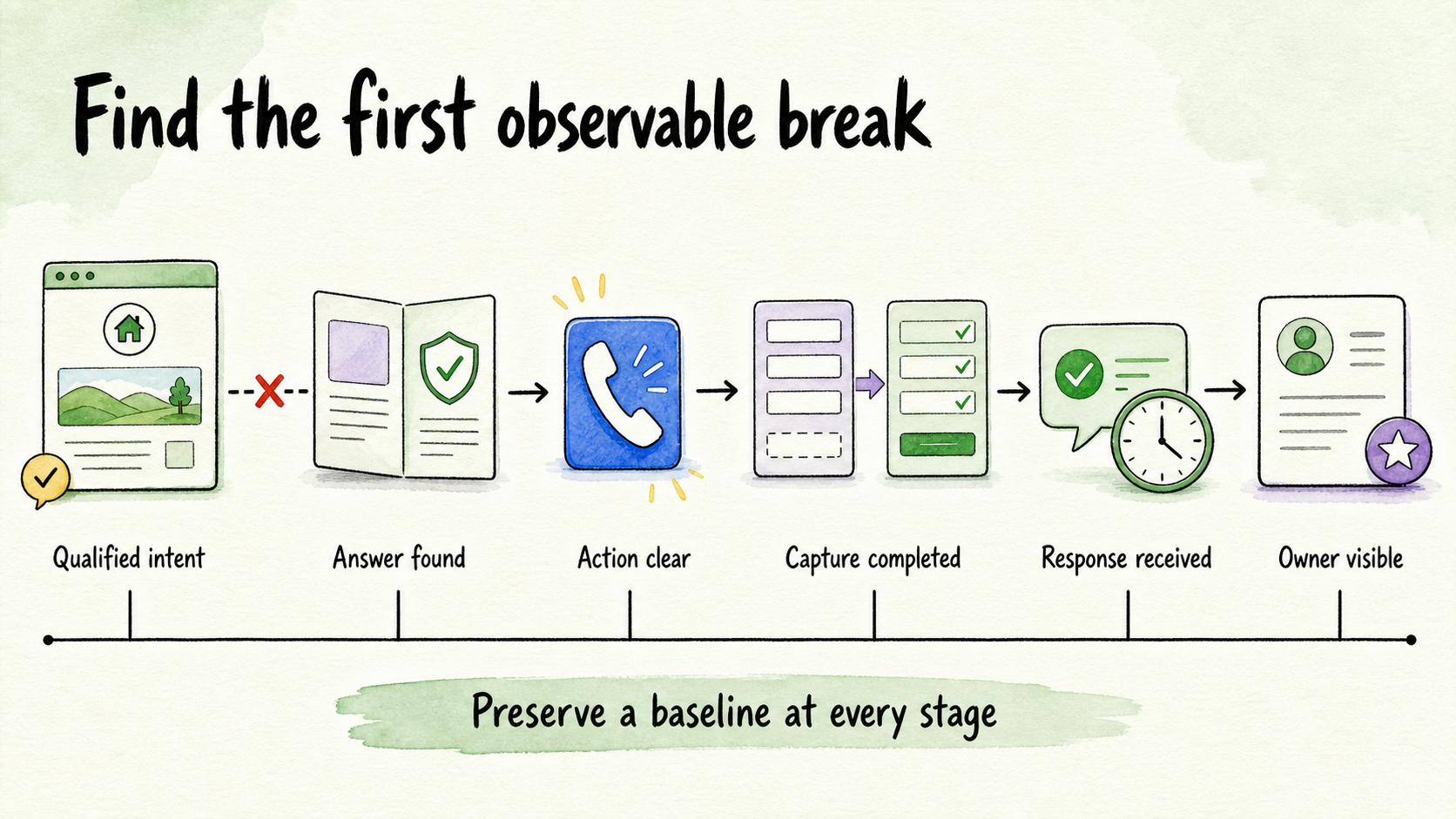
- Did the visitor arrive with relevant intent?
- Could they find and trust the answer they needed?
- Was the next action clear?
- Did they begin and complete that action?
- Did they receive a timely response or confirmation?
- Did the inquiry reach the right owner?
A break at any point can produce the same visible result: no recorded lead. A total traffic-to-inquiry ratio is useful as a warning, but weak as a diagnosis.
Consider an illustrative service business. A visitor reaches its services page, compares two options, opens the contact form, submits an inquiry, receives confirmation, and reaches the person responsible for that service. Each stage leaves a different signal. Page activity can indicate relevant interest. Searches or submitted questions can reveal information needs. Form events can show starts and completions. Timestamps can expose response delays. Internal records can show ownership and outcomes.
If the business records visits but none of those adjacent signals, it cannot tell whether the problem is traffic quality, missing information, capture friction, or follow-up. Measurement must come before a site-wide redesign.
Build a minimum baseline around these measures:
- Visits or qualified-intent sessions: Separate general browsing from visits to pages that indicate plausible buying intent, such as service, product, pricing, or contact pages. Define this group according to your business rather than using a universal rule.
- Usable inquiries: Decide what counts as an inquiry worth tracking. Keep this definition consistent throughout the diagnosis.
- Unanswered questions: Record questions the website, staff, or customer-facing tools could not answer clearly.
- Response timing: Measure the time between an inquiry and the first useful response. Review timing by channel, inquiry type, and time of day when those differences matter.
- Form starts and completions: Compare how many visitors begin the capture step with how many complete it. Include validation errors and failed submissions when available.
- Handoff outcomes: Record whether each completed inquiry has a visible owner and a known outcome.
Your baseline must still be established. Measure current values from your website, forms, conversations, and follow-up records before claiming that any change improved performance. No universal observation period can account for every business’s traffic, seasonality, sales cycle, or inquiry frequency. Gather enough normal activity to see a usable pattern, then extend the period when volume is low or unusually variable.
A baseline also protects against false confidence. If several parts of the site change at once, the total inquiry count may move without revealing which change mattered. Preserving the original measures gives each later test a fair comparison.
Diagnose answer, response, capture, and handoff gaps
Start at the earliest stage where qualified intent leaves an observable signal. Earlier leaks prevent visitors from reaching later steps, so changing a downstream form will not help someone who could not find a necessary answer.
Check answer availability and response timing.
Return to the Sunday-hours example. The useful diagnostic question is not simply whether the business was closed. Ask whether the visitor could obtain an accurate answer while the need was active. Inspect site searches, common messages, page exits, conversation records, and repeated questions. InsertChat’s visitor analytics can surface repeated unanswered topics that point to missing pages, unclear policies, weak product information, or information that is difficult to discover.
Now consider another illustrative visitor comparing service options after staff hours. If the factual differences are published but difficult to locate, the likely leak is answer discovery. If the visitor submits a question and receives no useful reply until interest has cooled, response timing deserves attention. These problems are related, but they require different measurements.
Immediate automation may help with approved factual questions when people are unavailable. Human judgment may still be necessary for sensitive requests, unusual circumstances, or advice that depends on context. Do not assume every question should receive an automated answer or that staff must always be available.
InsertChat says it answers chats and calls and saves leads under the business’s brand. Its homepage also describes answering questions and saving leads day and night. Those capabilities make it a possible option when measured evidence points to unavailable answers or missed capture. They do not prove that it will increase inquiries, improve response performance, or raise revenue for a particular website. Any improvement must be tested against the site’s established baseline.
Check friction after intent becomes visible.
When visitors start an inquiry but do not finish it, examine the capture step. Look for unclear requirements, validation errors, weak instructions, poor mobile behavior, or requests that appear excessive for the visitor’s current decision.
Review the number, timing, clarity, and apparent necessity of those requests. Asking for more information may give the business useful context, but each additional question requires time or disclosure from the visitor. Asking for too little may leave the team unable to respond usefully. The diagnostic goal is to find where completion falls, not to prescribe a universal set of fields.
A start-to-completion gap does not prove that a static form should be removed. It also does not prove that chat should replace it. The right capture method depends on the inquiry, accessibility needs, required information, visitor context, and the team’s ability to maintain the experience. Diagnose the friction before evaluating methods.
Check the next step and the owner.
Lead leakage can continue after a visitor clicks submit. Inspect what the visitor sees next. A vague confirmation such as “Thank you” may leave them unsure whether the message arrived, what will happen, or whether another action is required.
Then inspect the business side. Can the team identify who owns the inquiry? Is there a recorded outcome? If completed inquiries sit in a shared mailbox without visible responsibility, the website may appear to convert while qualified interest still disappears.
Conversation records can help locate this break. InsertChat’s conversation inbox preserves visitor wording, source-page information, metadata, and chat context for review. This information can support diagnosis of response and handoff gaps. It does not replace the need to identify ownership or evaluate what happened to each inquiry.
Keep this check observational. Verify that the next step and accountable owner are visible, without turning the diagnosis into a complete routing design.
Use a five-point audit to choose the first test
Apply this audit to one important inquiry path, such as a service request, product question, or contact-page visit:
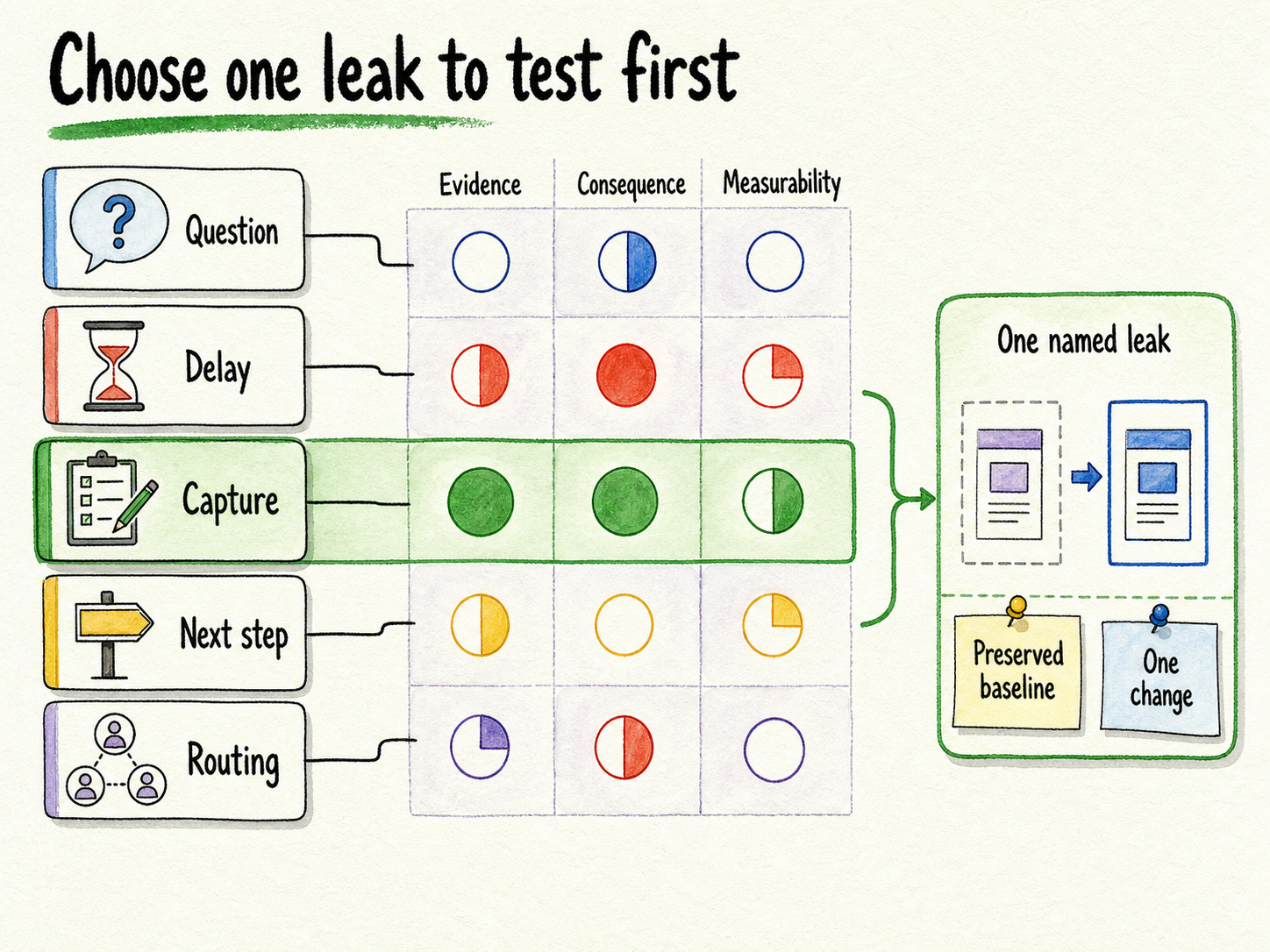
- Unanswered question: Can qualified visitors obtain the factual information needed to continue? Review repeated questions, failed searches, page exits, and unresolved conversations.
- Response delay: When a visitor asks for help, how long does it take to receive a useful response? Compare timestamps across relevant channels and operating periods.
- Capture friction: Do visitors begin the inquiry step but fail to complete it? Review starts, completions, errors, instructions, and the burden created by information requests.
- Next-step clarity: After acting, does the visitor see a clear confirmation and understand what happens next?
- Routing visibility: Does every completed inquiry have a visible owner and recorded outcome?
For each point, assess three factors without inventing a numerical benchmark:
- Strength of evidence: Do current records show the gap directly, or is it only a suspicion?
- Likely consequence: Could the gap stop a visitor with qualified intent from continuing?
- Ease of measurement: Can you change one element and observe the same stage again?
Choose the gap that combines strong evidence, a meaningful likely consequence, and a clear measurement path. Avoid changing the full journey at once.
For example, suppose a business sees steady activity on service pages, many inquiry-form starts, fewer completions, no unusual volume of unanswered questions, and consistent response timing for submitted inquiries. Capture friction becomes the strongest first test. The evidence sits close to the suspected break, and the business can compare starts, errors, and completions after one bounded change. This does not prove the form is the permanent cause or identify the right replacement. It identifies the first issue worth testing.
Finish with one named leak, the baseline measure that exposed it, and one change to evaluate. If the evidence points to unavailable answers or missed lead capture, you can Start for Free with InsertChat and compare the result with the preserved baseline. If the evidence points elsewhere, address that gap first.
FAQ
Can low lead volume be a traffic problem instead of a conversion problem?
Yes. If few visitors reach pages associated with relevant intent, traffic quality or content discovery may deserve investigation before the inquiry path. Separate total visits from qualified-intent sessions so weak traffic does not get confused with a response, capture, or routing problem.
How long should a baseline run?
There is no reliable universal period. Use enough normal business activity to represent common traffic patterns, inquiry types, and operating hours. Extend the observation when volume is low, demand varies sharply, or unusual events distort the data. Keep the definition of each measure consistent throughout the test.
Should I remove my contact form if completion is low?
Not based on that signal alone. A low completion count can justify checking errors, instructions, requirements, mobile behavior, and the burden of information requests. Choosing among a form, chat experience, or combined approach requires a separate evaluation for each inquiry type.
Does 24/7 answering guarantee more leads?
No. Always-on answering is a capability, not proof of a business outcome. It may be relevant when visitors repeatedly need approved factual answers outside staff availability. Measure the current leak first, then compare the same stage after one controlled change.
What if I cannot track every stage?
Start with the clearest observable break. You might have form starts and completions but no reliable ownership records, or conversation records without qualified-session data. Use what you can verify, document the missing measures, and improve tracking before drawing broader conclusions. A narrow diagnosis supported by evidence is more useful than a complete-looking guess.