TL;DR
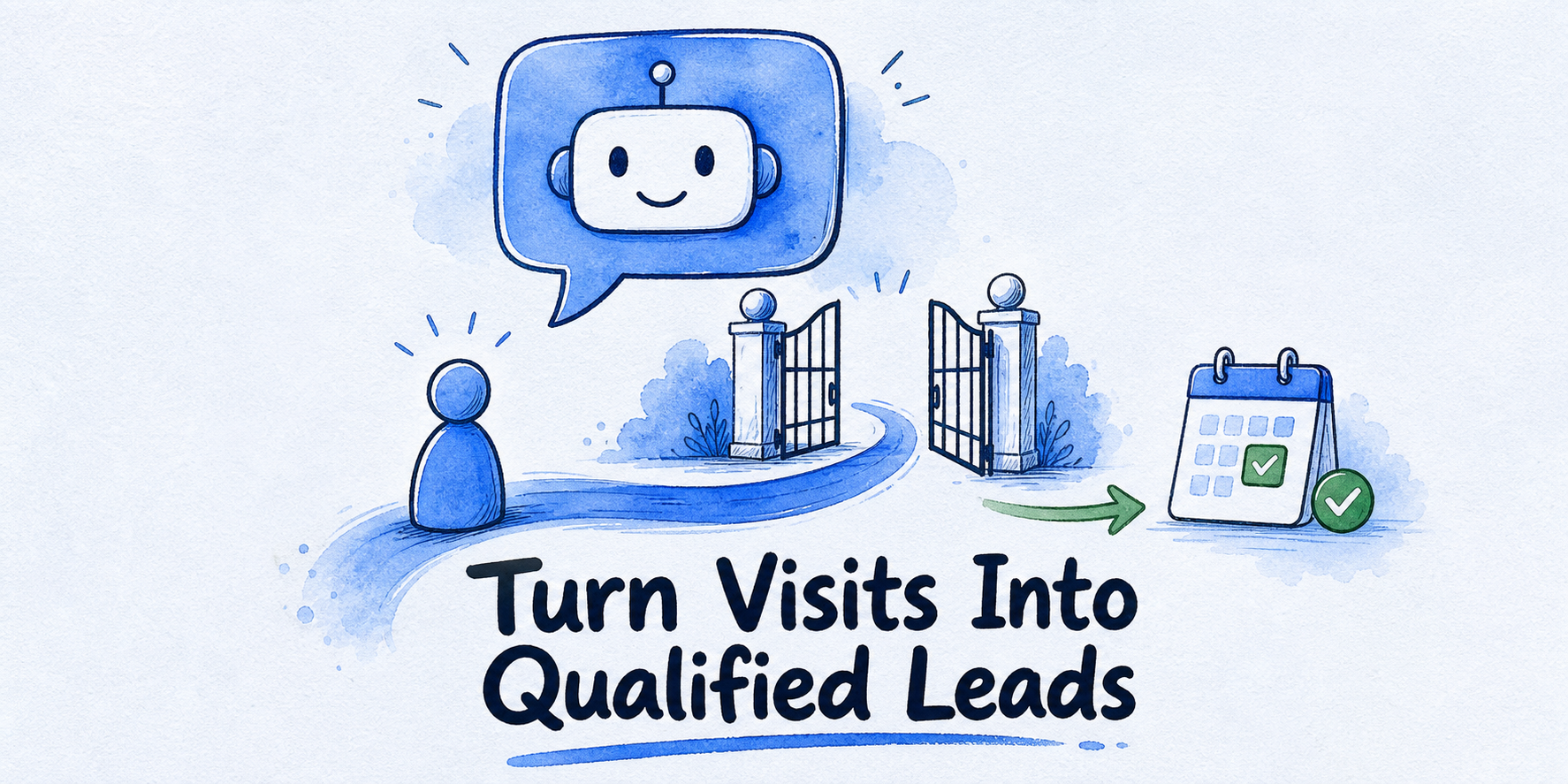
- Build the lead path around five gates: answer readiness, visitor intent, qualification, next action, and handoff.
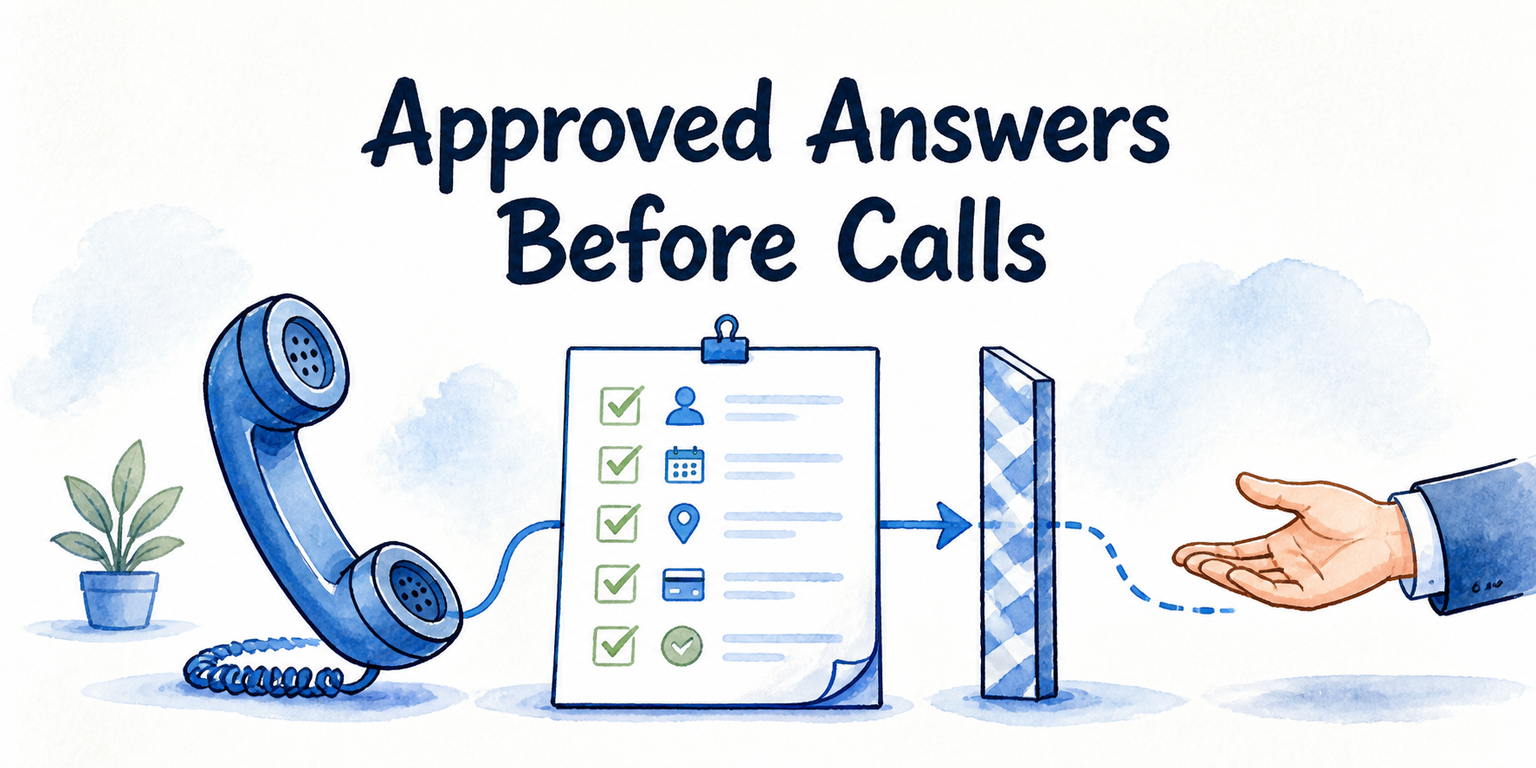
- Give a useful, approved answer before requesting information from the visitor.
- Ask only questions whose answers change eligibility, ownership, booking, or escalation.
- Offer a calendar only when a documented booking rule passes.
- Test the workflow on one controlled page. Narrow or pause it when facts, rules, consent language, or owners are missing.
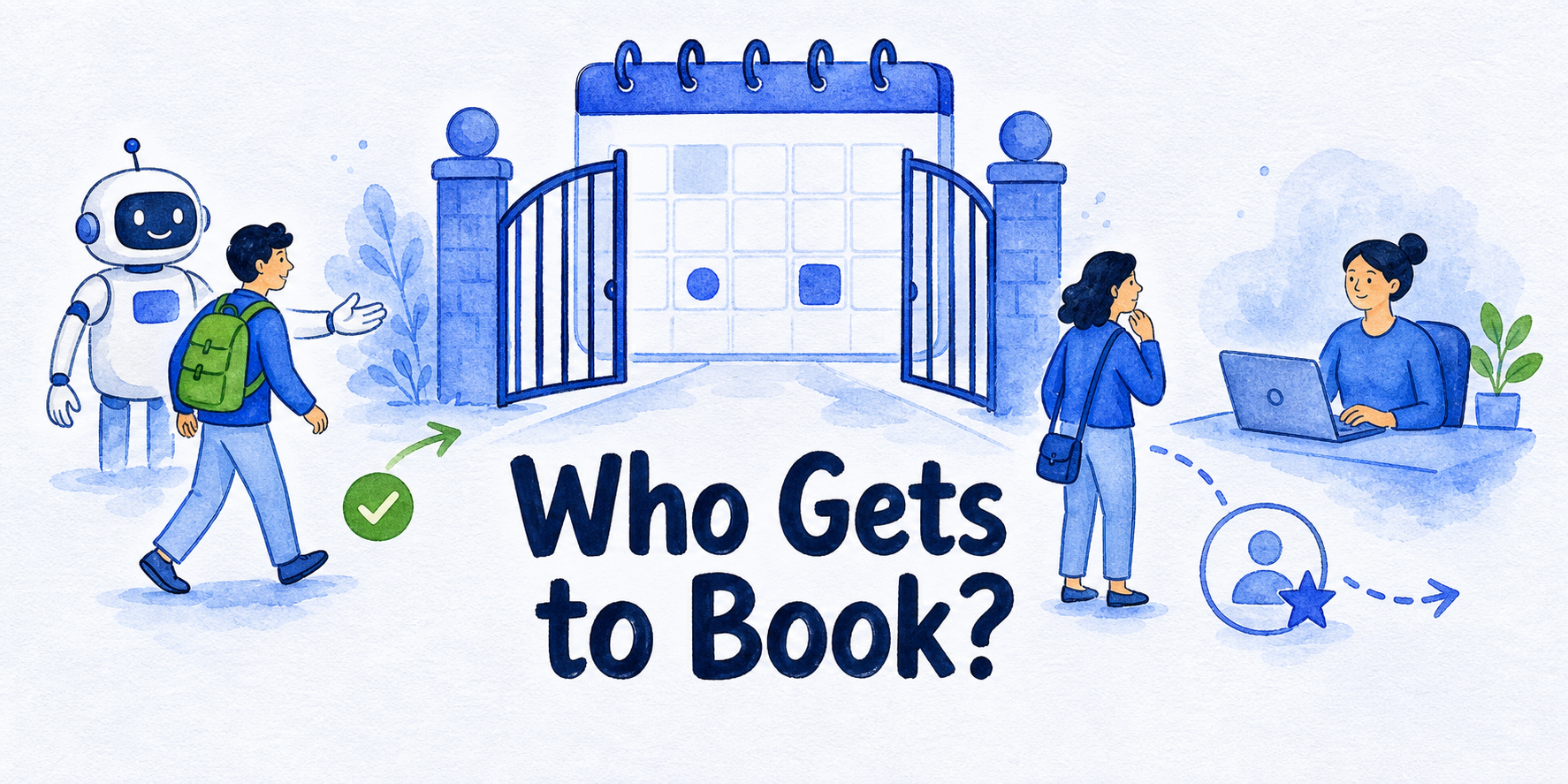
A visitor reaches the selected service page after hours and asks whether the business can solve a specific problem. You already know this is where an inquiry path breaks, but the operational response remains undefined: answer, request details, show a calendar, or wait for staff. A useful AI chatbot for lead generation resolves that decision through five gates, moving one visitor from a reliable answer to an appropriate next step without forcing every conversation into the same form.
Key Takeaways
- Choose trial when every gate has approved facts, explicit rules, and a named owner, and all six acceptance conditions pass.
- Choose narrow when the visitor job or answer set is too broad to test reliably on one page.
- Choose pause when consent language, calendar logic, qualification criteria, destination fields, or ownership remain unresolved.
- Protect the visitor's effort with a question-to-route test: if an answer changes no decision, do not ask the question.
- Protect staff time with a booking rule. A visitor should see a calendar only after the documented eligibility conditions pass.
Gate 1: Choose one page, then verify answer readiness
Begin after the lead leak has been selected. If that diagnosis is unfinished, use Website Visitors Not Converting to Leads? Find the First Leak to choose the first measurable problem before designing a chatbot route.
Choose a page only when it meets four conditions:
- Visitors ask a known question on or near the page.
- The question represents one bounded job, such as checking service fit.
- Current, approved business information can answer it.
- The conversation can reach a controlled next action with a named owner.
A service page where after-hours visitors ask about fit and availability is a stronger first scope than a site-wide assistant expected to cover every service, policy, and buyer type.
Answer readiness is a pass-or-pause decision. Pricing, service scope, availability, policies, eligibility, and other consequential buying facts need approved sources. If policies conflict or availability lacks a dependable update path, narrow the subject or route it to a person. A model cannot resolve a business decision the company has not made.
InsertChat states that assistants can answer from approved sources and provide citations. Its homepage also describes website and phone assistants that answer questions, save leads, and book meetings. These capabilities were verified against the InsertChat homepage and features material on July 23, 2026. They support a bounded path, but the business remains responsible for approving its facts.
For source inventory and cleanup beyond this gate, see AI Chatbot Knowledge Base Preparation | InsertChat.
Gate decision: Pass when the core buying questions have approved answers, narrow when only part of the visitor job is supported, and pause when a consequential answer is unresolved.
Gate 2: Recognize intent before requesting contact details
Intent is what the visitor wants to accomplish now. The first workflow only needs categories that lead to supported routes:
- Get an approved answer about fit or an option.
- Book or speak with sales.
- Continue asking questions within the approved source set.
- Reach a person because the request is unclear, sensitive, or unsupported.
Identify that intent before requesting an email address, telephone number, or company profile. The answer should earn the next question.
Consider an illustrative B2B buyer comparing two service options. First give the approved distinction between those options. Ask about company size, location, or timing only when the response changes the recommendation or owner. If every buyer reaches the same inbox, those questions add effort without changing the path.
Limit recognized intent to routes the business can operate. Broad automated coverage is a poor fit when approved answers, destinations, or owners are missing.
Gate 3: Ask only questions that change the route
Test each proposed qualification question against three requirements:
- Name the decision. Does the answer affect eligibility, ownership, booking, continued conversation, or escalation?
- Name the branches. What happens for each relevant response?
- Remove dead fields. If every response reaches the same route, omit the question.
Suppose a service business works only in certain locations and assigns appointment types by service category. Location and service type may be necessary because they control eligibility and calendar routing. Budget, telephone number, timeline, and project notes should not be requested by default unless the workflow has a defined use for them.
More questions can give sales richer context, but each adds effort and another point where a visitor may leave. Too few can leave the recipient unable to act. The minimum is not a fixed number. It is the smallest set that supports the next decision.
Before collecting personal or business information, the company must approve its consent wording, review requirements, and permitted destination fields. Those requirements are specific to the business and deployment.
Gate 4: Set the next-action rule before showing a calendar
Define the four route outcomes before selecting tools or connections:
| Outcome | Use it when |
|---|---|
| Offer booking | Eligibility and approved calendar rules pass |
| Route to sales | A named sales owner must review or continue the inquiry |
| Continue the conversation | Another approved answer can resolve the next question |
| Escalate to a person | The request is ambiguous, sensitive, unsupported, or judgment-dependent |
Immediate calendar access removes steps for suitable visitors, but vague eligibility can consume staff time with poor-fit meetings. Make booking the result of a documented rule.
An illustrative booking rule could require an eligible service type, a served location, an approved availability route, accepted consent wording, and a calendar owner. The real rule must come from the business.
InsertChat describes lead capture, booking, CRM or webhook routing, and support handoff on its workflows page, as well as visitor actions on its tools page. Its integrations page identifies connection categories. These pages were checked on July 23, 2026. A listed connection does not prove that it is configured, suitable, or included in a particular plan, so confirm the selected route on publication day and before deployment.
Gate 5: Send a five-field record to a named owner
When a person receives the inquiry, preserve only the context needed to continue:
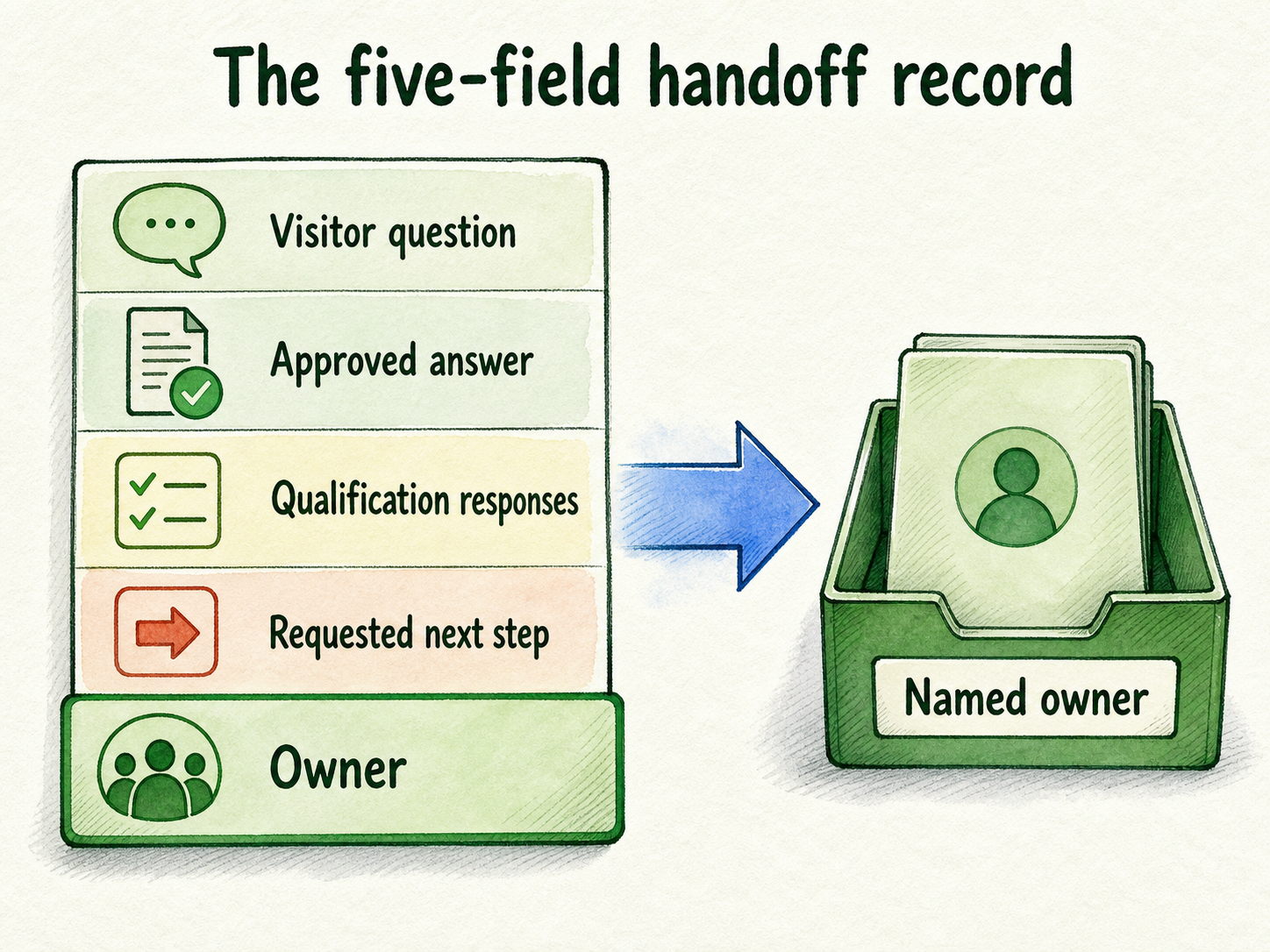
- Visitor question: the request in the visitor's words.
- Approved answer: the response already shown.
- Qualification responses: the answers used for routing.
- Requested next step: booking, sales contact, another answer, or personal help.
- Owner: the person or team responsible for acting.
InsertChat's assistant-builder material, verified July 23, 2026, states that a human handoff preserves the visitor's question and the assistant's prior answer. The other three fields are requirements for this workflow and need configuration-specific confirmation. Do not assume every destination stores them automatically.
An ambiguous or high-risk request should leave the automated route even when the visitor appears valuable. Human judgment is appropriate when approved guidance cannot support the answer or a mistake could cause material harm.
Worked example: Route one after-hours inquiry
This scenario is illustrative, not customer proof. An after-hours visitor asks a service business, “Do you handle this type of project, and do you have appointments next week?”
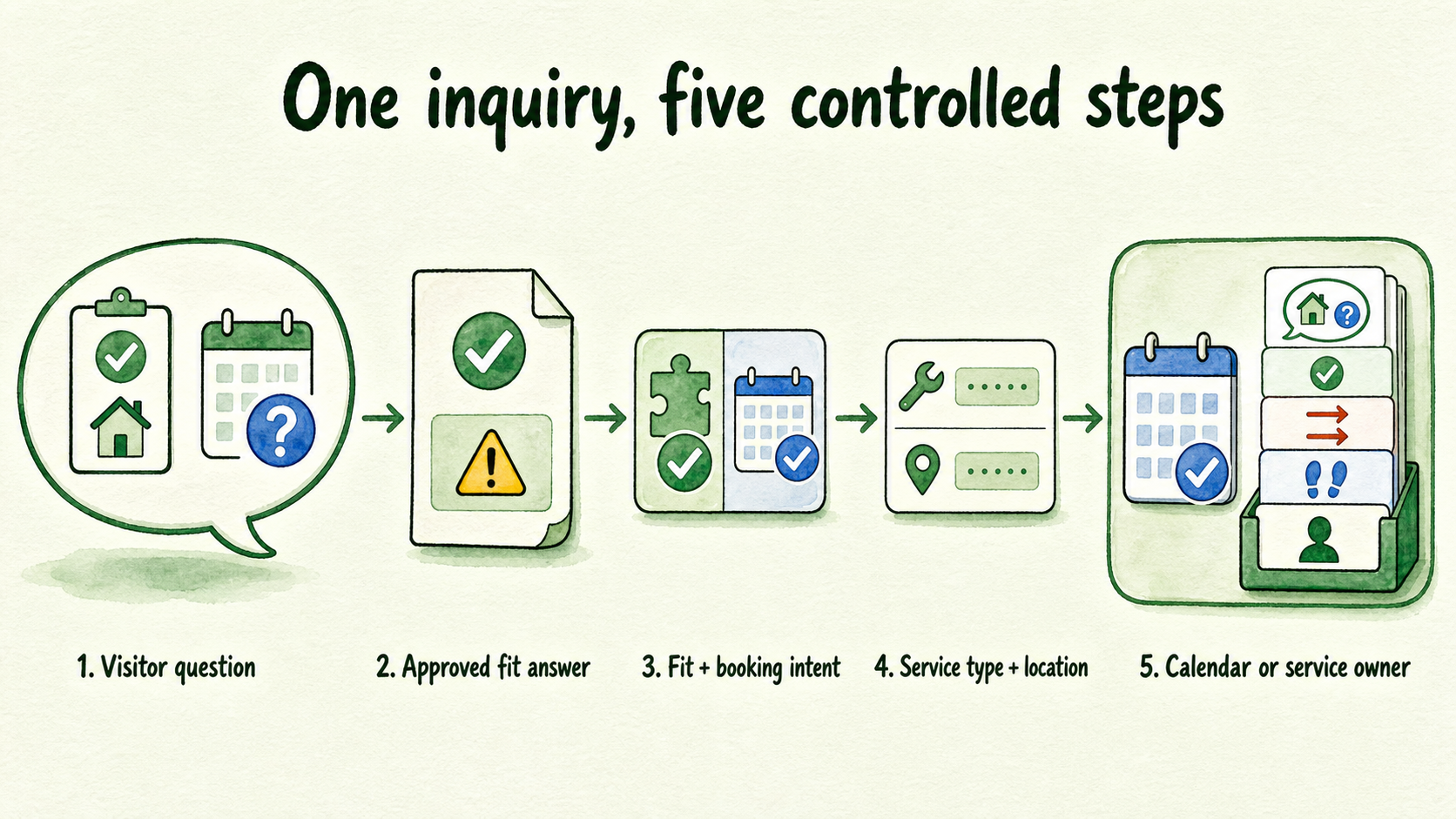
- Answer readiness: An approved service page supports the fit answer. The assistant explains the service boundary without inventing availability.
- Visitor intent: The question contains fit-checking and booking intent.
- Qualification: The assistant asks for service type and location because those responses determine eligibility in this example.
- Next action: If the assumed eligibility and calendar rules pass, the visitor can choose a slot. If availability cannot be confirmed, the request goes to the service owner.
- Handoff: The record contains the original question, approved fit answer, service type and location, request for a next-week appointment, and named owner.
If the location is outside the service area, the approved disqualifying route applies. If the request is unclear or sensitive, qualification stops and a person receives the existing context.
This path is not ready for a real business until that business supplies its lead definition, disqualifiers, consent language, calendar rules, destination fields, owners, response-time baseline, and outcome baseline.
Run one acceptance test, then trial, narrow, or pause
Test only the six conditions that determine whether this lead path works:
- Correct answers use approved facts.
- Missing sources produce a safe fallback or human route.
- Disqualifying responses reach their approved outcome.
- Eligible visitors reach the correct calendar route.
- The complete path works on mobile.
- Human takeover preserves the required record and reaches its owner.
During the controlled trial, watch captured leads, qualification completion, booking completion, handoff completeness, unanswered questions, and sales feedback. These signals can support an expand, change, or stop decision. They do not prove that the chatbot caused more leads, bookings, or revenue.
Choose trial when all five gates and six acceptance conditions pass. Choose narrow when the visitor job or approved answer set covers too much. Choose pause when facts, consent language, routing logic, destination fields, or owners remain unresolved.
For analysis beyond this bounded scorecard, see AI Chatbot Reporting Metrics Clients Can Act On | InsertChat.
The InsertChat product marketing owner should recheck the homepage, features, tools, workflows, integrations, assistant-builder behavior, and current terms on publication day. Repeat that review whenever pricing, packaging, plan entitlements, integration availability, handoff behavior, or the recommended workflow changes.
When the path passes, connect one approved source, test one qualification route on one controlled page, then Start for Free.
FAQ
Can a chatbot generate leads without approved answers?
It can collect contact details, but collection alone does not create a dependable lead route. When a visitor asks about fit, pricing, policy, or availability, the chatbot should use approved information or send the question to a person before requesting further details.
How many qualification questions are too many?
A question is excessive when none of its possible answers changes eligibility, booking, ownership, the next approved response, or escalation. There is no universal ideal count. Keep the smallest set that supports a defined routing decision.
Should every qualified visitor see a calendar?
No. Show a calendar only when the visitor meets the documented booking rule and the business has defined availability behavior, consent wording, and calendar ownership. Some suitable inquiries still need sales review or human judgment.
When does this approach need extra caution?
Use a narrower or human-owned route for ambiguous, sensitive, regulated, or high-value inquiries where an incorrect answer or action could cause material harm. Privacy, security, data handling, and procurement requirements need deployment-specific review before sensitive information is collected.
What must be decided before a controlled trial?
The business needs approved answers, qualification and disqualification rules, consent wording, calendar logic, destination fields, and an owner for every outcome. If any item remains unresolved, reduce the workflow's scope or pause the trial.