TL;DR
- Missed call automation connects detection, response, context capture, routing, follow-up, and review.
- A call is recovered only when its appropriate next step is completed—not simply when it is answered.
- Every transition needs an accountable primary owner, an observable record, a deadline where applicable, and a named fallback.
- Establish a business-specific baseline instead of adopting unsupported benchmarks.
- Begin with one bounded workflow and expand only when observed outcomes are stable.
A new lead calls while staff are serving another customer. The phone records the missed call, but the caller’s intent, promised response, assigned owner, deadline, and eventual outcome may remain disconnected. The operational problem is not only the unanswered ring; it is the broken chain between the caller’s request and the next step the business needs to complete.
Key Takeaways
- Answered is not the same as recovered. A callback request remains unresolved until the callback occurs or the case reaches a defined final state.
- Handoffs need structure. Each transition should preserve context, assign ownership, set a deadline where appropriate, and activate a fallback when the normal path fails.
- Automation scope depends on readiness and risk. A documented booking question differs from an urgent request requiring human judgment.
- Your baseline is the comparison point. Measure current handling before claiming improvement.
- Expansion follows evidence. Add call types only after sources, routing, outcomes, and review processes remain stable under normal and failure scenarios.
What Missed Call Automation Actually Includes
Missed call automation is a recovery workflow that detects an uncovered call, responds or acknowledges it, captures caller intent, routes the context, completes the promised action, and reviews the outcome.
The main terms have distinct meanings:
- A missed call is a call that did not reach its intended person or approved handling path.
- A recovery workflow is the connected sequence from detection through a completed or explicitly unresolved outcome.
- Caller intent is the task the caller wants completed, such as requesting a quote, booking an appointment, or reporting a problem.
- A phone agent handles an approved portion of the call path by answering, collecting information, or initiating an allowed action.
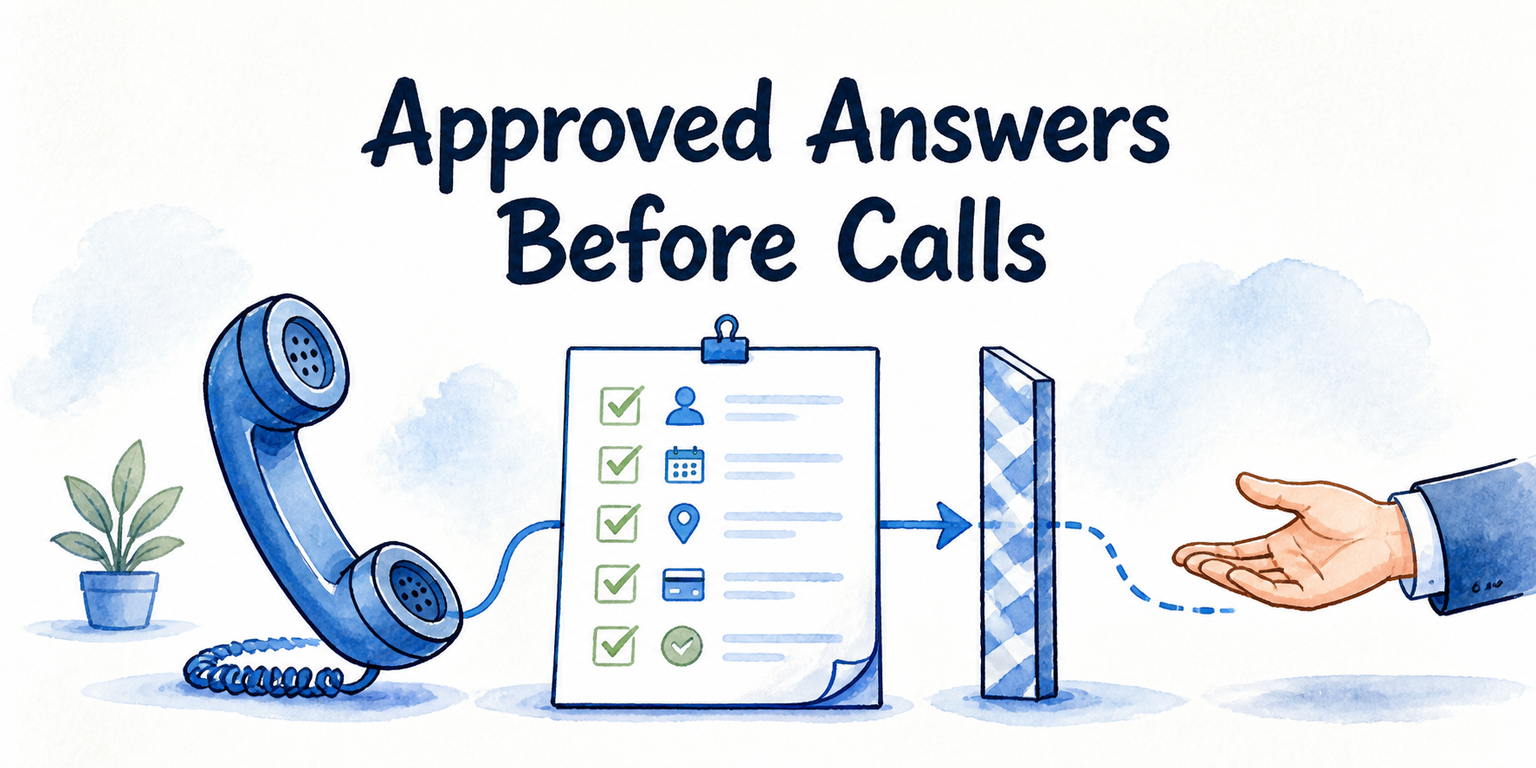
- An approved source is controlled, current business content that may be used in a response. It cannot replace guidance the business has not defined.
- A routing rule maps an intent and its necessary context to an accountable owner.
- Human takeover moves the interaction to a person when judgment, permission, sensitivity, caller preference, or risk exceeds the automated path.
- A follow-up outcome records what happened after routing, using states defined by the business.
- A recovery metric shows whether the appropriate next step was completed, not merely whether a response occurred.
Immediate response can reduce uncertainty, but it should not imitate human judgment where judgment is required. Additional questions may improve routing while increasing caller effort. Capture only what the next owner needs to act safely.
InsertChat’s documented knowledge-base workflow covers approved website pages, sitemaps, documents, videos, FAQs, policies, product data, and support content. It also describes refreshing changing sources and reviewing unanswered questions. Those practices support controlled answers; when approved guidance is missing, the safe action is escalation rather than invention.
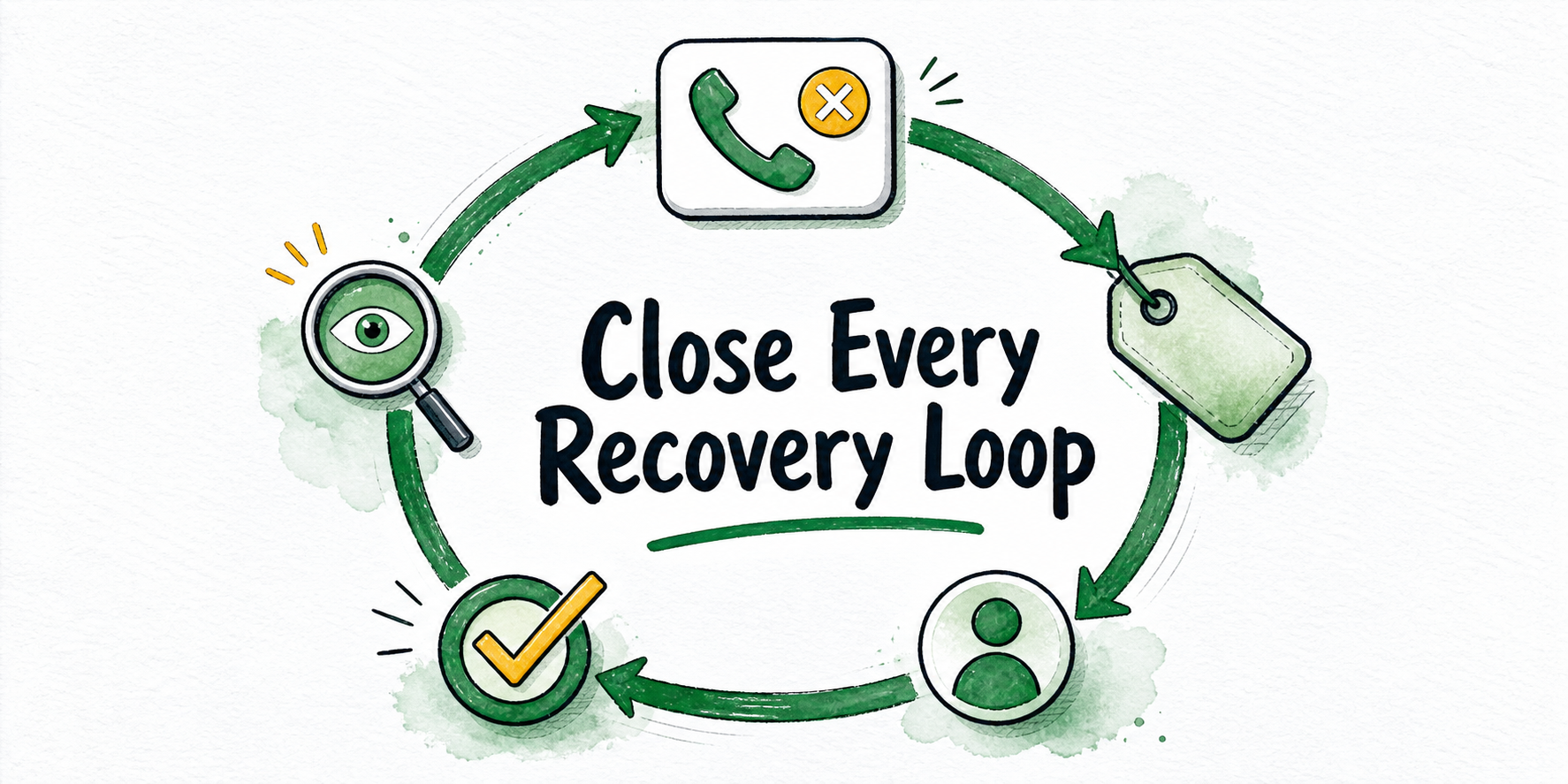
Map the Six-Stage Recovery Loop
Treat the workflow as six observable stages. Define the record, primary owner, timing rule, failure point, and fallback at every transition.
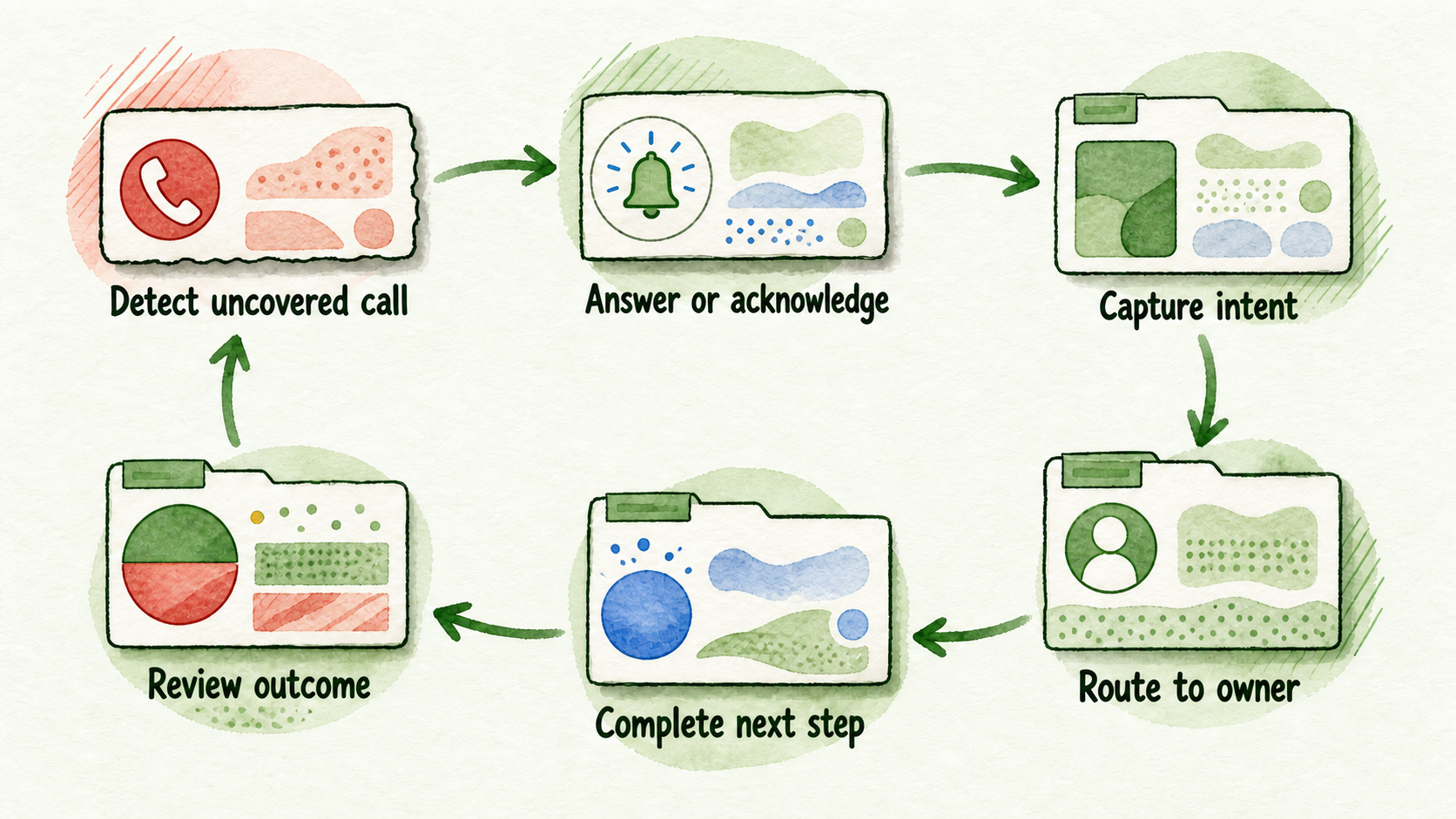
Detect the uncovered call. Create a call-event record containing the available caller identifier, time, source, and detection category. The phone-system owner is accountable for capture and reconciliation. Apply the business’s detection deadline. If automated capture fails, a named backup owner checks the authoritative phone log and creates the missing record.
Answer or acknowledge. Use the approved path: live answering, acknowledgment, voicemail, or callback notice. The channel owner maintains the response and its timing rule. If the primary channel fails, the designated backup channel owner activates a tested secondary path without promising an unavailable service.
Capture intent and necessary context. Record only the details needed to route or complete the next action, such as contact information, call reason, preferred time, and permitted qualifiers. The workflow owner defines the required fields and capture deadline. If intent remains unclear or a source is missing, the fallback review owner receives the available context instead of allowing a guess.
Route to an accountable owner. Create an assignment record naming a person or monitored team, the captured context, and the response deadline. The routing owner maintains the rule. If the primary recipient is unavailable or the assignment fails, a named backup owner or monitored escalation queue receives the record and preserves its original deadline.
Complete the promised next step. The assigned follow-up owner calls back, confirms a valid booking, answers the request, or escalates it within the business-defined deadline. Record each attempt and the final result. If the owner cannot complete the action, the named backup owner applies the approved retry, escalation, or closure rule; a notification alone does not count as completion.
Review the outcome and unresolved reason. The operations owner records or verifies the final state and examines failures such as missing context, stale sources, incorrect routing, late follow-up, or lost ownership on the chosen review cadence. If that owner is unavailable or the outcome cannot be observed, a designated backup reviewer reconciles source records and keeps the case unresolved until its status is supported.
Consider a hypothetical after-hours booking inquiry. The call is detected, the caller receives an approved acknowledgment, and the workflow captures the requested service, preferred time, and contact details. The record enters a scheduling queue with an owner and deadline. The scheduling owner confirms an available appointment, and the confirmed booking becomes the recorded outcome.
Each transition can fail. The event may lack a callback number. The acknowledgment may overpromise. A long intake may cause abandonment. The queue may be unmonitored. The callback may not happen. The appointment may be booked without a visible outcome. Each fallback should repair its specific transition while preserving the context already collected.
An urgent existing-customer request needs a different path. If approved information or permitted action is insufficient, a risk trigger occurs, or the caller asks for a person, the live-takeover owner becomes accountable. If that person is unavailable, the fallback must preserve context and activate the business’s approved urgent-response policy.
Choose the First Call Type and Response Path
Do not begin with every missed call. Assess candidate call types using four factors:
- Frequency: Does the call type occur often enough to produce useful observations?
- Source readiness: Are its answers, policies, qualifiers, and permitted actions current and approved?
- Consequence of error: What could happen if the response or route is wrong?
- Escalation clarity: Can the business state exactly when a person takes over, who owns that takeover, and what happens if the person is unavailable?
A frequent, source-ready call type with manageable consequences and a clear escalation path is a stronger first candidate than a rare, ambiguous, high-consequence request.
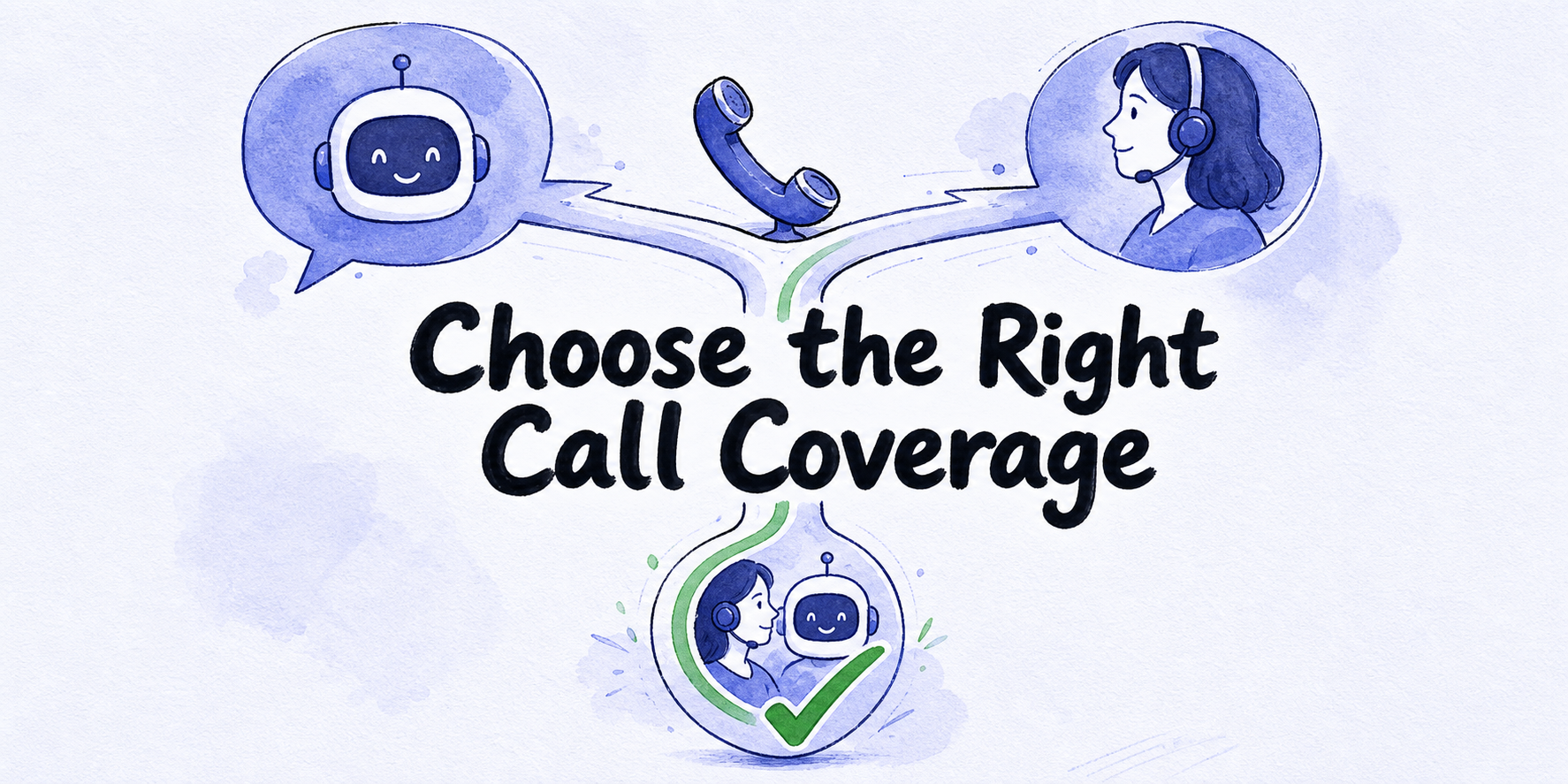
Choose the response path that matches the job:
- Live automated answering can address supported questions and collect context, but it depends on current sources and strict boundaries.
- Acknowledgment confirms receipt with little caller effort, but reliable follow-up remains essential.
- Voicemail accepts open-ended detail, although messages may be incomplete.
- Callback routing preserves human judgment, but makes timing and ownership critical.
- Booking can complete a clear next step only when availability and booking rules are connected and current.
- Human takeover fits requests involving judgment, sensitive context, caller preference, unsupported questions, or defined risk triggers.
For example, a new lead might receive an acknowledgment and enter an owned callback queue. A routine booking inquiry might follow a controlled booking path. An urgent customer issue should trigger takeover or its named fallback.
InsertChat’s integration directory documents connections involving chat, voice, and phone conversations across categories including CRM, customer support, calendars, scheduling, and handoff tools. That directory does not establish that every connection writes the ownership, deadline, and final-outcome fields this recovery loop requires. Confirm the behavior of the selected systems before relying on an end-to-end handoff. Readers still choosing between automated, human, and hybrid coverage can use the separate AI receptionist versus answering service comparison.
Verify the Product Evidence
Evaluate phone automation with current, capability-specific evidence. Before selection or launch, verify whether the exact proposed configuration supports:
- Operation with the business’s real phone numbers
- Live human takeover and a fallback when transfer fails
- Lead capture using the fields the business actually needs
- Appointment booking against current availability and rules
- Retained conversation history and context across handoff
- Phone transcripts in the conversation inbox
- Clearly defined resolution states for completed and unresolved calls
- Voice-call analytics with documented metric definitions
- Monthly reporting, if monthly reports are required
- Downstream updates for owner, deadline, follow-up, and final outcome
Do not infer one capability from another. A broad integration directory does not prove that a particular connection writes required statuses. A knowledge base does not by itself prove phone-number operation, live takeover, booking, inbox transcripts, analytics, or monthly reports. A menu label, demonstration, or general product statement is also insufficient when the operating decision depends on exact fields and failure behavior.
Use the product’s feature, workflow, conversation-inbox, integration, and pricing information as separate checks. Confirm the Start for Free path and current terms directly before beginning; do not assume that displayed availability, price, or trial terms remain unchanged. Record which document or observed test supports each required capability, who verified it, and what remains outside the configuration.
Build the Baseline and Recovery Measurement Sheet
Measure the existing process before changing it. Choose a period that reflects the business’s call volume and operating cycle; there is no universal observation window or recovery benchmark.
Baseline worksheet — complete using business-owned call and follow-up records:
| Field | Business definition | Baseline value | Data source | Data owner |
|---|---|---|---|---|
| Chosen call type | The bounded intent included in the test | |||
| Missed calls | Calls that did not reach the intended handling path | |||
| Recovered contacts | Callers who received a useful two-way response | |||
| Qualified outcomes | Contacts meeting the business’s documented criteria | |||
| Follow-up completion | Promised actions completed under the approved rule | |||
| Time to first response | Time from missed call to first useful response | |||
| Escalation rate | Included calls sent to the escalation path | |||
| Unresolved calls | Calls without an appropriate final outcome | |||
| Unresolved reason | The business-defined reason completion did not occur |
Count recovery only when the caller’s appropriate next step is completed. A high contact rate can still conceal unsuitable bookings, unnecessary escalations, poor qualification, or callbacks without resolution.
Review completion and appropriateness together: Did the record reach the right owner? Was the booking valid? Was the urgent case escalated under the approved rule? Is the final outcome visible? The baseline measurement guide likewise separates response timing, ownership, and downstream outcomes instead of relying on one activity count.
Exact phone-reporting fields and downstream status-update behavior vary by the selected configuration and are not established by the general integration documentation. Define each metric from records the business can actually observe, then test whether its phone, calendar, CRM, help-desk, inbox, and follow-up systems preserve the required values.
Run a Bounded Trial and Decide What Happens Next
Choose one call type and one owned outcome. For a booking-inquiry trial, the outcome might be a confirmed appointment or a documented handoff to the scheduling owner—not simply a captured phone number.
Test both the normal path and continuity failures:
- A routine request with complete information
- Missing or unclear caller context
- A question with no approved answer
- A stale or conflicting source
- A routing failure
- An unavailable primary owner
- A request for human takeover
- A failed transfer or urgent escalation
- A completed action whose final status is not visible
- An unresolved call lacking a reason or owner
Choose the review cadence according to call volume and consequence. Higher-consequence workflows may require faster review, while low-volume workflows may require more observation before patterns become useful.
Pause the trial if it produces unsupported answers, loses context, sends work to an ownerless queue, fails an urgent escalation, or cannot show the final outcome. Revise the source, response boundary, routing rule, system connection, or ownership model before resuming.
Expand only when approved sources remain stable, routing reliably reaches the intended owner, follow-up is completed appropriately, failures are visible, and the review workload is manageable. For an InsertChat evaluation, limit the initial scope to behavior supported by approved knowledge, a tested connection, and records the team can inspect. Then make one evidence-led decision: expand, revise, or stop.
FAQ
What is missed call automation?
It is the connected process of detecting an uncovered call, responding, capturing intent, routing context, completing follow-up, and reviewing the final outcome.
What should a missed-call recovery workflow include?
Include six stages, an observable record at every transition, an accountable primary owner, a named fallback, necessary caller context, a timing rule where applicable, and a visible final outcome.
Which missed-call metrics matter?
Track missed calls, recovered contacts, qualified outcomes, completed follow-ups, time to first useful response, escalation rate, and unresolved calls by reason. Interpret them together; no single activity count proves recovery.
When should a human take over?
Use human takeover when the request exceeds approved information or permitted actions, requires judgment, matches a defined risk trigger, contains sensitive context, or the caller asks for a person.
Can automation recover every missed call?
No. Some callers cannot be reached, some requests lack enough information, and some outcomes require human judgment. A sound workflow makes those limits visible, assigns unresolved cases, and prevents an automated response from being mistaken for a completed result.