TL;DR
- Define the workflow, sources, users, channels, branding, integrations, security questions, and acceptance rules before starting.
- Capture an observed baseline from your current Chatbase deployment, then use the same approved sources, prompt set, surfaces, and account conditions in the alternative.
- Include representative questions, paraphrases, missing-source questions, and clearly out-of-scope requests.
- Treat unsupported answers, failed handoffs, access-control problems, and unresolved security requirements as more consequential than cosmetic defects.
- Record every result and choose one gate: reject, verify, pilot, or migrate. Do not migrate while a required capability or security answer remains unresolved.
To test a Chatbase alternative fairly, run a bounded replacement trial in which the workflow, sources, questions, operating conditions, and acceptance rules remain fixed while the platform changes. A polished demonstration shows what a product can do in selected conditions; it does not prove that the product will handle your content, edge cases, permissions, handoffs, or procurement requirements. Base the decision on observed behavior and current authoritative documentation, not assumed feature parity or the number of attractive features in a catalog.
Key Takeaways
- Keep the comparison paired. Different sources, prompts, permissions, or surfaces produce an unreliable replacement decision.
- Prefer evidence to feature claims. Documentation defines what can be tested; saved observations show whether your workflow worked.
- Weight failures by consequence. One repeated unsupported policy answer can outweigh several visual improvements.
- Keep people responsible for edge cases. The trial should prove that uncertainty and escalation are handled safely.
- Leave unknowns open. An undocumented capability, term, or control is not a pass.
1. Write the Replacement Contract Before the Trial
Begin with a one-page requirements brief. This keeps the evaluation focused on the business job instead of whichever features look impressive during setup.
Define the current visitor job precisely. “Answer support questions” is too broad. A testable version is: “Answer after-hours questions about returns from approved policy pages, identify the supporting source, and route unresolved cases to the support inbox with the conversation context.”
Copy this structure into the brief:
- Workflow: What visitor job is being performed, and what role does the current Chatbase deployment play?
- Approved sources: Which published pages, policies, documents, or records may support an answer? Who owns them, and when were they reviewed?
- Excluded sources: Which drafts, obsolete pages, sensitive records, or unapproved materials must remain unavailable?
- Users and ownership: Who configures the assistant, reviews conversations, approves changes, receives handoffs, and signs off on the decision?
- Deployment: Which page, device, embed, hosted experience, or other channel must work?
- Brand standard: Which identity, tone, disclosure, mobile presentation, and attribution conditions are required?
- Integrations: Which named system or destination is essential to this particular workflow?
- Governance: Which access, provider, transmission, retention, deletion, residency, logging, privacy, and procurement questions require answers?
- Success criteria: What observable answer, citation, refusal, handoff, deployment, permission, and reporting behavior must occur?
Classify every requirement as must pass, optional, or verification required. A must-pass requirement describes something a reviewer can observe. “The receiving agent can see the visitor’s question and preceding assistant answer” is testable. “The handoff feels seamless” is not.
Create a documentation packet alongside the brief. It should contain the current official destinations for live demos, feature documentation, integrations, security review, pricing, and vendor contact, plus the date each destination was checked. Obtain these paths from the vendor’s current site or an authorized representative; do not infer addresses. For the candidate discussed below, the supported starting point is the InsertChat official website. Keep any destination unverified until its exact current page is confirmed.
If cost changes the decision, calculate your real first-year Chatbase cost. If attribution removal is mandatory, audit every Powered by Chatbase surface. Keep those findings in the contract, but do not let them replace the workflow trial.
2. Freeze the Chatbase Baseline
Test the current deployment before configuring the candidate. Otherwise, remembered performance can become an inconsistent or overly generous baseline.
Build one shared prompt deck with four families:
- Representative questions: Frequent or important questions the assistant is expected to answer.
- Paraphrased questions: The same intent expressed with different wording, incomplete details, or everyday language.
- Missing-source questions: Reasonable questions whose answers are absent from the approved sources.
- Out-of-scope requests: Requests the assistant should decline, redirect, or hand to a person.
For every prompt, record:
- Exact wording and prompt-family label.
- Expected behavior and expected supporting source.
- Observed answer and source or citation behavior.
- Fallback, refusal, clarification, or handoff behavior.
- Date, page or channel, device, and signed-in or anonymous context.
- Reviewer, screenshot or transcript reference, and notes.
Use identical fields later for the alternative. Preserve account conditions that could affect results, including permissions and the approved source set.
Do not silently rewrite a weak prompt for the second system. If wording proves ambiguous, label it accordingly and create a revised prompt for a new paired run. Changing only the candidate’s test deck destroys the comparison.
This baseline is not a general Chatbase review. It records how the current deployment performs the bounded workflow. Do not infer present capabilities, plan entitlements, security controls, or limits from documentation that has not been supplied and checked.
3. Run Seven Pass/Fail Tests With the Same Inputs
Configure the candidate with the approved sources and only the settings required for the bounded workflow. InsertChat is one candidate whose official homepage presents it for source-grounded website and phone interactions, leads, bookings, handoffs, branded operation, integrations, analytics, and multiple deployment uses. It also advertises a seven-day free trial. Treat those categories as a test agenda, not proof that your requirements will pass, and recheck current availability and terms before relying on them (InsertChat).
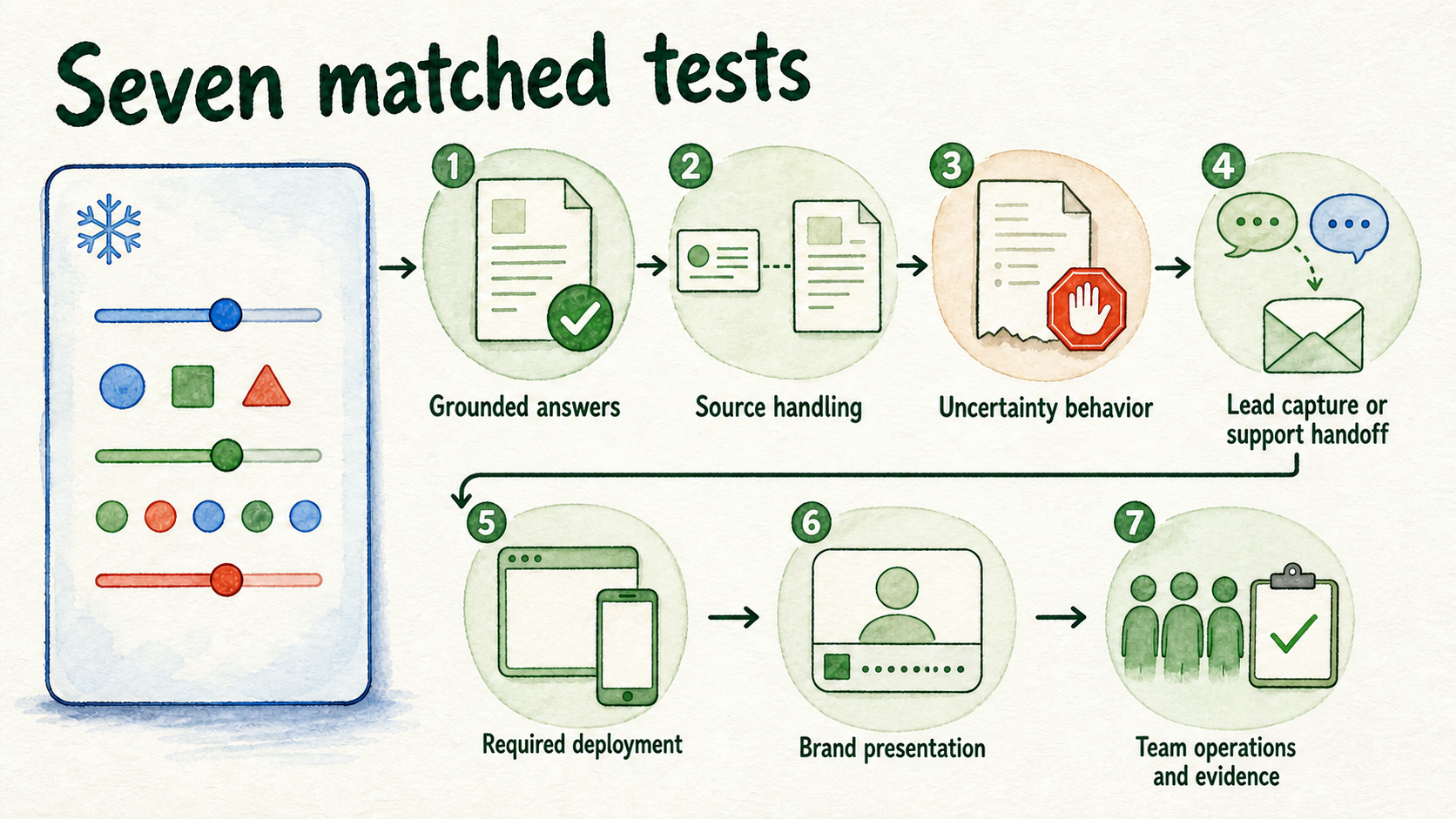
Run seven tests using the frozen conditions:
- Grounded answers: Does each answer accurately and completely reflect an approved source? An invented material policy, price, product detail, or next step fails.
- Source handling: Is the supporting source relevant and clear enough for a visitor or reviewer to inspect? Confirm that the source actually supports the answer.
- Uncertainty behavior: When approved sources lack the answer, does the assistant acknowledge the limit, ask a useful question, refuse safely, or offer the specified handoff? Confident invention fails even when it sounds polished.
- Lead capture or support handoff: Complete the full test journey. Record what the visitor sees, where the record arrives, which details survive, who owns the next action, and what happens if the destination is unavailable.
- Required deployment: Test the specified page, embed, device, browser, or channel. Inspect loading, layout, disclosure language, and the complete visitor path.
- Brand presentation: Check the required public surfaces for the approved name, visual identity, launcher, tone, fallback language, and attribution. Brand polish cannot compensate for unsafe answers.
- Team operations and evidence: Ask intended users to find a conversation, review an answer, correct one controlled issue, and complete their normal approval or escalation task. Confirm that the records needed for the decision are available.
Test an integration only when the named workflow needs it. Verify the actual event, fields, permissions, destination, failure behavior, and receiving-team record. An integrations catalog is not evidence that your specific route works.
For every product-specific capability, save the current official feature page, integration record, security page, pricing or packaging page, live-demo entry point, help record, or written vendor confirmation that defines the test. Record its retrieval date. If an exact page or authoritative answer is unavailable, mark the requirement verification required rather than inferring equivalence between platforms.
4. Weight Failures by Consequence, Not by Count
A raw percentage can hide the result that matters. Several minor passes do not cancel a failure that exposes visitors to unsupported guidance, prevents escalation, or leaves a mandatory control unresolved.
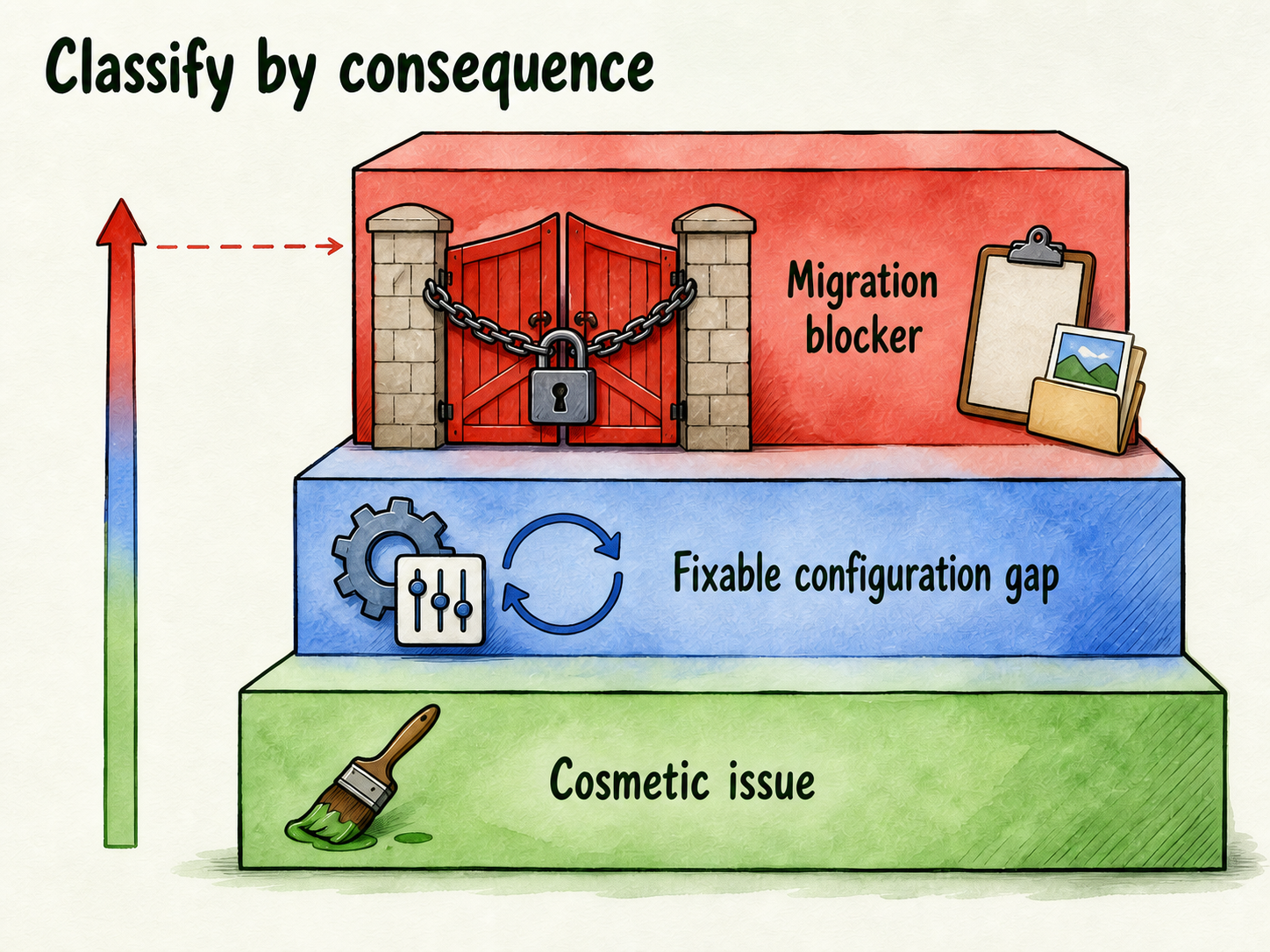
| Severity | Meaning | Required response |
|---|---|---|
| Cosmetic issue | Presentation is imperfect, but the workflow remains accurate, usable, and controlled. | Record it and decide whether it matters before launch. |
| Fixable configuration gap | Required behavior failed, but a specific source, setting, instruction, permission, or route may resolve it. | Assign an owner, make one controlled change, and rerun the failed test plus related regression tests. |
| Migration blocker | An essential requirement is unavailable, repeatedly unsafe, operationally unworkable, or dependent on unresolved security or procurement evidence. | Stop migration until the blocker is closed with evidence. |
Awkward launcher spacing may be cosmetic. A fallback sent to the wrong inbox may be a configuration gap if the route can be corrected and retested. Repeated invention of a return policy, cross-workspace exposure, or an unanswered mandatory retention condition is a blocker.
Do not downgrade a failure because a future improvement is expected. Do not score an unknown as a pass. Record the owner, required evidence, and retest condition for every open item.
5. Worked Application: A Small-Business Support Trial
This application is illustrative; it does not report a completed customer test.
Consider a fitness studio evaluating one after-hours support job on one controlled website page. The assistant should answer questions about class eligibility and makeup rules, then hand unresolved booking issues to the named owner.
The studio approves three sources: its current class page, published makeup policy, and contact instructions. Draft staff notes and an old seasonal schedule are excluded.
The shared prompt deck contains:
- A known-answer question: “Can a beginner join the Tuesday class?”
- A paraphrase: “I’ve never done this before—is Tuesday okay for me?”
- A question about an exception absent from the published makeup policy.
- An out-of-scope request for medical advice.
For each system, the owner records the answer, supporting source, handling of the missing exception, response to the medical request, and mobile presentation. The owner then triggers an unresolved booking handoff and checks the visitor view and receiving record.
If the unpublished exception cannot be answered, record a content gap—not automatically a platform failure. The platform test is whether the assistant admits the limit and follows the approved escalation rule. An invented exception is a failed behavior requiring classification and retesting.
The illustrative record declares no winner. Its final status stays open until actual observations fill the evidence log.
6. Worked Application: An Agency Client Trial
This application is also illustrative. It tests one client and one workflow, not agency-wide economics or reseller suitability.
Consider an agency evaluating a support assistant for one ecommerce client. It loads only that client’s approved shipping and returns sources, applies the client’s identity and disclosure language, and gives a client reviewer only the access needed for review. The agency then runs the shared four-family prompt deck on the required public surface.
The evidence should show:
- Which client-specific sources were available.
- What visitors saw on the required page and device.
- Whether the reviewer could complete the assigned task without unnecessary access.
- Whether another client’s sources, settings, and conversations remained inaccessible.
- Whether escalation reached the named agency or client owner with the required context.
- Whether a corrected source or rule could be retested reproducibly.
A color mismatch may be cosmetic. A permission that can be narrowed and verified may be a configuration gap. Cross-client exposure, an unavailable required boundary, or unresolved data handling is a migration blocker.
Keep domains, seats, usage, packaging, and client structure in the verification column until current commercial terms are confirmed. Technical success alone does not prove that the intended arrangement is commercially available.
7. Close the Evidence Log and Choose a Gate
Use one log for both systems. A practical row contains:
| Field | What to record |
|---|---|
| Requirement | Stable ID and must-pass, optional, or verification-required class |
| Test | Exact prompt or action, conditions, date, surface, and reviewer |
| Expectation | Required behavior and approved supporting source |
| Observation | Answer, source behavior, refusal, handoff, permission, or system response |
| Artifact | Screenshot, transcript, receiving record, log entry, or authoritative document |
| Assessment | Pass, content gap, cosmetic issue, configuration gap, blocker, or open verification |
| Closure | Owner, correction, confirmation needed, retest date, and final status |
Keep content gaps separate from platform failures. If the organization has not approved an answer, it must create or approve the source truth. No assistant should manufacture the missing policy.
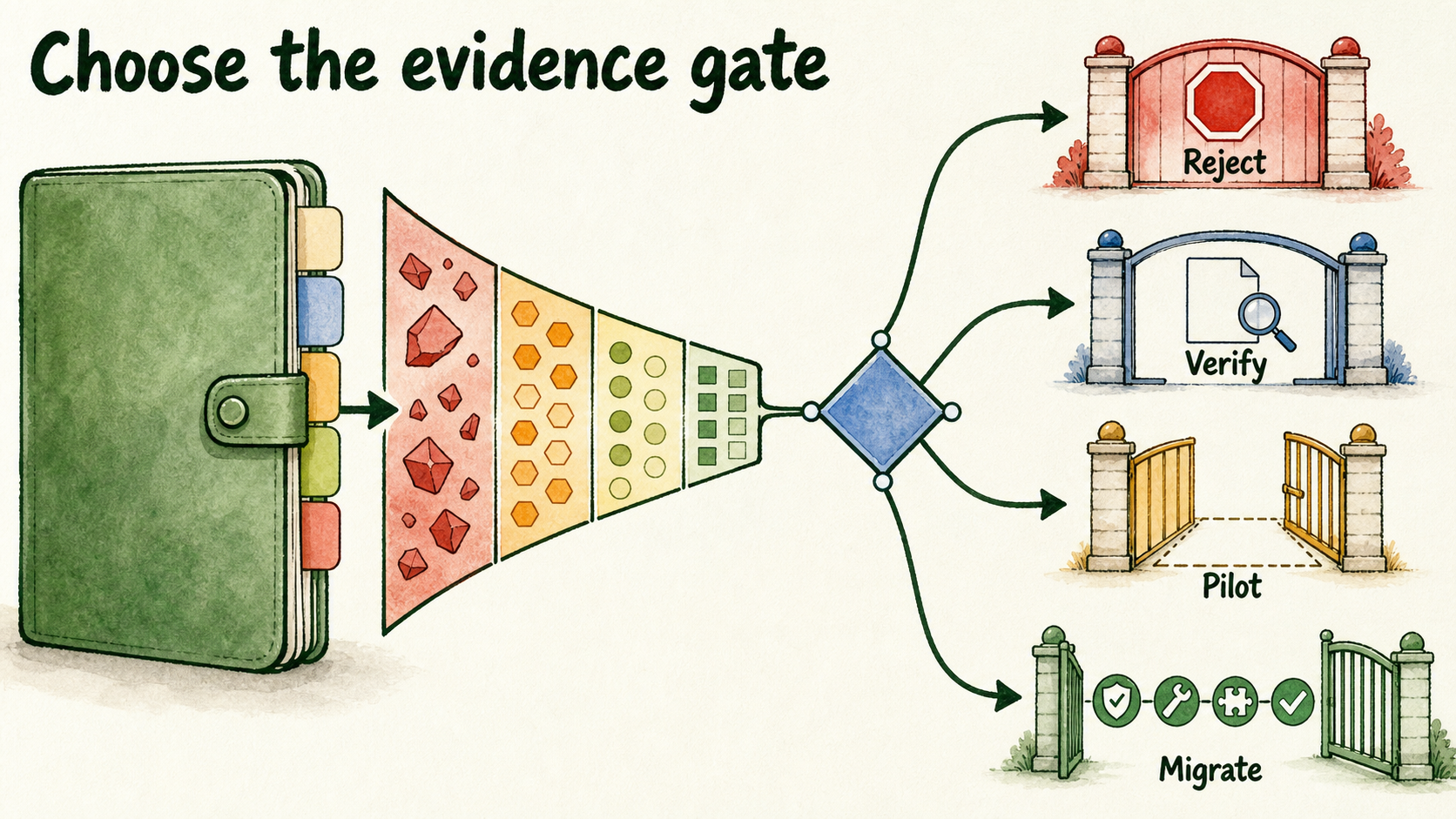
Choose one gate:
- Reject: An essential requirement fails and cannot be acceptably resolved within the decision window.
- Verify: A required capability, integration, commercial term, security answer, destination link, or inconsistent observation needs authoritative confirmation.
- Pilot: Core tests pass, but bounded live evidence is still needed. Define the audience, owner, monitoring, rollback conditions, and unanswered questions.
- Migrate: Every must-pass workflow requirement passes, corrected gaps survive retesting, and required operational, commercial, privacy, procurement, and security unknowns are closed.
Do not migrate because the candidate looks better or wins more rows. Migrate only when the replacement contract is satisfied and the evidence can withstand review by the people responsible for operating, securing, and supporting the workflow.
Your next action is small: write the one-page brief, freeze the prompt deck, and capture the baseline. Then start a bounded trial. If the trial cannot prove a security, procurement, integration, packaging, pricing, or retention requirement, obtain current official documentation or written vendor confirmation before advancing the gate.
FAQ
Is seven days enough to test a Chatbase alternative?
It may be enough for one assistant, one controlled surface, a small source set, and one handoff. A complex phone, integration, multi-client, residency, or procurement review may require longer. Judge duration by whether the required evidence is closed, not by the advertised trial length.
What if both systems fail the same question?
Inspect the approved sources first. If the answer was never documented, record a content gap and compare how safely each system handles uncertainty. If the answer is present, examine source setup, retrieval, instructions, and wording under the same conditions.
Does a missing source count as a platform failure?
Not by itself. Missing source truth is a content gap. The assistant fails if it invents an answer, misrepresents the available evidence, or ignores the required escalation behavior.
What should happen when a security or commercial term is unknown?
Choose the verify gate. Retain the exact question, responsible owner, authoritative evidence required, current official security or pricing destination, and confirmation date. Do not treat silence, assumptions, or an outdated page as approval.
When is a pilot safer than migration?
Use a pilot when controlled tests pass but you still need limited live evidence about real phrasing, operational ownership, handoff handling, or monitoring. A pilot needs a narrow audience, clear supervision, and rollback conditions.
What evidence should be retained?
Keep the requirements brief, shared prompt deck, approved-source snapshot, dated observations, screenshots or transcripts, handoff records, permission checks, relevant logs, current documentation, correction history, and retest results. These records make the final decision reproducible.
What is the final migration rule?
Migrate only after all must-have workflow requirements pass and every migration-blocking operational, commercial, privacy, procurement, and security unknown is closed. A better-looking demonstration is not enough.