TL;DR
- Stay with Chatbase when the current deployment satisfies every non-negotiable requirement and its operating burden remains acceptable.
- Investigate a Chatbase alternative when a required channel, workflow, control, or governance capability is absent.
- Treat missing evidence as a verification task, not proof of either good or poor fit.
- InsertChat is a conditional candidate for requirements involving approved-source answers, citations, branded chat, website voice, phone, and human handoff.
- No universal recommendation is possible without current first-party evidence and direct workflow testing across the vendors being considered.
A longer feature list will not correct a deployment mismatch. Deployment fit means that the system’s sources, answer rules, channels, actions, controls, governance, and ongoing workload match what the organization actually requires. The useful question is therefore not which chatbot has the most features, but which deployment model can clear every hard requirement with current evidence. Anything not documented or demonstrated must remain unknown until verified.
Key Takeaways
- Write requirements before comparing vendors. Attractive secondary features should not distract from a failed must-have.
- Separate hard gates from weighted preferences. A required phone channel is a gate; a preferred visual detail may be a preference.
- Treat “not documented” as “verify.” It means neither yes nor no.
- Count operating effort as part of fit. Someone must maintain sources, review conversations, manage escalations, govern integrations, and approve changes.
- Use product documentation to identify candidates, not to declare migration readiness. A migration decision needs plan confirmation, security review, operational evidence, and direct testing.
Should You Stay With Chatbase or Investigate an Alternative?
Staying is reasonable when the current Chatbase deployment meets every non-negotiable requirement, produces acceptable results for the intended workflow, can be governed properly, and creates a sustainable workload. Switching introduces implementation work and risk, so dissatisfaction alone does not prove that migration will improve the outcome.
Investigate alternatives when a hard requirement is demonstrably absent. The blocker might be a mandatory phone workflow, visible citations, a particular human-handoff path, client-separated access, or a procurement control. That failed requirement should define the shortlist.
Use a verification route when the answer is unclear. Request current documentation, confirm the applicable plan, or demonstrate the capability in the relevant account. This is especially important for feature availability, usage limits, branding entitlements, integrations, retention, regional processing, security materials, and commercial terms.
The decision rule is simple:
- Stay when every hard gate is met and the operating burden is acceptable.
- Verify when a decision-critical fact is unknown.
- Investigate alternatives when a required capability or control is absent.
Set the Deployment-Fit Gates Before You Name Vendors
Turn the intended customer journey into a pass-or-fail requirements sheet. Each row should state the requirement, why it matters, what evidence would satisfy it, and who owns verification.
Cover these gates:
- Approved sources and freshness: Specify which pages, documents, catalogs, policies, videos, or structured records the assistant may use. Name the owner responsible for keeping them current.
- Answer behavior: Define when the assistant should answer, cite a source, express uncertainty, refuse, ask a clarifying question, or escalate.
- Channels: Record whether the workflow requires a website widget, inline embed, hosted page, product interface, website voice, real phone number, email, messaging channel, or API.
- Lead capture and support handoff: Decide what information must be captured, where it goes, who receives it, and whether the person taking over can see the preceding exchange.
- Integrations and permissions: List the CRM, helpdesk, commerce, booking, payment, automation, API, webhook, or tool actions required for the initial workflow. Define what each connection may read or change.
- Branding and white-label scope: State the required name, logo, colors, disclosure, domain, email identity, portal treatment, and vendor attribution across every customer-facing surface.
- People and access: Specify who may edit sources, instructions, tools, conversations, integrations, deployments, and billing. Agencies should add client separation and client-scoped access.
- Analytics and inspection: Require enough records to review weak answers, unanswered questions, source use, feedback, leads, handoffs, activity, and usage.
- Security, privacy, and procurement: Identify the evidence needed for encryption, data-processing terms, subprocessors, model-provider handling, retention, deletion, hosting, residency, access control, private deployments, and procurement review.
- Operating ownership: Assign owners for content updates, conversation review, handoffs, integrations, incidents, and performance decisions.
A platform can pass its initial feature review and still fail the operating-effort gate. If nobody owns changing policies, recurring answer failures, or connected systems, the deployment will become harder to trust as the business changes.
Choose the Right Alternative Category
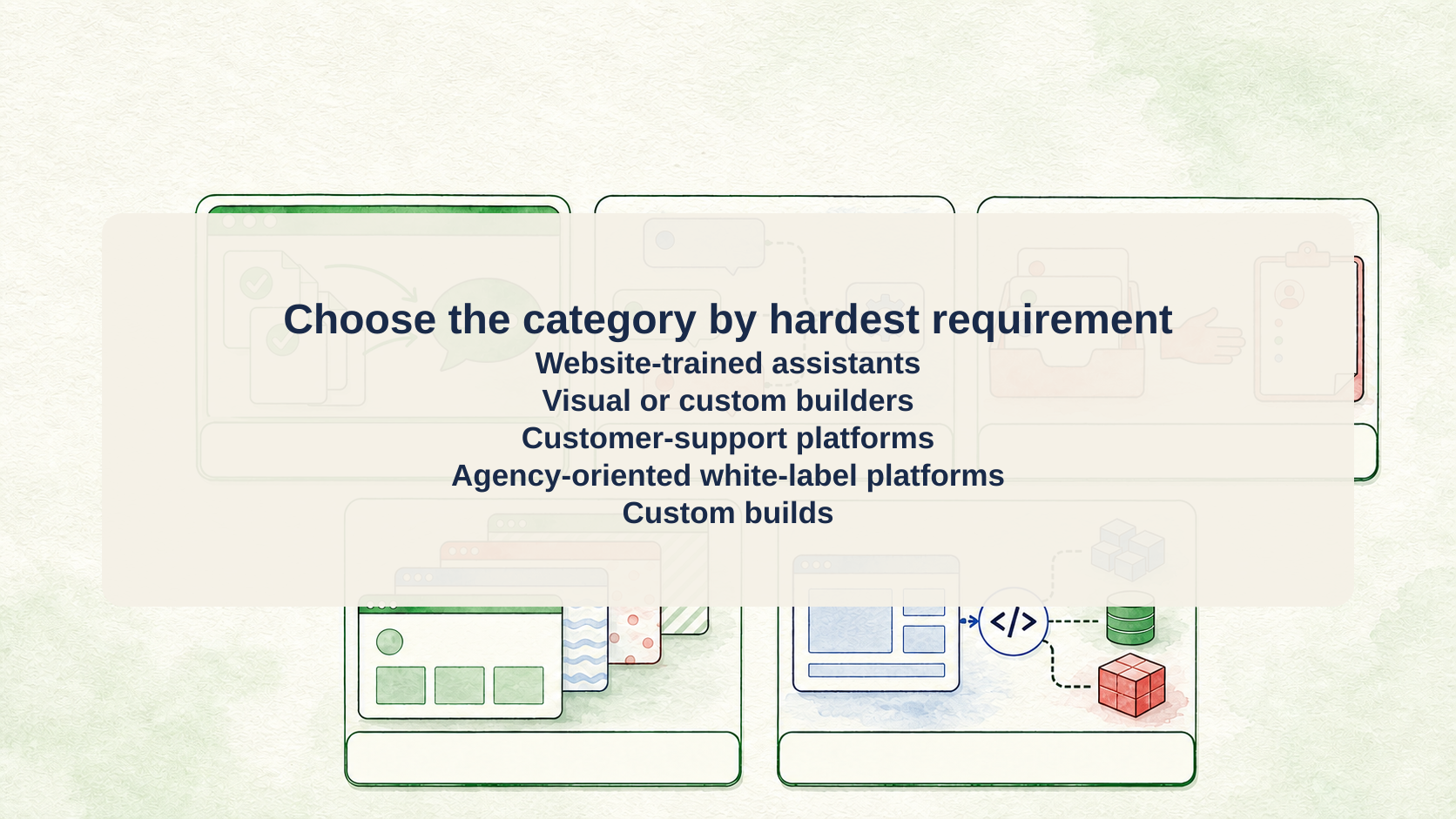
A category is a starting path, not a vendor recommendation. Begin with the deployment model that naturally fits the hardest requirements.
| Category | Start here when | Main tradeoff to examine |
|---|---|---|
| Website-trained assistants | The central job is answering from approved website and business content | Launch speed versus workflow, channel, and governance depth |
| Visual or custom builders | The team needs branching logic, designed conversations, or unusual actions | Greater control versus design, testing, and maintenance effort |
| Customer-support platforms | Ticketing, inbox operations, agent workflows, and support reporting are primary | Support depth versus broader voice, agency, website, or embedded uses |
| Agency-oriented white-label platforms | Multiple client brands, permissions, domains, reporting, and service delivery are required | Client-ready packaging versus limits, usage exposure, and service workload |
| Custom builds | Proprietary logic, infrastructure control, or a deeply embedded product experience is essential | Maximum control versus engineering ownership, monitoring, security, and upkeep |
Evaluate each category through the same lenses: speed, control, channel breadth, governance, and operating effort. Channel requirements can materially change the path. A business that only needs sourced website answers may begin with a website-trained assistant. Adding phone calls, live takeover, customer records, and one governed knowledge layer across channels points toward a broader operating model.
What the Supplied Vendor Evidence Can—and Cannot—Compare
The evidence status below is as of July 23, 2026. “Unknown” means current first-party documentation or direct trial evidence was not available for this comparison. It must not be interpreted as a missing product capability.
| Decision area | InsertChat evidence state | Chatbase and other alternatives |
|---|---|---|
| Approved-source answers and citations | Supported | Unknown; current evidence required |
| Website chat, website voice, and phone | Supported | Unknown; current evidence required |
| Human takeover and shared inbox | Supported | Unknown; current evidence required |
| Success with the buyer’s content and workflow | Requires direct trial | Requires direct trial |
| Current packaging, entitlements, and limits | Unknown until current terms are confirmed | Unknown until current terms are confirmed |
| Deployment-specific security suitability | Requires scoped review | Requires scoped review |
This evidence ceiling does not support a responsible multi-vendor ranking, competitor strength-and-limitation table, or definitive claim about who should leave Chatbase. A buying team should add dated first-party documentation, plan-specific confirmations, and direct observations before scoring named vendors.
Cost and branding also need their own evidence. Headline prices do not establish first-year cost, and one plan label does not prove how branding appears across every customer-facing surface.
When InsertChat Belongs on the Shortlist
InsertChat is a conditional candidate when the requirements combine approved-source answers and citations with branded website chat, website voice, phone assistance, and human takeover. Its official website describes these launch surfaces alongside real phone numbers, live call takeover, lead capture, and a shared inbox. Those capabilities establish shortlist relevance, not guaranteed workflow success. Review the current InsertChat product information against the written gates.
The candidate review should also cover brand and workspace controls, required integrations, REST API access, webhooks, MCP where relevant, and the records available for inspecting conversations, source use, feedback, and content gaps. Each item still needs current, deployment-specific confirmation before it becomes a pass.
Do not assume that plan entitlements or operational terms are permanent. Confirm limits, usage treatment, custom-domain availability, retention and cancellation outcomes, data residency, provider handling, security materials, and team permissions. The current InsertChat pricing page advertises a seven-day trial and multiple packaging paths, but current prices, inclusions, limits, and add-ons must be checked at the time of evaluation.
InsertChat should not be treated as universally suitable. Approved sources cannot supply a policy the business has never documented. Analytics do not repair missing guidance on their own. People still need to own high-stakes cases, source updates, tool permissions, review, and escalation.
Three Worked Shortlist Decisions
These scenarios are hypothetical decision examples, not customer outcomes.
Content-rich business
Non-negotiables: Current product and policy sources, citations, website deployment, phone coverage, lead capture, and contextual human handoff.
Category path: Begin with website-trained assistants, then remove any candidate that cannot satisfy the required phone and handoff model.
Supported candidate evidence: InsertChat belongs on the shortlist because the available first-party evidence supports approved-source citations, website chat, website voice, phone, and takeover.
Unknowns: Answer quality with the business’s content, workflow reliability, applicable limits, retention, and security suitability.
Next decision: Verify the applicable terms, then trial a narrow workflow with representative, non-sensitive content.
Agency
Non-negotiables: Separate client brands, scoped access, customer-facing domains and email identity, repeatable review records, predictable limits, and manageable service effort.
Category path: Begin with agency-oriented white-label platforms.
Supported candidate evidence: InsertChat may qualify for further review based on its documented multi-surface and workspace-oriented positioning.
Unknowns: Current assistant limits, domain entitlements, client permissions, branding scope, usage exposure, and the agency’s ongoing support burden.
Next decision: Obtain current plan-specific evidence before relying on any white-label entitlement.
Technical team
Non-negotiables: An embedded product surface, APIs or webhooks, controlled tools, provider governance, auditability, and possibly self-hosting or custom infrastructure.
Category path: Compare a managed platform with a custom build.
Supported candidate evidence: InsertChat can enter the managed-platform shortlist where its available integration and multi-channel evidence aligns with the requirements.
Unknowns: The exact API, webhook, MCP, provider, deployment, hosting, and security arrangements applicable to the intended design.
Next decision: Use a technical and security review to determine whether a managed platform clears the hard gates. Retain the custom-build path when proprietary behavior or infrastructure control outweighs its engineering and operational burden.
Decision Tree: Stay, Verify, Trial, or Migrate
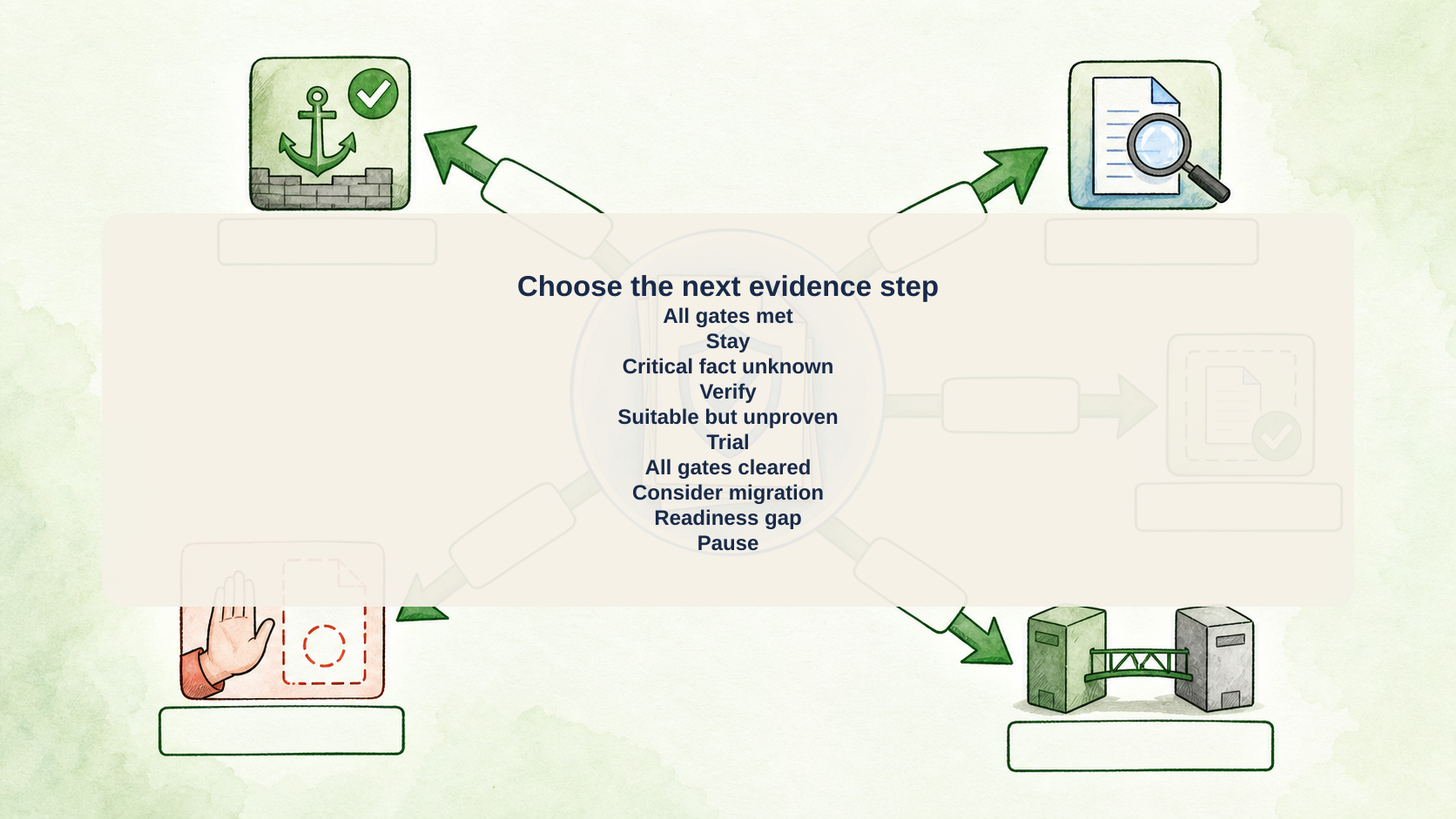
Follow the first route that matches the evidence:
- Does the current deployment meet every hard gate? If yes, stay unless its operating effort has become unacceptable.
- Is a decision-critical fact undocumented? Verify it through current documentation, plan confirmation, or an account-specific demonstration.
- Does a category appear suitable, but workflow performance remains unproven? Run a bounded trial using representative, non-sensitive content and real questions.
- Did the candidate clear the required workflow, commercial, privacy, security, and ownership gates? Consider migration planning.
- Is the organization missing approved content, an owner, sufficient evidence, or a viable category? Pause. Resolve the readiness problem or redesign the requirement before buying another tool.
Keep the trial bounded. Define the required workflow, matched conditions, pass-or-fail checks, evidence records, and decision gates before testing. Do not begin production migration merely because a feature page looks convincing.
Take the Next Evidence-Gathering Step
Write down the single unresolved gate blocking the decision. Then take the smallest action that can resolve it: inspect current feature information, view an available live demonstration, confirm the applicable plan, request security materials, or test one constrained workflow.
If InsertChat matches the required category, review its current product information and pricing before relying on packaging. A self-serve trial should use narrow, non-sensitive sources. Security review, residency requirements, self-hosting, custom infrastructure, and complex procurement belong in a contact-led discussion where deployment-specific evidence can be examined.
FAQ
When should I stay with Chatbase?
Stay when the current deployment satisfies every must-have source, answer, channel, workflow, branding, governance, security, and operating requirement. A switch needs both a defined blocker and evidence that another deployment model can address it.
What should make me investigate a Chatbase alternative?
Investigate when a required gate is absent or the operating burden is no longer acceptable. If the capability is merely undocumented, verify it before treating it as a reason to leave.
Which category fits a website-trained assistant requirement?
Begin with website-trained assistants when the central job is answering from approved website and business content. Move toward another category if required phone, support, agency, workflow, governance, or infrastructure needs exceed that model.
When does phone support change the shortlist?
Phone changes the shortlist when calls are part of the required customer journey rather than a future preference. Evaluate knowledge consistency, takeover, context preservation, routing, records, permissions, and ownership—not just whether a phone feature is advertised.
Is InsertChat the best Chatbase alternative?
No universal “best” claim is supportable. InsertChat is a relevant candidate when approved-source citations, branded chat, website voice, phone, and contextual handoff are required together. Suitability still depends on direct testing, current terms, security review, and operating fit.
What should I do when pricing, retention, residency, or packaging is unclear?
Mark the item unknown and request current, plan-specific evidence. Do not convert missing documentation into an assumption. An unresolved hard gate should block purchase or migration until it is closed.
When should a technical team consider a custom build?
Consider a custom build when proprietary logic, infrastructure control, self-hosting, or deep product integration is genuinely non-negotiable. Compare that benefit with full ownership of engineering, source pipelines, evaluation, monitoring, security, permissions, incident response, and ongoing maintenance.