TL;DR
- A published Chatbase plan price is only one part of first-year cost. Add usage charges, required entitlements, external services, setup work, and twelve months of operating labor.
- Attach a source, verification date, and confidence status to every commercial term. Leave unsupported prices, limits, and overage rules blank until current official documentation or a dated account-specific quote confirms them.
- Use one formula: annual subscription + expected variable charges + required services + one-time effort + recurring operating labor.
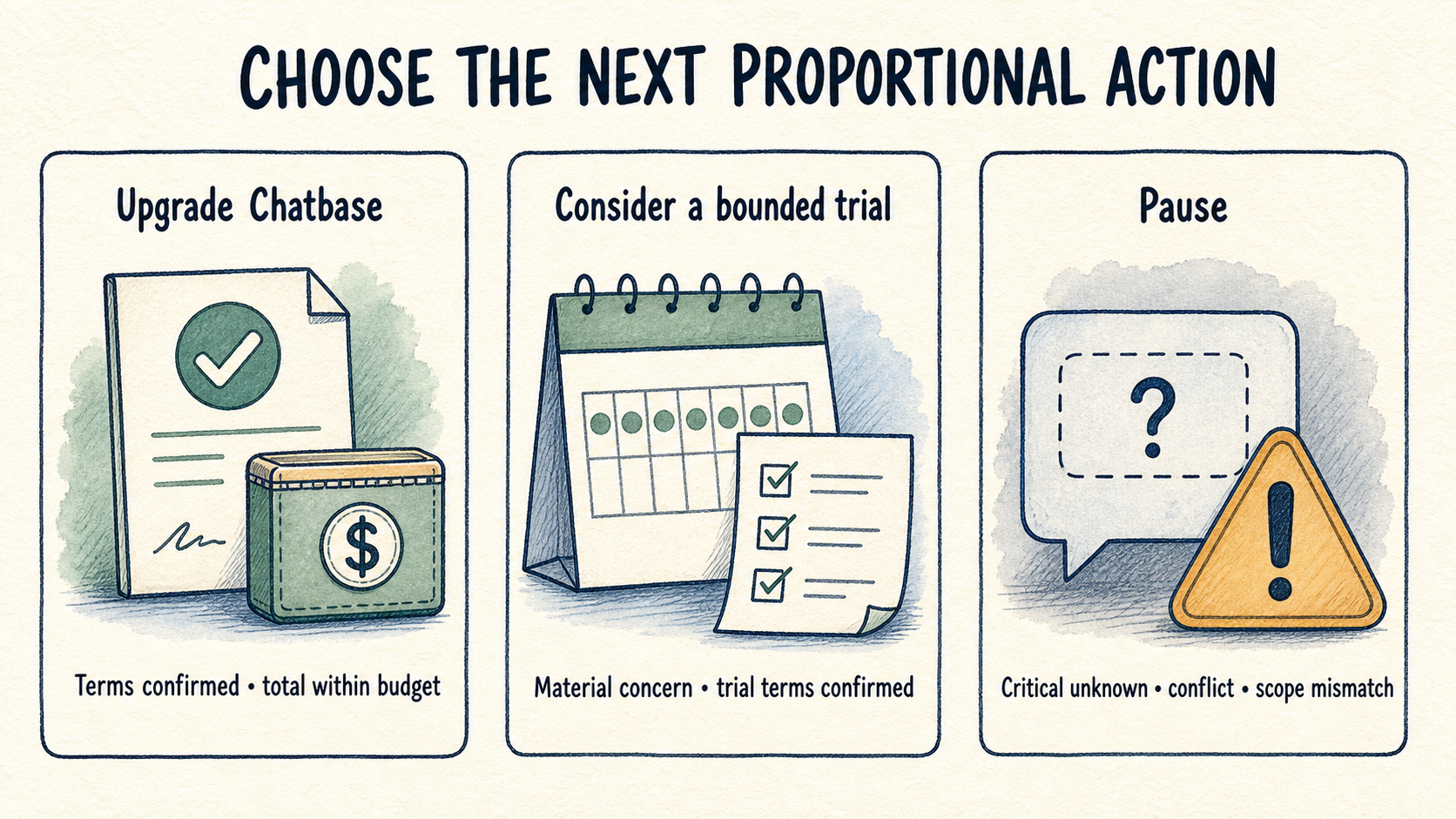
- Upgrade when critical terms are verified and the incremental cost is acceptable. Trial an alternative when a material cost or entitlement difference warrants investigation. Pause when a critical term remains unknown.
A plan may look affordable until the proposed deployment requires more seats, greater usage, additional sources, branding rights, an integration, or a support level that the displayed price does not cover. The number suitable for approval is a dated first-year total, not the smallest monthly figure on a pricing page. A structured worksheet shows which costs are known, which still need written confirmation, and which decision the evidence supports.
Key Takeaways
- A vendor term belongs in the calculation only when a current first-party source or account-specific quote supports it.
- A low plan price is irrelevant when a required seat, source allowance, branding right, integration, or support level forces an upgrade.
- One-time implementation or switching work and recurring maintenance affect first-year cost differently. Record them separately.
- Model uncertain usage with low, expected, and high cases rather than one falsely precise estimate.
- An unknown critical entitlement should block approval, even when every known charge fits the budget.
Start with requirements and dated evidence
Define the deployment before comparing prices. Two plans can carry similar prices while covering different quantities, rights, and service levels.
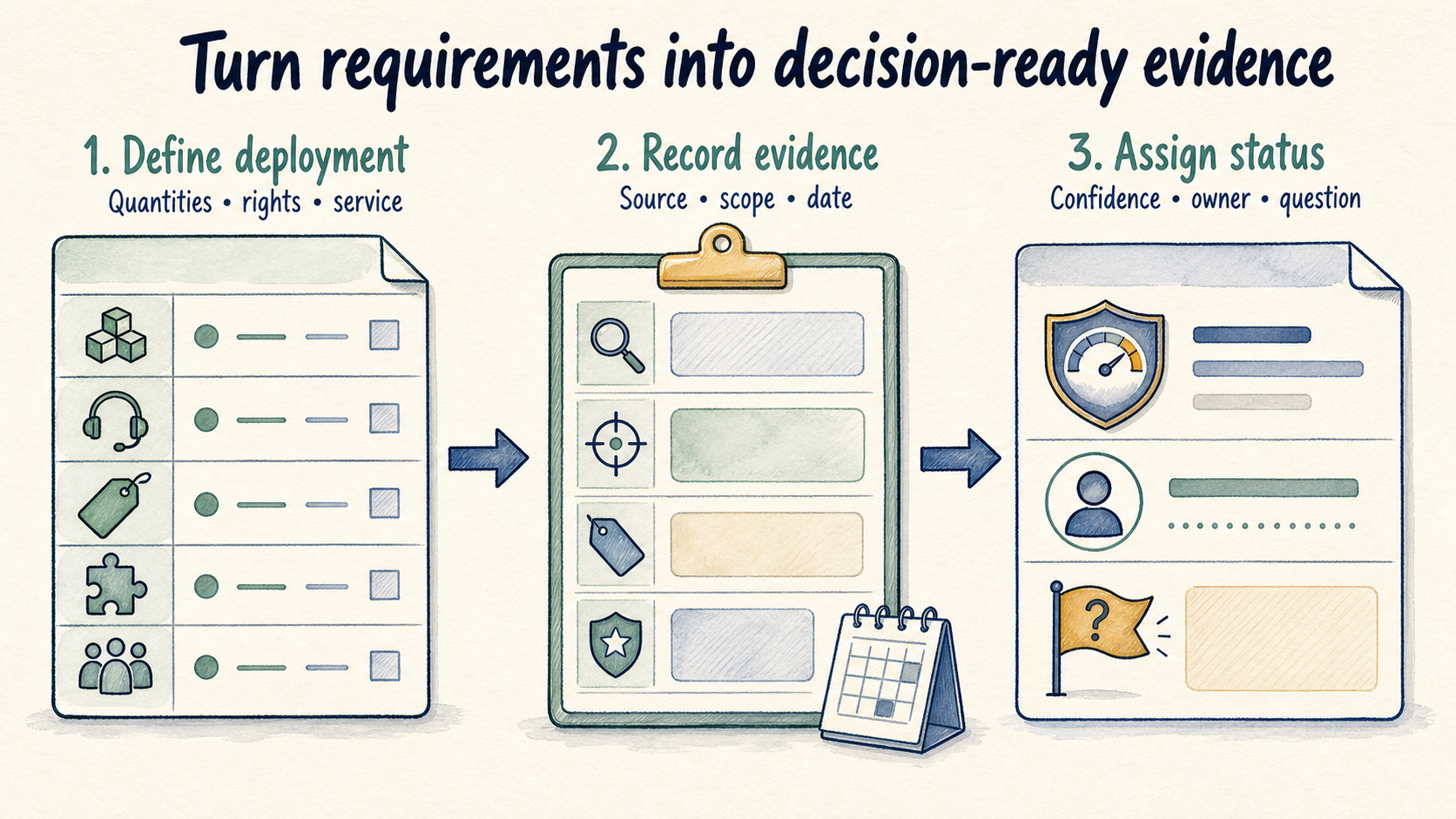
Record the requirements that could change cost:
- Number of assistants or deployments
- Expected conversations, messages, credits, or other metered activity
- Number and type of knowledge sources
- Required seats and user roles
- Websites, client accounts, or business units involved
- Required integrations and separately billed services
- Support response and onboarding needs
- Customer-facing branding requirements
- Estimated setup and monthly maintenance hours
Treat branding as a cost requirement only when it affects plan eligibility or charges. For example, record that customer-facing vendor attribution is unacceptable, then obtain written confirmation of the plan that meets that condition. Buyers who still need to identify the relevant surfaces can use Remove Powered by Chatbase: A Five-Surface Audit before pricing the requirement.
Give every commercial term an evidence record:
| Field | What to record |
|---|---|
| Requirement | Needed capability, quantity, or service level |
| Vendor term | Applicable plan, limit, entitlement, add-on, or billing rule |
| Value | Price, allowance, rate, or included quantity |
| Scope | Account, plan, assistant, seat, source, or billing period covered |
| Source | Official documentation, contract, or account-specific quote |
| Verified date | Date the source was checked or the quote issued |
| Confidence | Verified, account-specific, assumed, or unknown |
| Open question | Clarification required before approval |
Use verified for a term supported by current official material. Use account-specific for a dated written answer that applies to the planned deployment. Use assumed for buyer forecasts, such as usage or staff hours. Use unknown when written confirmation is still required.
Assign ownership as well. The commercial buyer should refresh vendor terms before approval, renewal, or a material deployment change. The person operating the assistant should review usage and labor assumptions when traffic, content, staffing, or workflows change.
Separate verified facts from quote questions
Current official Chatbase pricing and plan documentation was not available for verification on July 20, 2026. No Chatbase price, limit, branding entitlement, or overage rate should therefore be treated as current based on this page alone. Obtain official documentation or a dated account-specific quote before completing those fields.
Ask Chatbase to map the planned deployment to these questions in writing:
- Which base plan covers the required assistants?
- How is usage measured, and what allowance applies to each billing period?
- What happens at the limit: an overage charge, restricted use, or a required upgrade?
- What unit and rate apply to overages?
- How many seats and sources are included, and how are additional quantities priced?
- Which plan includes the required branding treatment?
- Are the necessary integrations included, limited, or separately priced?
- What onboarding, support, or service level is included?
- Which charges are monthly, annual, variable, or one-time?
- Which cancellation, renewal, and account-specific conditions affect the first year?
For a webpage, retain a timestamped capture showing the plan, selected billing state, relevant term, URL, and capture date. For a quote, preserve its issue date, validity period, account scope, and stated assumptions.
| Status | When it applies | Worksheet treatment |
|---|---|---|
| Verified | Current official material supports the value and scope | Include the value |
| Account-specific | A dated written quote covers the deployment | Include it only for that account |
| Assumed | The buyer estimates usage, labor, or another internal quantity | Include and label the assumption |
| Unknown | Price, rule, entitlement, or scope remains unresolved | Leave the amount open |
Apply the same standard to any alternative. InsertChat’s official pages, checked July 20, 2026, identify assistants, sources, usage, seats, white-label needs, content volume, and client complexity as pricing dimensions. They also advertise a seven-day free trial. However, different sections displayed inconsistent plan figures, including amounts that do not establish a reliable starting price, copyright-removal price, or full white-label price. Those amounts should remain unknown until InsertChat confirms the current plan, billing cadence, and canonical charge in writing.
This distinction prevents a favorable interpretation from entering the calculation. A visible number is not decision-ready when its billing state or scope is unclear.
Calculate first-year cost with one formula
Use the same formula for the current plan, an upgrade, and each alternative:
First-year total = annual subscription + expected variable charges + required entitlements and external services + one-time implementation or switching effort + twelve months of recurring operating labor
Build the calculation at line-item level:
| Cost category | Calculation | Required check |
|---|---|---|
| Base subscription | Monthly charge × 12, or verified annual charge | Is the billing cadence confirmed? |
| Usage or overages | Expected billable quantity × verified unit rate | Are the unit, allowance, and rate known? |
| Added capacity | Additional seats, assistants, or sources × verified rate | What is included in the base plan? |
| Branding entitlement | Required plan increment or add-on | Does it cover the stated requirement? |
| Integrations and services | Vendor charge + external service charge | Are separate subscriptions needed? |
| Support or onboarding | Included amount or quoted fee | Is the required service level covered? |
| One-time effort | Estimated hours × internal hourly cost | Has the responsible team reviewed the estimate? |
| Recurring operation | Monthly hours × hourly cost × 12 | Who owns the work? |
| Risk allowance | Stated range or probability-weighted amount | Which uncertainty creates the exposure? |
Use a verified annual charge when annual billing applies. Do not multiply a promotional display by twelve unless its billing basis is explicit. Add tax or currency-conversion lines when those amounts affect internal approval.
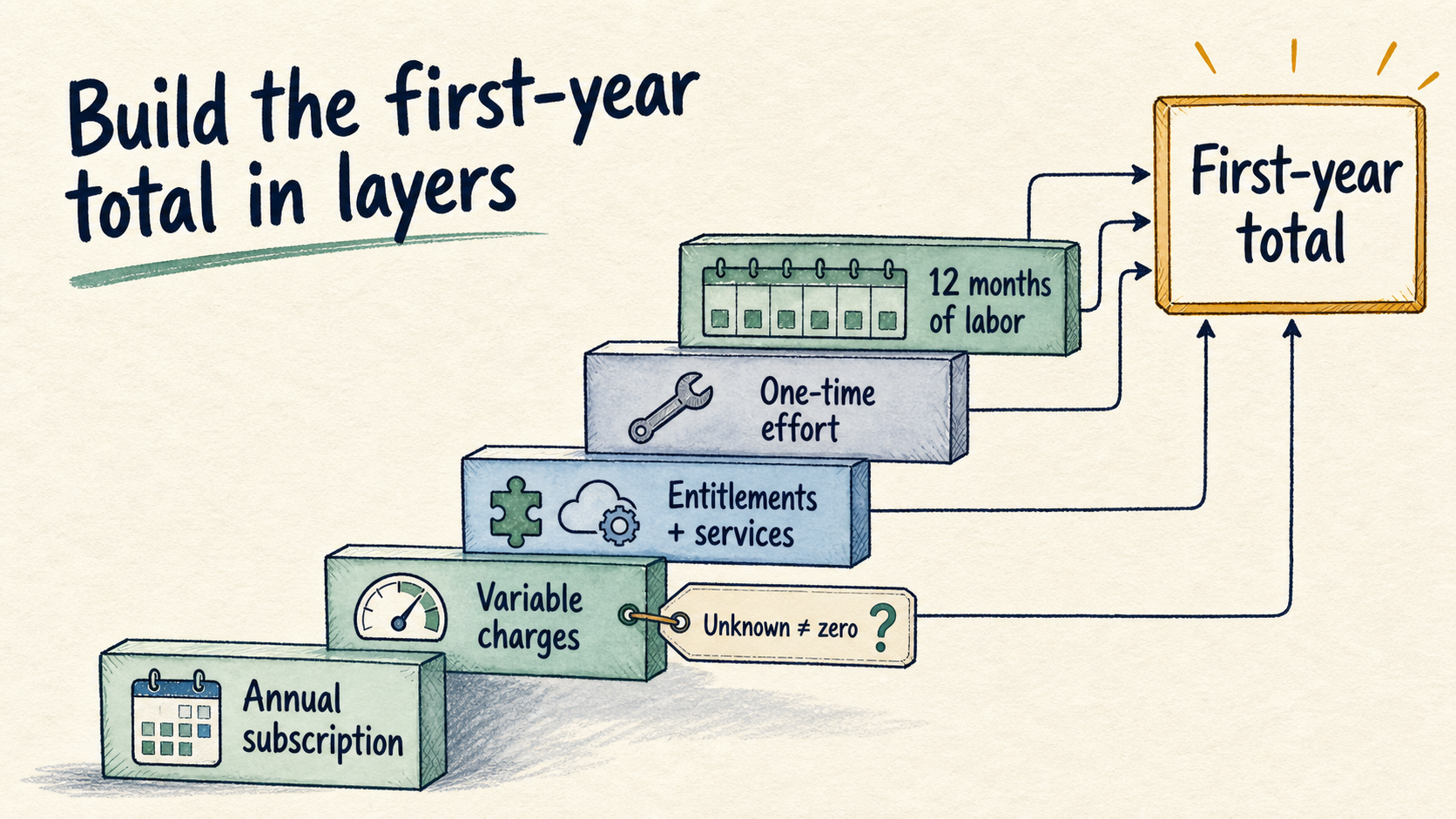
For uncertain usage, calculate three cases:
- Low: conservative adoption or a quiet operating period
- Expected: the most defensible forecast based on planned traffic and use
- High: a plausible peak that could affect plan choice or overages
If the usage definition or overage rate is unknown, record the expected quantity but leave the charge unresolved. Entering zero would turn missing information into an unsupported price advantage.
Keep one-time switching work separate from recurring savings. A lower subscription can still produce a higher first-year total when moving requires substantial setup. A higher subscription can sometimes reduce administration or replace another paid service, but count that effect only when the labor or service change has a stated basis.
For illustration, a buyer might estimate 24 hours of one-time work and three hours of monthly maintenance for an alternative. Multiplying those hours by its approved internal labor rate makes the scenario comparable. The hours are planning assumptions, not vendor facts or predicted results.
Apply the worksheet to two buyers
Consider a small business that wants one website assistant to answer common questions and capture sales leads. Its worksheet begins with the number of approved pages and documents, expected monthly conversations, the required lead-capture connection, support needs, setup hours, and monthly review time.
The business requests written confirmation of included usage, source allowance, integration access, support terms, and overage treatment for the applicable Chatbase plan. Branding enters the calculation only if a documented requirement changes the necessary plan.
A low-priced plan may remain suitable when it covers the expected usage, sources, and integration. It may cease to matter if lead capture, source volume, or projected usage requires a higher tier. Low, expected, and high usage cases expose that trigger without guessing which current plan contains each entitlement.
Now consider an agency managing assistants for several clients. Its quantities include assistants, seats, client-specific sources, expected usage by account, setup hours, and monthly portfolio maintenance. Client branding and account separation are recorded only as requirements that may change commercial terms.
The agency needs answers to narrow cost questions: which plan covers the required assistants and seats, whether the required branding entitlement is included, whether account separation changes the commercial structure, and how added capacity is charged. A broader assessment of permissions, ownership, client access, or offboarding belongs in a separate platform evaluation.
Switching effort may be higher for the agency because several client deployments are involved. Recurring labor may also rise with the assistant count. Compare staying and switching with the same client count, labor rate, maintenance period, and evidence standard.
A cost worksheet cannot settle a purchase when security, governance, workflow, or channel suitability is the decisive constraint. Record any verified cost effect, then move the broader fit question to the appropriate evaluation.
Choose an upgrade, trial, or pause
A completed worksheet should support one proportional next action.
Upgrade Chatbase when every critical price, limit, and entitlement has current official support or a dated account-specific quote, and the incremental first-year total fits the approved budget. Include expected usage and operating work, not just the subscription difference.
Consider a bounded InsertChat trial when the model reveals a material recurring-cost difference or an entitlement concern worth testing. InsertChat advertised a seven-day free trial on its pricing page and FAQ when checked July 20, 2026. The reviewed language did not establish that no charge occurs during the trial, so confirm the billing trigger, payment requirement, cancellation terms, conversion terms, eligible plan, and current price before signup.
Pause when a critical term remains unknown, displayed figures conflict, or a quote does not map clearly to the planned deployment. Obtain the missing term in writing and update the worksheet. An unknown overage rate or branding entitlement must not be treated as free.
First-year cost is the immediate gate, but record the later-year effect separately. One-time switching effort drops out, while subscriptions, usage, external services, and maintenance continue. A higher switching total in year one may justify further testing when the verified recurring difference is material, but it does not justify an automatic switch.
FAQ
What if Chatbase terms are not publicly available?
Request a dated account-specific quote naming the plan, billing cadence, included usage, overage treatment, seats, sources, branding rights, integrations, support, and add-ons. Mark unanswered fields as unknown. Pause if any unanswered term could change plan eligibility or the first-year total materially.
How should uncertain overages be modeled?
Calculate low, expected, and high usage cases after confirming the measurement unit, allowance, and overage rule. If the rate remains unavailable, show the expected quantity while leaving its cost unresolved.
Can monthly and annual prices be compared directly?
Only after converting them to the same period and confirming whether each display is a monthly charge, an annual total, or a monthly equivalent billed annually. InsertChat’s FAQ stated on July 20, 2026, that annual billing included two months free. Recheck that term and its billing basis before calculating savings.
Does InsertChat offer a no-charge seven-day trial?
The official pages advertised a seven-day free trial on July 20, 2026, but the reviewed wording did not explicitly confirm when charges begin. Verify the billing trigger and conversion terms before starting.
When should the worksheet be refreshed?
Recheck vendor terms immediately before approval or renewal and after a material deployment change. Refresh buyer assumptions when usage, client count, staffing, integrations, or required entitlements change.
Complete the Chatbase fields with current official terms or a written quote. Approve an upgrade only when the required terms are confirmed and the first-year total fits the budget. If the result shows a material cost or entitlement concern, verify InsertChat’s current terms and consider its advertised trial. Pause when either option still has a critical unknown.