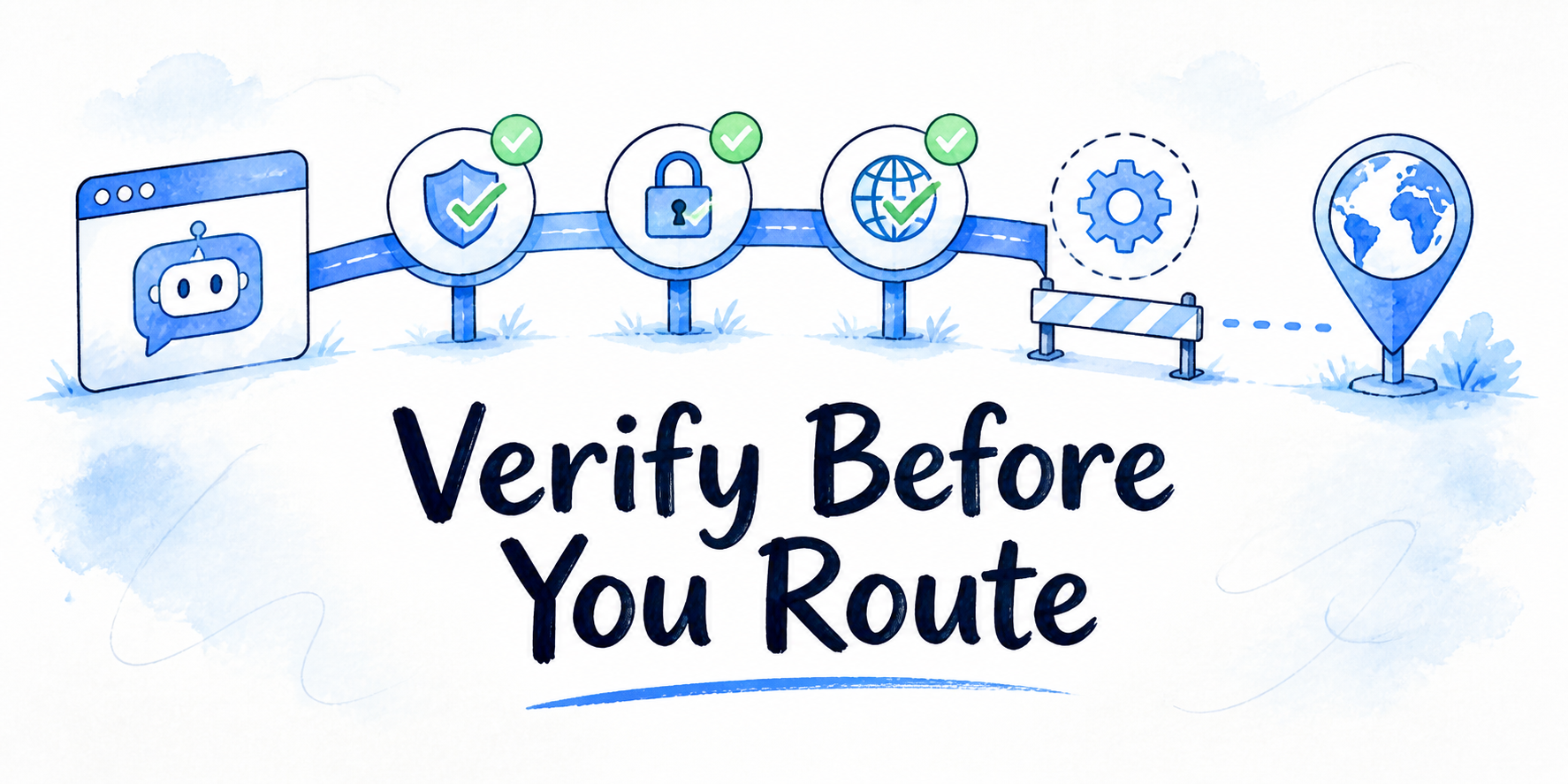
TL;DR
- Review six domains: data collection and storage, conversation logs, model use, permissions, retention and deletion, and incident support.
- Trace the complete data path, including connected systems and model providers. A claim about shared-model training does not explain what data leaves the platform to generate an answer.
- Ask for written evidence that applies to your proposed deployment. Hosting, retention, provider terms, and support arrangements may vary by configuration.
- Classify each answer as documented, deployment-dependent, or unresolved. Do not convert an unanswered material question into an assumption.
- Use the completed record to approve the deployment, narrow its scope, escalate specific issues, or pause procurement.
When a chatbot carries your name, domain, and visual identity, visitors experience it as your service—even when another company supplies the platform beneath it. That makes vague reassurance expensive: if a client asks where a conversation went, who could read it, or whether it was retained, your team needs an evidenced answer rather than a badge, slogan, or sales-call recollection. The right white label AI chatbot security questions expose the full data path and show where a proposed deployment still depends on configuration, contractual terms, or a decision by your own reviewers.
Key Takeaways
- Claims are not evidence. “Encrypted,” “private,” and “compliant” are starting points for questions, not complete answers.
- Configuration changes the result. The selected model provider, integrations, hosting arrangement, enabled tools, and retention settings can all affect data handling.
- Model transmission matters. Ask separately about training, prompt processing, source excerpts, provider retention, and abuse monitoring.
- Access must be examined by action. A role name says little unless you know what that role can view, change, export, delete, publish, or connect.
- Consequential unknowns stay open. Assign them to security, privacy, legal, or procurement rather than accepting an informal promise.
Start With the Data Path, Not a Compliance Badge
A useful security review begins with the records that make the assistant work. These commonly include approved source content, visitor messages, uploaded files, contact details, conversation histories, feedback, and information exchanged with connected systems. Some or all of a prompt and its relevant source context may also be processed by a model provider.
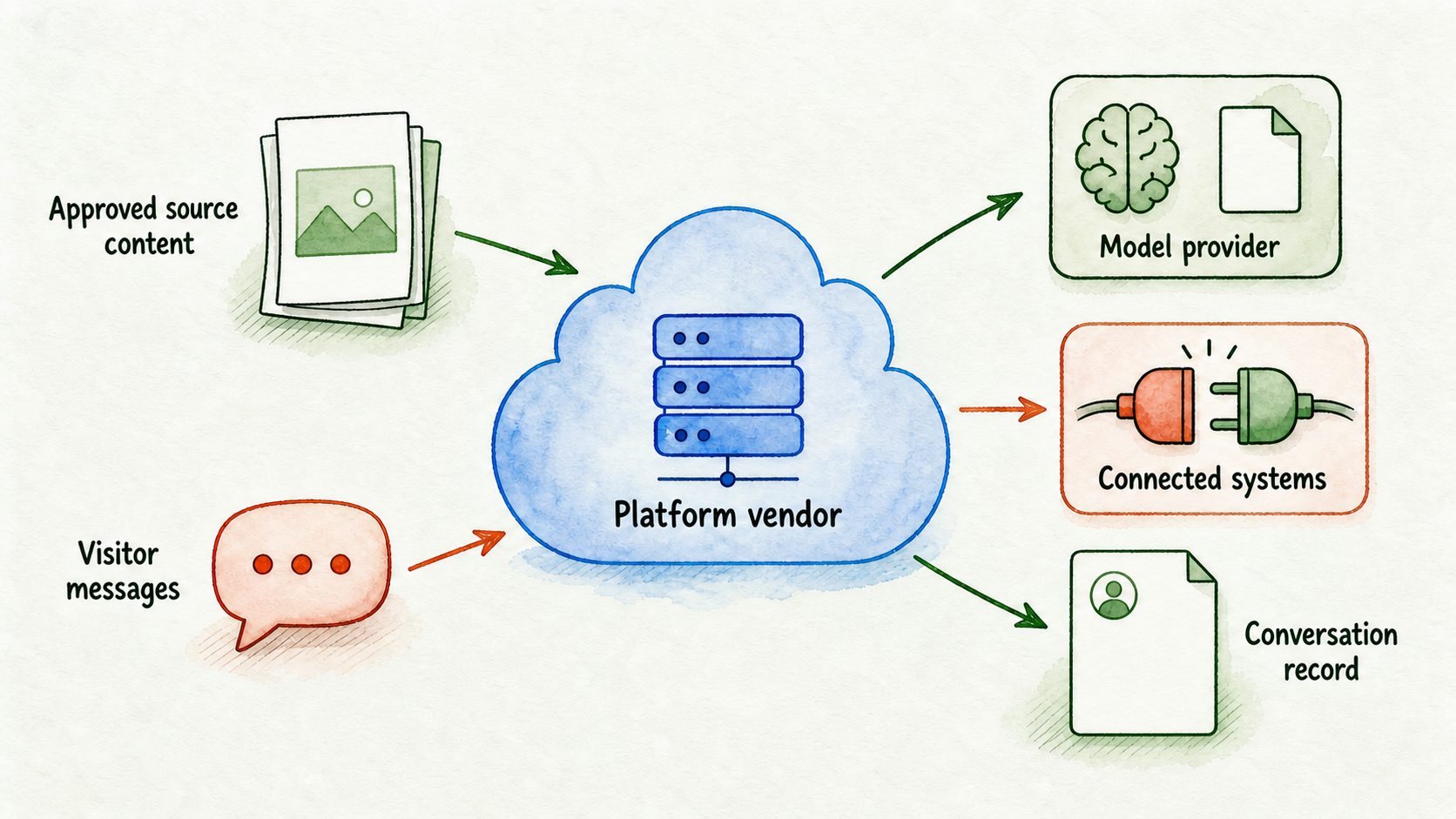
Define the parties while tracing that path. The platform vendor operates the chatbot service. A model provider generates responses. A subprocessor supports part of the vendor’s service, such as infrastructure or communications. A connected system is one your organization chooses to involve, such as a CRM, inbox, payment service, or booking tool.
Then classify each vendor answer:
| Status | Meaning | Appropriate response |
|---|---|---|
| Documented | Written evidence directly answers the question for the proposed deployment. | Record the document, scope, version, and any exceptions. |
| Deployment-dependent | The answer changes with configuration, region, provider, contract, or enabled feature. | Obtain confirmation for the exact arrangement under review. |
| Unresolved | The answer is missing, contradictory, verbal only, or too broad to rely on. | Assign an owner and keep the issue open. |
For example, “data is encrypted” is incomplete without the protected data categories, stages, exclusions, and supporting documentation. Likewise, an assurance report may be relevant evidence about a control environment, but it does not by itself decide whether your particular sources, integrations, retention choices, and model-provider terms meet your requirements.
This is also the right way to interpret InsertChat’s assurance language. Its security page presents security and privacy controls while making scoped review important for the intended deployment. Treat statements such as SOC 2 Type II examined, GDPR and CCPA aligned, or HIPAA-ready as representations to investigate—not as automatic approval or an unconditional compliance conclusion for your use case. Review the stated security and assurance information beside the configuration and contract you are actually considering.
Questions About Data Collection, Processing, and Storage
Start by asking the vendor to name every material data category involved in your proposed workflow. Avoid the generic question, “What data do you collect?” It often produces a generic privacy-policy answer instead of a usable system description.
Ask:
- What source content, visitor input, uploaded files, lead details, feedback, metadata, and integration data can the platform receive?
- Which records are stored, and which are processed only for the immediate request?
- Where are platform data, backups, and operational logs hosted for this deployment?
- Can a customer select or restrict a region? Which services or subprocessors could operate outside that region?
- Which data categories are encrypted at rest and in transit? Are there material exclusions?
- How are accounts, assistants, tenants, and workspaces isolated?
- What information can flow to enabled integrations, tools, webhooks, APIs, email services, or analytics systems?
- Which subprocessors participate in those paths, and where is the current list documented?
Consider a hypothetical public support assistant. A useful trace follows an uploaded returns policy, a visitor’s question, an email captured for follow-up, the source excerpts retrieved to support an answer, the information transmitted for model processing, and the conversation record retained afterward. Use your intended sources, input types, integrations, and deployment channels when conducting the real review.
Do not accept a hosting region as a substitute for the full answer. The application database, model provider, support tooling, backups, and customer-enabled integrations may have different roles. If the vendor describes European or region-aware infrastructure but cannot confirm the exact arrangement, mark residency as deployment-dependent rather than inferred.
Questions About Conversation Logs and Audit Access
Conversation logs can contain more than a visitor’s visible messages. They may include retrieved source passages, contact details, feedback, classifications, internal notes, tool results, or handoff context. Their value for quality review also makes their access boundary important.
Ask:
- Which customer roles can view, search, annotate, export, or delete conversations?
- Can access be limited to one client, workspace, assistant, or channel?
- Can a user see conversations without gaining access to sources, integrations, publishing controls, or billing?
- Under what circumstances can vendor support personnel access conversation content?
- Is support access approved, time-limited, logged, or visible to the customer?
- What records show conversation access, administrative activity, feedback changes, or configuration changes?
- Can records be exported? In what format, with what fields, and on what timescale?
- Are deleted or redacted records also removed from search, analytics, exports, and support interfaces?
Test roles individually. An agency manager, client-scoped teammate, vendor support engineer, and model provider do not necessarily need—or receive—the same information. A vendor’s answer should distinguish these actors instead of referring collectively to “authorized users.”
Conversation review and history screens can demonstrate that records are inspectable, but they do not prove export completeness or access logging. Unless the vendor confirms formats, included fields, timing, and restrictions in writing, keep portability and audit coverage open.
Questions About Model Providers, Training, and Data Use
“No training on your data” answers one question. It does not answer the entire model data-use question.
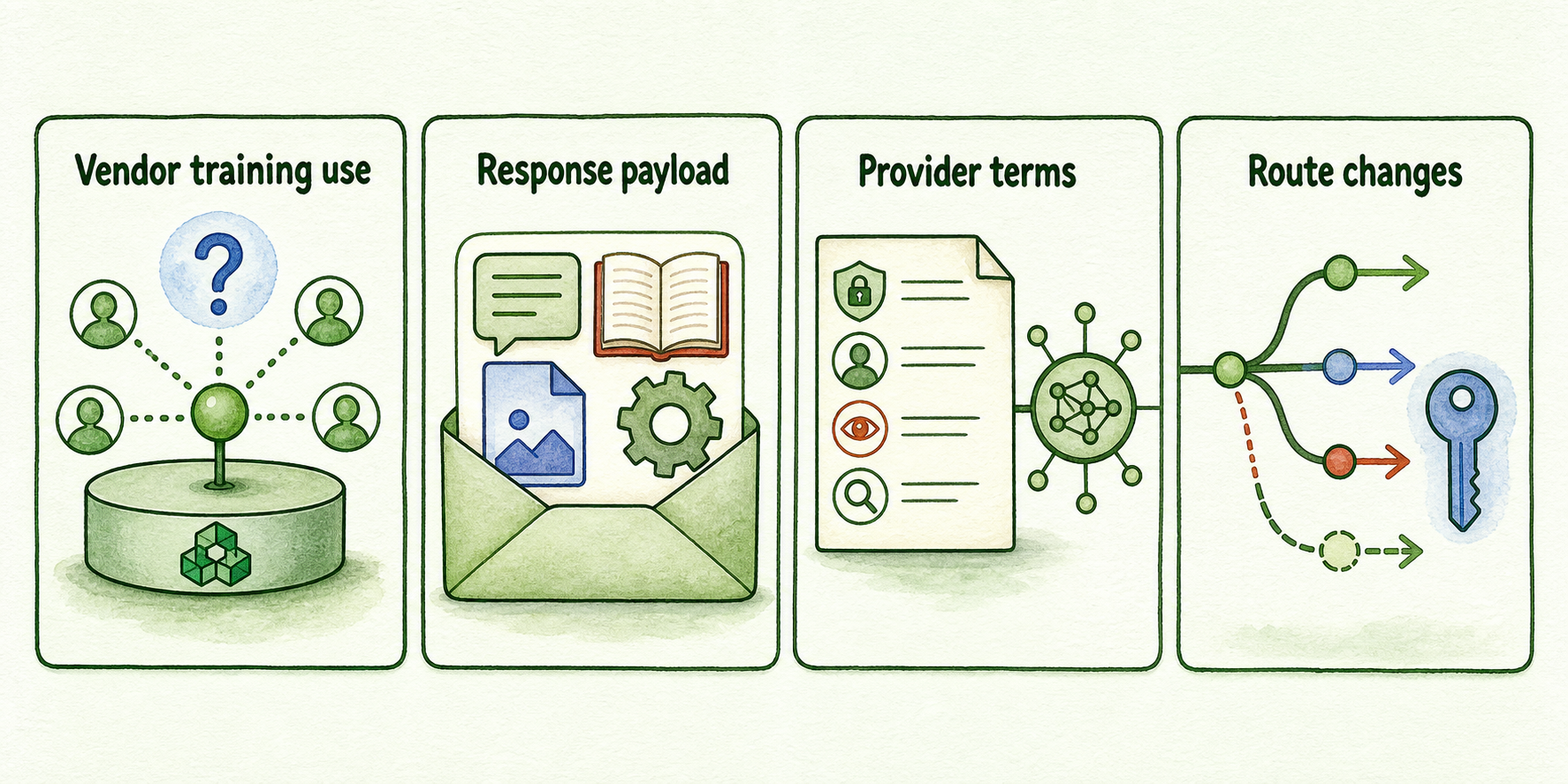
Separate the review into four parts:
- Does the platform vendor use customer sources, prompts, conversations, or feedback to train shared models?
- What prompts, source excerpts, conversation history, files, images, or tool outputs are sent to the selected model provider to produce a response?
- What retention, training, human-review, and abuse-monitoring terms does that provider apply to this route?
- Can the route change through model selection, automatic routing, fallback behavior, or a customer-supplied key?
This distinction matters because a platform can decline to repurpose customer data for shared-model training while still transmitting the material needed to generate each answer. That transmission may be essential to the service, but it must be included in the assessment.
If multiple model-provider families or routing options are available, request an answer for every route you expect to enable. Do not assume one provider’s contractual or retention terms apply to another.
Bring Your Own Key can place provider procurement, billing, and key governance under your organization’s account. It does not automatically remove the chatbot platform from the data path or eliminate platform storage, retrieval, logging, analytics, and tool processing. Ask the vendor to diagram what changes under BYOK and what remains the same.
Questions About Permissions, Roles, and Client Separation
Role-based access is useful only when its scope matches the actions your deployment requires. A list of role names—owner, administrator, manager, teammate—does not show whether client data is adequately separated.
Ask:
- What can each role view, create, edit, publish, export, delete, and connect?
- Can access be restricted to a specific client, workspace, assistant, source collection, or conversation set?
- Can a client-scoped user review one assistant without seeing another client’s sources, conversations, integrations, publishing settings, or billing?
- Can sensitive or pre-release assistants be private or password-protected?
- Can tools and integrations be enabled separately for each assistant?
- Who can change model selection, prompts, source rules, domains, credentials, or data settings?
- Does the vendor provide an action-level permission matrix?
- What access, if any, can vendor administrators or support personnel obtain?
Request screenshots or documentation for the consequential actions rather than relying on a sales demonstration of one role. If the needed separation requires a particular plan, contract, or deployment type, classify it as deployment-dependent.
These answers provide inputs to your governance process; they do not define that process. Your organization still decides who should receive each role, approve changes, or review permissions. Keep that operational design separate from the vendor’s capability evidence.
Questions About Retention, Deletion, and Contract Exit
A single statement that customers “can delete data” is rarely precise enough. Sources, conversations, leads, feedback, logs, backups, and provider-held copies may follow different lifecycles.
Ask:
- What determines the retention period for each material data category?
- Which periods can the customer configure, and what are the available ranges?
- What does a deletion action remove immediately?
- When is deletion completed in primary storage, backups, logs, analytics, and subprocessors?
- What evidence confirms completion?
- How does the platform support access, correction, or deletion requests involving an individual’s data?
- What can be exported before termination, and what does the export include?
- What happens to data when a trial ends, an assistant is removed, a client leaves, or the contract is cancelled?
- Do contractual or data-processing terms specify deletion or return obligations?
Request separate answers for each record type. Deleting an uploaded policy does not necessarily answer what happens to conversations that quoted it. Deleting a visible conversation does not explain backup treatment or copies processed by another provider.
Exact periods and deletion times should come from current documentation applicable to the proposed deployment. If backup deletion, export completeness, post-cancellation treatment, or provider-held copies are not confirmed, record them as unresolved. Do not fill the silence with a preferred interpretation.
Questions About Incidents, Monitoring, and Security Support
The procurement objective is not to design the vendor’s incident-response procedure. It is to establish whether the vendor can receive a report, investigate an issue, preserve useful evidence, and communicate with the affected customer.
Ask:
- How should a customer report suspected unauthorized access, disclosure, or misuse?
- Is there a dedicated security contact or escalation path?
- How are incidents classified, investigated, and communicated to customers?
- What monitoring and logging support detection and investigation?
- What records can the vendor provide about affected data, accounts, assistants, users, time windows, and actions?
- Under what conditions will the vendor notify a customer?
- Are notification deadlines or response targets contractually documented?
- How are the vendor, agency, and end client expected to coordinate during investigation and communication?
- What support route applies outside normal service hours?
Broad claims about monitoring, audit logs, penetration testing, vulnerability management, or automated response should lead to evidence requests. Ask for scope, recency, exceptions, and the documents available during procurement. A feature statement alone does not establish how the control operated or whether it covers your deployment.
Keep exact notification timing, severity definitions, investigation deliverables, and service levels open until they appear in current written terms. The vendor can explain its support process; your organization separately determines its own incident roles and communications.
Turn Answers Into an Approval Record
Do not leave the results scattered across call notes and email threads. Create one evidence matrix that procurement and reviewers can use without reconstructing the conversation.
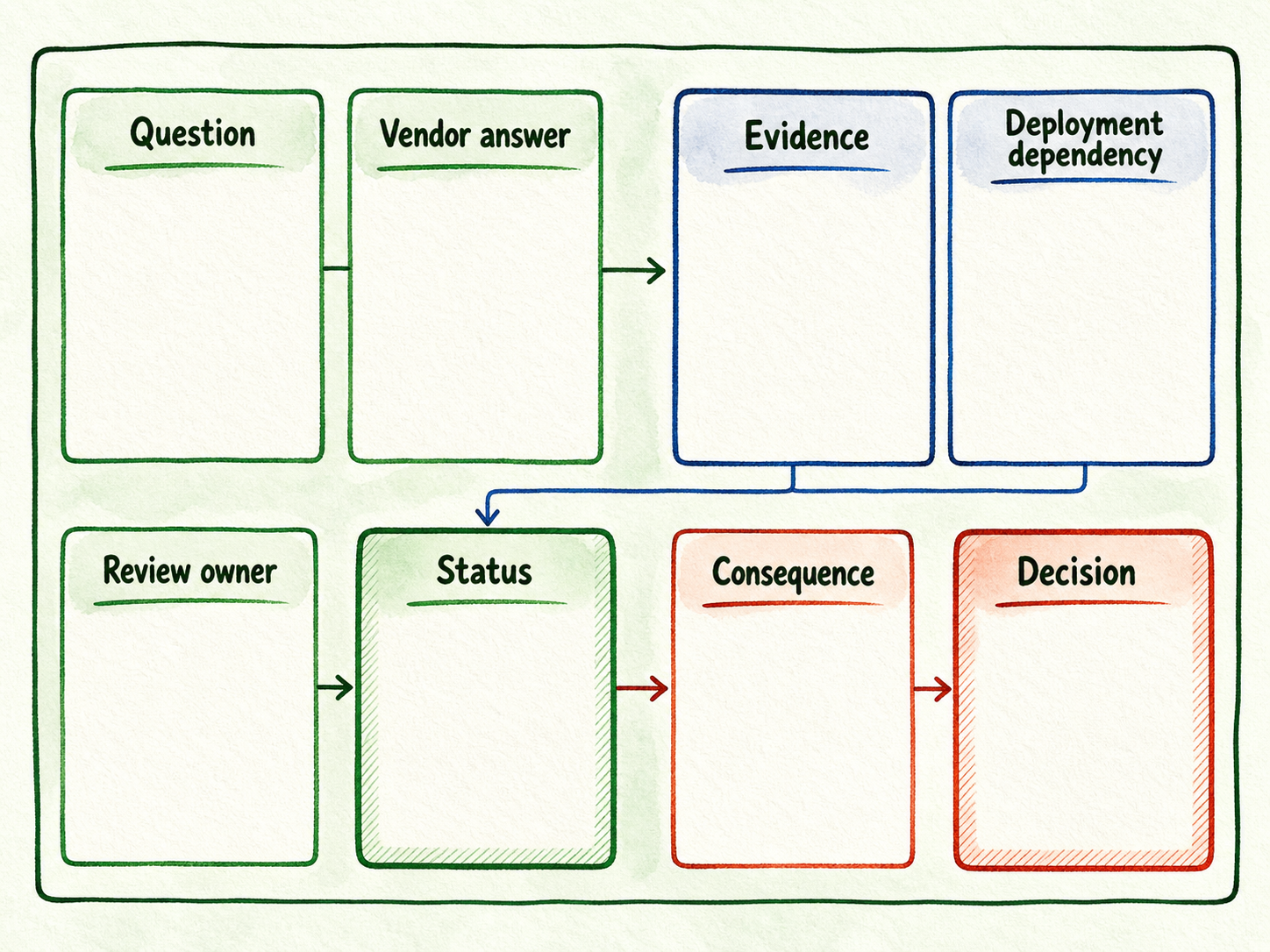
| Field | What to record |
|---|---|
| Question | One precise question tied to a data path or control. |
| Vendor answer | The answer in the vendor’s own written terms. |
| Evidence | Document name, section, version, date, or screenshot. |
| Deployment dependency | Region, model provider, integration, plan, contract, or configuration affecting the answer. |
| Review owner | Security, privacy, legal, procurement, or another accountable reviewer. |
| Status | Documented, deployment-dependent, or unresolved. |
| Consequence | What could happen if the answer remains open. |
| Decision | Approve, narrow, escalate, or pause. |
“Narrow” is often a useful decision. If the evidence supports a public assistant answering from non-sensitive content but not a workflow handling account details or connected actions, approve only the supported scope. That preserves the business case without pretending every proposed use has passed the same review.
The completed questionnaire does not prove compliance. It creates a defensible record of what was asked, what evidence was received, which conditions affect the answer, and who accepted any remaining issue.
For InsertChat, the practical next step is to compare the proposed data path with its current Security & Privacy Review, then contact the team for the deployment-specific documents your reviewers require. Start for Free only if a bounded, non-sensitive evaluation fits your approval rules; route complex security, residency, contractual, or custom-deployment questions through a documented review before committing client data.