TL;DR
- Use a setup fee for bounded initial work with a clear acceptance point.
- Use a retainer when your agency owns recurring review, updates, support, or reporting.
- Use usage-based pricing when client activity creates meaningful variable costs.
- Use a bundle when scope and usage are predictable enough to support one simple client bill.
- Use a pilot when workflow fit, delivery effort, or usage remains unproven.
- Separate software from service costs when entitlements, provider charges, or usage can change materially.
- Do not issue a firm quote until the required inputs, support allowance, revision rules, and billing ownership are known.
You already know the category basics; the commercial decision is who pays for setup effort, recurring labor, software access, and uncertain usage. There is no universally best pricing model, so use the comparison and quote-readiness rules below to match each charge to the responsibility and cost volatility your agency accepts.
Key Takeaways
- Price the responsibility you assume, not merely access to chatbot software.
- Match fixed charges to bounded work and variable charges to costs that move with activity.
- Define ongoing support and revision allowances before committing to a recurring or bundled price.
- Keep unknown software entitlements, usage costs, and integration effort conditional.
- A sound evaluation ends with a firm quote, conditional quote, limited pilot, or pause—not a number built on unresolved assumptions.
Compare the Five Pricing Models by Risk and Responsibility
The useful comparison is not simply monthly versus one-time billing. Evaluate every model on two axes: responsibility and volatility.
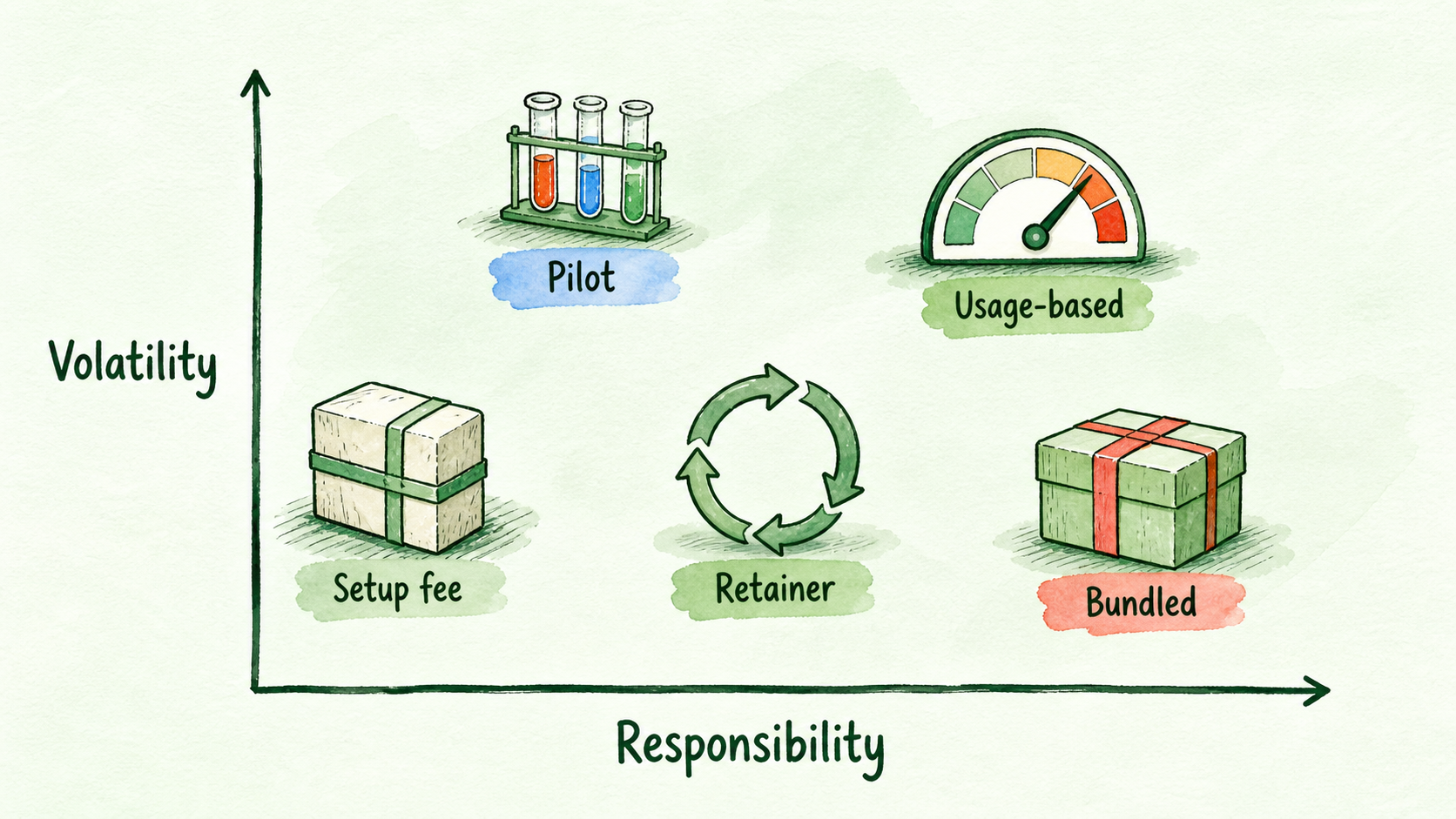
Responsibility asks what your agency must deliver, approve, monitor, or correct. Volatility asks how much the associated cost can change when the client adds content, attracts more conversations, requests another channel, or needs more human support.
| Pricing model | Best fit | What the agency owns | Main exposure |
|---|---|---|---|
| Setup fee | Bounded initial delivery | Agreed configuration, content preparation, testing, branding, and launch work | Underestimating content or integration complexity |
| Retainer | Recurring operational work | Defined reviews, updates, support, or reporting cadence | Open-ended requests consuming unpriced time |
| Usage-based | Activity-linked costs | Metering, billing logic, and usage communication | Unclear units, delayed data, or disputed charges |
| Bundled | Predictable scope and usage | One client price covering stated software and service allowances | Agency absorbs activity or support above assumptions |
| Pilot | Material uncertainty | One limited workflow, evidence goal, and end decision | Pilot quietly expanding into production service |
A setup fee works when the initial assignment has an observable finish line. The fee might cover preparing an approved source set, configuring one assistant, applying the client brand, testing defined questions, and publishing to an agreed surface. The acceptance point matters because “setup until everyone is happy” is not bounded work.
A retainer fits recurring responsibility. That can include scheduled answer review, approved content updates, limited support, or a defined reporting activity. The model fails when the monthly promise is simply “optimization as needed,” because neither side can tell what has been purchased or when a new request changes the price.
Usage-based pricing follows variable activity. It can be appropriate when conversations, model-provider consumption, tools, phone activity, or other metered events create costs that move with adoption. It requires a unit the client can understand, visibility into consumption, and a rule for what happens before a threshold is crossed.
Bundled pricing gives the client a simpler bill. It works when the agency can predict both its labor and the software exposure within an explicit allowance. Simplicity for the client transfers risk to the agency, so bundling becomes fragile when usage is unknown or support is highly variable.
A pilot is a commercial structure for unresolved questions, not merely a discounted full deployment. It should limit the workflow, source set, launch surface, evaluation period, and operational responsibility. Its result is a next decision: proceed, revise the commercial model, narrow the use case, or stop.
These structures can be combined. A project may have a fixed setup fee, a recurring support allowance, and a variable usage component because those obligations behave differently. A hybrid is useful when each layer has a clear reason; it should not become a pile of fees the client cannot trace to responsibilities.
Collect the Inputs That Can Change the Quote
A quote becomes firm only when the facts capable of changing the price are sufficiently settled. This section identifies commercial variables and their pricing consequences. Define the complete service boundary in the separate package-design job, then carry the approved scope and price into proposal construction.
Start with the workflow. Identify the visitor job the assistant will handle and the outcome your agency is expected to enable. Answering approved questions on one website page has a different cost profile from handling conversations across a website, phone line, shared inbox, and connected business systems.
Then record the inputs that can change delivery effort or software exposure:
- The workflow and included outcomes
- The number and condition of approved sources
- Whether policies, product details, and support guidance are current
- The number of assistants, audiences, brands, or separated workspaces
- The required deployment surfaces, such as a widget, hosted page, phone, or API-backed experience
- Integrations, actions, and human handoff requirements
- Client access, approval, security, privacy, and procurement needs
- Expected activity and whether reliable usage data exists
- Review rounds and the person authorized to accept the initial delivery
- Ongoing support cadence and responsibility for source updates
- Open questions about plan entitlements, usage measurement, or provider billing
Classify each variable as firm, conditional, or excluded. A firm input is confirmed and included in the price. A conditional input has an explicit assumption that may change the quote. An excluded input is outside the current commercial decision.
For example, suppose a client wants one assistant but has not decided whether it should only answer questions or also create tickets in a connected system. The answer-only workflow can be quoted if its other inputs are known. The integration should remain conditional rather than being absorbed into the fixed fee on the assumption that it will be easy.
This distinction protects the client as much as the agency. A conditional quote makes uncertainty visible before it turns into an unexplained invoice or an unprofitable promise.
Price Support and Revisions Before They Become Invisible Labor
Support changes price because it creates recurring availability, judgment, and labor. The cost is not limited to time spent typing a response. Someone must inspect the issue, determine whether it comes from the platform, the approved content, the configuration, or a new client request, and then coordinate the appropriate owner.
Define the included support categories and cadence. Examples might include correcting configuration errors, reviewing an agreed allowance of answer issues, applying approved source updates, or completing a scheduled operational check. The appropriate allowance depends on your team and the client workflow; there is no universal number of updates or review rounds.
Distinguish a correction from a scope change. Correcting an answer that fails an agreed acceptance test belongs to the initial commitment. Adding a new product catalog, language, channel, integration, workflow, or recurring deliverable changes the work being purchased.
Useful change triggers include:
- A new or substantially restructured source set
- Another assistant, brand, workspace, audience, or deployment surface
- A new integration or automated action
- More review activity than the included allowance
- A change to security, access, hosting, or procurement requirements
- A support cadence or response expectation beyond the quoted level
Client delays can affect timing and price. If approval, source delivery, or access arrives late, the agency may need to reschedule work or keep resources available longer. Record that pricing assumption here; define the exact commercial terms later during proposal construction.
Ownership must be explicit. The client owns business facts and approval of new guidance. The agency may own configuration, testing, and the agreed operating work. The platform vendor owns platform-level issues. When everything is labeled “support,” the agency becomes the default owner of all three.
If reporting is included, price its cadence and the labor required to produce it. Select the actual workflow-specific metrics in the separate reporting-metrics job rather than expanding the pricing decision into a reporting framework.
Decide When Software and Service Costs Should Be Separate
Software cost includes the platform subscription and any expense tied to assistants, sources, seats, provider consumption, usage credits, tools, channels, or plan entitlements. Service cost is the agency’s work: setup, content preparation, testing, support, revisions, reporting, coordination, and governance.
Separate those costs when one or more of the following is true:
- Usage could vary enough to change the agency’s exposure materially.
- The client needs direct ownership of a provider account or key.
- Plan entitlements may change with the final workflow.
- The client’s procurement process requires software and professional services to be distinct.
- Upgrades or additional capacity require client approval.
- The agency cannot reliably monitor or absorb variable consumption.
Bundling can still be sensible when the underlying cost is predictable and the included allowance is explicit. The client receives one bill, while the agency monitors consumption and knows what event triggers a commercial review. Bundling without an allowance is not simplicity; it is an uncapped liability hidden inside a fixed price.
InsertChat plans use credits as part of usage budgeting, and using a client’s own model-provider key does not remove the InsertChat platform subscription. Because plan inclusions and usage terms can change, confirm the current pricing documentation before deciding what to bundle or pass through.
Whichever structure you choose, state who can approve an upgrade or overage and what happens while approval is pending. The agency should not silently buy more capacity, and the client should not discover a service interruption without a known decision path.
Build the Quote in Four Layers
A practical quote can be built in four layers even when the client ultimately sees a simple total. Each layer answers a different cost question.
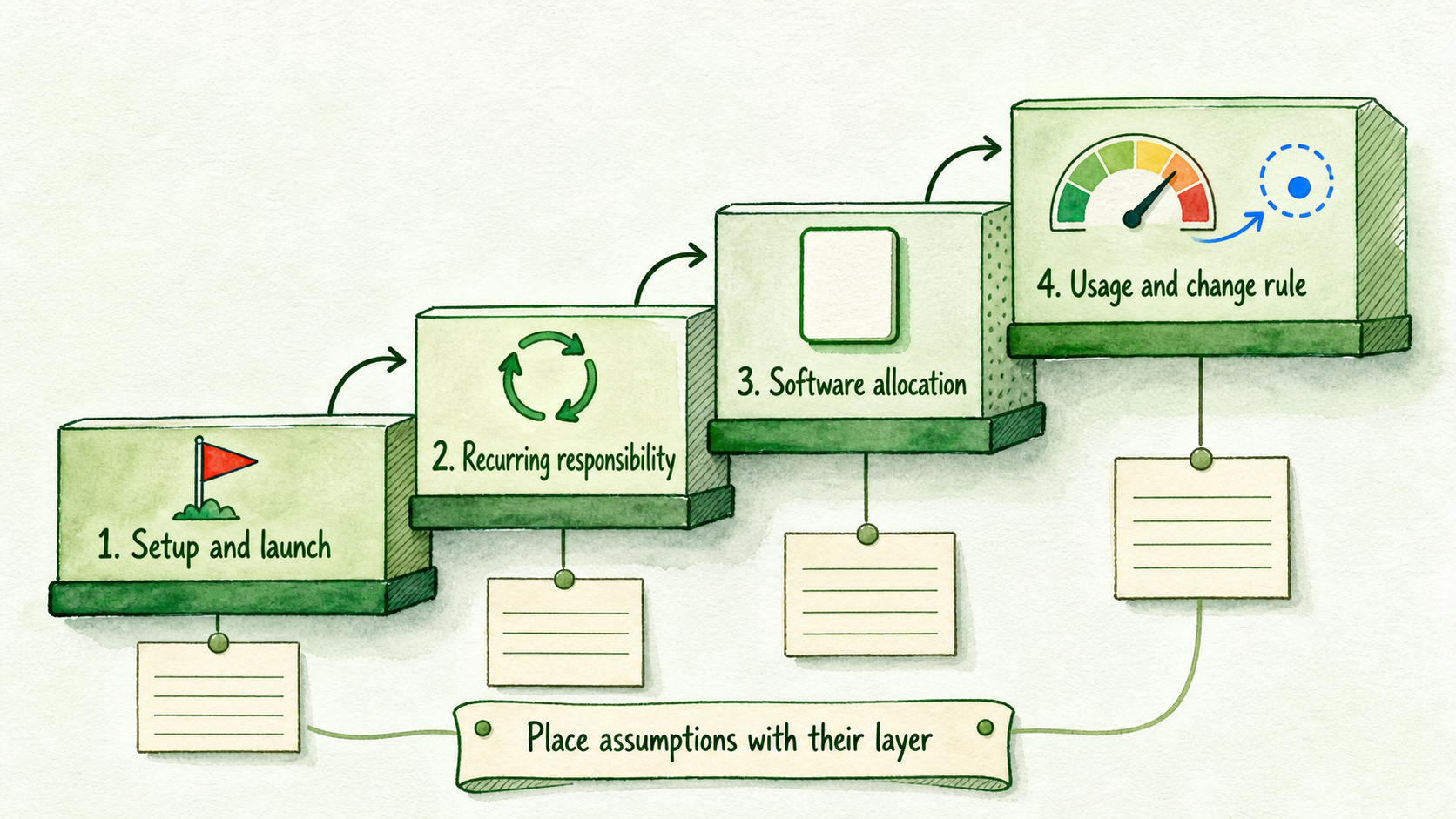
Bounded setup and launch work. Define the workflow, included sources, configuration, branding, testing, launch surface, review allowance, and acceptance point.
Recurring operational responsibility. State the included support categories, update or review cadence, reporting responsibility, and owner. If no ongoing work is included, say so clearly.
Software allocation. Identify whether the platform and provider costs are included, allocated across clients, billed directly to the client, or passed through. Record the plan and entitlement assumptions behind that choice.
Variable usage and change rule. Define the monitored unit, included allowance, approval trigger, and treatment of new work or increased consumption.
Consider a hypothetical client that wants one source-grounded assistant for a single customer-support workflow. The client has approved content but cannot estimate conversation volume. The agency could price the bounded setup separately, include a defined monthly review allowance, identify the current software allocation, and keep usage beyond the agreed assumption subject to review.
That example is a structure, not a price recommendation. To calculate a real quote, use your own delivery estimates, software invoices, support capacity, overhead, usage records, and required return. Without those agency-specific inputs, a margin figure cannot be calculated defensibly.
Write the assumptions beside the relevant layer. If the source set must be current before setup begins, put that condition with setup. If the recurring allowance assumes one approval owner, put it with support. If the software allocation depends on a particular entitlement, put it with the software layer.
Stress-Test the Model Before You Send a Firm Quote
Before sending a firm quote, test how the model behaves when reality differs from the central assumption. You do not need invented volume figures. Use low, expected, and high activity cases based on the client’s available records or clearly labeled uncertainty.
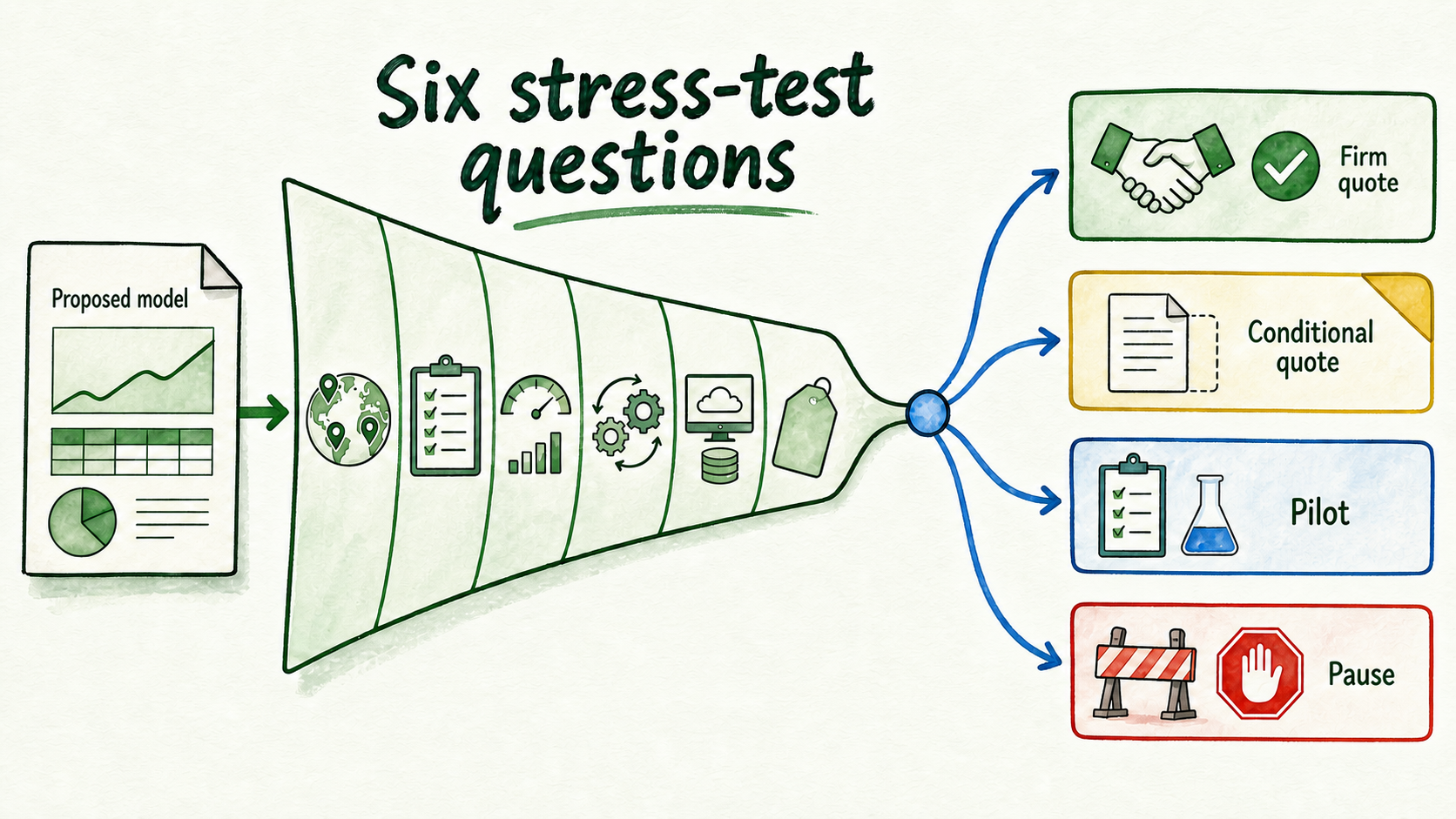
Ask six questions:
- Does the fixed revenue cover the bounded delivery work if source preparation or testing takes longer than expected?
- Do recurring duties have both an allowance and an owner?
- Can the agency observe usage before it creates an unapproved cost?
- Do extra revisions, delayed approvals, or added requirements change the price or delivery timing?
- Are software entitlement, billing ownership, and upgrade authority confirmed?
- Can the client trace every charge to setup work, recurring responsibility, software, usage, or an approved change?
The answers lead to one of four decisions:
- Firm quote: Material inputs and cost ownership are confirmed.
- Conditional quote: The structure is sound, but named assumptions can still change the price.
- Pilot: Workflow effort, usage, or operating responsibility needs limited real-world evidence.
- Pause: A critical input, entitlement, owner, or approval path remains unknown.
A pause prevents an unsupported assumption from becoming a client commitment. A pilot is useful only when it is narrow enough to resolve the uncertainty blocking a durable price.
Choose the Smallest Model You Can Defend
The core rule is simple: match the pricing behavior to the cost behavior. Use fixed charges for bounded responsibilities, recurring charges for defined ongoing work, and variable charges for exposure that moves with activity. Bundle only what your agency can monitor and absorb within a stated allowance.
When important assumptions remain unproven, start with one bounded client workflow. If InsertChat is under consideration, confirm that its current white-label delivery, approved-source grounding, usage-credit structure, and human-control options fit that workflow before committing to the commercial model. Review current trial and plan terms, then Start for Free when the workflow and quote assumptions are ready to test.
For complex pricing, security, procurement, custom deployment, or billing requirements, use current documentation or a contact-led review before issuing a firm client price.