TL;DR
- Start with a bounded request that is frequent, supported by an approved source, and answered consistently.
- Score each candidate on frequency, source readiness, answer stability, consequence of error, and escalation clarity.
- Do not let a high total override serious customer consequences or an unclear human handoff.
- Give each candidate one outcome: automate, prepare, or keep human-owned.
- Treat the ratings and thresholds below as illustrative. Your business must measure its own request frequency and risk.
A store-hours question, a request about the returns policy, and a disputed charge may enter the same support queue. Yet a wrong answer about closing time has different consequences from an incorrect refund decision. Choosing what to automate in customer service requires more than counting repeated questions. You need to compare useful volume with the control you have over the answer and its next step.
Key Takeaways
- The right scoring unit is one request type paired with one approved outcome.
- A written answer can still be unstable if it changes often or contains many exceptions.
- Consequence of error and escalation clarity are safety checks, not minor scoring details.
- A narrower workflow often offers more control, even if it covers fewer conversations.
- Deferring a candidate for source preparation is a valid decision, not a failed automation project.
Rank bounded requests with five factors
Begin by turning the support queue into specific candidates. “Automate returns” is too broad. It may include stating the published return window, checking whether an order qualifies, approving an exception, and resolving a disputed refund. Those requests rely on different facts and carry different risks.
A scorecard row should contain one request and one allowed outcome. For example:
- Request: “What is your return window?”
- Allowed outcome: State the published policy and link the customer to it.
This boundary matters because broad coverage can hide risk. Automating every returns conversation might appear more valuable, but control falls when the workflow moves from explaining a policy to judging an individual claim.
Support teams can draw candidates from customer service task categories such as FAQs, ticket triage, troubleshooting, and escalation. Category availability does not prove that a request is suitable. Break each category into bounded requests before scoring it.
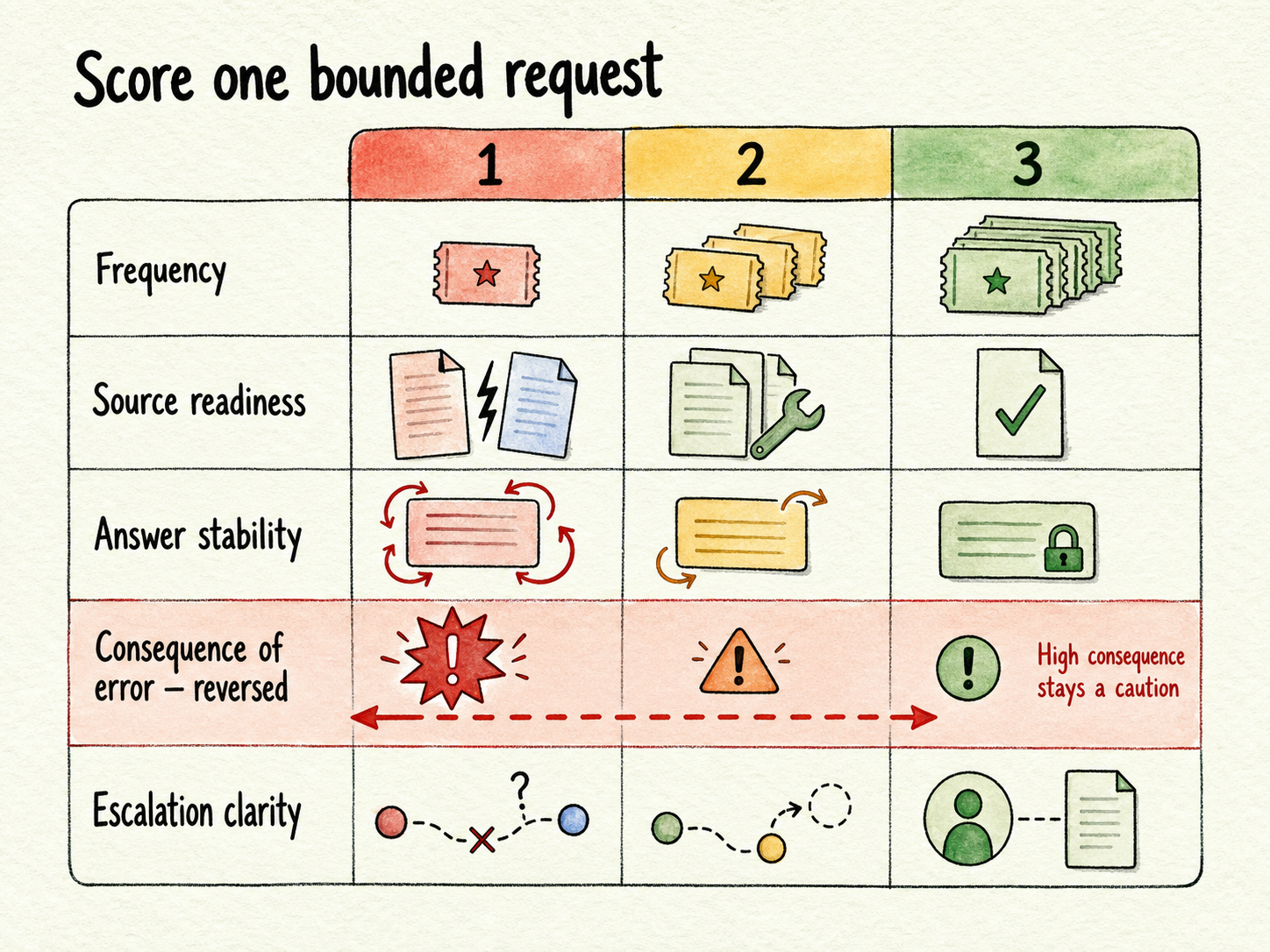
Use five factors, rated from 1 to 3. The scale below is illustrative, with a higher total indicating a stronger candidate.
Frequency
Score 1 for an uncommon request, 2 for a recurring request, and 3 for one that appears often enough to create meaningful repetitive work. Count your own conversations rather than relying on an industry assumption. The same question may dominate one business’s queue and barely appear in another.
Source readiness
Score 1 when the answer lives in staff memory, conflicting documents, or missing records. Score 2 when a usable source exists but needs correction or consolidation. Score 3 when there is one approved, current source that directly supports the response.
Source readiness concerns the existence and quality of the answer material. A platform that provides answers from approved website content can use pages, policies, documents, and other selected sources, but the business still owns the accuracy of those sources.
Answer stability
Score 1 when the answer changes often or depends on many exceptions. Score 2 when changes are occasional and identifiable. Score 3 when the answer is consistent across customers and changes infrequently.
Source readiness and stability are separate. A returns policy may be clearly documented today but still change with product type, purchase date, location, or promotion. The document exists, yet the answer may not be stable enough for broad automatic handling.
Consequence of error
Reverse this factor so that 3 means low consequence, 2 means manageable consequence, and 1 means high consequence. Consider what happens if the response is wrong: mild inconvenience, an avoidable support contact, a financial loss, an incorrect account action, or damage to customer trust.
A high-consequence request should trigger caution regardless of its total score. Arithmetic should not excuse a harmful outcome.
Escalation clarity
Score 1 when no person or queue clearly owns the exception. Score 2 when an owner exists but the trigger or required context is incomplete. Score 3 when the workflow defines when to stop, where to send the request, and what information accompanies it.
Clear routing and human handoffs are especially important for requests involving individual accounts, exceptions, or uncertainty. The company must define what may happen automatically and what remains with a person.
Before assigning scores, collect only the evidence that can change them:
- Counts of each bounded request type across a representative period and the channels you actually use.
- The page, policy, document, or record that controls the answer.
- Known variations, exceptions, and reasons the answer changes.
- The observable result of giving a wrong answer.
- The person or queue that receives an escalation.
- The trigger for handoff and the information that person needs.
Choose a review period that reflects your business. A seasonal retailer, subscription company, and local service provider will see different patterns. There is no general benchmark that can replace measuring your own frequency and risk.
Compare three requests and make the decision
The following comparison shows how a small business might apply the scorecard. These ratings are examples, not universal values. Seasonal hours, inconsistent policies, or unusual billing processes could change every row.
| Bounded request | Frequency | Source readiness | Answer stability | Low consequence of error | Escalation clarity | Total | Override | Illustrative decision |
|---|---|---|---|---|---|---|---|---|
| State published store hours | 3 | 3 | 3 | 3 | 3 | 15 | None | Automate |
| Explain the general returns policy | 3 | 2 | 2 | 2 | 3 | 12 | None, if exceptions are excluded | Prepare |
| Resolve an account-specific billing dispute | 2 | 2 | 1 | 1 | 3 | 9 | High consequence | Keep human-owned |
The store-hours request is a likely low-risk candidate when the business maintains one current page for each location. Its scope is narrow: state the published hours. An unpublished holiday closure or contradictory listing would reduce its source or stability score.
The returns-policy question is medium risk. It may be frequent and supported by a written policy, but exceptions can make the answer conditional. The business could prepare this candidate by approving one source, listing exclusions, and limiting the automated outcome to explaining the general policy. Order-specific eligibility and disputed refunds would remain separate candidates.
The account-specific billing dispute is high risk because resolution depends on customer records and an individual claim. A wrong answer can affect money or account status. Even if the request becomes frequent, repetition does not make automatic resolution safer. A bounded system might collect the relevant details or explain a general invoice term, but the dispute decision remains human-owned.
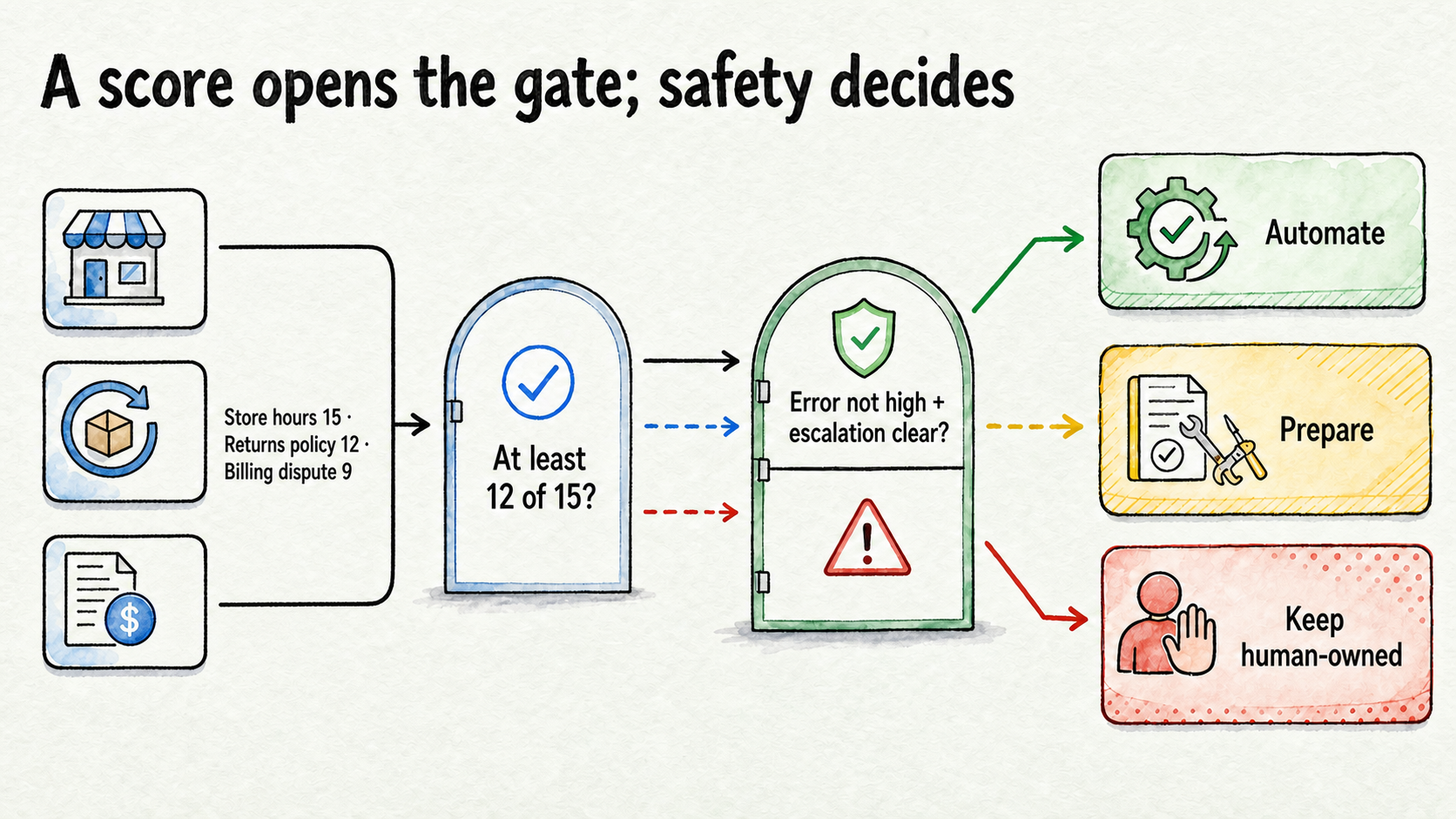
An illustrative go/no-go rule makes the comparison usable:
- Automate: The candidate scores at least 12 out of 15, the consequence of error is not high, and escalation has a named destination and trigger.
- Prepare: The candidate could qualify after a specific gap is fixed, such as approving one source, clarifying exceptions, or defining the handoff.
- Keep human-owned: The request has high error consequences, depends heavily on individual judgment, or lacks a safe escalation path.
The 12-point threshold is a working example, not a general standard. Adjust it to local evidence, but retain the two overrides: do not select a first workflow when the consequence of error is high or escalation remains unclear.
Suppose a three-person support team scores these candidates. Store hours receive 15, the returns-policy explanation receives 12, and billing disputes receive 9. The team selects store-hours answers, prepares a single approved returns source, and keeps billing decisions with a person. It has made three useful decisions without pretending the entire support queue is ready for automation.
This approach favors control over maximum coverage. The first workflow may remove less work than a broad returns or billing project, but it gives the team a clearer source, outcome, and boundary. A fast launch is only useful when the answer material is ready. If a frequent request relies on contradictory pages or unwritten exceptions, source preparation comes first.
Record the boundary before implementation
Once a candidate receives an automate decision, create a short selection record. This is not an implementation plan. It preserves the exact scope that earned the score.
Record five items:
- Chosen request: Published store-hours questions for listed locations.
- Approved source: The current location pages maintained by the business.
- Allowed outcome: State the published hours and direct the visitor to the relevant page.
- Exclusions: Do not infer unpublished closures, promise staff availability, or answer account-specific questions.
- Human handoff: Route uncertainty or conflicting information to the named support destination with the location and question attached.
This record prevents a controlled FAQ from quietly expanding into a general support assistant. It also exposes missing information before anyone discusses setup. If you cannot name the source, exclusions, and human destination, move the candidate back to prepare.
InsertChat supports approved-source answers, routing, and human handoff, which are relevant once the workflow boundary is clear. Those capabilities do not decide whether a request is safe. Your scorecard and business rules do. After documenting one bounded candidate, you can Start for Free to examine that narrow use case while leaving broader readiness, testing, and launch decisions for the next stage.
FAQ
Can a high-frequency request still be a poor first workflow?
Yes. Frequency shows how often work occurs, not how safely it can be handled. A frequent request with conflicting sources, many exceptions, serious consequences, or no clear escalation path should be prepared further or remain human-owned.
What if the policy changes often?
Reduce the answer-stability score. You may still define a narrower candidate, such as linking to the current policy without interpreting eligibility. If updates are not reliably reflected in the approved source, defer the workflow.
Should triage or troubleshooting come before FAQs?
Score the bounded requests rather than choosing by category. Simple triage with clear routing may outrank an unstable FAQ. Troubleshooting may qualify when the steps are approved, consequences are manageable, and failure routes cleanly to a person.
Can part of a billing request be automated?
Potentially, if the parts are scored separately. Explaining a published invoice term or collecting dispute details may have a clear source and outcome. Deciding whether a customer is owed money is a different request and may need to remain human-owned.
How many candidates should a small team score?
Start with a short list drawn from requests your team sees repeatedly. There is no required number. Score enough bounded candidates to make a meaningful comparison, then stop when one clearly meets the rule and its boundary can be documented.