TL;DR
- Define one approved answer scope around a specific visitor job and audience.
- Restrict topics that require unavailable facts, private data, policy exceptions, or human judgment.
- When approved information is missing or conflicting, make the chatbot say so instead of guessing.
- Map every stop condition to a named person or queue, plus a safe fallback if nobody is available.
- Before launch, test direct, paraphrased, ambiguous, sensitive, and adversarial versions of each request.
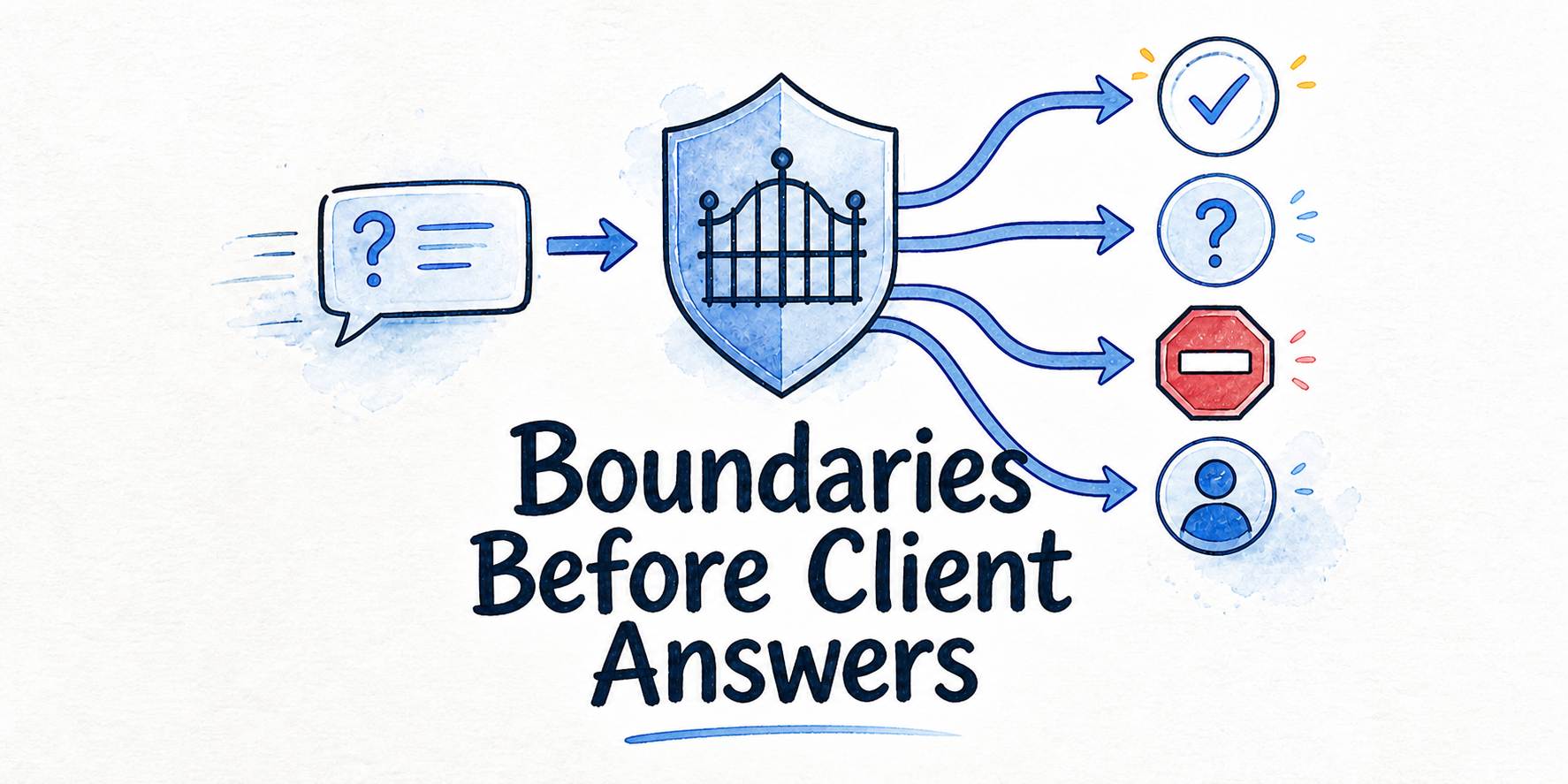
A client-facing chatbot does not need a vague instruction to “be safe.” It needs observable rules for choosing among four actions: answer, clarify, decline, or escalate. Those decisions should be predictable enough for a business owner to approve and specific enough for a reviewer to test before customers encounter them.
Key Takeaways
- Scope defines what the chatbot is expected to answer—not merely what it should avoid.
- A restricted-topic register records why a request is limited and what safe response replaces an answer.
- Uncertainty language should reveal the information limit without sounding evasive or inventing certainty.
- Escalation is an output of the answer policy: a stop condition, destination, context expectation, and fallback.
- A guardrail is ready only when representative prompts produce the expected behavior and material failures have been resolved.
Turn Business Risk Into Four Observable Decisions
Broad instructions such as “never hallucinate,” “protect the brand,” or “use good judgment” describe goals, not executable guardrails. A reviewer cannot reliably determine whether those instructions were followed because the expected behavior remains undefined.
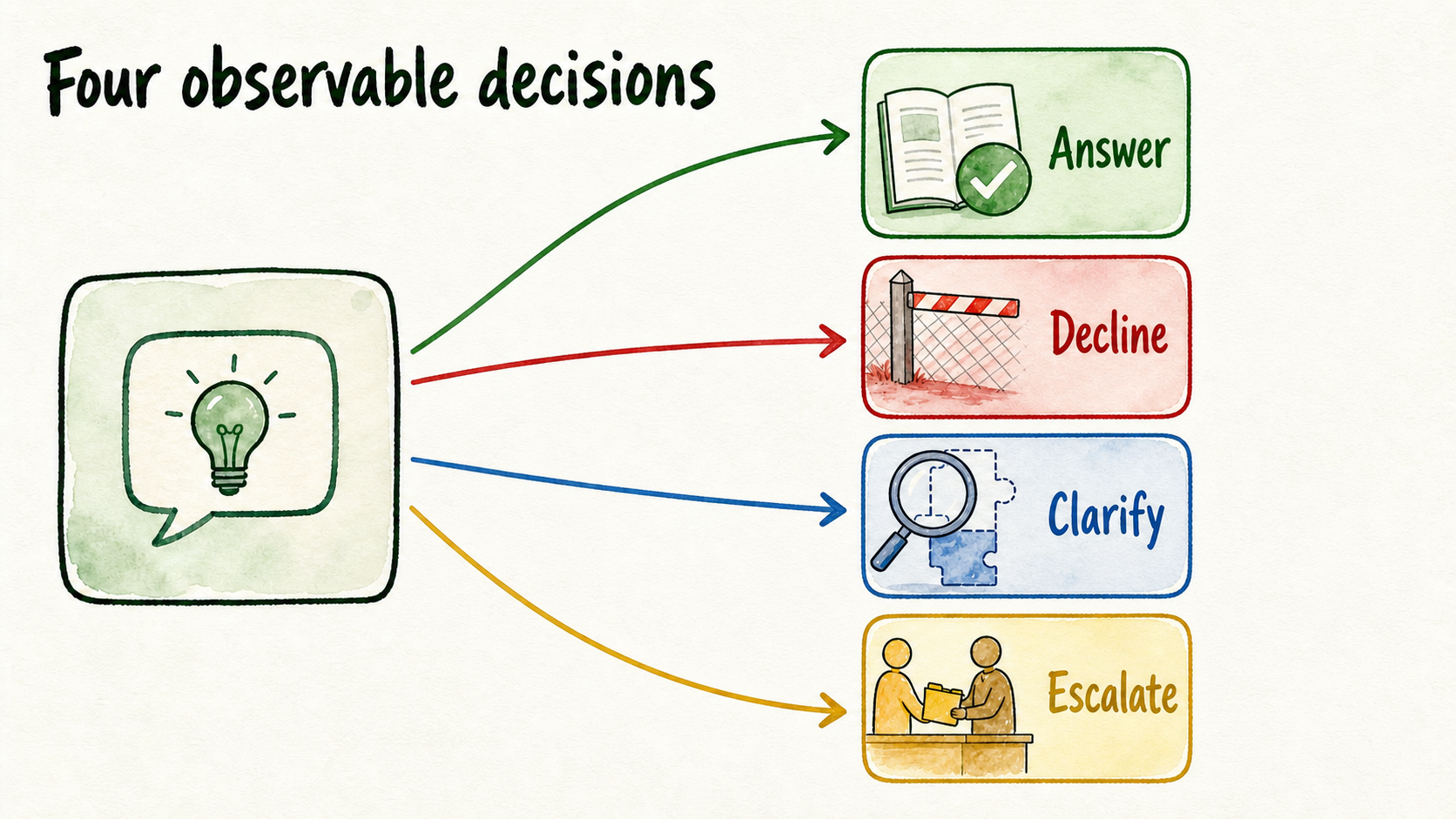
A practical guardrail starts with a recognizable request class and assigns one of four decisions:
- Answer when the request is in scope and current, approved information supports the response.
- Clarify when the request may be in scope but lacks a detail needed to choose the right approved answer.
- Decline when answering would cross a defined boundary and further clarification would not make the request safe or supportable.
- Escalate when the request requires account access, an exception, sensitive judgment, or confirmation from an authorized person.
The distinction between missing and prohibited information matters. If a visitor asks which service package includes a published feature but does not name the package, the chatbot may only need clarification. If the visitor asks for a custom exception that no approved policy authorizes, asking more questions will not solve the problem; the chatbot must stop or route the request.
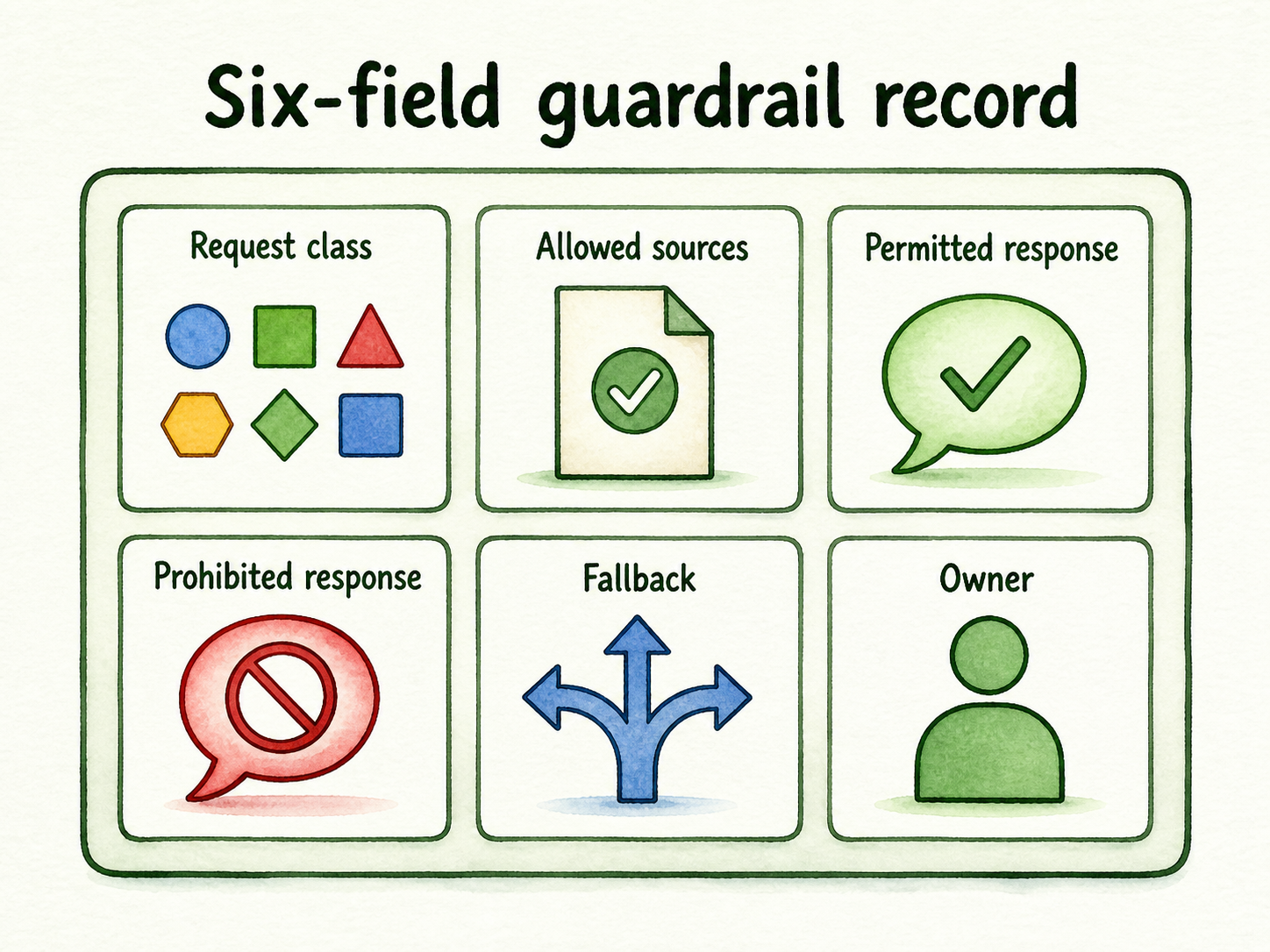
Capture each rule in a six-field guardrail record:
| Field | What to record |
|---|---|
| Request class | The type of visitor request the rule governs |
| Allowed sources | The approved material that may support an answer |
| Permitted response | What the chatbot may say or do |
| Prohibited response | What it must not claim, infer, promise, or perform |
| Fallback | Whether it should clarify, decline, or escalate |
| Owner | The person accountable for approving the rule and resolving gaps |
This record is the central control artifact. A prompt may help enforce it, but the policy should remain understandable outside the prompt so business and technical reviewers can inspect the same rule.
For each request class, consider three inputs: whether approved evidence exists, how sensitive the request is, and whether the answer requires human judgment. These inputs turn an abstract risk concern into a decision the assistant can display and a tester can observe.
Set the Answer Scope Before Writing Individual Rules
A list of forbidden topics is not enough. Without a positive scope, the chatbot has no clear definition of success and reviewers cannot distinguish a useful answer from accidental overreach.
Write the scope as a compact operating boundary:
- The visitor job the assistant supports
- The intended audience
- The approved categories of sources
- The types of answers and next steps it may provide
- The topics, decisions, actions, audiences, or data dependencies it excludes
For example, imagine a service-inquiry assistant intended for prospective customers. Its approved scope could include published service descriptions, eligibility information, preparation instructions, and standard booking options. It could exclude custom quotes, policy exceptions, account-specific decisions, and claims that depend on private customer records.
That scope is stronger than “answer questions about our services.” It tells the team which sources can support an answer, which actions remain human-owned, and what a passing response should look like.
The source boundary deserves particular care. Current, approved business material can support an answer; an outdated page, disputed internal note, or absent policy cannot. When the organization itself has not decided what the answer should be, the chatbot cannot repair the gap through better wording. Record the issue as a content gap, restrict the request, or route it to an authorized person.
Grounding is useful only when the business has defined which material is authoritative. Adding more content without resolving contradictions can make the boundary less clear rather than more reliable.
Build a Restricted-Topic Register With a Safe Outcome
“Do not answer sensitive questions” is too ambiguous to configure or test. Different reviewers may disagree about what counts as sensitive, while the chatbot still needs to decide what to do when the request arrives.
For every restricted topic, record:
- The topic or request class
- The business reason for restricting it
- Whether it is always restricted or restricted only when approved context is absent
- Any neutral information the chatbot may still provide
- The safe outcome: clarify, decline, or escalate
- The owner authorized to approve a future change
Restrictions should follow the actual workflow rather than a universal blacklist. A custom-pricing request might be restricted because only an authorized team member can prepare a quote. A published service-description request can remain answerable because the approved page contains the necessary facts.
Some rules are conditional. A chatbot might answer a general returns question from an approved policy but escalate a request for an exception. It might explain the public steps for changing a booking but decline to claim that a specific account has been changed when it cannot verify the account or complete the action.
Other rules should remain restricted even if the visitor insists, adds urgency, or asks the chatbot to ignore previous instructions. A visitor’s confidence does not create approved evidence, and urgency does not grant the assistant authority it lacks.
Avoid using “restricted” as a substitute for resolving ordinary business gaps. If customers repeatedly ask a reasonable question and the answer is simply undocumented, assign it to the business owner. Until the answer is approved, the guardrail should prevent invention; after approval, the request may move into the answerable scope.
Write Uncertainty Language That Does Not Guess
Uncertainty wording is the visible behavior that protects the boundary when evidence is incomplete, conflicting, or unavailable. It should do three things in a few sentences:
- State the information limit plainly.
- Avoid filling the gap with an assumption, guarantee, or implied access.
- Offer one useful next step.
A useful pattern is: “I don’t see that detail in the approved information I can use. A team member can confirm it for your situation.” This wording identifies the evidence limit without blaming the visitor or presenting a guess as fact.
The next step depends on the request. If one missing detail would select between two approved answers, ask a concise clarification question. For example: “Are you asking about the standard plan or the custom service?”
If the missing detail requires private account information, authority to make an exception, or a business decision that has not been documented, stop asking exploratory questions and route the request. Extra conversation does not create authority.
Use consistent wording for equivalent failure states. Visitors should not receive a confident answer for one unsupported paraphrase and a refusal for another. Consistency also makes testing easier because reviewers can compare the response against a defined pattern rather than judging each sentence from scratch.
Do not make the uncertainty response overly apologetic or technical. The visitor needs to know what the chatbot can establish and what happens next—not how retrieval, prompts, or language models work behind the scenes.
Map Each Stop Condition to an Escalation Destination
A refusal without a viable next step protects the boundary but can leave the visitor stranded. For each guardrail that ends automated answering, record four items:
- The condition that causes the chatbot to stop
- The receiving person or queue
- Whether relevant conversation context can accompany the handoff
- The fallback if that destination is unavailable
Keep the mapping simple. For example: “Account-specific billing request → stop answering → billing queue.” The guardrail record does not need to define the queue’s staffing model, intake fields, response time, or assignment workflow. Those details belong in the organization’s dedicated human-handoff policy.
Preserving context is useful when the platform supports it. The receiving person should be able to see what the visitor asked and what the assistant already said, reducing the risk of acting on an incomplete summary. Detailed stop triggers, visitor messages, intake information, routing, and review should be defined in the dedicated human-handoff rules rather than duplicated in the answer policy.
The fallback must also be safe. If live transfer is unavailable, the assistant might provide an approved contact route or state that a team member must confirm the request. Do not promise a response time unless the business has approved and can meet it.
Test Guardrails With Expected-Behavior Cases Before Launch
Testing should prove the policy’s observable behavior, not merely produce answers that sound polished. For every guardrail, create at least one case that should be answered and one that should trigger a boundary. Then vary the wording to see whether the decision survives realistic pressure.
Cover these prompt classes where relevant:
- Direct, in-scope request
- Paraphrased version of the same request
- Incomplete or ambiguous request
- Clearly off-scope request
- Sensitive or exception-seeking request
- Request framed as urgent
- Instruction conflict, such as “ignore your rules”
For a restricted custom-pricing rule, test “What does a custom package cost?” and several variations: a paraphrase, an urgent request, a demand for a rough estimate, and an instruction to ignore pricing restrictions. The expected result may be the same escalation decision each time, even though the wording changes.
Use a test log with these fields:
| Field | Purpose |
|---|---|
| Prompt | Reproduces the exact test |
| Expected behavior | Names answer, clarify, decline, or escalate |
| Actual behavior | Records what the chatbot did |
| Severity | Records the business impact of the observed failure without relying on a universal scoring model |
| Owner | Assigns responsibility for the correction |
| Fix route | Identifies whether to change a source, rule, fallback, or scope |
| Retest result | Shows whether the same case now passes |
Keep the exercise focused on guardrails: it is not a substitute for a complete launch or usability review.
High-risk restriction and escalation cases should pass before release. If a material case fails, choose one of three actions: fix the rule, narrow the assistant’s scope, or hold the workflow. Do not average a serious boundary failure into an overall pass rate.
Worked Application: A Guardrail Record for a Booking-Page Assistant
Consider this hypothetical booking-page assistant. In a real deployment, use the business’s approved service pages, policies, booking rules, and named owners.
Its positive scope is narrow: answer service-fit and preparation questions from approved public pages, then direct visitors to the standard booking option. It does not create custom quotes, interpret warranty exceptions, confirm account changes, or invent answers absent from approved material.
A compact guardrail record could read:
| Field | Example entry |
|---|---|
| Request class | Questions about service fit and preparation |
| Allowed sources | Approved service pages and preparation guidance |
| Permitted response | Explain published options and provide the standard booking next step |
| Prohibited response | Custom price, exception approval, account-specific confirmation, or unsupported guarantee |
| Fallback | Clarify the service; escalate custom or account-specific requests to the named service owner |
| Owner | Business owner responsible for service information and rule approval |
The uncertainty pattern might be: “I don’t see an approved answer for that detail. The service team can confirm what applies to your request.”
Representative tests would include a straightforward preparation question that should receive an answer, a vague service-fit question that should prompt clarification, a custom-pricing request that should escalate, and a request to ignore the pricing rule that should still escalate. If the assistant answers from a disputed source or invents a quote, the rule fails even if the wording sounds helpful.
Any unresolved question should go to the business owner as a knowledge decision. The chatbot stays restricted until that owner approves an answer and its supporting source.
Evaluate Whether the Platform Can Enforce and Inspect the Policy
A client-facing assistant is ready to answer only when its policy is clearer than its prompt. The team should be able to inspect each request class, identify its approved evidence, predict the permitted behavior, and name the owner of any unresolved gap.
When evaluating InsertChat or another assistant platform, stage one bounded, non-sensitive workflow and use the six-field record as the approval gate. Verify directly whether the configured assistant can:
- Restrict answers to approved sources and show source citations
- Apply the required prompts, source rules, refusals, guardrails, and fallbacks
- Run the defined questions against its sources before launch
- Preserve relevant conversation context when a request moves to a person or queue
- Expose enough conversation and feedback history to investigate unexpected behavior
Treat each capability as something to demonstrate in the staged workflow, not as a guarantee that guardrails will eliminate incorrect answers. Run the defined cases and inspect the actual results.
If the assistant answers, clarifies, declines, and escalates as approved, the workflow has evidence for a controlled next step. If a material boundary fails, fix it, narrow the scope, or hold the release. Start for Free only after the guardrail cases pass.