TL;DR
- Pick one first niche to validate, not a long list of possible markets.
- Score each candidate on buyer access, buyer pain, content readiness, risk, repeatability, and first validation fit.
- Strong buyer access means you can reach real decision-makers through existing relationships, warm channels, or credible industry context.
- Content readiness matters because chatbot offers work better when buyers already have approved pages, FAQs, guides, policies, or resource libraries.
- If two niches score close, start with the one that has lower answer risk, clearer source content, and easier buyer conversations.
You already understand the basic reseller idea. The hard part is choosing where to start before you build sales pages, packages, proposals, or a long vendor question list. If your niche choice is too broad, every next step gets fuzzy: the buyer changes, the workflow changes, the content inputs change, and the risks change. Use the scorecard below to pick a niche for an AI chatbot reseller offer by choosing one market to validate first, not every market you might serve later.
Key Takeaways
- Niche selection should be based on access, pain, content readiness, risk, repeatability, and first validation fit.
- A niche with visible interest can still be a weak first choice if you cannot reach buyers directly.
- A niche with strong pain can still be too risky if the assistant would answer legal, medical, financial, safety, or advice-sensitive questions.
- A content-ready niche is easier to scope because buyers already have material the assistant can use.
- The best first validation niche is often the plainest one: reachable buyers, repeated questions, usable content, and one workflow you can explain in a sentence.
Start With One First Niche, Not a List of Ideas
The decision is not “which niches could use AI chatbots?” Many could. The useful decision is “which niche should I test first with the least confusion and the clearest buyer conversation?”
Start with two or three candidate niches, chosen from places where you already have some advantage. That advantage might be client history, industry knowledge, a warm network, a service you already sell, or repeated conversations you keep having with the same type of buyer.
A marketing consultant might shortlist SEO agencies, email marketing agencies, and coaches or consultants. A local service marketer might shortlist local businesses, home service firms, and appointment-based professional services. The shortlist should come from your access and experience, not from a generic list of chatbot reseller niche ideas.
Do not try to prove the whole business model at this stage. You are only choosing the first niche to validate. That keeps the next steps smaller: one buyer type, one likely workflow, one content pattern, one risk profile, and one reason to talk to buyers.
A simple rule helps: if you cannot name the buyer, the repeated problem, and the source content they already have, the niche is not ready for first place on the list.
Score Buyer Access Before Buyer Interest
Buyer access comes before buyer interest because interest does not matter much if you cannot get into real conversations. A niche may look active online, but if you have no relationships, no credible reason to contact buyers, and no way to hear objections, it may be a slow first test.
Use a 1 to 3 score:
| Score | Buyer access signal |
|---|---|
| 1 | You know the niche only from public content or broad market chatter. |
| 2 | You understand the niche and can reach a few buyers through weak ties, communities, or past work. |
| 3 | You already have clients, prospects, partners, referrals, or repeated conversations in the niche. |
Score access honestly. A reseller with existing SEO agency clients may have a stronger path into that niche than into unrelated local verticals. Someone already managing newsletters may have easier access to email marketing teams or agencies. A consultant who works with coaches may hear repeated support and resource questions before an outsider would.
Access also includes credibility. If buyers would need a long explanation of why you understand their workflow, score lower. If they already trust you with adjacent work, score higher.
Buyer pain should be scored next, but only when it is attached to a workflow. Strong pain looks like repeated questions, repeated handoffs, lead qualification needs, support load, content requests, or resource navigation. Weak pain sounds like “they are curious about AI” with no clear job for an assistant.
A Chat With or InsertChat-aligned offer is easier to evaluate when the niche has content-rich websites and workflows where grounded answers, lead capture, handoff, or workflow automation could support a bounded job. Keep the claim at that level. Do not assume the niche will buy, save money, or improve conversion until you validate that with real buyers.
Check Content Readiness Before You Promise the Offer
Content readiness is one of the fastest ways to separate a promising niche from a time sink. AI assistants need source material to answer with useful boundaries. If buyers do not have approved pages, FAQs, service descriptions, guides, policies, resource libraries, or product information, the first engagement may become a content cleanup project before it becomes a chatbot offer.
Use this 1 to 3 score:
| Score | Content readiness signal |
|---|---|
| 1 | Knowledge is mostly undocumented, scattered across calls, inboxes, or individual staff members. |
| 2 | Some content exists, but it is incomplete, stale, or spread across many formats. |
| 3 | Buyers commonly have approved pages, FAQs, guides, service pages, help content, or resource libraries. |
For InsertChat-style assistants, content readiness matters because answers can be grounded in approved content and source links, and analytics can help show unclear or missing answers. That does not remove the need for review, but it makes the first scope easier to define.
A niche with strong buyer pain but weak source content may still be worth pursuing later. It is just harder as the first validation niche. You may need to help buyers organize content before you can test the assistant workflow. That can be valuable work, but it changes the offer and the amount of setup you must support.
For example, a content-rich consultant with public frameworks, FAQs, and resource pages may score higher than a consultant whose expertise lives mainly in private calls. A local business with clear service pages, hours, service areas, and policies may score higher than one with thin website copy and many exceptions. An agency with documented client onboarding material may be easier to scope than one where every process is handled ad hoc.
Weigh Risk and Repeatability Together
Risk can override an otherwise attractive niche. The question is not only “can an assistant help?” The question is “what could go wrong if the assistant answers beyond its boundary?”
Score risk in reverse, where 3 is easier to handle:
| Score | Risk and sensitivity signal |
|---|---|
| 1 | The assistant may touch legal, medical, financial, safety, regulated, or high-liability advice. |
| 2 | Some answers are sensitive, but a narrower informational workflow could reduce exposure. |
| 3 | The likely workflow is low-risk, informational, and easy to route to a person when needed. |
Sensitive niches are not automatically off the table. They may need tighter boundaries, human review, careful routing, and a lower-risk first workflow. But if you are choosing your first validation niche, high sensitivity should make you pause.
Repeatability is the next filter. A niche should score higher when multiple buyers share similar questions, source materials, review needs, and handoff patterns. One custom project can be tempting, but it may not teach you much about a repeatable reseller offer.
Use this 1 to 3 score:
| Score | Repeatability signal |
|---|---|
| 1 | Each buyer would need a highly custom build, unique content model, or unusual workflow. |
| 2 | Some patterns repeat, but each engagement would need heavy customization. |
| 3 | Buyers share common questions, content types, handoffs, and review expectations. |
Repeatability does not mean you should build package tiers now. That belongs later. At this stage, repeatability only tells you whether the niche can support a second and third conversation without starting from zero each time.
Pick the First Validation Niche With a Simple Scorecard
Score each candidate from 1 to 3 across six criteria. Do not overthink decimals. The goal is to make tradeoffs visible.
First Niche Validation Scorecard
- Buyer access
Can you reach decision-makers through clients, referrals, partners, or credible context this month?
- Buyer pain
Are repeated questions, handoffs, support load, lead qualification, or content requests already visible?
- Content readiness
Do buyers already have approved pages, FAQs, guides, policies, resources, or service descriptions?
- Risk and sensitivity
Is the first workflow informational, bounded, and easy to route to a person?
- Repeatability
Can the same workflow repeat across similar buyers without rebuilding the whole offer each time?
- Validation fit
Can you validate with a clear buyer conversation before building full sales materials?
| Criterion | High score earns | Low score warns | Reader notes |
|---|---|---|---|
| Buyer access | You can reach decision-makers through clients, referrals, partners, or credible industry context. | You only know the niche from public research. | Who can you contact this month? |
| Buyer pain | Buyers face repeated questions, handoffs, support load, lead qualification, or content requests. | Pain is vague or based on general AI curiosity. | What repeated workflow shows up? |
| Content readiness | Buyers already have approved pages, FAQs, guides, policies, resources, or service descriptions. | Knowledge is undocumented or scattered. | What sources would the assistant use? |
| Risk and sensitivity | The first workflow is informational, bounded, and easy to route to a person. | Answers may cross into regulated, legal, medical, financial, safety, or advice-sensitive territory. | What must the assistant avoid? |
| Repeatability | Multiple buyers share similar questions, content, handoffs, and review needs. | Every project would be custom. | Could the second client look similar? |
| First validation fit | You can test one narrow workflow without building a full service line. | The niche requires broad setup before any buyer can react. | What single workflow can you describe? |
Add the scores, but do not treat the total as the only decision. A niche with the highest total can still be a poor first choice if the risk score is low or content readiness is weak. The tie-breaker is simple: choose the lower-risk niche with clearer content and easier buyer conversations.
That rule keeps you from choosing based only on excitement. It also prevents a common mistake: building sales materials for a niche before you know whether the source content, buyer access, and workflow boundaries are strong enough.
Worked Scenario: Choose Between Three Candidate Niches
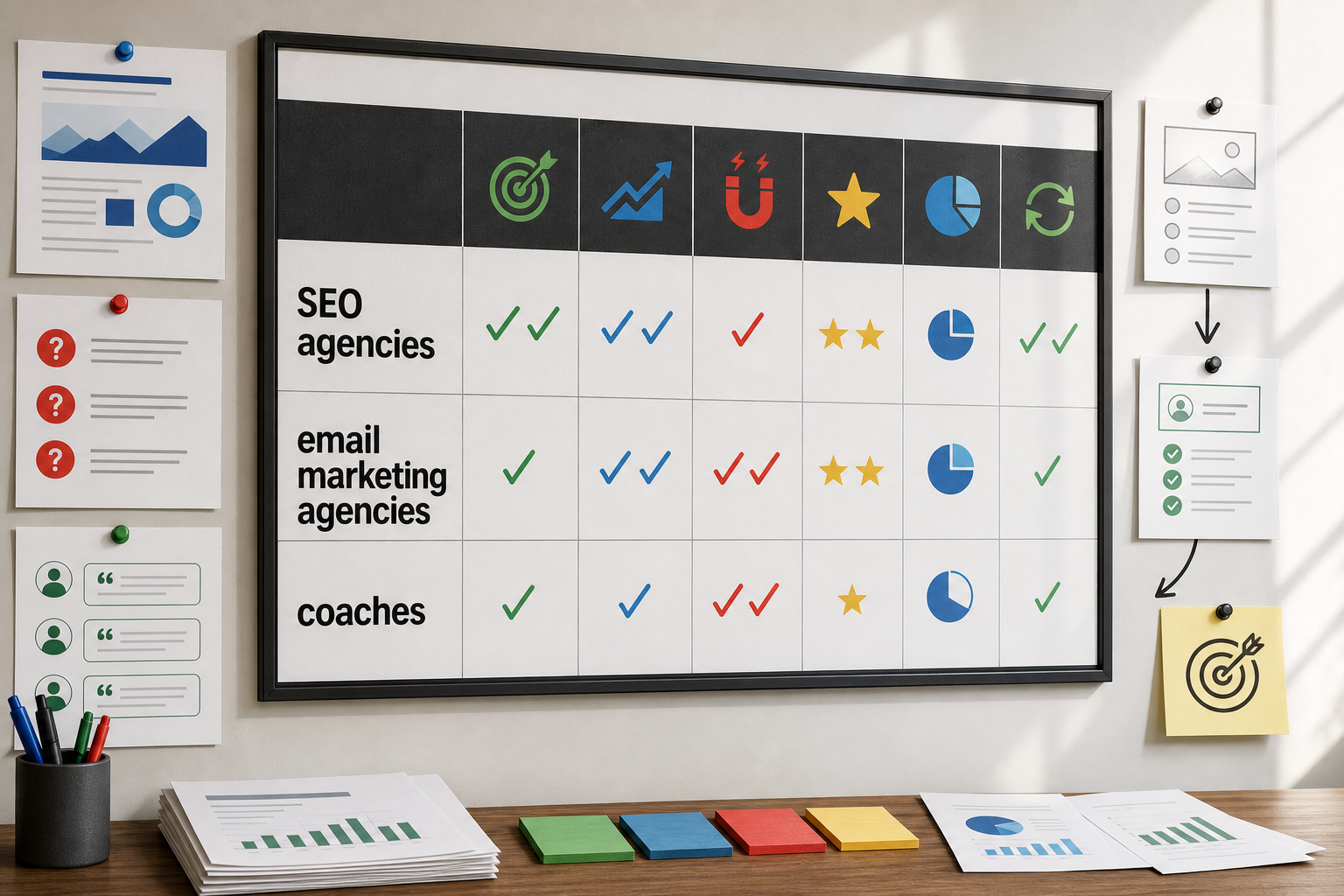
Assume a small marketing service provider wants to choose a first niche before writing sales materials. They have experience with SEO projects, email campaigns, and consultant websites. They shortlist three candidate niches: SEO agencies, email marketing agencies, and coaches or consultants.
Worked Scenario: Three Candidate Niches
| Access | Pain | Content | Risk ease approach-wise, not danger score typo? Need concise. Schema ok. Use 'Risk' maybe values. | |
|---|---|---|---|---|
| SEO agencies | 3 | 2 | 2 | 2 |
| Email marketing agencies | 2 | 3 | 2 | 2 |
| Coaches and consultants | 2 | 2 | 3 | 1 |
| Candidate niche | Access | Pain | Content | Risk | Repeatability | Validation fit | Read |
|---|---|---|---|---|---|---|---|
| SEO agencies | 3 | 2 | 2 | 2 | 3 | 2 | Strong access, but workflow choice needs care. |
| Email marketing agencies | 2 | 3 | 2 | 2 | 3 | 2 | Clear workflow pressure, but inputs may vary by client. |
| Coaches and consultants | 2 | 2 | 3 | 1 | 2 | 2 | Strong content in some cases, but advice sensitivity can rise quickly. |
The SEO agency niche scores well on access and repeatability because the provider already knows agency owners and understands repeated content and review patterns. The risk is not extreme, but some client-facing advice could create accuracy or expectation issues. A reader who wants deeper SEO-specific workflow detail can use the dedicated page on AI chatbots for SEO agencies after choosing that niche.
The email agency niche has clear pain around repeated campaign work and handoffs, but the content inputs can vary by client and campaign. It may still be a good candidate if the reseller already works with email teams. Detailed campaign workflow ideas belong in the page on AI chatbots for email marketing agencies, not in the niche scorecard.
The coach and consultant niche may have strong content readiness when the buyer has courses, frameworks, FAQs, and public resources. The caution is sensitivity. If the assistant drifts into advice that should come from the expert, the first workflow needs narrower boundaries. That does not disqualify the niche, but it may make it a second validation target rather than the first.
In this scenario, the provider chooses SEO agencies as the first validation niche because access is strongest, repeatability is clearer, and the initial workflow can be kept narrow. Email agencies stay on the shortlist for a later test. Coaches and consultants require more careful boundary work before a first outreach sequence.
A different reseller could reach a different answer. If their strongest relationships are local business owners with clear service pages and simple FAQ needs, they might score local businesses higher and then move to the page on AI chatbots for local business resellers for the vertical-specific package fit. The scorecard is meant to choose the first test, not crown a universal best niche.
After You Choose, Write One Workflow Hypothesis
Once one niche wins, do not jump straight into a full sales page. Write one workflow hypothesis. It should name the buyer, the workflow, the source content, and the handoff or lead action.
Use this structure:
“For [buyer type], test an assistant that helps with [workflow] using [source content] and routes [handoff or lead action].”
Examples:
- For SEO agency clients, test an assistant that helps answer common service and reporting questions using approved service pages, FAQs, and client-facing resources, then routes qualified inquiries to the right contact.
- For email marketing agency clients, test an assistant that helps collect campaign context using approved intake material and routes incomplete requests back to the agency team.
- For local business clients, test an assistant that answers service, hours, area, and booking questions using approved website content, then routes qualified leads to the business.
This sentence is not a proposal, package, pilot plan, or pricing model. It is the bridge between niche selection and validation. If you cannot write the sentence clearly, the niche may still be too broad or the workflow may be too vague.
The next action is to validate the chosen niche with real buyer conversations and a narrow workflow. Keep the scope small until the buyer access, content readiness, and risk assumptions are confirmed.
FAQ
What is the best way to pick a niche for an AI chatbot reseller offer?
Use a scorecard instead of a brainstorm. Score each candidate niche on buyer access, buyer pain, content readiness, risk and sensitivity, repeatability, and first validation fit. The best first niche is usually the one where you can reach buyers, name a repeated workflow, use existing source content, manage answer risk, and test one narrow idea.
Should I start with SEO agencies, email agencies, local businesses, or coaches and consultants?
Start with the one that scores highest for your situation. SEO agencies may score higher if you already know agency workflows and have warm access. Email agencies may score higher if you already support campaign work. Local businesses may score higher when owners have clear service content and simple handoff needs. Coaches and consultants may score higher for content readiness, but sensitivity can rise when the assistant gets close to expert advice.
What if two niches score the same?
Choose the niche with lower answer risk, stronger source content, and easier buyer access. If those are still tied, choose the niche where you can write the clearest one-sentence workflow hypothesis.
Should I choose a platform before I choose a niche?
Choose enough of the niche and workflow to know what platform questions matter. You do not need a full vendor evaluation before niche selection, but you do need a clear idea of the buyer, source content, workflow, and risk level before comparing tools or reseller programs.