TL;DR
- Consolidate AI tools when duplicated operating cost and workflow friction exceed transition costs and capability risks—and the new workspace can preserve required access, context, and dependencies.
- Keep tools separate when specialist features, data isolation, direct provider access, or established dependencies matter more than central administration.
- Choose a hybrid when repeatable work benefits from shared context but specialist or sensitive workflows should remain outside the central workspace.
- Compare total operating cost, not subscription prices alone. Include provider usage, administration, review, training, migration, integration, and temporary parallel work.
- If the evidence is promising but incomplete, authorize one bounded trial with a named owner rather than a company-wide move.
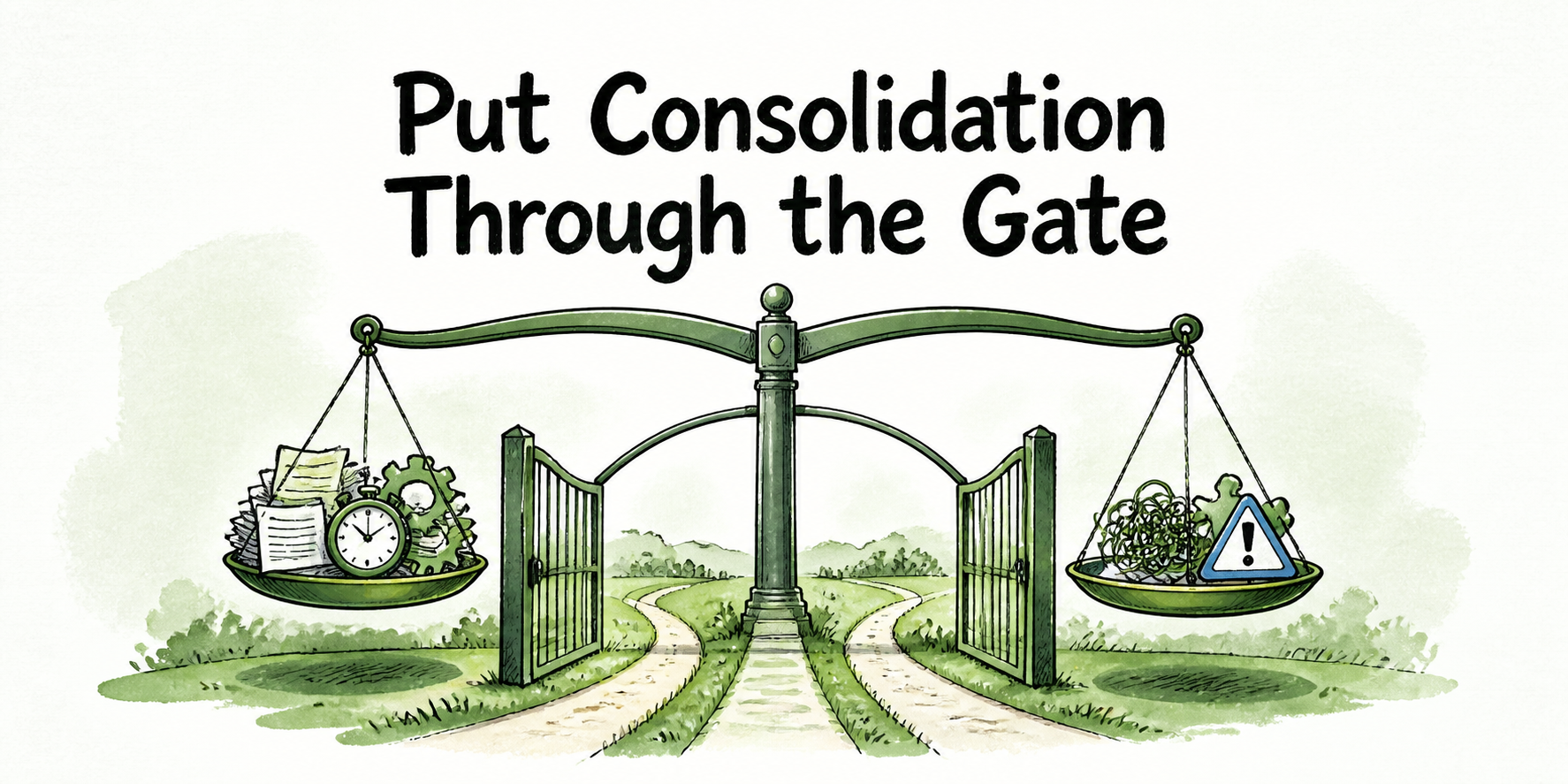
A growth team may see only a row of AI subscriptions, yet the real operating model is spread across private prompts, disconnected sources, separate tabs, informal approvals, and undocumented dependencies. Removing licenses could reduce visible spend while increasing correction work or taking away a specialist capability. A defensible decision starts with an inventory, prices the work around each tool, and stops at one of four outcomes: keep, consolidate, hybrid, or approve a narrow trial.
Key Takeaways
- A cheaper license stack can cost more to operate if review, retraining, or transition work rises.
- Shared context can reduce copying and handoffs, but it makes access boundaries more consequential.
- Central administration reduces fragmented ownership while increasing dependence on one workspace.
- Unknown costs are unresolved inputs, not zeros.
- A hybrid is not failed consolidation. It is often the clearest way to protect specialist work while simplifying repeatable workflows.
Inventory the Stack and Define the Decision
Do not begin with the question, “Which subscriptions can we cancel?” Begin with, “Which workflows are we deciding about?” A research-and-drafting workflow has different requirements from customer support, software development, image production, or regulated document review.
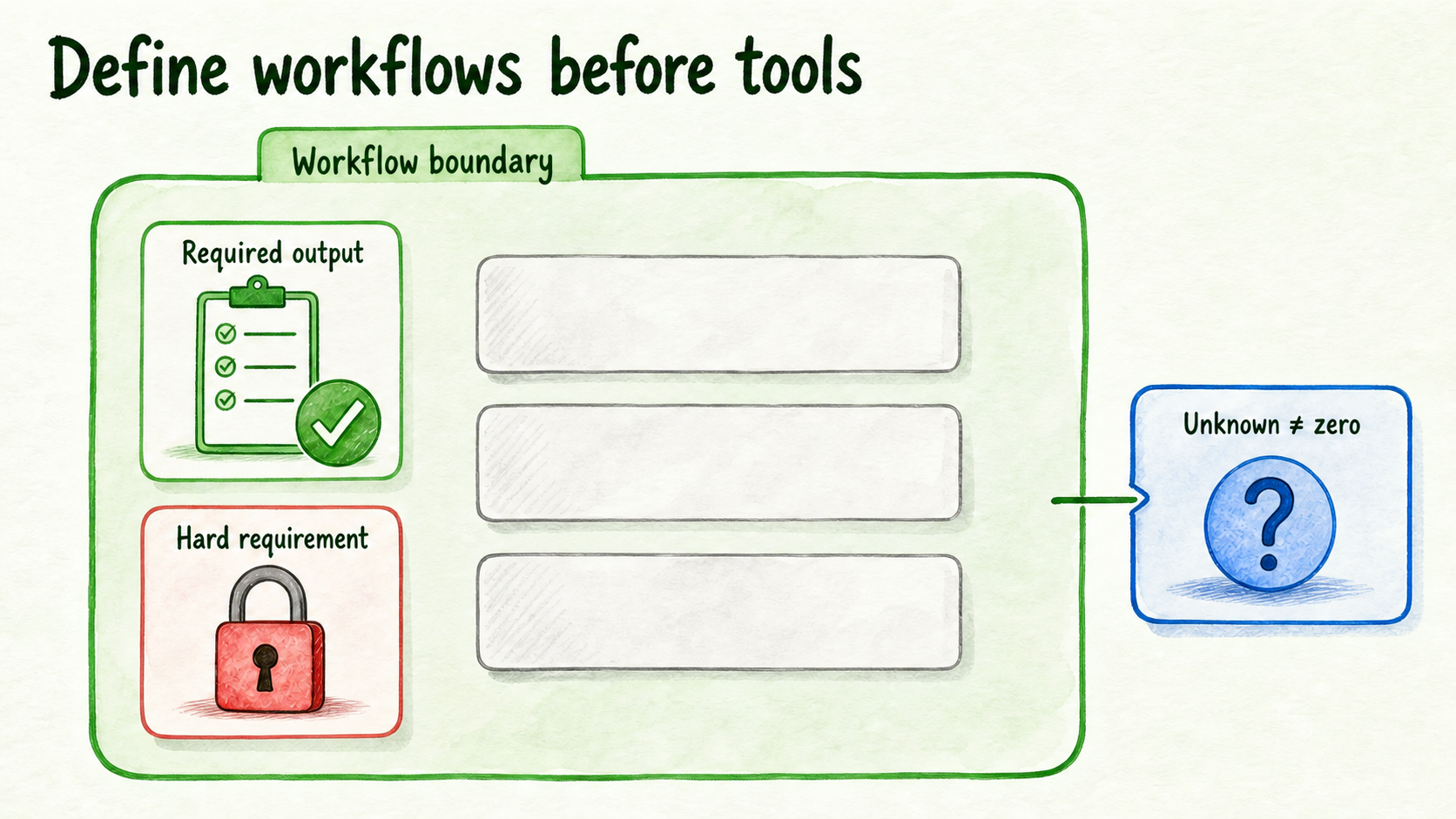
Set a boundary before collecting costs. For example, a growth team might include market research, brief creation, first drafts, and editing while excluding a specialist production tool used for an unusual file format. This prevents a broad consolidation target from quietly absorbing work that the proposed workspace cannot support.
Use one row per tool or workspace and record these fields:
| Field | What to record | Why it changes the decision |
|---|---|---|
| Tool and model provider | Product, provider relationship, and models actually required | Reveals whether access depends on a particular provider or capability |
| Owner | Person accountable for renewal, configuration, and acceptable use | Exposes ownerless tools and duplicated administration |
| Active users | People who used it during a defined recent period | Separates purchased seats from real demand |
| Workflow | Repeated business job and required output | Shows duplicated work and specialist requirements |
| Subscription cost | Seat, workspace, add-on, and annual charges | Establishes visible recurring spend |
| Provider usage | Metered API or model charges, including BYOK usage | Prevents provider bills from disappearing from the comparison |
| Data handled | Customer, internal, public, confidential, or sensitive information | Identifies access and isolation constraints |
| Sources and context | Approved documents, prompts, history, or shared knowledge | Shows what must remain available and current |
| Access requirements | Who may view, edit, administer, or approve work | Tests whether shared operation is acceptable |
| Integrations and outputs | Connected systems, exports, formats, or actions | Identifies dependencies beyond the chat interface |
| Renewal date | Contract term and decision window | Makes timing visible without assuming immediate cancellation |
| Migration dependency | Prompt libraries, histories, custom workflows, integrations, or trained habits | Surfaces transition effort and potential hard stops |
A workspace is the shared operating environment around the models: its context, users, sources, controls, administration, and workflow connections. A subscription pays for access to a product or plan. A model provider supplies the underlying model. These may be the same vendor relationship, but they do not have to be.
BYOK—bring your own key—means the business supplies a provider API key. That can preserve a direct billing or governance relationship with the provider, but it may create two cost lines: the workspace subscription and provider usage. A usage credit is a platform unit used to budget or measure activity; it should not automatically be treated as equivalent to a provider token or a fixed amount of work.
Shared context includes the approved sources, conversation history, prompts, and other material reused across people or workflows. Access control determines who can see or change those assets. A migration dependency is anything that makes a workflow costly or risky to move, such as an integration, unique output, accumulated context, or specialist feature.
Complete the worksheet with invoices, administrator records, provider bills, active-user data, team calendars, and workflow-owner estimates. If an amount or dependency is unknown, mark it unknown and assign someone to resolve it. A blank cell is evidence that the decision is not ready; it is not permission to enter zero.
Calculate Total Operating Cost
License spend is only the first line. Compare every option over the same period—usually one year—and use the same workflow volume, labor rates, and evidence standard.
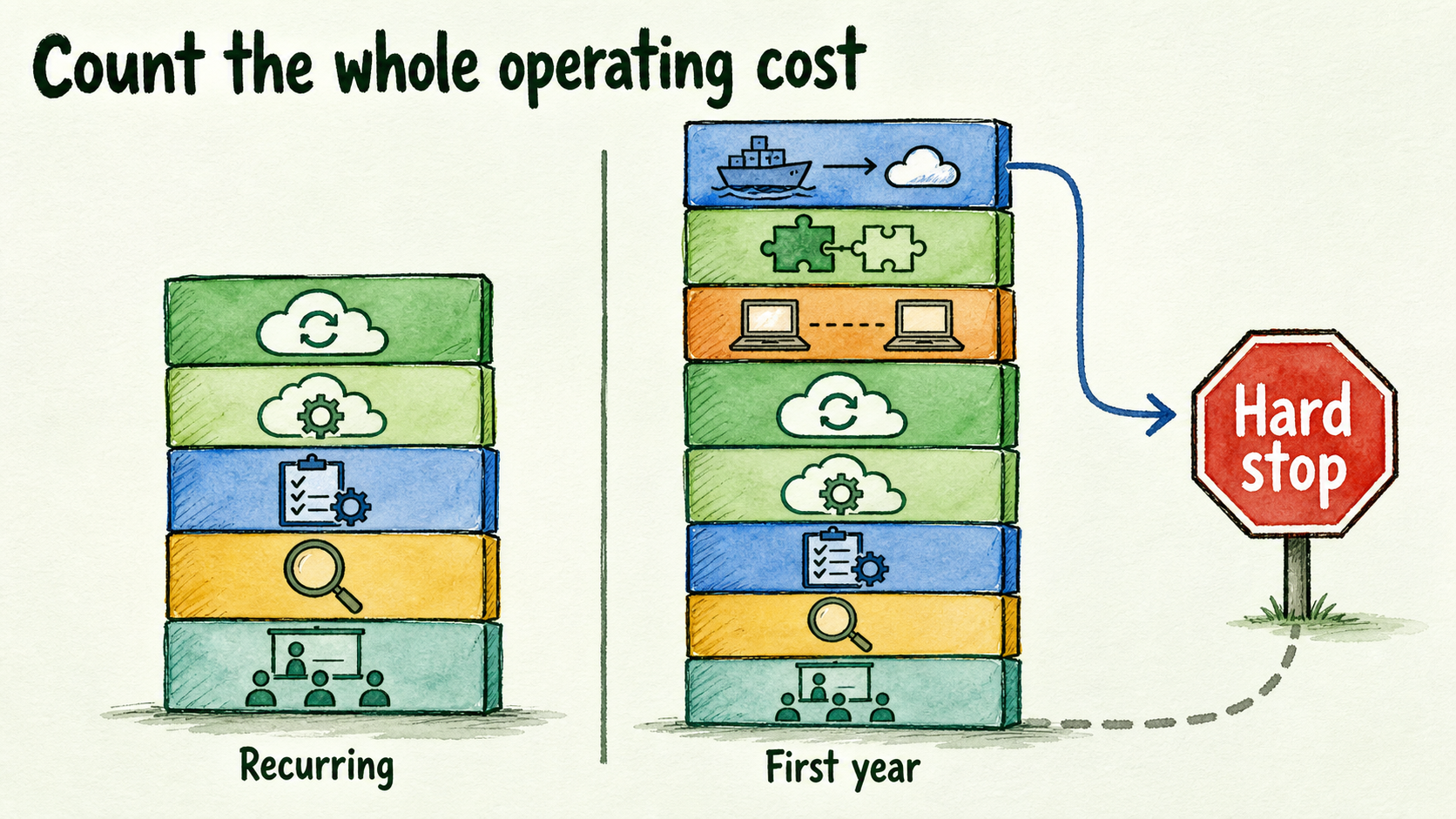
Calculate the current annual operating cost as:
Current cost = subscriptions + provider usage + administration + review + training
Then calculate each proposed option as:
Transition-adjusted first-year cost = target subscriptions + provider usage + administration + review + training + migration + integration + temporary parallel work
The categories should include:
- Subscriptions: seats, workspace plans, add-ons, support packages, and other recurring product charges.
- Provider usage: model or API charges billed directly or through a platform. Include separate provider billing when BYOK applies.
- Administration: account setup, user changes, renewals, billing reconciliation, source maintenance, and configuration.
- Review: checking outputs, correcting mistakes, approving sensitive work, and resolving inconsistent answers.
- Training: onboarding, updated instructions, documentation, and the temporary slowdown while people learn a new environment.
- Transition effort: preparing context, rebuilding connections, adapting prompts, handling dependencies, and any temporary parallel operation required to evaluate the change.
Convert labor into a consistent cost using the team’s own loaded hourly rates. If review takes 12 hours per month, for example, multiply that time by the applicable rate and by 12. Apply the same method to every option; otherwise, the favored choice will appear cheaper because its hidden work was left out.
Separate first-year cost from steady-state cost. Consolidation may have a higher first year because of training and transition work but a lower recurring cost later. The reverse can also happen: fewer subscriptions may look attractive initially, while continuing review or missing specialist features makes the target state more expensive to operate.
Do not force a financial answer when workflow requirements fail. A lower-cost option that cannot produce a required output, maintain an integration, separate sensitive data, or give the right people access is not a viable option. Record it as a hard stop rather than trying to compensate with a speculative savings estimate.
Choose Keep, Consolidate, or Hybrid
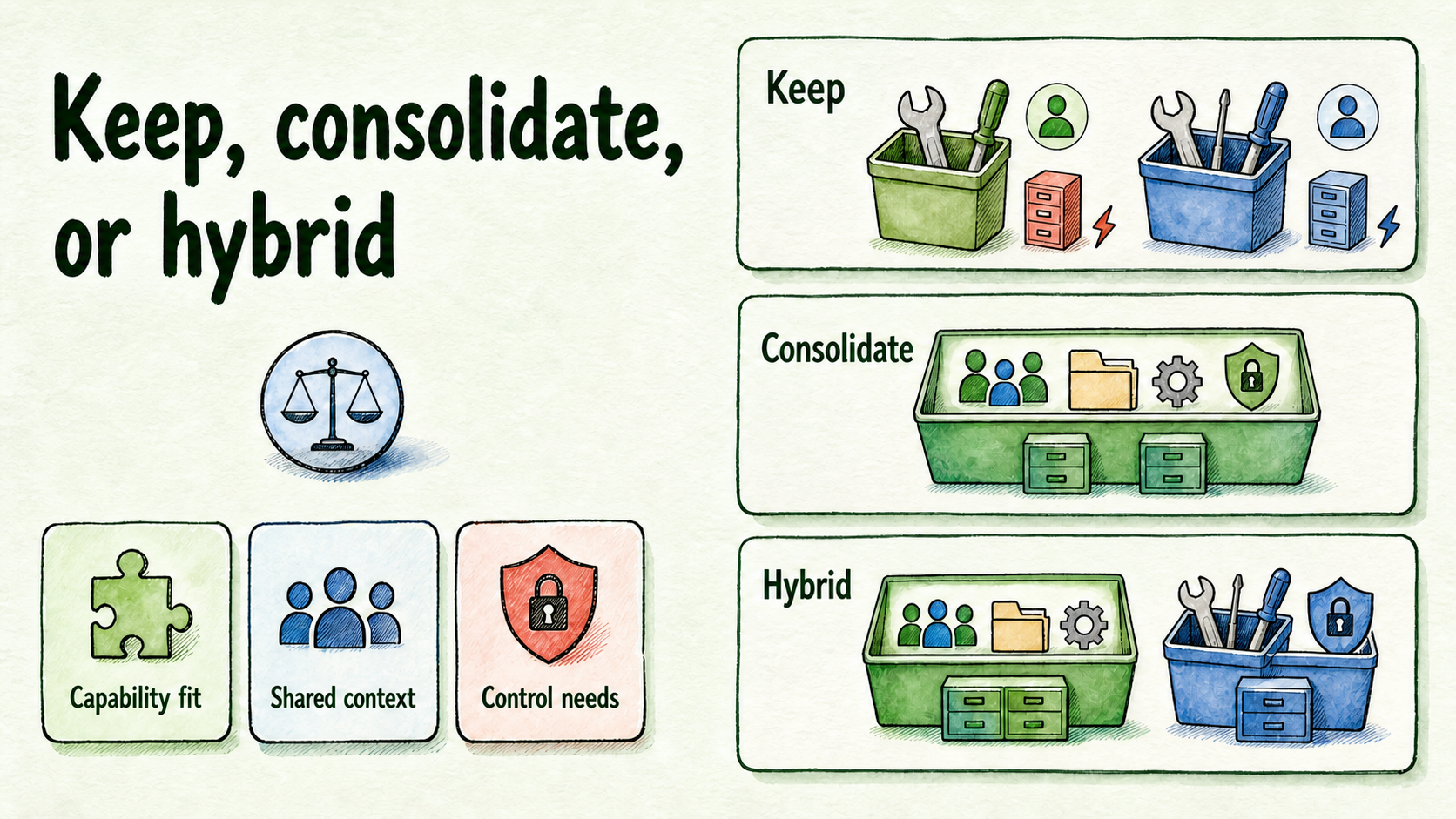
Use the inventory and cost model together. The subscription total tells you what is paid. The matrix tells you what the business receives, preserves, or risks.
| Decision factor | Keep separate tools | Consolidate selected workflows | Hybrid |
|---|---|---|---|
| Specialist capability | Strongest when unique features are essential | Acceptable only if required capabilities survive | Retains specialist depth where needed |
| Shared context | Usually fragmented or manually transferred | Central source and context can reduce handoffs | Shared for common work; separate where justified |
| Source control | Managed independently in each tool | Can become more consistent in one workspace | Central for selected workflows only |
| Access control | Clear isolation, but duplicated management | Requires suitable role and scope controls | Sensitive work can remain isolated |
| Provider access | Preserves direct product relationships | Depends on supported providers or BYOK | Central access plus direct specialist access |
| Workflow continuity | No transition required | Existing habits and dependencies may change | Limits change to selected workflows |
| Administration | Multiple accounts and renewals | Fewer operating surfaces if coverage is sufficient | Reduced, though not eliminated |
| Review effort | Separate practices may persist | Can become more consistent—or rise if fit is poor | Varies by workflow |
| Switching friction | More tabs and context transfer | Lower when context and workflows truly carry over | Lower for shared work only |
| Concentration risk | Distributed across vendors | Greater dependence on one workspace | Limits dependence while retaining shared operation |
| Total operating cost | May retain duplicated overhead | May reduce recurring cost after transition | Often trades some savings for capability protection |
A business should consolidate when several teams repeat the same work, move the same approved material between tools, and carry duplicated administration—and when one workspace can meet the hard requirements at an acceptable transition-adjusted cost.
Keep separate tools when a specialist capability, strong isolation requirement, direct vendor feature, or migration dependency materially outweighs those benefits. An established design, coding, research, or production workflow should not be removed merely because a general workspace offers a superficially similar function.
Choose hybrid when the evidence splits. A support and marketing team might benefit from shared approved product and policy sources while requiring different access to conversations and editing controls. Meanwhile, a specialist production tool can remain separate because its unique output or integration is not replaceable. The common work becomes easier to administer without forcing every workflow into one environment.
This is also where the central tradeoffs become explicit: fewer subscriptions versus possible feature loss; shared context versus stronger privacy requirements; central administration versus workspace dependence; and fewer tabs versus transition and retraining effort. If access boundaries need deeper review, use an AI workspace governance boundary matrix. If model choice is the unresolved requirement, evaluate it through a task-level model routing policy rather than provider reputation.
Work the Gate and Authorize a Bounded Trial
Consider this hypothetical example. A growth team switches between provider applications for research and drafting. Support and marketing also reuse approved product information, but support can see customer conversations that marketing should not. A specialist production tool creates a required deliverable and has no proven replacement.
Build the example with the company’s real invoices, provider bills, active-user records, time estimates, and dependencies:
- List the workflows, owners, active users, required outputs, data types, sources, access constraints, and integrations.
- Calculate current subscription, provider, administration, review, and training costs.
- Calculate recurring and first-year costs for keeping the stack, consolidating the eligible work, and using a hybrid.
- Test each option against required capabilities and access constraints.
- Mark missing capabilities and unresolved dependencies as hard stops.
- Compare the viable options without treating unknown amounts as savings.
Suppose the unified option has the lowest subscription total but requires more corrections, cannot produce the specialist deliverable, and needs substantial retraining. It does not win merely because the license row is smaller. A hybrid could be the defensible result: research, drafting, and approved-source work enter a shared workspace; the specialist production tool remains outside it; and support and marketing receive appropriately scoped access.
InsertChat is one candidate to evaluate against requirements produced by this gate. Its indexed product documentation describes access to OpenAI, Anthropic, Google, and open or alternative model families, model switching that retains chat history and retrieved context, and BYOK for businesses that want a direct provider relationship (model and BYOK documentation). Its team documentation describes owner, administrator, manager, and client-scoped operation, including restrictions around assigned assistants and conversations (team workspace documentation).
Those capabilities do not establish fit on their own. Model availability, role entitlements, limits, and packaging can change. InsertChat’s pricing page describes plans using variables such as assistants, sources, seats, usage credits, branding needs, and client complexity. It also states that BYOK customers continue paying for the workspace while model-provider usage is billed separately (review current pricing, credits, limits, and trial terms). Do not assume that one subscription includes every provider charge.
If the requirements fit, authorize a bounded trial around one repeated workflow—for example, growth research and first-draft preparation from an approved source set. Name one owner. Define the users, non-sensitive test data, acceptable outputs, review responsibilities, and measurement period before starting.
Measure operating time, correction work, output acceptability, context continuity, access fit, platform usage, and provider cost. Stop if a required capability is absent, access boundaries are unacceptable, corrections increase materially, commercial terms remain unresolved, or transition effort defeats the cost gate.
If the evidence supports a trial, Start for Free after reviewing the current terms. If it supports keeping the present stack, keep it deliberately and document when the decision should be revisited. A team that approves consolidation or a hybrid can then plan how to consolidate AI tools without breaking workflows; that execution work begins after this gate, not inside it.
FAQ
When should a business consolidate its AI tools?
Consolidate when repeated workflows, duplicated administration, and context transfer create more cost and friction than the proposed workspace’s transition work, capability risk, and concentration risk. Required outputs, provider access, data boundaries, and dependencies must still pass.
When should a business keep separate AI tools?
Keep them when specialist features, direct vendor capabilities, data isolation, or established dependencies are essential and cannot be preserved economically. Avoid treating every separate tool as waste.
What belongs in total operating cost?
Include subscriptions, provider usage, administration, human review, corrections, training, migration, integration, retraining, and temporary parallel work. Compare options over the same period with consistent labor assumptions.
Does BYOK remove the workspace subscription?
No. BYOK changes how model access and provider billing are handled; it does not inherently remove the platform charge. InsertChat states that its workspace still supplies the agent product while provider usage is billed separately. Check the current pricing terms for the applicable arrangement.
Is hybrid consolidation a valid outcome?
Yes. Hybrid operation is appropriate when shared, repeatable work benefits from common context and administration while specialist or sensitive work needs distinct tools or stronger isolation.
How should unknown costs be handled?
Leave them open and assign an owner to investigate. Entering zero gives the least-understood option an artificial advantage and weakens the decision.
What should a bounded trial prove?
It should show whether one repeated workflow can meet required output, context, access, review, and cost conditions under a named owner. The trial authorizes evidence collection—not broader migration.