TL;DR
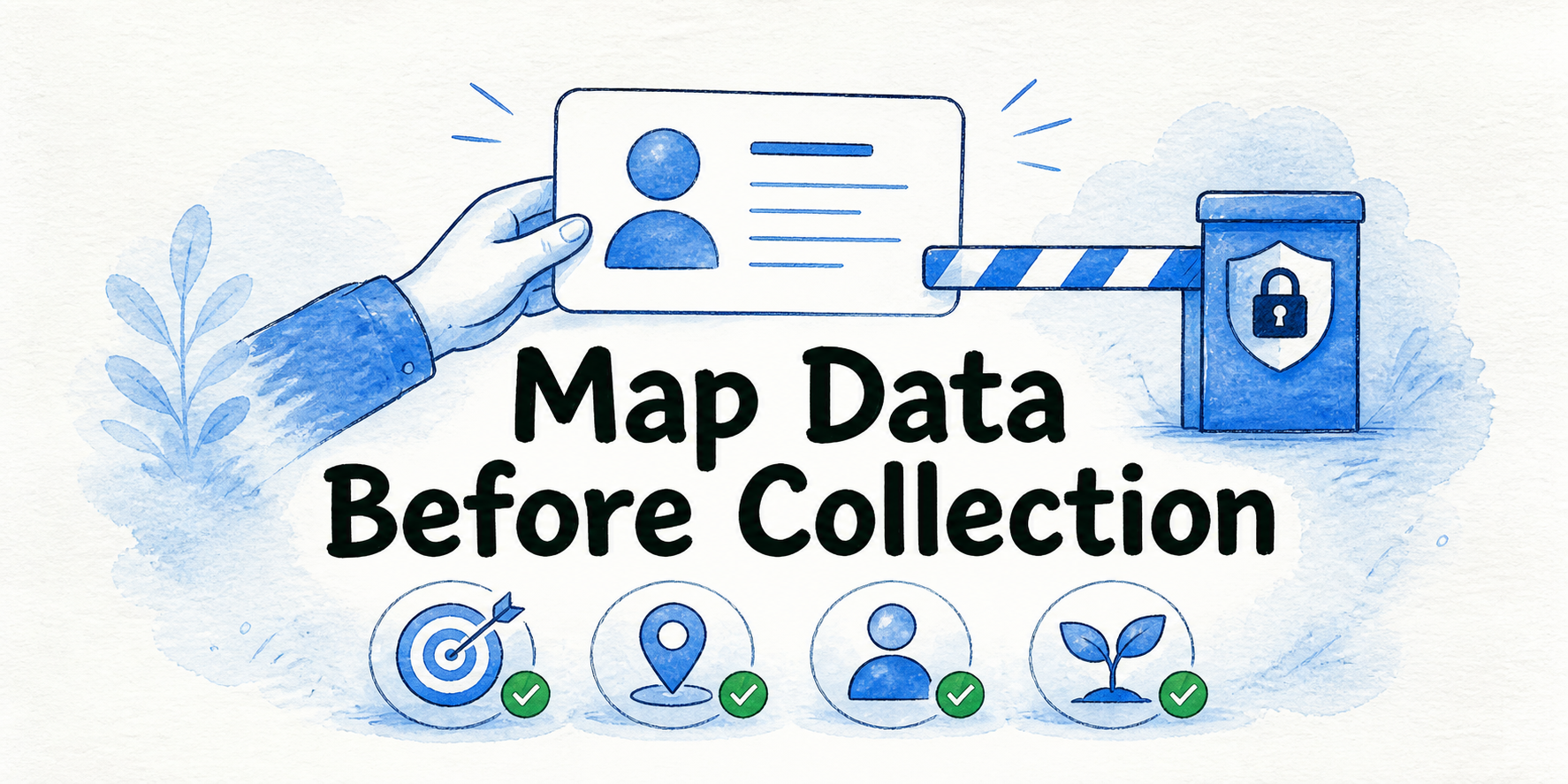
- Map every type of data the chatbot will receive, create, retrieve, or send before accepting visitor input.
- Minimize collection by connecting each requested field to a specific purpose, destination, access group, retention decision, and deletion owner.
- Treat disclosure and consent as separate questions: explain the assistant and its data use clearly, then obtain scoped advice on whether consent is required.
- Write down the responsibilities of the client, agency, platform vendor, model provider, and connected systems; white-label presentation does not settle ownership.
- Define retention triggers and deletion paths for conversations, leads, feedback, sources, logs, and downstream copies before launch.
A branded assistant can look like a natural part of a website while creating a data path that extends through several systems. Because privacy requirements are deployment-specific, the practical decision is not simply whether to add a chatbot. It is whether one defined workflow has a justified purpose, collects the minimum necessary information, tells visitors what they need to know, and gives an accountable owner control over every consequential data category from collection through deletion.
Key Takeaways
- A familiar logo and domain tell visitors who is presenting the experience, not necessarily who processes or controls the data behind it.
- Data minimization should happen before fields, memory, tools, and integrations are configured.
- A retention period needs a documented purpose, trigger, review point, and owner—not a number copied from another deployment.
- Chatbot prompts and relevant context may reach a selected model provider, so the provider path belongs in the data map.
- If consent, ownership, residency, provider terms, or deletion behavior could change whether the workflow is viable, keep that decision open until it receives the right review.
Map the Data Before the Chatbot Collects It
Start with one visitor job, such as answering a delivery question, qualifying a sales inquiry, or booking an appointment. Trace what enters the workflow, what the assistant creates, where each item goes, and who can see it.
Do not put everything under the vague label “chat data.” Separate at least three layers:
- Source data: approved website pages, policies, documents, catalogs, FAQs, and other knowledge the assistant retrieves to form an answer.
- Conversation data: visitor messages, assistant responses, uploaded files, contact details, lead fields, feedback, and any history retained to preserve context.
- Operational metadata: timestamps, usage events, browser or device details, interaction logs, routing events, source-use records, and similar information created while the service operates.
InsertChat’s privacy information identifies voluntarily submitted personal data, account and authentication details, IP addresses, browser and operating-system information, usage data, and interaction logs. It describes retention as dependent on purpose, legal obligations, business needs, and data minimization. These categories provide a useful starting point, but the actual map must reflect the tools and settings enabled in the deployment. InsertChat Privacy
Next, document movement. A visitor’s message may be combined with instructions and relevant excerpts from approved sources and sent through the selected model-provider path. A lead form may send selected fields to a sales system. A handoff may copy the conversation into an inbox or support tool. Feedback and interaction events may appear in reporting or review surfaces.
For each movement, record both the immediate destination and any downstream system of record. Deleting a lead from a chatbot workspace does not necessarily address a copy already sent to a CRM, inbox, calendar, or automation. Likewise, removing a document from the knowledge layer is different from deleting conversations that previously used that document.
A compact data map can use these columns:
| Data category | Collection point | Purpose | Destination | Access | Lifecycle owner |
|---|---|---|---|---|---|
| Visitor message | Chat input | Answer the inquiry | Assistant and selected provider path | Approved operators | Client privacy owner |
| Email address | Lead form | Send requested follow-up | Workspace and CRM | Assigned sales staff | Client sales owner |
| Source excerpt | Retrieval step | Ground the response | Assistant and selected provider path | Approved operators | Content owner |
| Conversation feedback | Rating control | Review answer quality | Analytics or review surface | Service team | Operations owner |
Use the real source register, form configuration, integration list, workspace roles, and provider terms to complete the map. The table is useful only when it describes the deployed workflow rather than the platform in the abstract.
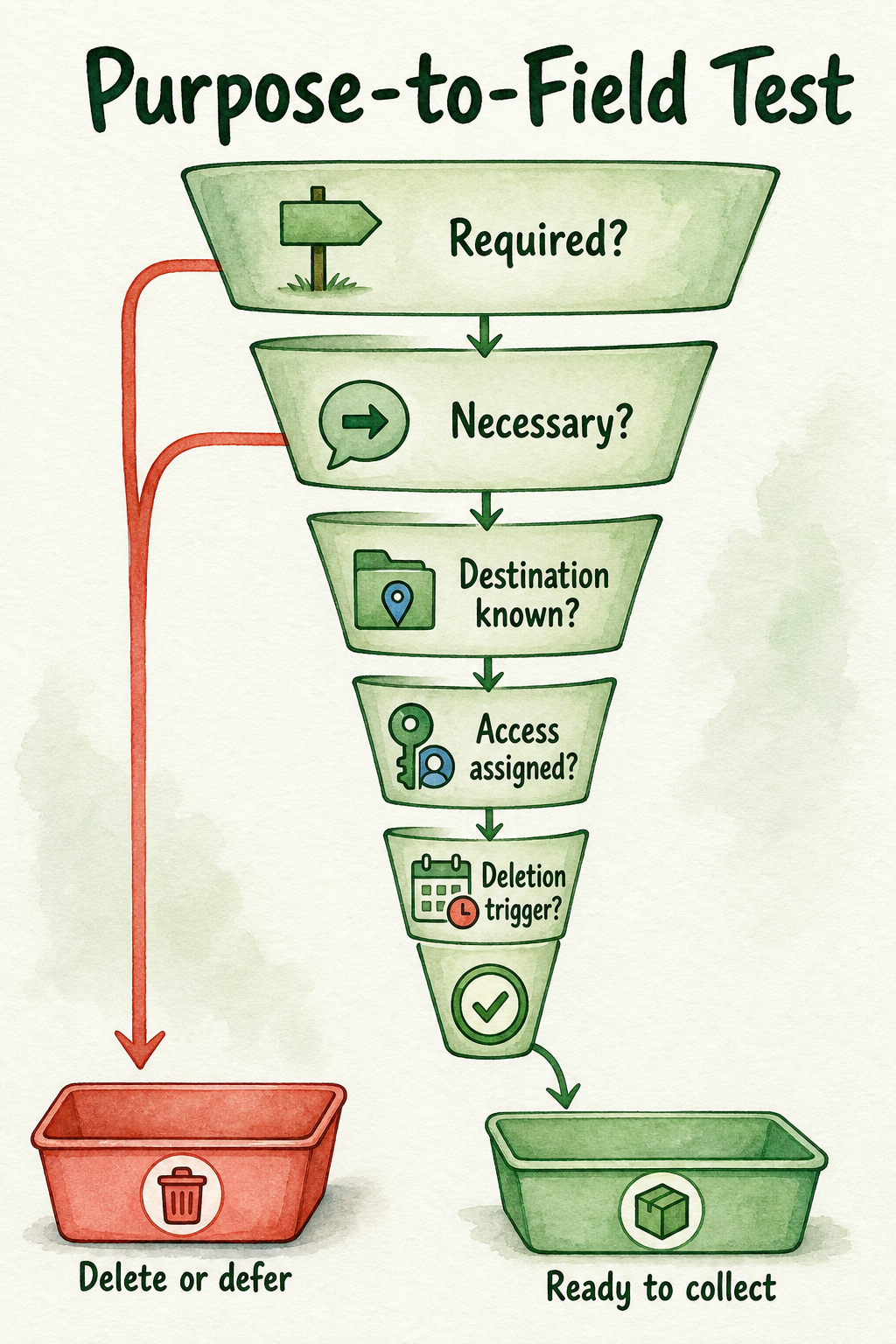
Use a Purpose-to-Field Test for Data Minimization
Every requested field should survive a simple chain of questions:
- What exact visitor or business purpose requires this field?
- Is the field necessary to answer, route, or hand off the inquiry?
- Which system receives it?
- Who needs access?
- What event ends the need to retain it?
- Who can complete and verify deletion?
If the team cannot answer the first two questions, remove or defer the field. If it cannot answer the remaining questions, the field is not ready for collection.
Consider a hypothetical appointment assistant. It may need the visitor’s preferred service, suitable time, and a way to confirm the booking. It probably does not need an open-ended request for medical history, account credentials, payment-card details, or unrelated demographic information. If a later stage genuinely requires additional data, collect it through the approved system designed for that purpose rather than asking for everything in the opening chat.
Free text needs special treatment because visitors can volunteer information that was not requested. A prompt such as “Tell us anything else” creates a wider and less predictable collection surface than a short set of bounded choices. Where possible, tell visitors what not to share, constrain the input, and provide a human or specialist route for requests that exceed the assistant’s approved scope.
Minimization also applies to sources, memory, tools, and access. Do not connect an entire drive when the assistant needs three approved policies. Do not enable a customer-record lookup for a public FAQ workflow. Do not preserve long-term context merely because the option exists. InsertChat’s security guidance similarly frames processing scope, access, retention, deletion, and enabled tools as deployment choices that should match the actual purpose. InsertChat Security & Privacy Review
Separate Disclosure Decisions From Consent Decisions
Disclosure explains the experience. Consent, where required, provides a legally relevant indication of choice. They are related, but one does not automatically satisfy the other.
Before launch, decide what a visitor should understand at the point of interaction. Depending on the deployment and approved review, that may include:
- that the visitor is interacting with an AI assistant;
- which business presents the assistant;
- why particular details are requested;
- whether information moves to providers or connected business systems;
- how to reach a person or the applicable privacy contact; and
- where to find the relevant privacy information.
Avoid absolute claims such as “your data never leaves this chat” unless the complete data map supports them. Model processing, source retrieval, integrations, handoffs, analytics, and operational records can all affect the path.
A disclosure-planning prompt might read: “You are chatting with an AI assistant for [business]. We use the information you provide to answer your question and, if requested, route it to our team. Please do not share sensitive information.” This is a planning example for scoped review, not approved or universally sufficient notice language.
Whether the deployment requires consent—and what form it must take—depends on factors such as jurisdiction, purpose, data type, tracking behavior, audience, and configuration. Do not turn a generic template into a legal conclusion. Record the unresolved question, name the legal or privacy owner, and obtain scoped review before collecting the affected data.
Make White-Label Ownership Visible Behind the Brand
White labeling can give the visitor one coherent client experience, but operating responsibilities may still be distributed across a client, agency, platform vendor, model provider, and connected services. Those responsibilities need to be written down even when the visitor sees only one brand.
For one deployment, assign owners for:
- approving source content and collected fields;
- reviewing conversations and correcting business guidance;
- answering access, correction, deletion, export, or restriction requests where applicable;
- approving retention and deletion decisions;
- reviewing model-provider and integration terms;
- managing workspace access; and
- communicating material privacy information to visitors.
The client might approve the purposes and visitor language while an agency configures the assistant and manages routine reviews. The platform vendor supplies the underlying service, and separate providers may process selected prompts or actions. That allocation must be confirmed for the actual arrangement; a client logo does not by itself transfer or remove legal responsibility.
InsertChat’s explanation of true white labeling treats ownership as broader than changing a logo. It includes the client experience, support path, data expectations, and handoff responsibilities. That is the right operational lens: the visible brand and the underlying responsibility map should reinforce each other, not conflict.
Write the Retention and Deletion Plan Before Launch
“Keep data only as long as necessary” becomes useful only when the team defines what necessity means for each category. Sources, conversations, leads, feedback, account data, and operational logs can have different purposes and destinations, so they should not inherit one unexplained period.
For each category, record:
- the purpose that justifies retention;
- the system of record and known downstream copies;
- the event that starts the retention period;
- the applicable obligation or approved business need;
- the review date or deletion trigger;
- whether the outcome is deletion, anonymization, or another approved treatment;
- the person responsible for requests; and
- the evidence used to confirm completion.
The trigger matters as much as the duration. A lead record might begin its lifecycle when the visitor submits a follow-up request, while a source document might remain active until its owner replaces or retires it. A conversation retained for quality review has a different purpose from contact details copied into a sales system.
Test the operational path as well as the policy. Determine whether authorized staff can locate the relevant account, conversation, lead, feedback, and connected-system copies. Define how access, correction, deletion, export, or restriction requests will be routed where applicable. InsertChat’s GDPR guidance recommends mapping collection, movement, access, retention, deletion, model-provider paths, subprocessors, and data-subject request processes before launch. InsertChat GDPR Review
Do not assume that deleting the primary record automatically clears provider or integration copies. Review the applicable terms and configure downstream systems accordingly. Post-cancellation retention, export, and deletion must also be confirmed against current terms rather than promised from memory.
Apply the Privacy Record to an InsertChat Deployment
For a bounded, non-sensitive InsertChat pilot, begin with the privacy record—not the styling controls. List the connected sources, conversation fields, tools, provider path, workspace access, retention decisions, deletion procedures, and visitor-disclosure owner.
InsertChat stores agent configuration, connected knowledge sources, and conversation data used for the experience and analytics. Prompts and relevant context excerpts are sent to the selected model provider. Configure the deployment accordingly: restrict role-based and client-scoped access, connect only approved knowledge, enable only necessary tools, and test whether authorized staff can find and delete relevant sources, conversations, leads, and feedback. Review the available DPA and subprocessor information when the deployment requires it.
InsertChat states that customer data is not used to train shared models. That is not the same as zero retention, nor does it mean no information reaches a model provider. The deployment still needs a documented account of stored configuration, connected knowledge, conversation data, relevant provider processing, enabled integrations, and analytics.
Hosting, residency, retention, model-provider, access, and tool choices remain deployment-specific. If the intended workflow involves sensitive information, unresolved regional requirements, or complex procurement terms, request a scoped review before using live data.
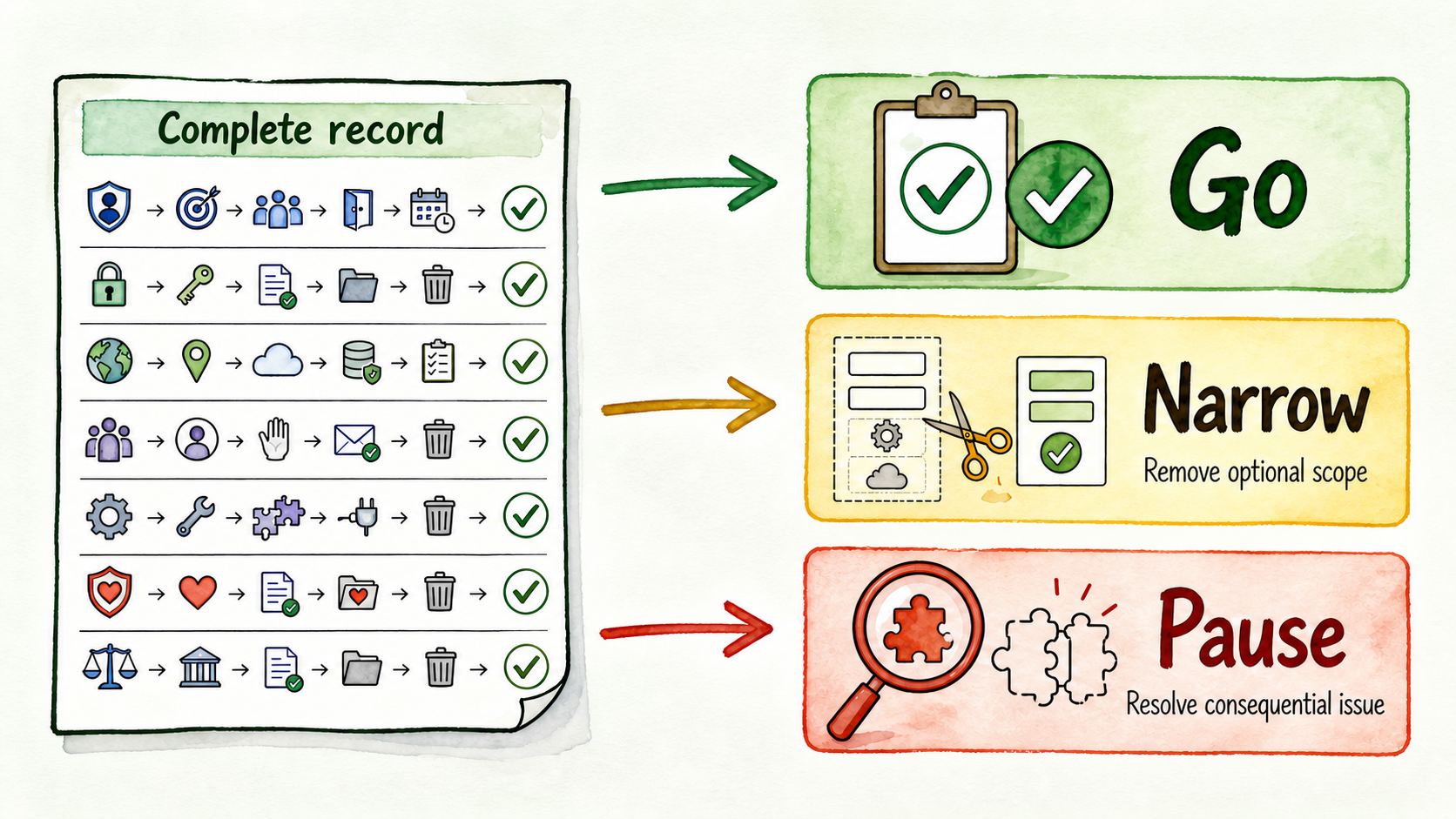
Use a Go, Narrow, or Pause Privacy Gate
Make the final decision against the completed record for the bounded workflow.
- Go when every consequential data category has an approved purpose, destination, access rule, disclosure decision, retention trigger, deletion path, and accountable owner.
- Narrow when optional fields, open-ended inputs, memory, tools, integrations, or sensitive paths can be removed without defeating the visitor’s core job.
- Pause when unresolved consent, ownership, provider, residency, retention, or deletion requirements could change whether the workflow is feasible.
A pause is not a failure. It prevents the team from collecting data first and negotiating responsibility later. Resolve the consequential issue, update the record, and reassess the smaller workflow.
Once one non-sensitive workflow has a complete privacy lifecycle, you can Start for Free and test it with controlled data. For complex security, privacy, regional, or procurement requirements, contact the provider and request current documentation and a deployment-specific review before accepting visitor information.