TL;DR
- Start with one bounded visitor workflow, a named audience, and an observable next action.
- Record every source, behavior rule, access requirement, and handoff path with an owner and approval status.
- Treat missing information as an assigned dependency—not permission to fill the gap with assumptions.
- Keep conditional or unapproved content out of answer behavior, even if it remains in the source inventory.
- Let unaffected preparation continue when dependencies are separable, but pause or narrow any core path that lacks reliable content or ownership.
- Finish onboarding with a documented decision: ready, conditionally ready, or blocked.
A signed agreement does not make a chatbot project ready to build. Readiness begins when the agency can hand delivery a controlled onboarding packet: an approved record of what the assistant should do, which facts it may use, how it should communicate, when it must stop, who receives escalations, and who has authority to approve the result.
Key Takeaways
- Onboarding is an evidence-and-ownership gate between the sale and the build.
- Current, approved content matters more than a large collection of loosely governed files.
- Incomplete intake does not always stop the entire project; only unaffected work should continue.
- Missing source truth, risky-topic rules, access, or escalation ownership can block the behavior that depends on them.
- One client approver must have authority to accept the complete packet, not merely comment on individual sections.
1. Confirm the kickoff contract: one workflow, audience, owner, and next action
Start by converting the sold service into one sentence the client can approve. It should name the primary visitor, the job the assistant will handle, the information or action included, and what should happen next.
For example, a service business might approve this workflow:
Help prospective customers compare approved service options, answer general preparation questions, and direct qualified inquiries to the consultation form.
This is a hypothetical example. Use the client’s signed proposal, kickoff notes, current website journey, and operating procedures to write the real statement.
The workflow record should capture:
- The client-approved business goal
- The primary visitor group
- The main question or task the assistant will handle
- The included answer or action path
- Audiences and requests that are out of scope
- The client business owner
- The agency delivery owner
- One observable next action or success signal
Be precise about exclusions. If the assistant may explain services but cannot access customer accounts, say so. If it can route an existing customer to support but cannot interpret an invoice, record that boundary before anyone configures an answer.
The workflow contract should state what the assistant handles, which information it uses, when it stops, who owns it, and how the team will recognize a useful outcome. Keeping the first workflow bounded makes those decisions reviewable rather than implied.
Narrow the workflow when a central source, responsible owner, or risk control is unavailable. A smaller approved experience is more buildable than a broad promise supported by assumptions.
2. Build the source-intake register
Do not begin with a shared folder full of files. Begin with a register that tells the builder what each item contains, whether the client authorizes its use, and which questions it should answer.
Create one row for every website page, document, policy, catalog, FAQ, video, spreadsheet, or structured record proposed as knowledge. Include these fields:
- Source URL or file name
- Source type
- Questions or topics it is intended to cover
- Client owner responsible for its facts
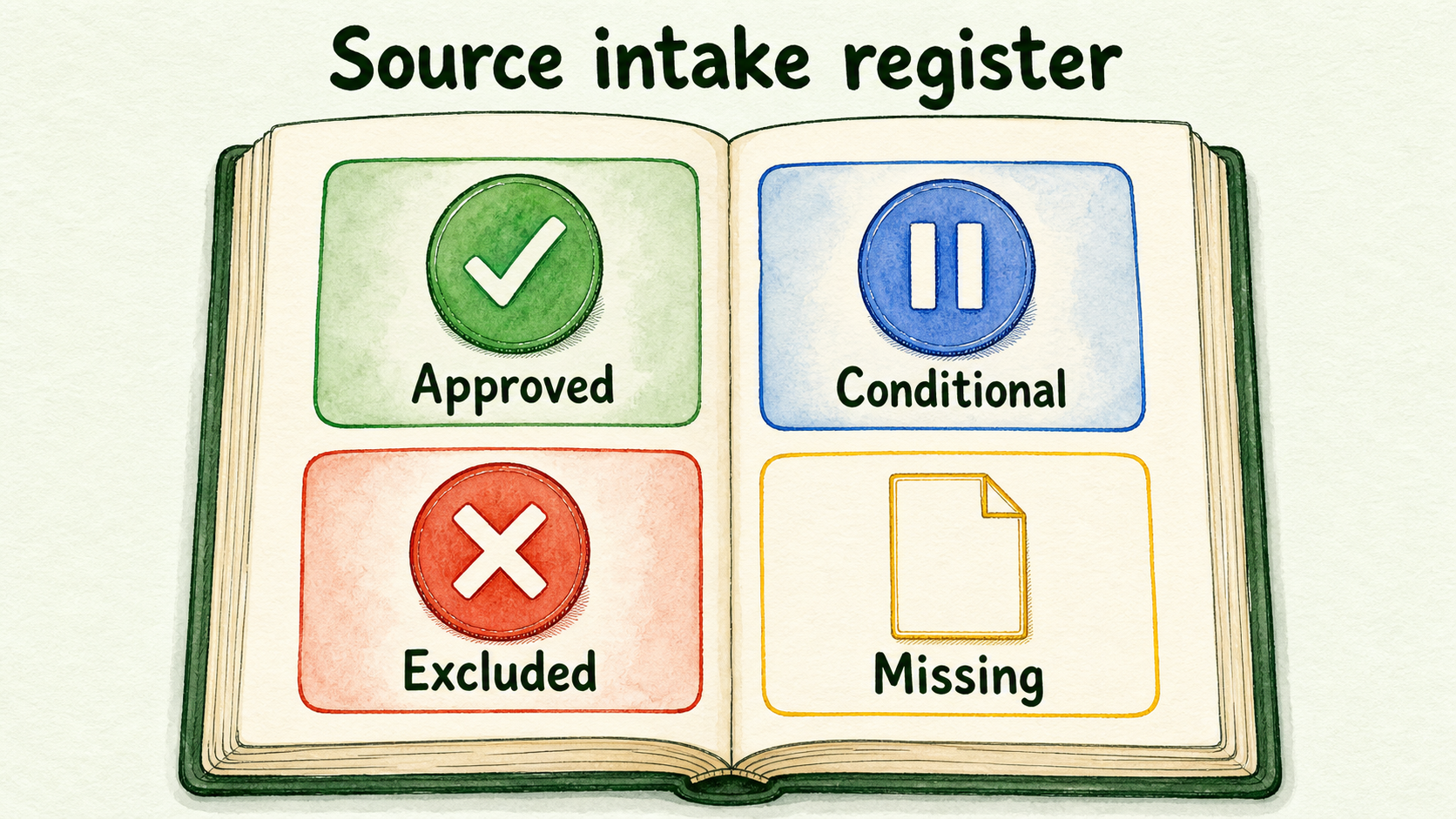
- Status: approved, conditional, excluded, or missing
- Freshness or contradiction flag
- Intended audience
- Known content gaps
These statuses have operational consequences.
Approved means the client has authorized the material for the defined workflow. Conditional means the material can be inventoried, but answer behavior depending on it must wait. Excluded means the content should not inform public answers. Missing means the business has not yet documented or approved an answer.
Suppose the client supplies a homepage, three service pages, an FAQ, and a service-guide PDF. The pricing overview changes frequently and has not been approved by the pricing owner. Keep it in the register as conditional, but exclude pricing answers until that owner resolves it. File organization and unrelated brand preparation may continue because they do not depend on the pricing decision.
A large source collection cannot compensate for absent business guidance. If two policies conflict, record the contradiction and its owner. If no approved refund, eligibility, or service-area rule exists, the assistant should not invent one.
The handoff from intake should contain an approved-source list, exclusions, freshness concerns, unresolved contradictions, known gaps, and do-not-answer rules. Detailed rewriting and source cleanup can happen later; onboarding only needs to establish what is usable and what remains unresolved.
3. Capture voice, prohibited topics, and uncertainty language
“Friendly and professional” is too vague to guide implementation or approval. Translate the client’s brand preferences into behavior another person could recognize in an answer.
Collect rules for:
- Tone and formality
- Preferred answer order
- Typical answer length
- Preferred words and product names
- Prohibited terms or phrases
- Claims the assistant must not make
- Topics that require qualification, refusal, or routing
- Approved uncertainty language
- Client-specific exceptions
- The brand or subject-matter approver
A practical voice record might say: lead with the direct answer, use short paragraphs, avoid jokes and pressure language, do not describe availability as guaranteed, and present the next action only when it follows from approved information.
Prohibited topics deserve the same precision. “Avoid legal advice” is a start, but the delivery team also needs to know what the assistant should do instead. The rule might require a brief limitation statement followed by a route to the responsible team.
Give the assistant an approved sentence for missing information. For example: “I don’t have an approved answer for that, but I can help you contact the team.” Adjust the wording to the client’s real process and brand.
Voice intake should cover answer structure, preferred terminology, prohibited wording, uncertainty, escalation language, and genuine client exceptions. That creates reviewable constraints without trying to write every future response during onboarding.
4. Assign fallback and escalation paths before configuration
A fallback is not the same as a human handoff. Define the difference so unsupported questions do not disappear into a generic “try again” response.
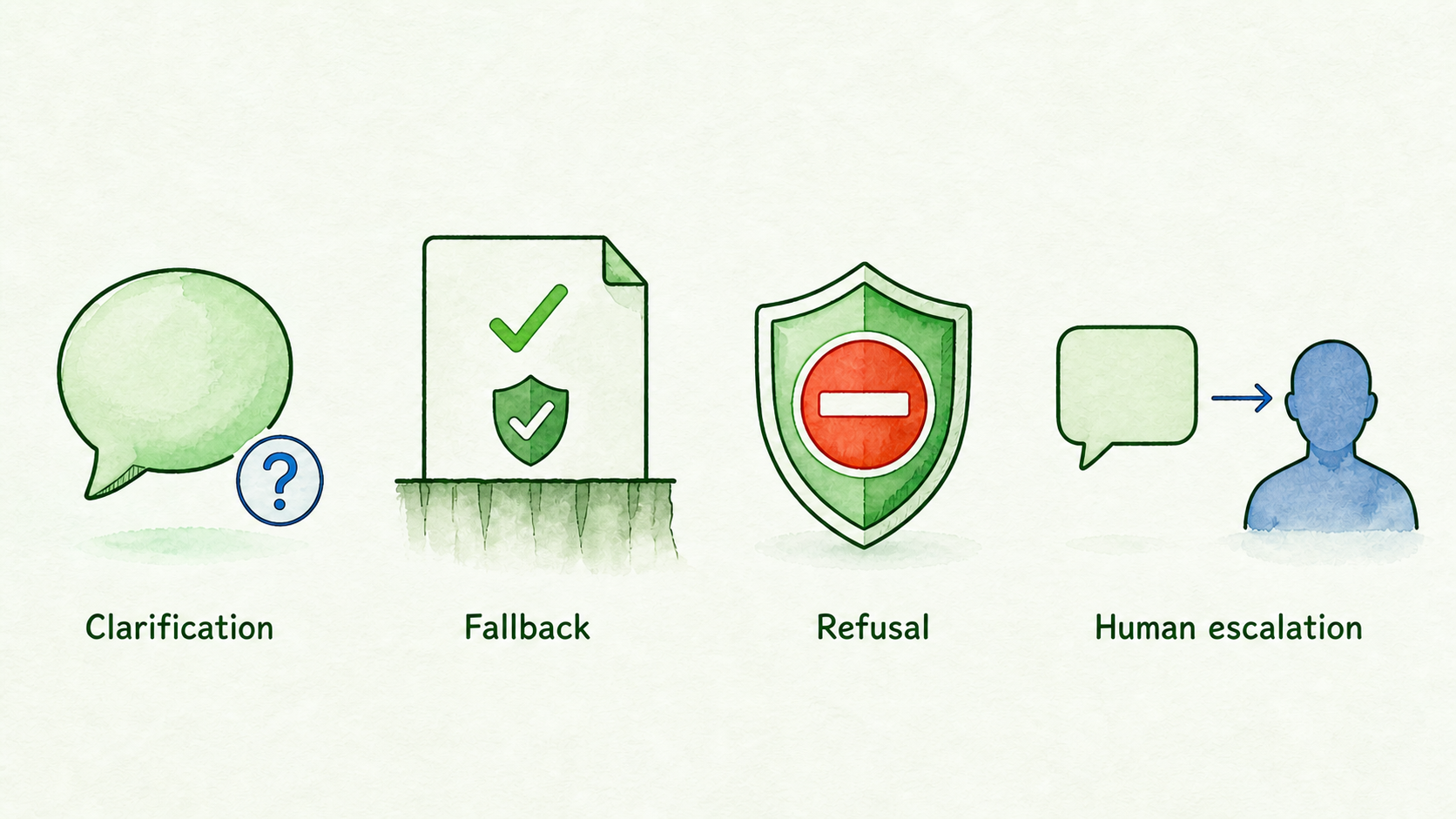
- Clarification: Ask for a missing detail that may make the question answerable.
- Fallback: Explain that the approved information does not support a reliable answer.
- Refusal: Decline a prohibited or unsafe request without attempting to complete it.
- Human escalation: Transfer or route the conversation to a named person or queue.
List the categories that require human involvement. These may include account-specific questions, high-risk decisions, complaints, custom commercial requests, repeated unresolved questions, and explicit requests for a person. The exact categories must come from the client’s workflow and risk owners.
For every escalation category, record:
- The triggering situation
- The receiving person or queue
- The smallest useful context to collect
- The message shown to the visitor
- What the visitor should expect next
- A backup owner
- What happens when the normal destination is unavailable
Do not collect extra personal information simply because a form can accept it. Ask what the receiving team genuinely needs to continue the conversation. A sales route and a general support route may require different information; the client must approve the fields for each.
Preserve the visitor’s question and relevant prior context when the chosen workflow supports it. If context cannot be carried forward, tell the visitor what information they may need to repeat.
A usable handoff rule connects the trigger, visitor message, minimum context, receiving owner, backup route, and review responsibility. Those fields turn “send difficult questions to the team” into an accountable process.
5. Record access, permissions, and data-review dependencies
Many apparent technical delays are ownership gaps. The packet should identify who can approve a website change, create a workspace user, review a connected tool, or answer a privacy question.
Record the people responsible for:
- Website or deployment access
- Workspace administration
- Client-scoped user access
- Source and conversation visibility
- Connected tools or destinations
- Security, privacy, procurement, or legal review
- Final deployment approval
Apply least-required access. A client reviewer who only needs to inspect answers should not automatically receive billing, integration, source-management, or administrative permissions. Agency team members should receive only the access required for their assigned client work.
Define what visitor data the workflow may and may not request. A public FAQ assistant may need no personal data. A lead-capture workflow may require limited contact information. Account details, payment information, health information, legal facts, or other sensitive inputs require an explicit decision from the relevant client owner.
Keep unresolved vendor and governance questions visible. Retention, data location, deletion, export, provider behavior, compliance suitability, and post-cancellation handling should not be promised from assumptions. Assign each open question to the appropriate security, legal, procurement, or technical reviewer, and prevent the workflow from depending on an unanswered assurance.
This section is not a full security assessment or technical integration plan. Its job is to identify the access and review decisions that must exist before delivery can rely on them.
6. Convert the intake into approval and launch prerequisites
Once the inputs are collected, turn them into a readiness record. A folder of documents is not enough; every consequential area needs an approver, status, and unresolved-item owner.
Use acceptance categories for:
- Workflow and audience
- Approved sources and exclusions
- Brand voice and prohibited topics
- Fallback and escalation routes
- Access and permissions
- Data-review dependencies
- Deployment responsibility
For each category, record the evidence or current status, the client approver, a backup approver, the review deadline, and any open item with its owner and due date.
Then assign one overall disposition:
- Ready: Core inputs are approved, owned, and sufficient for the bounded workflow.
- Conditionally ready: A missing item affects a separable behavior that can remain excluded while other work continues.
- Blocked: A core answer path, sensitive topic, required handoff, necessary access dependency, or final approval authority remains unresolved.
Conditional readiness must name the excluded behavior. “Proceed while waiting for pricing approval” is too loose. “Proceed with source organization and brand configuration; exclude pricing answers until the pricing owner approves the current source” is actionable.
Keep estimates separate from verified facts. If the client supplies an unverified baseline or target, label it as client-estimated until an authorized owner confirms the evidence and intended use.
Later quality assurance should test the configured assistant against the approved sources, boundaries, voice rules, handoffs, workflow expectations, and signoff criteria. Onboarding establishes the expected behavior; testing determines whether the implementation follows it.
7. Use the dependency matrix to decide what can start
The most useful onboarding checklist is a decision system, not a list of documents received. Create a matrix with these columns:
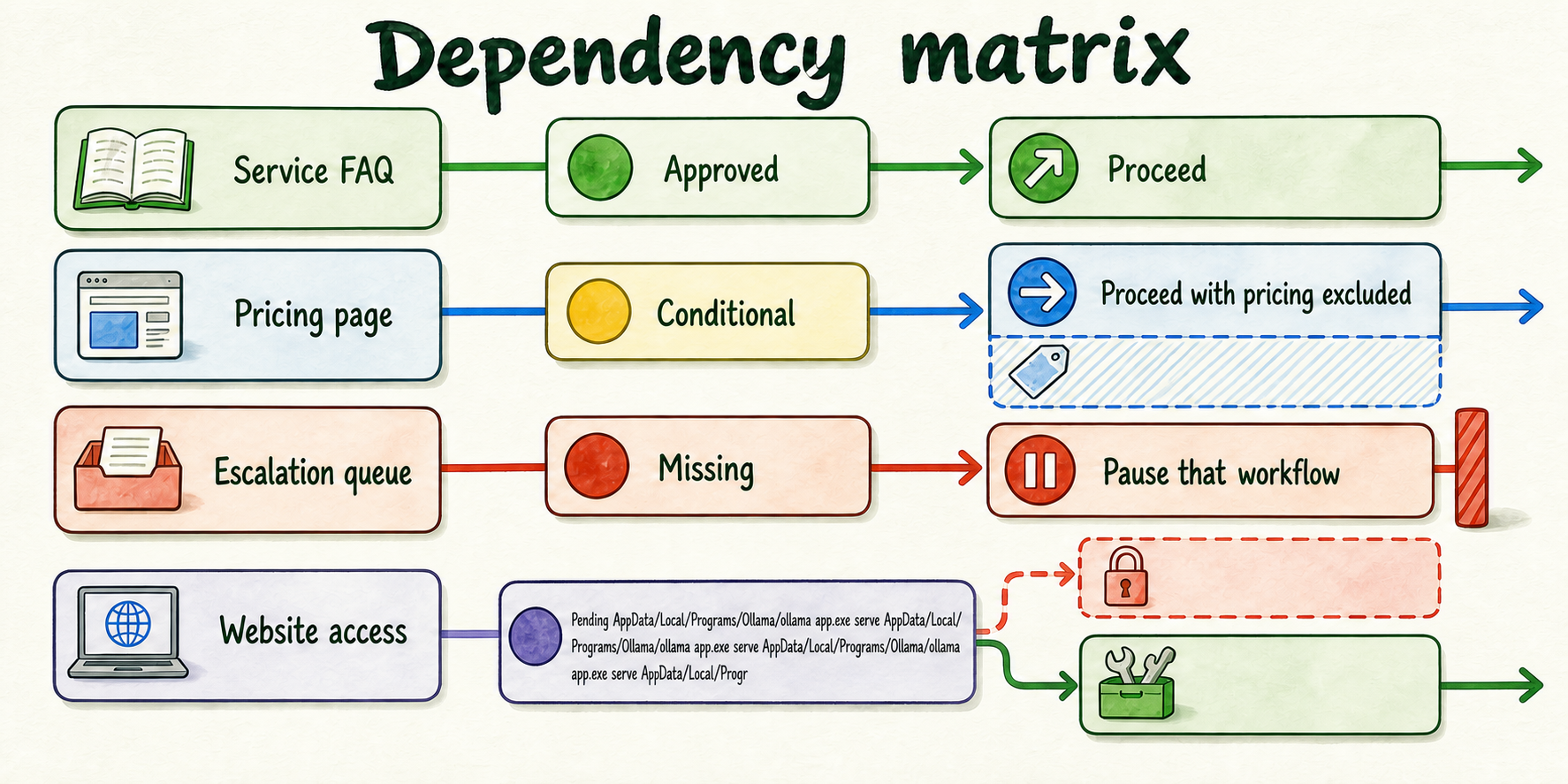
| Input | Owner | Evidence or status | Deadline | Downstream work blocked | Disposition |
|---|---|---|---|---|---|
| Service FAQ | Content owner | Approved | Recorded date | None | Proceed |
| Pricing page | Pricing owner | Conditional | Assigned date | Pricing answers | Proceed with pricing excluded |
| Escalation queue | Support lead | Missing | Assigned date | Support handoff | Pause that workflow |
| Website access | Web owner | Pending | Assigned date | Page deployment | Continue non-deployment preparation |
The rows above are hypothetical. Build the actual matrix from the client’s proposal, approved content, operating procedures, access records, and named owners.
Apply three rules:
- Proceed when the input is approved, sufficient, and owned.
- Proceed conditionally when the missing input affects only a separable workstream that can remain excluded.
- Pause or narrow when the gap affects a core answer path, material risk, required handoff, necessary access, or final approval.
Before declaring the packet complete, confirm that it contains:
- One approved workflow and audience
- A source register with exclusions and gaps
- Observable voice and topic-boundary rules
- Owned fallback and escalation routes
- Access and data-review responsibilities
- An authorized final approver and backup
- A disposition for every unresolved dependency
That is the point at which onboarding has done its job: delivery knows what it may build, what it must exclude, and who can resolve the remaining decisions.
Apply the packet in a white-label assistant workspace
InsertChat can be evaluated as a workspace for implementing this packet. Approved content can map to source controls, voice decisions to brand and behavior settings, escalation decisions to fallback or human routes, and client responsibilities to separated workspace access. Confirm that the current product configuration supports each required control before relying on it; the packet remains the authority and should not be expanded by default settings.
Test the bounded workflow against the client-approved sources, topic boundaries, uncertainty language, and escalation expectations before a controlled launch. Source restrictions, citations, brand settings, fallback controls, workspace separation, permissions, and testing surfaces can support this process when available in the selected configuration, but they do not guarantee accuracy, approval speed, or business outcomes. The client still needs owners for changing facts, edge cases, approvals, and human follow-up.
If the packet is ready, Start for Free with a bounded, non-sensitive workflow. If security, procurement, regional deployment, retention, or other complex requirements remain open, contact the team for a scoped review before making the workflow depend on them.