TL;DR
- Keep an AI app when verified active use supports a distinct business job or when an essential dependency cannot be preserved elsewhere.
- Combine or replace tools only when they serve the same audience, use equivalent approved information, produce the same operational outcome, and can be switched without unacceptable disruption.
- Retire a tool only after prompts, history, integrations, user habits, security requirements, permissions, and ownership have been addressed.
- Base every decision on a dated register built from invoices, active-user records, approved use cases, renewal dates, and known switching dependencies.
Two AI tools can produce similar text in a demo and still do completely different jobs in practice. Cancel one because its feature list looks familiar, and a team may lose a trusted drafting routine, a customer handoff, an integration, or access to approved information. A sound renewal decision starts with observable use and operational consequences—not preference, novelty, or apparent feature overlap.
Key Takeaways
- Define the business job before discussing which app people prefer.
- Separate low-risk internal creation from source-backed answers and customer-facing actions.
- Treat switching dependencies as part of the value of a tool, not as an afterthought.
- Give every decision a date, a governance owner, and a renewal or migration action.
- Balance subscription savings against specialist capability, shared governance against experimentation, migration effort against continued duplication, and provider flexibility against a simpler operating stack.
Build a Dated AI Tool Register Around Business Jobs
The direct answer to “How do you decide which apps like ChatGPT to keep?” is: keep the apps that support verified, distinct work or preserve an essential dependency; challenge the rest with a consistent overlap test. You cannot make that distinction from a list of features. You need an AI tool register.
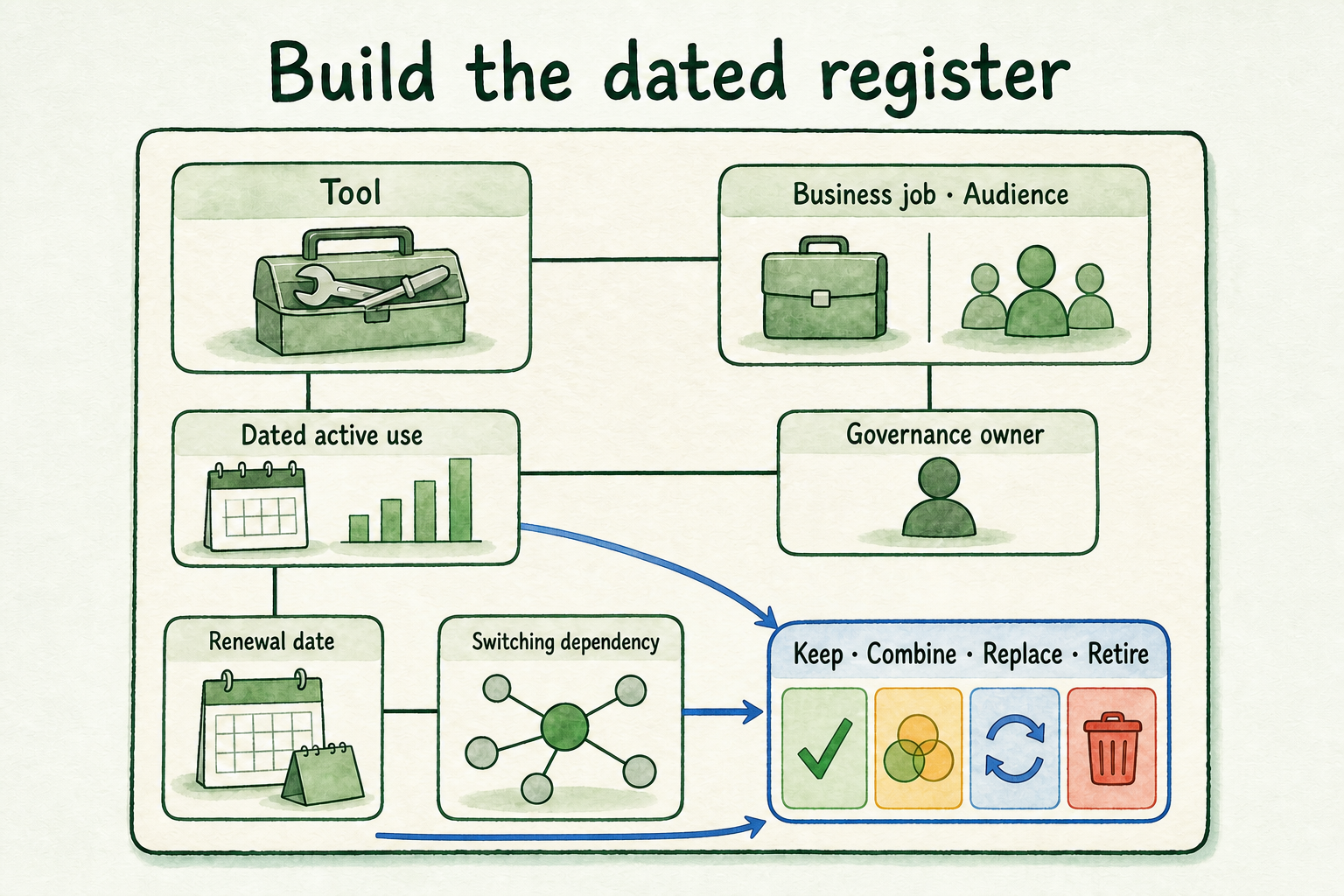
An AI tool register is a dated record of the tools the business pays for or formally permits. It connects each subscription to a business job, the people it serves, the information it may use, the place its output goes, and the person accountable for its governance.
Start by collecting the records that show what is actually happening:
- Invoices and contract records, including the billing owner
- Active-user records for a defined recent period
- The approved-use-case register or equivalent policy record
- Renewal and notice dates
- Known switching dependencies, such as integrations, saved prompts, conversation history, templates, permissions, or established user routines
Do not treat a login as proof of value. Active use should connect to a named business job: drafting campaign options, answering policy questions from approved sources, booking customer appointments, reviewing code, or producing design assets, for example.
Create one row per tool and record:
| Register field | What to capture |
|---|---|
| Tool | The paid or approved application |
| Business job | The specific work it supports |
| Audience | Internal user, customer, client, or mixed |
| Governance owner | The person accountable for access, use, and renewal |
| Approved inputs | Information the tool is permitted to receive |
| Output destination | Draft, inbox, website, CRM, codebase, client deliverable, or another system |
| Customer exposure | Whether a customer sees or acts on the output |
| Active use | Dated evidence of current use tied to the business job |
| Renewal date | Renewal and cancellation-notice dates |
| Switching dependency | What must be preserved, rebuilt, reviewed, or retrained |
| Decision | Keep, combine, replace, or retire |
Add the date and source owner for every material field. “Marketing uses it” is too vague. “Campaign manager confirmed weekly use for first-draft concepts on August 1” is a record someone can revisit.
Next, classify each job into one of four groups:
- Internal creation: exploratory writing, brainstorming, summarization, analysis, or first drafts reviewed by an employee.
- Source-backed answering: responses that must be grounded in approved policies, documentation, catalogs, or other controlled business content.
- Customer actions: workflows that book, qualify, route, look up, submit, pay, escalate, or otherwise change something for a customer.
- Specialist work: coding, design, research, data analysis, or another job where domain-specific capability matters.
This separation prevents a common error. A marketing drafting app and a public support assistant may both generate prose, but they do not serve the same audience, operate from the same information, or carry the same risk. Similar output is not sufficient evidence of redundancy.
Apply the Dependency-Adjusted Overlap Test
Compare tools only within a clearly defined business job. Then ask four questions in order:
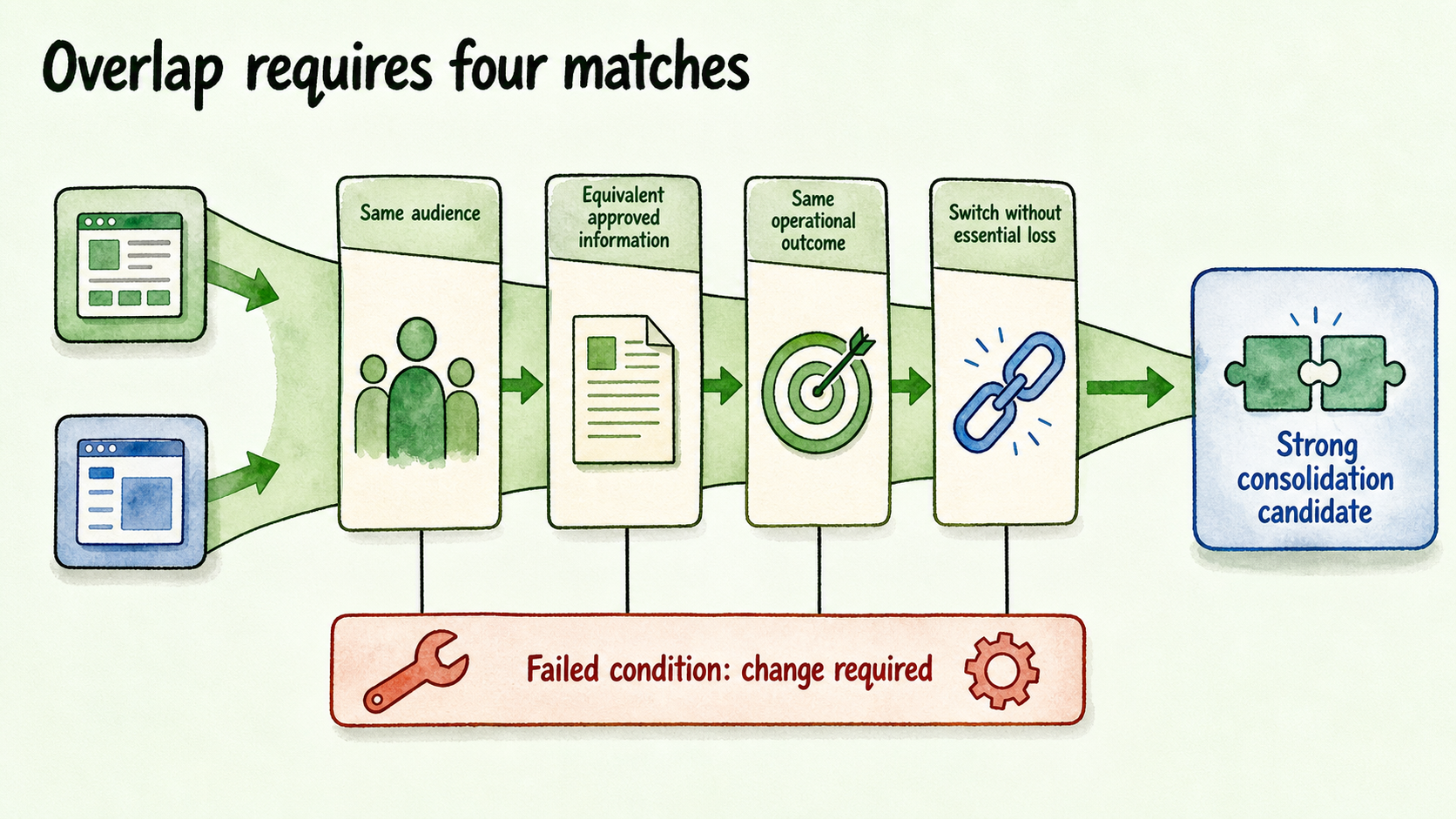
- Do they serve the same audience? An employee preparing a draft and a customer seeking a final policy answer have different needs, even when both type a question into a chat box.
- Do they use equivalent approved information? Open-ended exploration is different from answering from controlled, current business sources.
- Do they produce the same operational outcome? A suggested reply, a published answer, and a completed booking are three different outcomes.
- Can the business switch without losing an essential dependency? Account for prompts, history, integrations, access controls, review practices, user habits, and ownership.
Only tools that pass all four conditions are strong consolidation candidates. A failure on one condition does not automatically justify keeping both forever, but it identifies what must change before consolidation becomes safe.
Assign one of four outcomes:
- Keep: The tool has verified active use and owns a distinct, justified job, outcome, or essential dependency.
- Combine: Overlapping work can move into one governed operating path, while any genuinely specialist capability remains separate.
- Replace: Another tool can deliver the same required outcome and has passed migration validation.
- Retire: No justified active job remains, accountable owners agree, and all dependencies have been cleared.
Consider a marketing team that uses one general-purpose tool to explore campaign angles and another system to give customers approved product answers. Keep both if both jobs remain valuable. Centralizing customer answers can improve governance, while the exploratory tool preserves useful individual experimentation. Combining them solely because both can write would erase the operational distinction.
The same reasoning applies to agencies. Internal creation tools may remain useful for briefs and concepts, while client-facing branded assistants need separate knowledge, presentation, permissions, and ownership. Shared governance is valuable where customers are exposed; it need not eliminate every low-risk internal workspace.
Provider flexibility introduces another tradeoff. Several direct provider subscriptions may preserve experimentation or specialist access, while a consolidated operating layer may simplify governance. Judge that choice by the business job and dependencies, not by the number of model names available.
Test the Decision Before the Renewal Date
Use a controlled migration to prove a replace or retire decision. The closer a workflow is to customers, regulated information, or connected systems, the stronger that proof should be.
Before changing a subscription, check:
- Prompts and templates: Identify shared instructions, examples, tone rules, and reusable workflows. Decide what should migrate and who may approve it.
- Conversation history: Determine whether prior chats contain operational knowledge, customer context, or records that must be retained under current policy.
- Integrations: Map every connection to inboxes, documents, websites, CRMs, help desks, calendars, automation tools, or internal systems.
- User habits: Observe shortcuts, review practices, browser extensions, handoffs, and informal routines. A technically capable replacement can still fail if it adds friction to frequent work.
- Security review: Reassess approved data, provider handling, access boundaries, retention, deletion, and procurement requirements for the proposed destination.
- Permissions: Recreate only the access each user or client needs, rather than copying broad legacy access.
- Ownership: Name the governance owner, migration owner, approver, and post-change support contact.
Run overlapping tools in parallel for a bounded period or migrate one contained workflow first. Define what must remain stable: source use, output quality, handoff context, completion of connected actions, or employee review effort. If the replacement cannot preserve the required outcome, record the failed condition and revise the decision.
Here is a hypothetical small-team audit. Use your own invoices, active-user evidence, approved-use-case records, renewal dates, and dependency notes when applying it.
The team has marketing, support, and an operations owner. Its register identifies four tools:
- Tool A supports exploratory marketing drafts used only by employees.
- Tool B drafts support replies for human review and contains shared prompts.
- Tool C also drafts support replies but has little verified use and no unique integration.
- Tool D answers customer questions from approved policies and passes complex cases to support.
The team first separates the jobs. Tool A belongs to internal creation. Tools B and C belong to internal reply drafting. Tool D belongs to source-backed customer answering. That classification immediately prevents Tool A or B from being treated as a full substitute for Tool D.
Next, the team applies the four conditions to Tools B and C. They serve the same internal audience, use equivalent approved support material, and aim to produce the same reviewed reply. The dependency check finds that Tool B contains the maintained prompt set and fits the team’s established review habit, while Tool C has no essential dependency.
The resulting decisions are:
- Keep Tool A: Marketing has verified use for a distinct exploratory job.
- Combine Tools B and C: Move the shared reply-drafting job into Tool B, preserve the approved prompts, and retire the duplicate path after a controlled check.
- Retire Tool C: Its job is covered, no unique dependency remains, and the operations owner schedules cancellation before the notice date.
- Keep Tool D: It owns a separate customer-facing job that depends on controlled sources and support handoff.
If Tool B were being replaced too, the team would first test prompt behavior, history requirements, inbox connections, permissions, security conditions, and user review habits in the proposed destination. The decision would remain provisional until those checks passed.
An agency could reach a similar result while keeping internal concept development separate from client-branded assistants. The saving comes from removing true duplication, not forcing unlike work into one tool. That protects specialist capability while still reducing avoidable subscriptions.
Route Customer-Facing Requirements to a Separate Evaluation
A portfolio audit may reveal that several subscriptions are supporting pieces of one retained public workflow: approved answers, branding, model access, handoffs, and deployment across customer surfaces. That is a reason for a separate platform evaluation—not proof that every internal tool should be replaced.
For this requirement, assess whether one governed assistant can preserve the approved knowledge and customer journey while reducing fragmented provider or channel administration. InsertChat documents support for OpenAI, Anthropic, Google, and open or alternative provider families. It also describes per-workflow model choice, routing routine paths to lower-cost models, and switching models without losing chat history, retrieved context, or enabled handoff paths. Those capabilities are relevant when provider consolidation must preserve one governed customer experience (review the model and routing evidence).
Then check the launch surfaces. InsertChat states that the same approved sources, brand controls, answer behavior, prompts, tools, and analytics can be reused across website widgets, embeds, hosted pages, custom domains, and API-backed experiences. Its guidance also recommends expanding only after the first workflow is stable (review the channel-reuse evidence).
Do not mark consolidation complete from those descriptions alone. Choose one bounded customer-facing job—such as answering a defined set of approved support questions on one controlled page—and test it against the register’s requirements. Confirm source behavior, customer presentation, handoff, permissions, security conditions, ownership, and the required channel before changing existing subscriptions.
Use the InsertChat comparison route to evaluate that governed, branded customer-facing requirement separately. It is not evidence of your team’s usage, migration effort, or savings; those conclusions must come from your dated register and controlled test.
Finish the renewal cycle with no blank decisions. Approve justified renewals, assign owners and target dates to controlled migrations, and schedule retirement only after dependencies are cleared. If the retained public workflow matches the documented requirements, Start for Free with that single bounded job. For complex security or procurement needs, route the evaluation to a human review before launch.