TL;DR
- Start with one bounded customer request and one permitted outcome, not the whole support queue.
- Approve the sources the system may use and define what it must refuse, route, or leave untouched.
- Use three response lanes: answer automatically, collect context and hand off, or keep human-owned.
- Name the owners, channel, test cases, baseline measures, cost inputs, launch blockers, and stop conditions.
- Approve expansion only after dependable performance against thresholds your organization set before launch.
A customer asking for store hours, requesting a return with conditional eligibility, and disputing an account-specific charge may enter through the same interface, but they require different authority and evidence. A useful pilot makes those differences explicit before launch, allowing a small support team to approve, narrow, prepare, or postpone one controlled use case without assuming that a chatbot should automate the entire queue.
Key Takeaways
- Scope begins with one request and outcome. “Answer store-hours questions from the approved page” is bounded; “automate customer service” is not.
- Sources control what can be answered. Missing, stale, or contradictory material requires a refusal, correction, or handoff.
- Authority controls what remains human-owned. Retrieving a published policy differs from deciding whether one customer qualifies for an exception.
- A baseline must precede outcome claims. Measure current conditions before deciding whether automation changed them.
- Expansion follows dependable performance. More workflows, channels, languages, or integrations introduce additional failure modes and owners.
Define the Automation Job and the One-Page Pilot Brief
AI customer support automation uses software to answer, route, or advance customer requests within defined limits. The term covers several distinct jobs:
- Answer automation returns information from current approved sources.
- Workflow actions retrieve or change information through another system.
- Ticket triage classifies a support ticket and routes it to an owner or queue.
- Human handoff transfers a request and its relevant context without claiming that automation resolved it.
An AI support agent may perform one or more of these jobs. A customer service chatbot is the conversational interface through which a customer interacts with the system; the interface alone does not establish its authority. An approved source is information that a named owner has confirmed may be used for the pilot. A support ticket is the recorded case passed into the support process. A pilot is a controlled test of a defined operating arrangement. A baseline records conditions before the change. A content gap is a relevant question that current approved material cannot answer. An expansion gate is a requirement the pilot must meet before its scope grows.
Start with the business goal, such as reducing repeated manual lookup of published information while keeping exceptions under human control. Screen the proposed request using five factors: frequency, source readiness, answer stability, consequence of error, and escalation clarity. This is enough to decide whether the request should enter the pilot-brief stage; a full prioritization exercise belongs outside this brief.
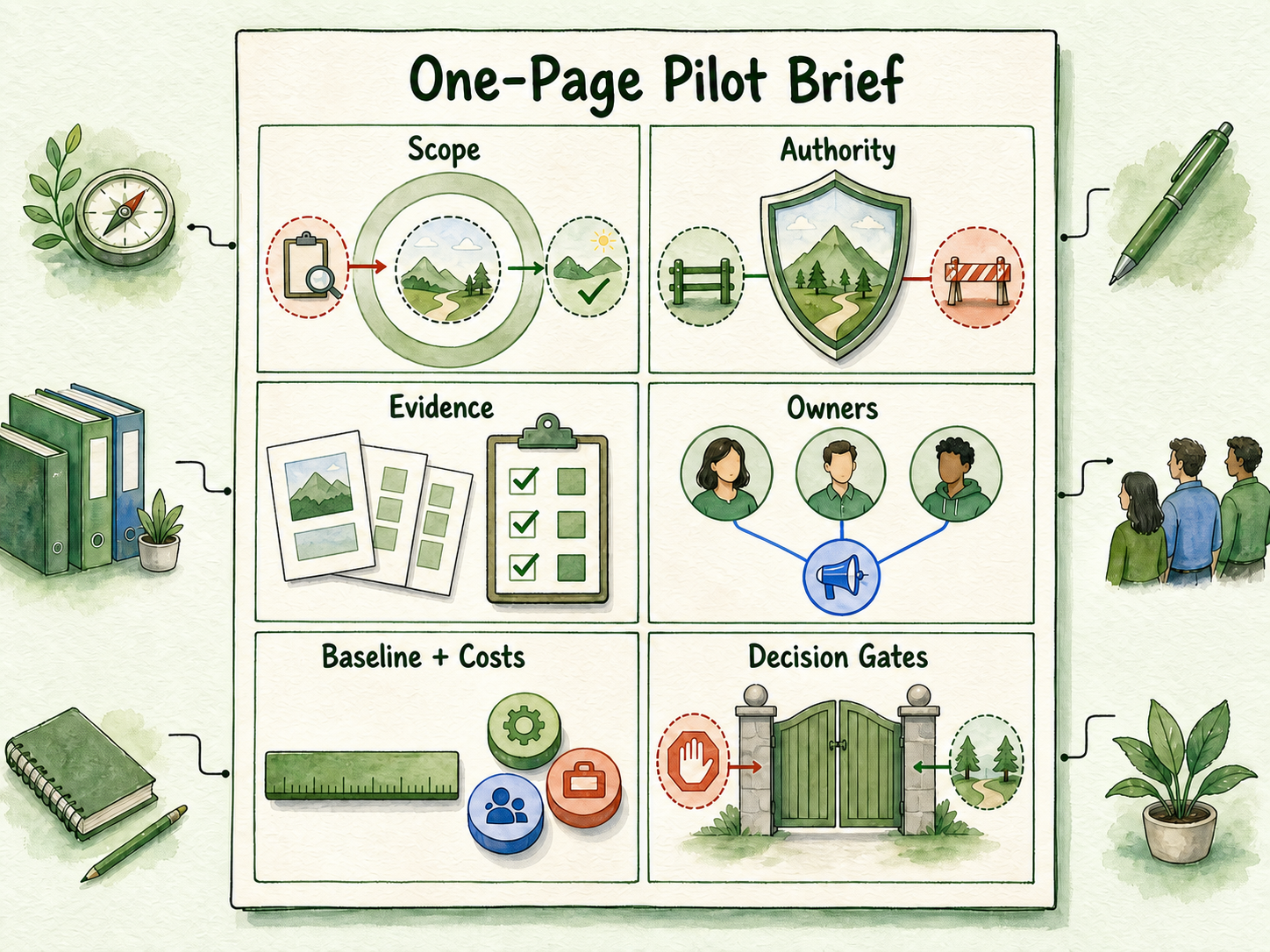
The one-page brief should contain:
- Business goal: The operational problem the pilot is intended to examine.
- Bounded request and outcome: The exact request, permitted response, and allowed action.
- Approved sources: The pages, documents, FAQs, policies, or product information the system may use.
- Prohibited requests: Questions and actions the system must refuse, route, or leave untouched.
- Response lanes: Conditions for automatic answers, context collection with handoff, and human ownership.
- Owners: Named responsibility for source accuracy, support operations, and technical configuration.
- Channel: One initial customer-facing surface.
- Test cases: Representative questions, variations, edge cases, and expected behavior.
- Baseline: Current measures against which observations will be compared.
- Cost inputs: Software, usage, setup, source preparation, testing, maintenance, integrations, and failure handling.
- Decision gates: Launch blockers, stop conditions, review points, and requirements for expansion.
Tool selection comes after these decisions. Before approving any platform, obtain current documentation showing how it handles source grounding, assistant behavior, fallbacks, human handoff, workflow actions, ticket creation, conversation context or transcripts, operational oversight, channels, and multilingual behavior needed by the proposed pilot. If a required mechanism cannot be verified, record it as a launch blocker rather than assuming it exists.
Check Sources, Authority, and the Three Response Lanes
Inventory every website page, document, FAQ, policy, and product-information source relevant to the selected request. For each one, record:
- Its approval state and owner
- When it was last checked
- How frequently it can change
- Whether another source contradicts it
- Which conditions or exceptions it omits
- What response should be used when it cannot answer the question
Resolve conflicts before launch. If an FAQ and policy document specify different return periods, the system has no justified basis for choosing between them. A content gap or contradiction is not permission to invent an answer.
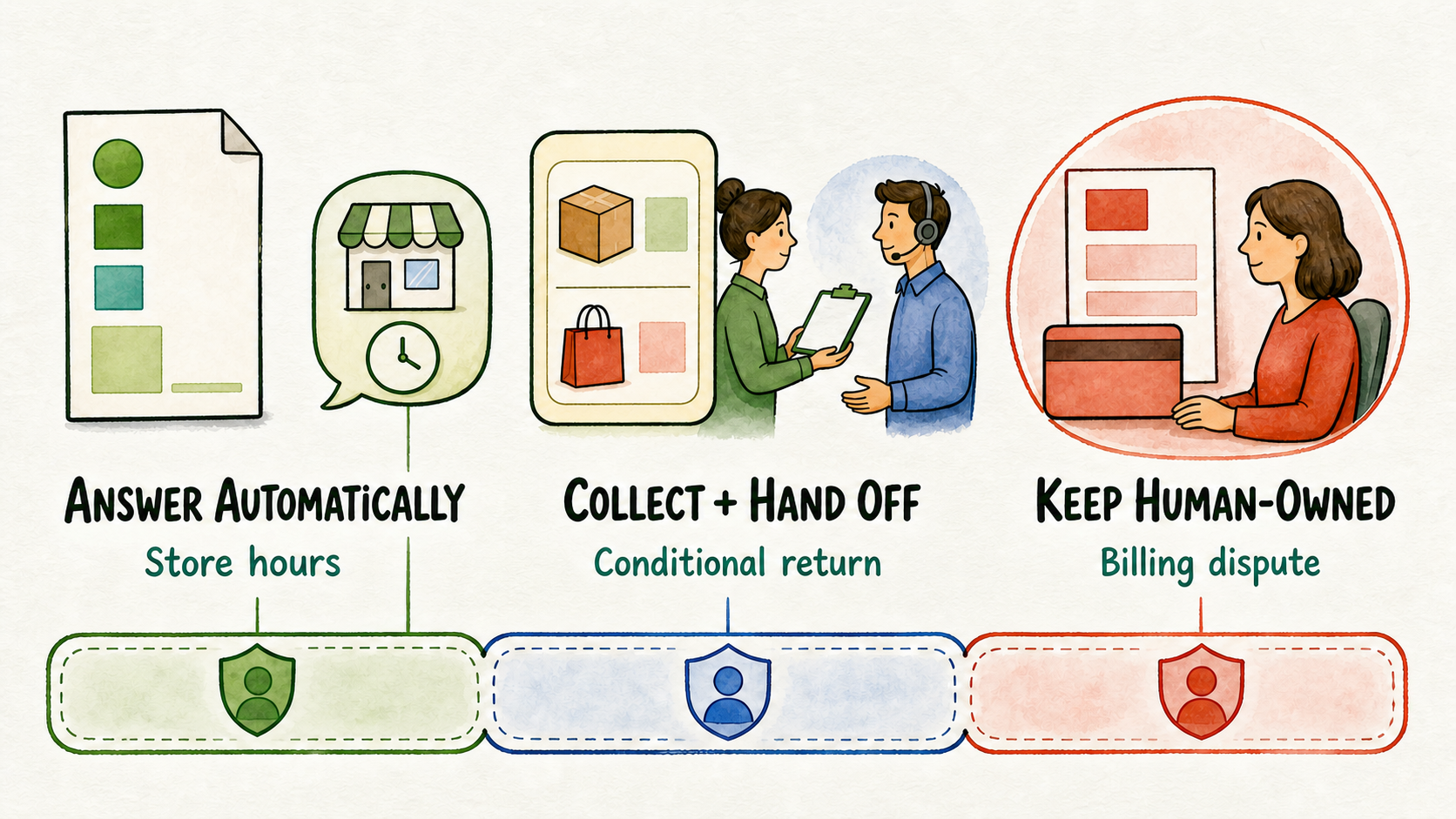
Classify requests into three lanes:
| Lane | Permitted behavior | Illustrative request |
|---|---|---|
| Answer automatically | Answer only from current approved sources and stay within the permitted outcome | Provide store hours covered by the approved page |
| Collect context and hand off | Gather the minimum approved details, explain the next step, and route the request | Collect an order reference and return reason when eligibility depends on conditions |
| Keep human-owned | Do not assess, decide, or alter the case | Route an account-specific billing dispute to the billing owner |
This classification exposes the tradeoff between coverage and answer control. Adding more sources may increase the questions the system can address, but it also increases the material that owners must approve, reconcile, and maintain. A narrower source set limits coverage while making permitted answers easier to inspect.
Availability also needs a boundary. An automated interface may accept an after-hours request, collect approved context, and explain the authorized follow-up path. It should not imply that a person is currently handling the case or that an unsupported issue has been resolved.
Worked Example: Complete the Brief for Three Support Requests
The following retailer example is illustrative. It shows how to apply the brief without assuming any performance result.
Inputs
- Goal: Answer stable store-information questions while routing customer-specific cases with useful context.
- Approved sources: The current store-hours page, general returns policy, and customer-facing FAQ.
- Owners: A content owner for source accuracy, a returns owner, a billing owner, and a technical owner.
- Channel: A website assistant on the help page.
- Baseline fields: Request volume, first useful response time, repeat contacts, unresolved questions, handoff completeness, escalation quality, resolution status, and customer feedback.
- Cost fields: Software and usage, setup labor, source preparation, testing, maintenance, integration work, operational oversight, and failure handling.
- Tests: Direct questions, paraphrases, missing details, unsupported exceptions, conflicting information, and attempts to move from general information into an account decision.
Request 1: Stable FAQ answer
“What time does the store close on Saturday?” enters the automatic-answer lane when the approved hours page clearly covers the location and date. Tests should include ambiguous locations, holidays, and dates missing from the source. If the source does not cover the request, the system should not guess.
Request 2: Conditional return
“Can I return this item?” enters the context-and-handoff lane when eligibility depends on purchase date, product category, item condition, or account details. The system may provide the approved general policy, collect the minimum authorized context, and route the request to the returns owner. A person decides the individual outcome.
Request 3: Account-specific billing dispute
“Why was I charged twice?” remains human-owned. The system may acknowledge the request, collect only the approved minimum details, and route it to the billing owner. It should not diagnose the account, determine fault, or promise a refund.
After hours, the billing request stays in the same lane. The response may confirm that the approved context was captured and state the authorized next step. It must not imply immediate human attention unless the business can meet that expectation.
This example favors preparation over a fast launch if the sources conflict, owners are missing, or the handoff destination is unreliable. It also shows why containment—the share of requests that remain automated—cannot be the only goal. A pilot that keeps more conversations automated but sends incomplete escalations or attempts risky decisions is not ready to expand.
The readiness decision follows the evidence:
- Approve when sources, boundaries, owners, costs, tests, and gates are documented.
- Narrow when only the stable FAQ path is ready.
- Prepare when source or handoff work is incomplete but has clear owners.
- Postpone when a high-consequence request lacks a dependable human path or acceptable failure limits.
Set Measurement, Cost, Launch, and Expansion Gates
Build an organization-specific baseline before launch. Define and record:
- Volume for each request type
- First useful response time by relevant channel and time of day
- Repeat-contact and unresolved-question rates
- Handoff completeness and visible ownership
- Escalation quality
- What counts as resolution
- The customer-feedback measure, if one is used consistently
- Source-update cadence
- Acceptable failure thresholds for wrong answers, missing context, routing failures, and unauthorized actions
There is no universal pilot duration, sample size, accuracy target, containment target, savings rate, or expansion threshold. Use enough representative activity to evaluate the declared gates, accounting for your volume, seasonality, and case mix.
During the pilot, examine answer quality against approved sources, unresolved questions, content gaps, handoff completeness, ownership, support outcomes, and customer feedback. A top-question count can show what customers asked, but it does not establish that the answer was correct or the case was resolved. Each signal needs an owner and a defined response.
Complete a separate cost worksheet and break-even analysis before approval. Include software and usage costs, implementation effort, source preparation, testing, staff review, maintenance, integrations, and expected failure-handling costs. Keep assumptions visible instead of collapsing uncertain inputs into one unexplained total.
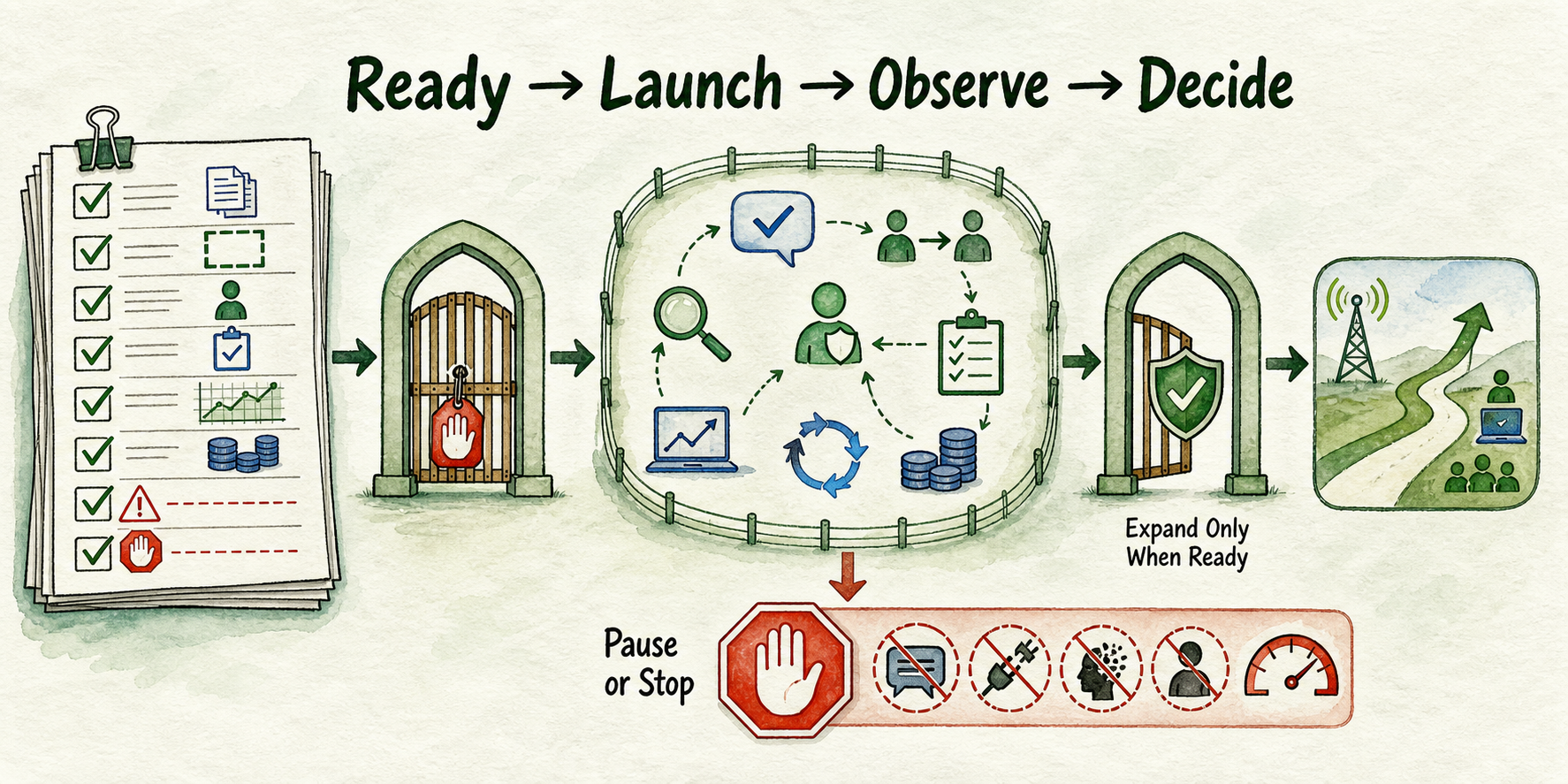
Launch blockers should include:
- Missing, stale, or contradictory sources
- No owner for source updates or escalations
- Handoffs that omit required context
- Unsupported actions or account decisions
- Unverified platform behavior needed by the pilot
- Missing baseline or cost inputs
- Undefined failure thresholds or stop conditions
Pause or stop the pilot if it produces unsupported answers, attempts prohibited actions, repeatedly loses handoff context, leaves cases without visible ownership, or exceeds the organization’s declared failure tolerance.
Expand only after the bounded workflow performs dependably. Add another workflow when its sources, authority, owners, tests, and costs are ready. Add another channel only when the team can test consistency without obscuring the first workflow’s results. New languages, integrations, and actions require their own verification because they introduce additional wording, data movement, failure modes, and operating responsibilities.
FAQ
What is AI customer support automation?
It is the use of software to answer, route, classify, or advance customer requests within defined rules. It can include automatic answers, workflow actions, ticket triage, and human handoff. Those functions should not be treated as interchangeable.
What should be automated first?
Choose one frequent, bounded request with current approved sources, a stable answer, tolerable consequences if something goes wrong, and a clear escalation path. Use your own request records and operating constraints to make the final selection.
What sources are required?
Use only sources a named owner has approved for the pilot, such as current website pages, documents, FAQs, policies, or product information. Record freshness, contradictions, missing answers, conditions, and ownership before launch.
When should a human take over?
Use human handoff when the request depends on account data, judgment, exceptions, sensitive circumstances, missing or contradictory sources, or an action outside the system’s approved authority. Keep the request human-owned from the start when automated interpretation would create unacceptable risk.
How should a pilot be measured?
Compare observations with an organization-specific baseline. Examine answer quality, unresolved questions, repeat contacts, response timing, handoff completeness, ownership, escalation quality, support outcomes, customer feedback, costs, and declared failure limits. Do not substitute a universal benchmark for your own decision gates.
What is a content gap?
A content gap is a relevant customer question that current approved material cannot answer. Record the question, affected source, required owner, interim response, and decision needed. Do not let the system improvise the missing policy or fact.
When is a pilot ready to expand?
Expand when answers remain faithful to approved sources, handoffs are complete, unresolved questions have owners, support outcomes and feedback meet the declared gates, costs remain acceptable, and failures stay within the limits established before launch.
When should a team consider an InsertChat trial?
Consider a controlled trial only after the proposed workflow, approved sources, owners, human-handoff path, baseline, cost inputs, tests, launch blockers, and expansion gates are documented. Before starting, verify current InsertChat capabilities, packaging, limits, security requirements, data handling, integrations, language behavior, and trial terms against the needs of the brief. If any required mechanism remains unverified, keep it as a blocker and postpone configuration.