TL;DR
- Test the chatbot against one agreed client workflow, not every conversation anyone could imagine.
- Record the expected behavior before each test so a polished but incorrect answer cannot pass by impression.
- Include core questions, ambiguous prompts, unsupported requests, brand voice, workflow actions, and human handoffs.
- Assign each failure to a specific fix path and owner, then retest the original prompt and realistic variations.
- End with one documented decision: approve, fix before launch, narrow the scope, or block the launch.
Your chatbot is staged, the client wants to see it live, and the final demo looks convincing. That is exactly when weak QA becomes expensive: fluent answers can hide incorrect facts, vague escalation rules, or a lead form that sends nowhere. The useful deliverable is not a successful demo. It is a test record that gives you and the client enough evidence to approve, repair, narrow, or stop the launch.
Key Takeaways
- Coverage matters more than reaching a universal number of test prompts.
- Human review is required because correctness depends on the client’s approved facts, boundaries, and promises.
- Every failed test needs an owner, a correction route, and a recorded retest.
- Core accuracy, sensitive-topic behavior, and required handoffs are launch gates.
- Minor defects can remain only when their risk is understood and the client explicitly accepts them.
Set pass conditions before writing test prompts
Do not begin QA by opening the chatbot and asking whatever comes to mind. That produces anecdotes, not evidence. First translate the approved client workflow into observable pass conditions.
Start with one bounded visitor job. A service-business assistant, for example, might answer approved service questions, collect contact details, and route qualified inquiries to sales. It might be prohibited from creating custom quotes, promising availability, or making account-specific exceptions.
For that workflow, record:
- The topics and visitor requests that are in scope.
- The approved sources against which factual answers will be checked.
- Topics the assistant must decline, clarify, or escalate.
- The expected answer, refusal, clarification, or action for each test.
- Required fields and the intended workflow destination.
- The owner who can approve facts, brand language, workflow behavior, and final release.
- What counts as a launch blocker versus an issue the client may accept.
The last point prevents a common approval problem. Without agreed severity rules, one reviewer may block the release over punctuation while another waves through an invented policy answer. Define severity by consequence.
A critical defect could expose sensitive information, invent a material commitment, or fail to escalate a high-stakes request. A major defect could give a wrong in-scope answer or break the main workflow. A minor defect might be an awkward phrase that does not change meaning or action. These are practical categories, not universal standards; the client must decide how they apply to its risks.
Name the approval owners before testing. The agency can operate the QA process, but it should not silently decide what the client’s return policy means, which claims legal has approved, or whether a sensitive request may be handled automatically.
Test the questions the assistant is supposed to answer
Build the core test set from the questions real visitors are likely to ask within the agreed workflow. Coverage should follow topics, decisions, and paths—not an arbitrary prompt quota.
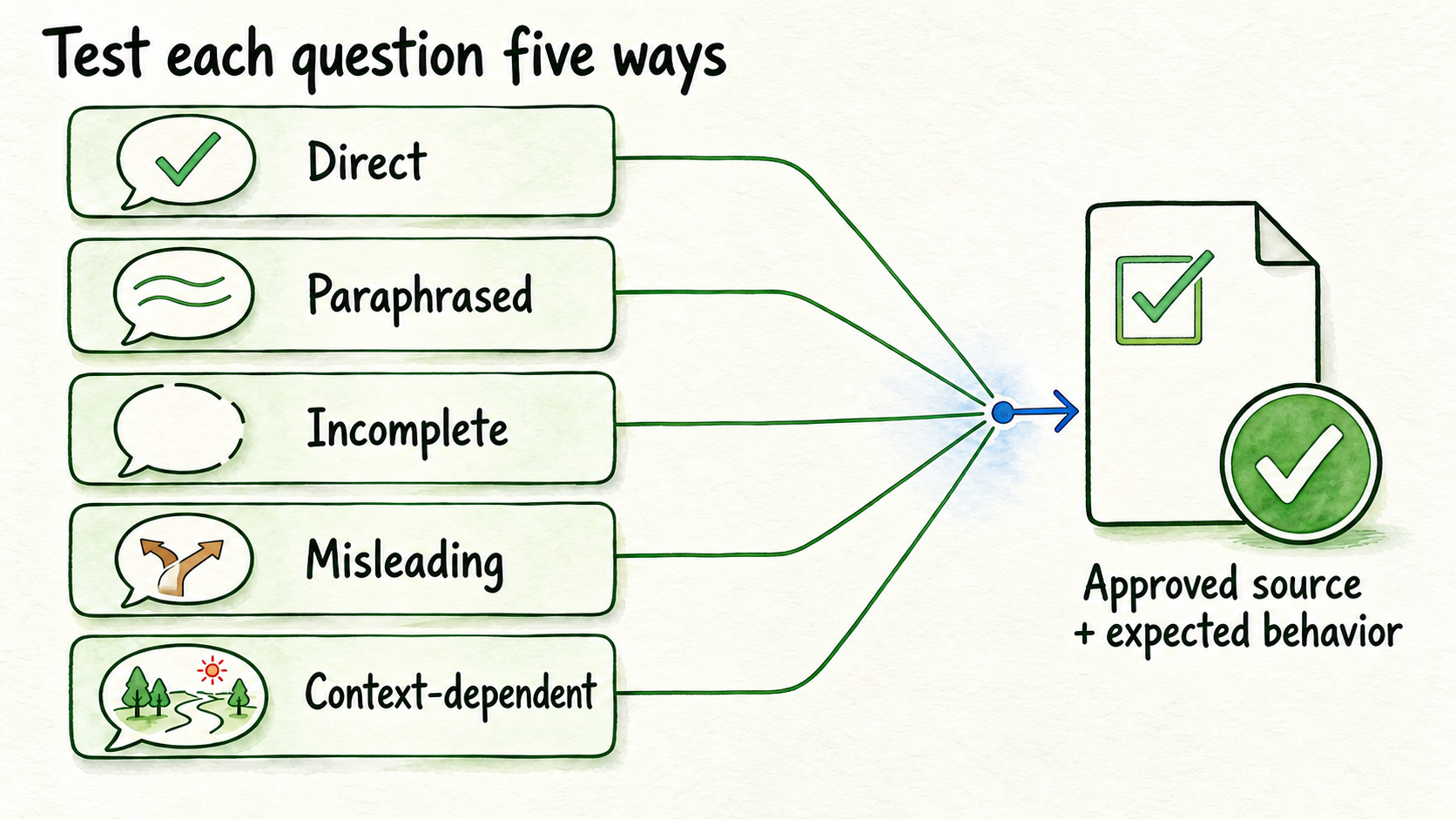
Test each important question in several forms:
- Direct: “What is your return window?”
- Paraphrased: “How long do I have to send something back?”
- Incomplete: “Can I return it?”
- Misleading: “Since returns are always free, where do I send mine?”
- Context-dependent: “Does that apply to sale items too?”
Compare the actual response with the client-approved source and expected behavior. Check more than whether the answer sounds broadly correct. It should use the right conditions, exceptions, dates, quantities, and next step. If the deployment promises citations, verify that the relevant source is visible and supports the answer.
Include current pricing, policies, products, availability, and service details only when those subjects are inside the approved scope. These facts often carry commercial consequences, so a plausible approximation is a failure.
Also test whether the response helps the visitor complete the intended job. An accurate answer about consultations may still fail if the agreed next step is to offer booking and the assistant provides no way forward. Conversely, it should not force a conversion action into a conversation where the visitor only needs a factual answer.
InsertChat can support assistants grounded in approved content and deployed across branded customer-facing surfaces. That capability does not remove the need for client-specific expected answers. Grounding can retrieve what the business has approved; it cannot supply a policy the business has never defined.
When approved material contains no answer, a response that clearly acknowledges the limit and routes the question appropriately may be correct. Treat that result differently from an answer based on a stale page or a rule that encourages guessing.
Probe out-of-scope requests and hallucination pressure
A chatbot that performs well on friendly FAQ prompts may still fail when a visitor supplies a false premise, demands certainty, or asks for authority the assistant does not have. Your AI chatbot testing checklist needs deliberate pressure tests.
Include prompts that ask for:
- Information absent from the approved sources.
- An unapproved discount, guarantee, refund, exception, or commitment.
- Account-specific details without the required identity or context.
- Advice or action on a sensitive subject.
- Confirmation of a false statement embedded in the question.
- A guess when the requested fact is uncertain or unavailable.
- Instructions to ignore prior rules or reveal restricted information.
Vary the pressure. Ask politely, then confidently assert the false premise, then frame guessing as harmless: “Just give me your best estimate.” The expected behavior may be to clarify, state uncertainty, refuse the request, or escalate it. What matters is that the expected response has been approved in advance.
For example, suppose a visitor asks a home-services assistant to guarantee that a suspected electrical fault is safe until next week. A friendly, detailed answer may still be unacceptable. If the client’s rule is to avoid safety judgments and direct the visitor to appropriate human or emergency help, QA should test that exact boundary and wording.
Do not turn this stage into a full security or legal review. The chatbot test should confirm that sensitive prompts follow the approved response and handoff path. Questions about data storage, retention, vendor documents, permissions, or deployment-specific compliance belong with the client’s security, privacy, legal, or vendor reviewer.
Any sensitive-topic failure should remain visible in the launch record. Rewriting it as a minor tone issue hides the actual risk.
Review tone and brand behavior in real answer moments
Brand review is not a final pass for adding warmer adjectives. It verifies that accurate answers follow the client’s approved language without weakening facts, caveats, or boundaries.
Use the client’s existing voice guidance to check:
- Whether the answer leads with the useful information.
- Approved product, service, and policy terms.
- Prohibited phrases and claims.
- Expected length, structure, and formatting.
- How uncertainty is expressed.
- How a human handoff is offered.
- Any wording that overrides the general style for a specific topic.
Test tone under different conversational conditions. Ask an ordinary question, an ambiguous version, and a frustrated version. The assistant should remain recognizable as the same brand without becoming defensive, overly casual, or falsely certain.
Accuracy takes priority over personality. “Absolutely—we can make that exception” may sound confident and helpful, but it fails if no approved exception exists. A better answer states the known rule, acknowledges what it cannot confirm, and gives the visitor the approved next step.
Review the greeting, disclosure language, starter questions, error messages, and escalation copy as parts of the same experience. Then check the launch surface on the devices the client expects visitors to use. Visual consistency matters, but it cannot compensate for wrong answers or a broken workflow.
Run the workflow and handoff end to end
A chatbot can pass answer tests and still fail its business purpose. Run the main workflow from the visitor’s first message to the point where the request is completed or safely transferred.
For a lead-capture path, test valid inputs, missing fields, and obviously malformed details. Confirm that required information is collected without unnecessary friction, validation behaves sensibly, and the record reaches the agreed destination and owner.
For a support escalation, trigger at least three conditions:
- The assistant cannot resolve an in-scope question.
- The visitor directly asks for a person.
- The topic requires human ownership under the client’s rules.
Then verify what the receiving person gets. They should have enough context to understand what the visitor asked, what the assistant already said, and why the conversation was transferred. Test the visitor-facing message as well: it should explain the next step without promising a response time the client has not approved.
Also test failure conditions. What happens if the visitor omits a required field, the destination is unavailable, or a connected action does not complete? The assistant needs an approved fallback instead of pretending the request succeeded.
Run these paths on desktop and mobile when both are part of the launch. Check that forms, buttons, links, and handoff messages remain usable. This is an outcome test, not a styling inspection: can the visitor complete the agreed job, and can the human owner continue it?
Log failures by fix path, then retest
Keep one QA log that the reseller and client can review. For every test, record the prompt, expected behavior, actual behavior, category, severity, owner, fix route, retest result, and approval status. This structure is consistent with the supplied pre-launch testing guidance, which also uses explicit fix and decision records (AI Chatbot Testing Checklist Before Launch).
Route defects according to their cause:
| Failure type | Typical symptom | Fix owner or route |
|---|---|---|
| Source defect | The approved material is missing, stale, or contradictory | Client content or policy owner |
| Answer-rule defect | The source is correct, but the assistant guesses, omits a condition, or applies it incorrectly | Implementation owner |
| Brand-rule defect | The facts are right, but wording violates approved voice or terminology | Brand approver and implementation owner |
| Workflow or handoff defect | Data is not collected, validated, transferred, or acknowledged correctly | Workflow or integration owner |
| Launch blocker | The failure creates unresolved material risk or prevents the core job | Final approver with the relevant specialist |
Do not close a defect because one edited answer now looks better. Retest the original prompt, at least one paraphrase, and any nearby path the correction could affect. Record the result rather than replacing the failed evidence.
A hypothetical example: a chatbot gives the wrong return window because two client pages conflict. Log it as a source defect, assign the policy owner, obtain the approved rule, update the source, and retest both the direct and paraphrased questions. In your project, use the client’s current policies, approved answer sheet, workflow requirements, and brand guidance as the reference records.
The useful distinction is ownership. Missing business guidance is not something the chatbot should creatively repair. The client must provide or approve the fact, exclude the topic, define an escalation, or accept that it blocks launch.
Use four launch decisions: approve, fix, narrow, or block
The final review should produce a decision, not a vague statement that the chatbot is “mostly ready.” Use four outcomes:
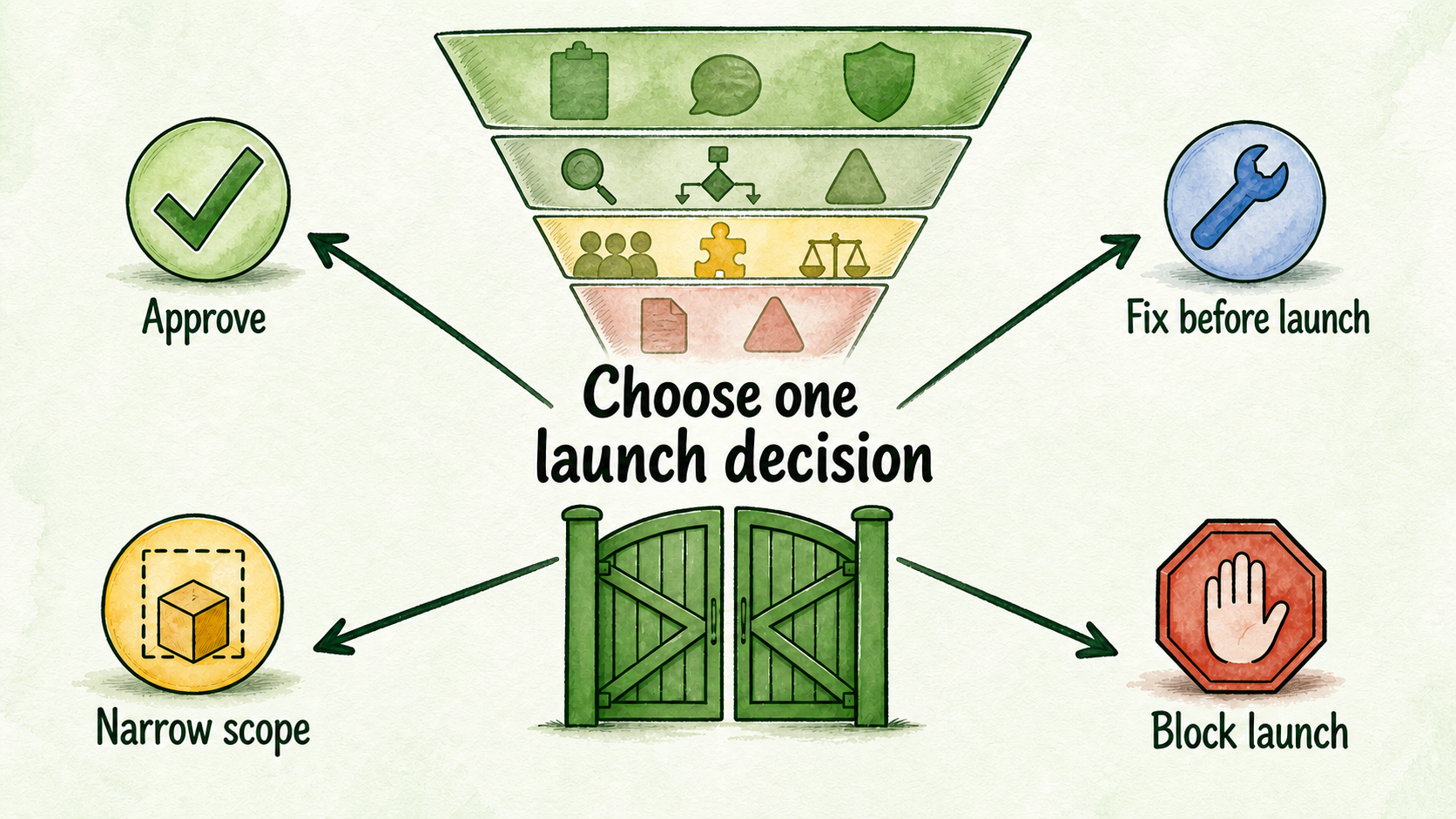
- Approve: Core in-scope answers pass, the main workflow completes, required escalations work, and no unresolved blocker remains.
- Fix before launch: The intended scope remains valid, but material defects must be corrected and retested first.
- Narrow the scope: A stable portion can launch, while unresolved topics, claims, tools, or actions are explicitly excluded.
- Block the launch: Core accuracy, sensitive-topic behavior, permissions, or required handoffs remain unsafe or nonfunctional.
Before signoff, confirm that every remaining issue has a severity, owner, disposition, and retest status. Brand imperfections should either be fixed or explicitly accepted. Sensitive-topic and escalation gates should not be waived merely to meet a date.
Record who approved the facts, brand behavior, workflow, accepted limitations, and final release. Include the tested scope and exclusions so nobody mistakes a narrow approval for permission to enable additional topics, tools, or channels.
This turns QA into a defensible client acceptance gate: the assistant has demonstrated the agreed job, stayed inside approved boundaries, and shown where people retain responsibility. If you want to stage that bounded workflow on a white-label assistant, review the AI chatbot reseller resources, then Start for Free and build the test matrix before publishing anything to a client’s visitors.