TL;DR
- The biggest AI chatbot reseller program red flags are unresolved contracting responsibility, uncontrolled variable costs, unclear client or account ownership, unsupported white-label promises, weak support escalation, unverifiable data handling, and missing exit or portability terms.
- A missing answer is not automatically disqualifying. Classify it as a research gap, caution signal, material red flag, or immediate stop condition according to the exposure it creates.
- Score severity by asking who is exposed, what could be lost, whether the harm is reversible, whether it will be detected before affecting the client, and whether the client can leave cleanly.
- Record every consequential issue with the evidence needed, mitigation, decision owner, status, and stop condition. An unresolved field must never become an approved client promise by default.
- Verify contained research gaps, use a bounded pilot only for isolated and reversible risks, pause onboarding for unresolved material risks, and walk away when a required protection is absent or cannot be documented.
A polished demonstration cannot compensate for obligations that the reseller cannot prove, price, control, detect, or unwind. Before exposing a client, require written evidence for every material promise and avoid converting vendor ambiguity into your own contractual, operational, or reputational commitment.
Key Takeaways
- Risk follows the exposed party. If the client suffers the interruption while the reseller owes the explanation, remediation, or refund, vendor ambiguity is a reseller risk.
- Written terms outrank verbal reassurance when billing, ownership, branding, support, data, or termination matters.
- Severity depends on impact and reversibility, not the number of unanswered questions. One hidden ownership or data issue can outweigh many minor feature gaps.
- Client onboarding should stop before an unresolved material risk becomes a proposal term, contract promise, configuration choice, data transfer, or live dependency.
Four levels: research gap, caution signal, material red flag, stop condition
Use four levels to distinguish ordinary due diligence from risks that should block a commitment.
- Research gap: Information is incomplete, but no current client promise, payment, data transfer, or operational dependency relies on it. Gather evidence before the issue becomes relevant.
- Caution signal: The ambiguity could matter, but it can be isolated while evidence is gathered. A restricted test may remain possible.
- Material red flag: The unresolved issue could cause meaningful client, financial, operational, brand, data, or exit harm. Do not expose a client until it is resolved or removed from the offer.
- Immediate stop condition: A required protection is absent, contradicted, unverifiable, or impossible to remediate before exposure. Do not contract, onboard, or launch within that scope.
A reseller program is a commercial arrangement under which a business offers a vendor-supported service to clients. A reseller agreement is the written set of rights and duties governing that arrangement. The contracting party is the legal entity buying or supplying the service, which may differ from the brand visible to the client.
A data processor handles personal data on another party’s instructions. Portability is the practical ability to export or transfer accounts, records, and operational continuity. Termination is the contractual end of the relationship. A stop condition is a specific unresolved fact that blocks approval, such as: “Do not promise a custom domain until the applicable entitlement is confirmed in writing.”
Score severity before deciding
Assess every warning against five factors:
- Client exposure: Has a client received a promise, paid money, supplied data, or made the service operationally important?
- Financial impact: Could the issue create unexpected usage charges, refunds, taxes, support labor, rework, or lost revenue?
- Reversibility: Can the decision be changed without disrupting the client, replacing infrastructure, or renegotiating a contract?
- Detectability before harm: Will the problem appear in a controlled test, or only after a bill, incident, missed escalation, or failed transfer?
- Exit difficulty: Can the client leave with the necessary accounts, knowledge, conversations, leads, domains, and continuity?
Ask five direct questions: Who is exposed? What can be lost? Can it be reversed? Will we know before the client is harmed? Can the client leave cleanly?
Higher exposure, impact, irreversibility, hiddenness, and exit difficulty require stronger evidence and an earlier stop. An unconfirmed domain entitlement may be a caution signal during internal evaluation. It becomes material if the domain has already been promised in a signed proposal.
Build a red-flag register
Put consequential concerns in a single decision record rather than scattering them across meeting notes and messages.
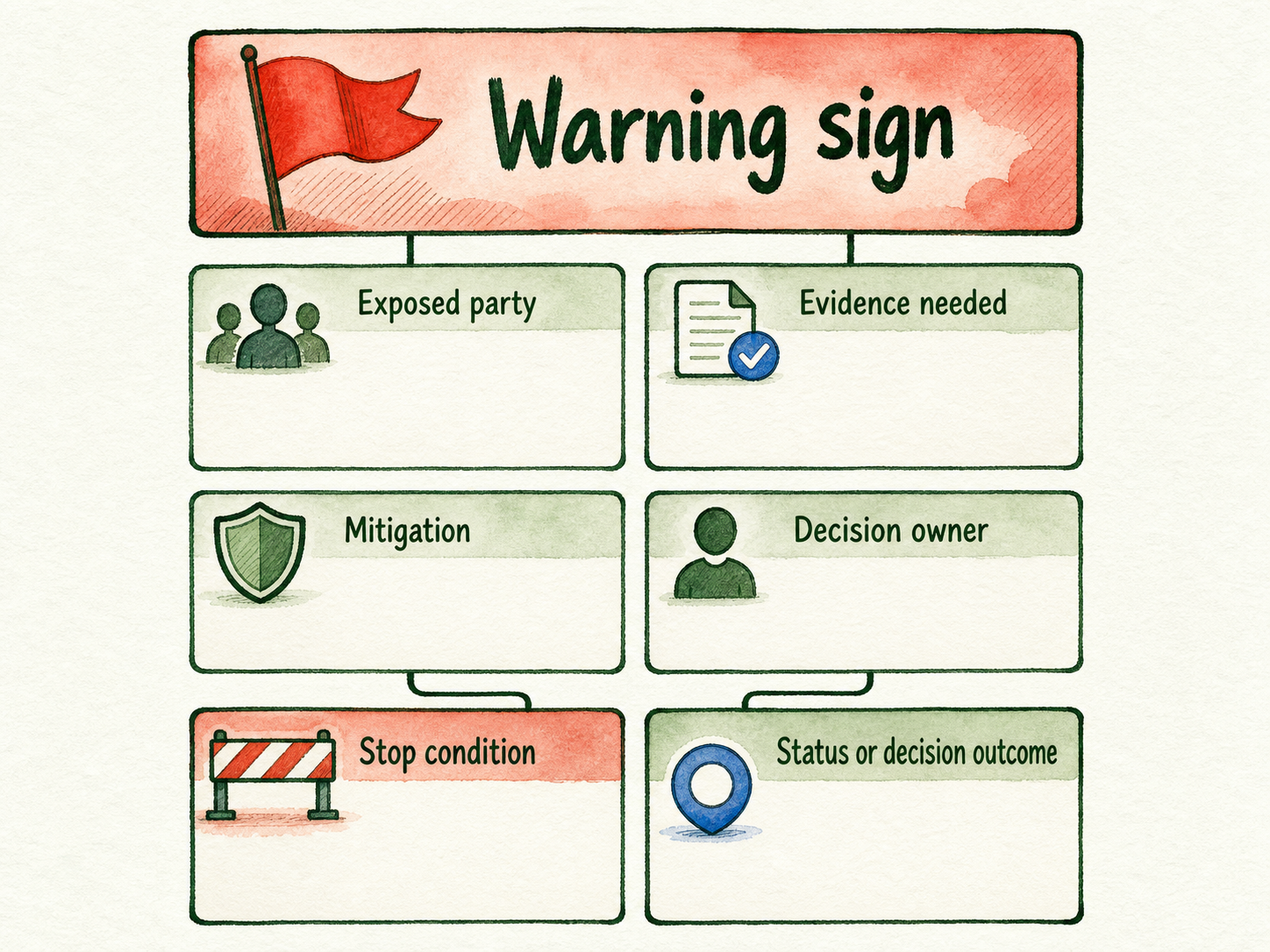
| Field | What to record |
|---|---|
| Warning sign | The specific ambiguity, conflict, or missing protection |
| Exposed party | Client, reseller, vendor, data subject, or another party |
| Evidence needed | Current plan term, contract clause, DPA language, billing rule, or written confirmation |
| Mitigation | Remove the claim, narrow the scope, cap exposure, change access, or delay launch |
| Decision owner | The person authorized to accept, remediate, or reject the risk |
| Stop condition | The fact that prevents contracting, onboarding, or launch |
| Status or decision outcome | Open, verified, mitigated, paused, rejected, or scheduled for review |
For an unclear custom-domain entitlement, the client and reseller are exposed. Current written plan terms are the evidence needed; removing the domain from the initial offer is a possible mitigation; the commercial owner makes the decision; and the stop condition is “No branded-domain promise without written entitlement.”
An open field cannot silently become an approved client promise.
Commercial red flags: obligations and costs nobody owns
A published subscription price is not complete reseller economics. The reseller must still establish whether it is authorized to resell, which entity contracts with the vendor, who invoices the client, and who absorbs variable charges.
Included usage, overages, refunds, taxes, payment disputes, commissions, discounts, and billing responsibilities all require written evidence when they affect the offer. An advertised discount or base price does not establish the reseller’s eventual margin or liability. Permitted sales claims matter too: the reseller should not promise plan entitlements, exclusivity, performance, or compliance language beyond what current written terms support.
Stop before selling if the reseller cannot identify who owes the vendor, who invoices the client, or who absorbs variable charges. If an uncertainty is genuinely containable, narrow the offer until the commercial terms are resolved.
Operational red flags: work and escalation without an owner
A functioning demo does not establish who performs onboarding, maintains connected sources, manages changes, or handles incidents after launch. Undefined work can become reseller workload precisely when the client needs a rapid answer.
Establish who receives, triages, escalates, communicates, and closes every issue. Separate client-facing support from platform support. Assign responsibility for source changes, integration failures, service incidents, restoration checks, and client updates.
Capacity becomes an exposure when the required work is unknown or unowned. Pause onboarding if neither reseller nor vendor is committed to investigate a platform incident, escalate it appropriately, communicate with the client, and confirm closure.
Brand and account-control red flags: the client relationship can be trapped
White-label capability is a presentation feature, not proof of legal ownership or durable control. Logo removal, color settings, custom domains, customer-domain email, branded portals, and client-scoped workspaces may exist without establishing who owns the client account or what happens after termination.
Verify client separation, visible vendor branding, logo and color controls, custom-domain entitlement, customer-domain email or SMTP entitlement, workspace access, administrative authority, billing visibility, account ownership, and transfer rights. Determine which party creates the workspace and whether administrative control can be reassigned without rebuilding the deployment.
A supported white-label entitlement is a current written right. An unsupported white-label promise is a reseller claim that goes beyond that evidence. A client-critical account that cannot be transferred on acceptable written terms may be a stop condition even when its interface appears fully branded.
Security and data red flags: assurances without a verifiable data path
Map the actual deployment rather than relying on broad security labels. For InsertChat, the available product descriptions state that prompts and relevant source-context excerpts go to the selected model provider. They also state that the platform stores configuration, connected sources, and conversation data used to provide the experience and analytics. A statement that customer data is not used to train shared models would not mean that no information is stored or sent to the selected provider.
The available trust wording also uses three distinct formulations: “SOC 2 Type II examined,” “GDPR/CCPA aligned,” and “HIPAA-ready.” These are not interchangeable. An examination describes an assessed control environment; alignment wording does not establish unconditional legal compliance; and “HIPAA-ready” is not a certification or proof that a particular deployment satisfies every applicable requirement. Each client deployment still needs a scoped contractual, technical, and legal assessment.
Obtain current evidence for retention and deletion, role-based access, workspace separation, encryption, subprocessors, the DPA, regional requirements, sensitive-data restrictions, and incident responsibilities. Confirm what each processor receives, who can access it, how long it remains, how deletion is completed, and whether the selected model provider’s terms fit the intended data.
The direct gate is: can every processor, data flow, access path, retention rule, deletion step, and regional requirement be evidenced for the scoped deployment? If not, exclude sensitive data or pause the deployment.
Exit red flags: cancellation is not continuity
“Cancel anytime” addresses the ability to end a subscription or billing relationship. It does not prove portability or operational continuity.
Before launch, confirm termination rights, export availability and format, deletion steps and timing, account transfer, conversation-history handling, lead-record handling, domain changes, post-cancellation access, and the client’s ability to continue operating. Determine what remains accessible, what must be migrated, and which party performs each action.
Stop if a client-critical deployment cannot be transferred, exported, or wound down under acceptable written terms. Cancellation language alone cannot answer those questions.
Worked application: evaluate InsertChat without filling the gaps
A defensible InsertChat evaluation separates current, directly reviewable evidence from conflicts and unanswered contractual questions. It should record the review date because pricing, packaging, security descriptions, and contractual terms can change.
Review these four exact records:
- InsertChat pricing: verify the current price, included usage, usage warnings, limits, billing rules, cancellation language, and plan entitlements. Available evidence does not validate a current Agency price or settled allowance, so neither should be quoted to a client until this page is reviewed and recorded.
- InsertChat partnership: determine whether a current reseller arrangement or agreement exists and verify the contracting party, permitted sales claims, billing duties, refunds, taxes, discounts, commissions, and application terms. White-label or resale capability alone does not establish these commercial terms.
- InsertChat security: verify the current descriptions of data flows, access controls, encryption, regional options, examination or assurance language, and sensitive-data boundaries. Compare the page with the proposed configuration, including the selected model provider.
- InsertChat DPA: verify processor obligations, subprocessors, deletion or return provisions, termination language, and other deployment-specific duties. DPA availability does not establish the contents or suitability of the current document.
The working register should retain two packaging conflicts until the pricing record resolves them. One description gives the Agency assistant limit as 20, while another gives it as 150. Custom domains are described both as an Agency inclusion and as a typical enterprise option. Neither entitlement should appear in a client proposal while the conflict remains open.
The commercial register should also remain open for the reseller agreement, contracting structure, commissions, discounts, taxes, refunds, and permitted claims unless the partnership record or signed terms answer them. Separate open entries are required for support escalation, account transfer, export formats, conversation and lead portability, retention periods, deletion timing, and post-cancellation continuity.
The bounded conclusion is that the described platform capabilities may justify further evaluation or a non-sensitive pilot. They do not justify presenting unverified pricing, packaging, reseller rights, compliance conclusions, support commitments, or exit rights as settled facts. Any pilot should exclude conflicting entitlements and prevent unresolved terms from becoming client promises.
Choose one decision—and record what would change it
Match the outcome to the evidence threshold:
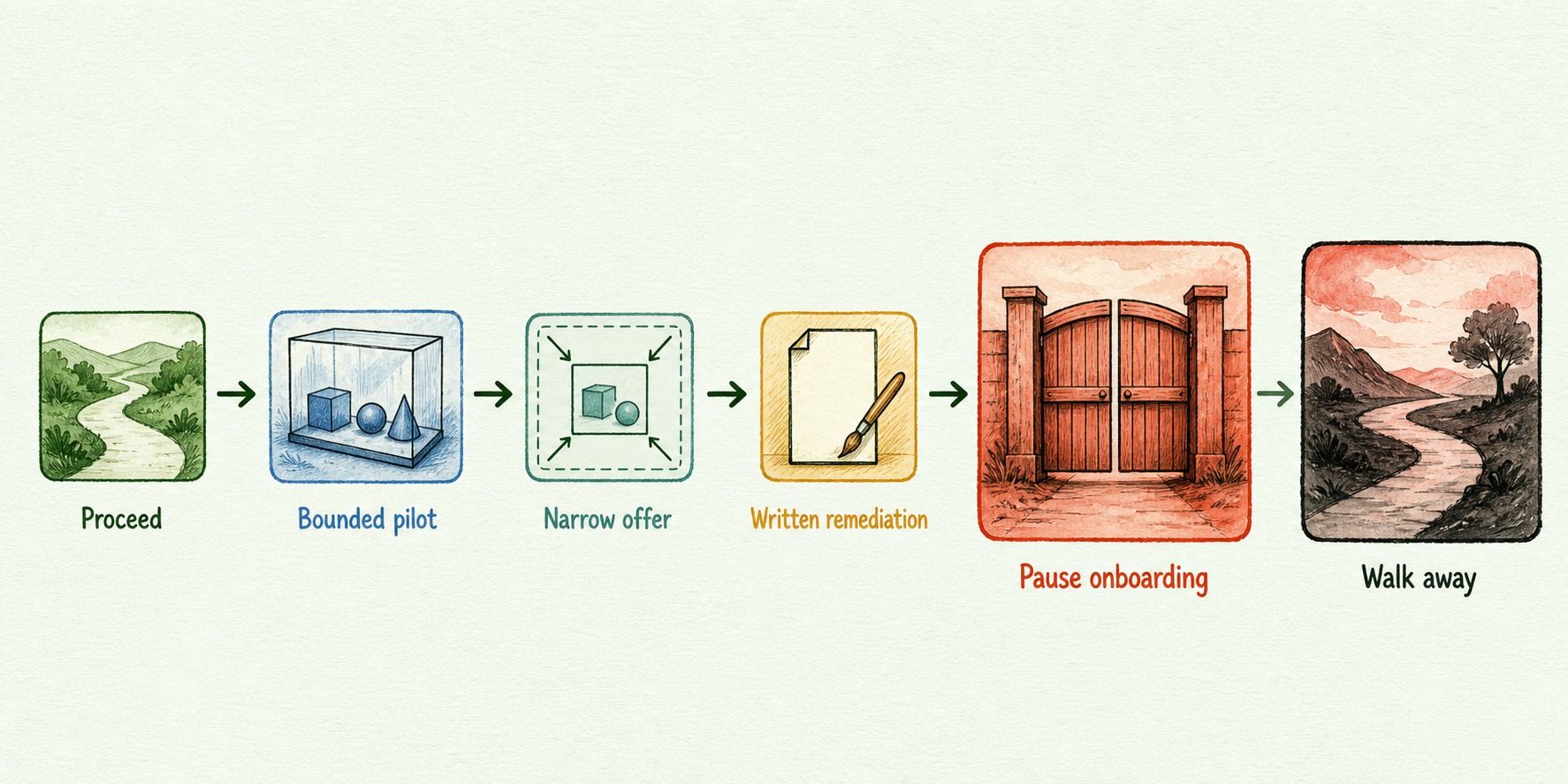
- Proceed: Material obligations are documented, conflicts are resolved, responsible owners accept the remaining low-level risks, and no stop condition is open.
- Proceed with a bounded pilot: The workflow uses non-sensitive data, unresolved issues are isolated from clients, exposure is limited and reversible, and a named owner can stop the test.
- Narrow the offer: Remove unverified branding, domains, integrations, service levels, usage promises, or sensitive-data handling from the scope.
- Request written remediation: Require a contract amendment, entitlement confirmation, DPA clarification, support commitment, billing rule, or transfer provision.
- Pause client onboarding: Use this when an unresolved material issue affects a promise, data transfer, payment, or operational dependency about to go live.
- Walk away: Reject the arrangement when a required protection is absent, the vendor will not document it, the exposure cannot be contained, or the client cannot exit cleanly.
Record a named decision owner for every outcome. Add a review date or triggering condition and state exactly what would change the decision, such as a specified document, resolved entitlement conflict, completed mitigation, usage threshold, or contractual commitment.
FAQ
What are the biggest AI chatbot reseller program red flags?
The largest are unclear reseller and contracting responsibility, uncontrolled usage costs, uncertain account ownership, unsupported white-label claims, unowned support escalation, unverifiable data handling, and missing portability or termination terms. They become serious when they expose a client or create harm that is difficult to detect, reverse, or escape.
Is every unanswered vendor question a red flag?
No. A minor unanswered detail without current exposure is a research gap. It becomes a caution signal or material red flag when a price, promise, client workflow, sensitive dataset, or exit path depends on the answer.
What must be in writing before involving a client?
Document the reseller role, contracting party, billing responsibility, relevant usage exposure, promised entitlements, client account ownership, support escalation, applicable data-processing terms, termination rights, and portability. Any client-critical stop condition should also be explicit.
When is a bounded pilot appropriate?
Use one only when unresolved risks can be isolated, the workflow avoids sensitive data, no unsupported term is promised to a client, exposure is limited and reversible, and a named owner can stop the test. A pilot is not a substitute for contractual evidence required before production use.
When should a reseller walk away?
Walk away when a required protection cannot be verified or remediated before exposure, a material obligation has no owner, the vendor will not document a necessary term, or a client-critical deployment cannot be transferred or wound down acceptably.
Does white-label capability prove client account ownership or transfer rights?
No. Branding controls show what users may see. They do not establish who legally owns the workspace, data, domain configuration, email configuration, administrative access, or the right to transfer the account after termination.
How should conflicting plan entitlements be handled?
Record each conflicting statement, identify the current written evidence needed, and exclude the disputed entitlement from proposals and contracts. Do not choose the more favorable interpretation without authoritative written confirmation.
Why is “cancel anytime” not enough evidence of portability?
Cancellation may only end billing. Portability requires separate evidence for exports, formats, account transfer, conversation history, lead records, deletion, post-cancellation access, and continuity. Without those terms, a client may be able to cancel yet still be unable to leave cleanly.