TL;DR
- Chatbot service unit economics includes acquisition, setup, platform, usage, maintenance, support, reporting, renewal, and offboarding—not just the difference between client revenue and a software subscription.
- Calculate contribution with your own billing, usage, labor, and delivery records. If an input is unknown, keep it visibly unknown until you can measure it.
- Model support burden as events: launches, content changes, QA reviews, escalations, reports, and meetings multiplied by their observed handling time.
- Use an admission gate before accepting work, then replace sales assumptions with observed evidence during recurring profitability reviews.
- Keep, re-scope, reprice, pause expansion, or offboard according to the cause of the problem. There is no universal target margin, utilization rate, or support allowance.
A client assistant can show a healthy subscription spread while quietly consuming that spread through content changes, quality checks, escalations, meetings, and renewal work. The operating question is therefore not simply, “Does revenue exceed the platform fee?” It is, “Does this account make an acceptable contribution after its full workload, and can the portfolio deliver it without consuming the capacity needed for existing clients?” The system below answers that question while leaving unmeasured inputs visible instead of filling them with convenient assumptions.
Key Takeaways
- Contribution is not subscription markup. It changes when account-specific usage, labor, fees, and setup recovery are counted.
- Support demand becomes manageable when it is recorded as work-triggering events rather than hidden inside a vague monthly allowance.
- An account should pass an operating-readiness gate before it enters the delivery portfolio.
- Live account evidence should replace forecast assumptions as conversations, changes, escalations, and outcomes accumulate.
- Expansion is defensible only when forecast workload fits inside available capacity after an explicit buffer.
Define the account before measuring it
For this model, the unit is one client assistant: the bounded assistant, approved sources, workflows, tools, handoffs, review work, and service obligations managed for one client. An AI chatbot reseller may manage several assistants for one client, but each should remain separately visible when its workload, usage, or owner differs materially.
Use the following terms consistently:
- Contribution margin: account revenue remaining after the costs that vary with or are allocated to that account.
- Account profitability: contribution after the labor and lifecycle obligations included in your chosen economic view.
- Support burden: the volume and cost of events that require human attention.
- Utilization: the share of available delivery time already committed to account work. Set its treatment from your own staffing records rather than an industry benchmark.
- Capacity buffer: hours deliberately withheld from new commitments to absorb variance, leave, incidents, and uneven demand.
- Renewal: the commercial and operational work required to continue an account.
- Offboarding: the work required to end service responsibly, such as access changes, data handling, documentation, and client communication under the applicable agreement.
Keep three layers separate. Cash cost tells you what leaves the business. Labor demand tells you which people and hours the account consumes. The economic output combines those records according to a documented policy so accounts can be compared consistently.
Map the full account lifecycle
Build one row for every proposed and live account. Give each field an owner, source of truth, and status such as measured, allocated, provisional, or missing.
| Lifecycle area | What belongs in the account record | Cost behavior |
|---|---|---|
| Acquisition | Sales calls, discovery, proposal effort, paid acquisition, and deal-specific presales work | Usually one-time |
| Setup | Source preparation, configuration, branding, testing, deployment, training, and initial coordination | Usually one-time |
| Platform | The account’s documented share of subscriptions, seats, assistants, or shared infrastructure | Recurring or allocated |
| Usage | Conversation, model, credit, telephony, tool, provider, or overage costs tied to activity | Variable |
| Maintenance | Approved-source changes, prompt changes, workflow updates, retesting, and access administration | Recurring or event-driven |
| Support | Inbox review, questions, troubleshooting, escalation, and coordination | Event-driven |
| Reporting | Analysis, report preparation, explanation, and client discussion | Recurring |
| Renewal | Review, negotiation support, diligence refresh, and operational recommitment | Periodic |
| Offboarding | Access removal, exports or deletion work where applicable, documentation, and transition communication | One-time exit work |
Do not force every shared platform cost into an arbitrary equal split. Choose an allocation rule that reflects how your portfolio consumes the resource—for example, usage, assistants, seats, or an equal base allocation—and apply it consistently. A documented imperfect rule is more useful than changing the allocation whenever an account looks unattractive.
Acquisition cost, labor rates, support frequency, churn, and client lifetime value must come from your own records. Until they do, they are missing decision inputs, not market facts.
Calculate four decision outputs
Use symbols or values from your own billing, finance, platform, and time records. The formulas organize evidence; they do not supply an acceptable target.
1. Contribution per account
Contribution = collected account revenue − account-variable cash costs − allocated shared costs
Variable cash costs may include usage, provider charges, payment fees, refunds, and account-specific tools. Apply taxes and pass-through charges according to your accounting policy.
2. Setup-cost recovery
Setup recovery periods = unrecovered setup cost ÷ positive recurring contribution available for recovery
This output is valid only when the denominator is positive. If no recurring contribution remains for recovery, the setup cost is not being recovered under the current economics.
3. Support-adjusted profitability
Support-adjusted contribution = contribution − observed recurring labor cost − setup-recovery charge − other account-specific lifecycle costs
Calculate labor cost as recorded hours multiplied by your role-specific internal labor cost. Do not substitute a generic agency rate.
4. Portfolio capacity
Usable capacity = available delivery hours − committed hours − chosen capacity buffer
Forecast account demand = Σ(expected event count × observed handling time)
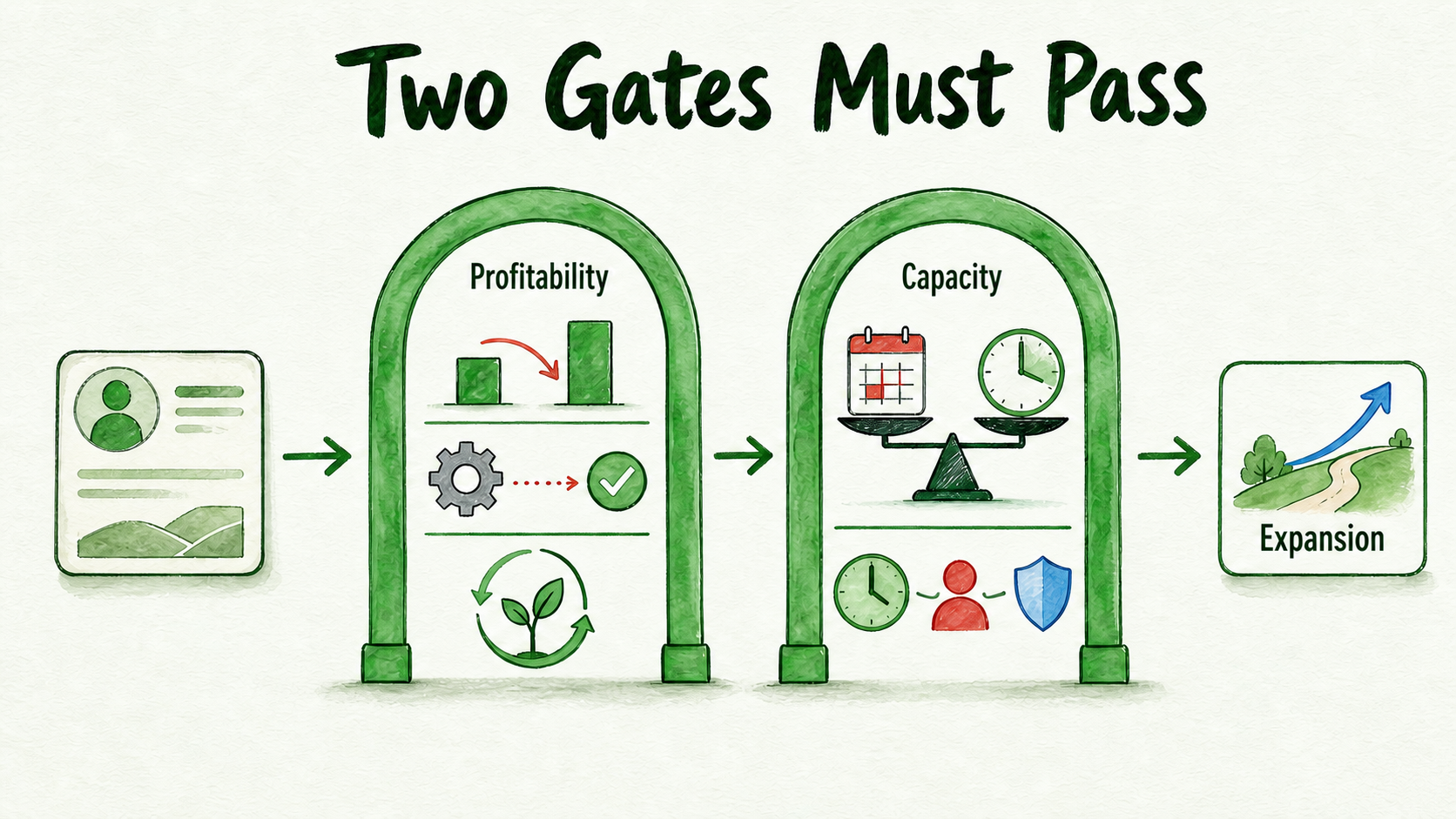
An account can make a positive contribution and still be unsuitable for expansion if it requires skills or hours the portfolio does not have. Profitability and capacity are separate gates; both must pass.
Convert service events into capacity demand
A flat support allowance hides the mechanism that creates work. An event model makes it visible.
Track at least these event classes:
- launches and major releases;
- approved content changes;
- QA reviews and retests;
- escalations and human handoffs;
- recurring reports;
- client meetings;
- renewal reviews; and
- offboarding tasks.
For each class, record event count, hands-on time, waiting or coordination time when it consumes staff capacity, responsible role, and cause. Then multiply observed frequency by observed handling time.
Consider a hypothetical account with one launch, several approved content changes, scheduled QA, escalations, a report, and a client meeting during the review period. The lesson is not the number of events; it is that each event has a different owner and cost. Use your ticket history, calendars, time records, change logs, and conversation records to replace the hypothetical pattern with reality.
Add forecast event demand across every account, then compare it with usable capacity. Pause growth when forecast demand exceeds usable capacity or when missing records make the forecast too weak to defend. A full calendar is not evidence of efficient utilization if urgent work has nowhere to go.
Use an account admission gate
The admission gate asks whether work is ready to enter the portfolio. It is not a quote stress test or a substitute for contract, privacy, or legal review.
Before admission, require a defensible answer to six questions:
- Is the workflow clear? Define the assistant’s bounded visitor or client job and what it will not do.
- Is the content ready? The client must provide current, approved material for the promised answers. Disputed or absent guidance cannot be repaired by the assistant.
- Is the support boundary named? Identify what triggers human escalation, who owns it, and which changes create additional work.
- Has proportionate diligence occurred? Review the proposed data, access, tools, providers, retention needs, and deployment environment with the appropriate stakeholders.
- Can the account be measured? Name the operational signals, outcome evidence, data owner, and review cadence before launch.
- Is expected contribution positive? Use measured inputs where available and label provisional inputs clearly. Missing labor or usage cost prevents a confident decision.
The possible outcomes are practical: admit the bounded account, narrow it to a workable first job, verify unresolved inputs, or decline it. For example, a client with a clear FAQ use case but disputed policies could narrow the first release to approved public information rather than pushing unresolved claims into production.
Run a recurring profitability review
After launch, compare the plan with observed reality. The review should explain variance, not merely report activity.
For each account, compare:
- collected revenue with planned revenue;
- allocated and variable costs with the original assumptions;
- planned event counts with observed launches, changes, QA work, escalations, reports, and meetings;
- planned labor with recorded labor by role;
- expected conversations with actual demand and usage;
- source-quality issues with the content changes required to resolve them;
- expected handoffs with observed escalations and their causes; and
- claimed outcomes with attributable evidence, where that evidence exists.
Separate volume from difficulty. More conversations may create little work when answers are stable, while a smaller number of policy-sensitive conversations may trigger repeated review and escalation. Likewise, analytics can reveal weak answers or recurring content gaps, but the client still has to approve the business guidance needed to resolve them.
Assign one owner to the economic review and select a cadence based on account risk, change volume, and cost volatility. A new or unstable account may need closer observation than a mature, bounded assistant. At renewal, use the accumulated record to decide what the next service period can responsibly include.
Choose the smallest defensible intervention
Match the action to the cause instead of treating every unfavorable variance as a pricing problem.
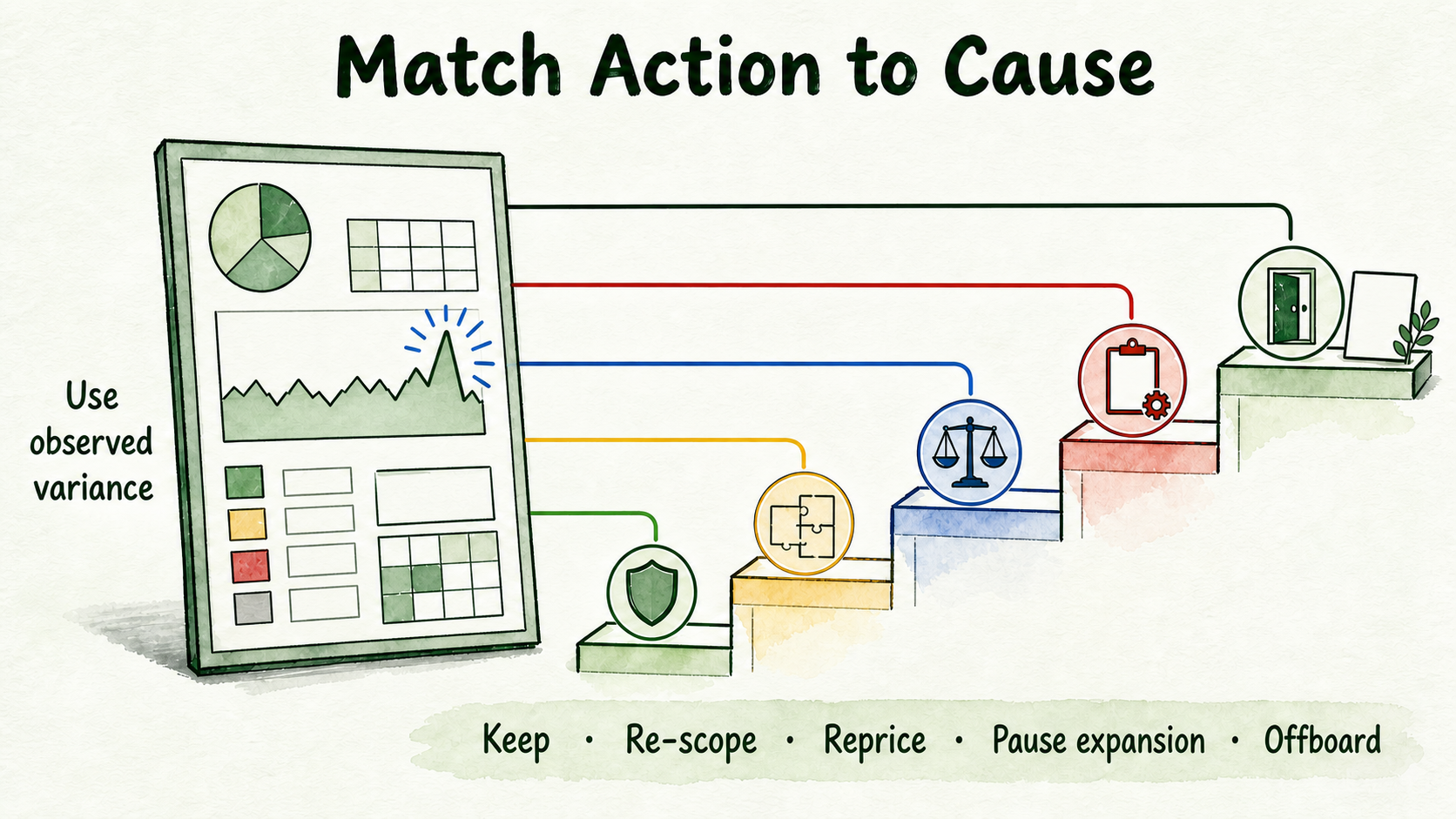
- Keep the account unchanged when contribution, workload, ownership, and outcomes remain inside your documented operating limits.
- Re-scope when demand comes from new channels, tools, workflows, content volume, or support responsibilities outside the bounded job.
- Reprice when persistent in-scope usage or delivery effort invalidates the assumptions behind the current price while the service remains useful and operable.
- Pause expansion when the capacity buffer is consumed, required records are unreliable, or the first workflow is not stable enough to support another channel or account.
- Offboard when a viable scope and contribution cannot be restored, essential ownership remains absent, or the account cannot be operated within the required controls.
Document the evidence, action owner, effective date, and next review. Repricing and offboarding must follow the applicable agreement and professional advice; an operating model does not determine contractual rights.
Use break-even as a checkpoint
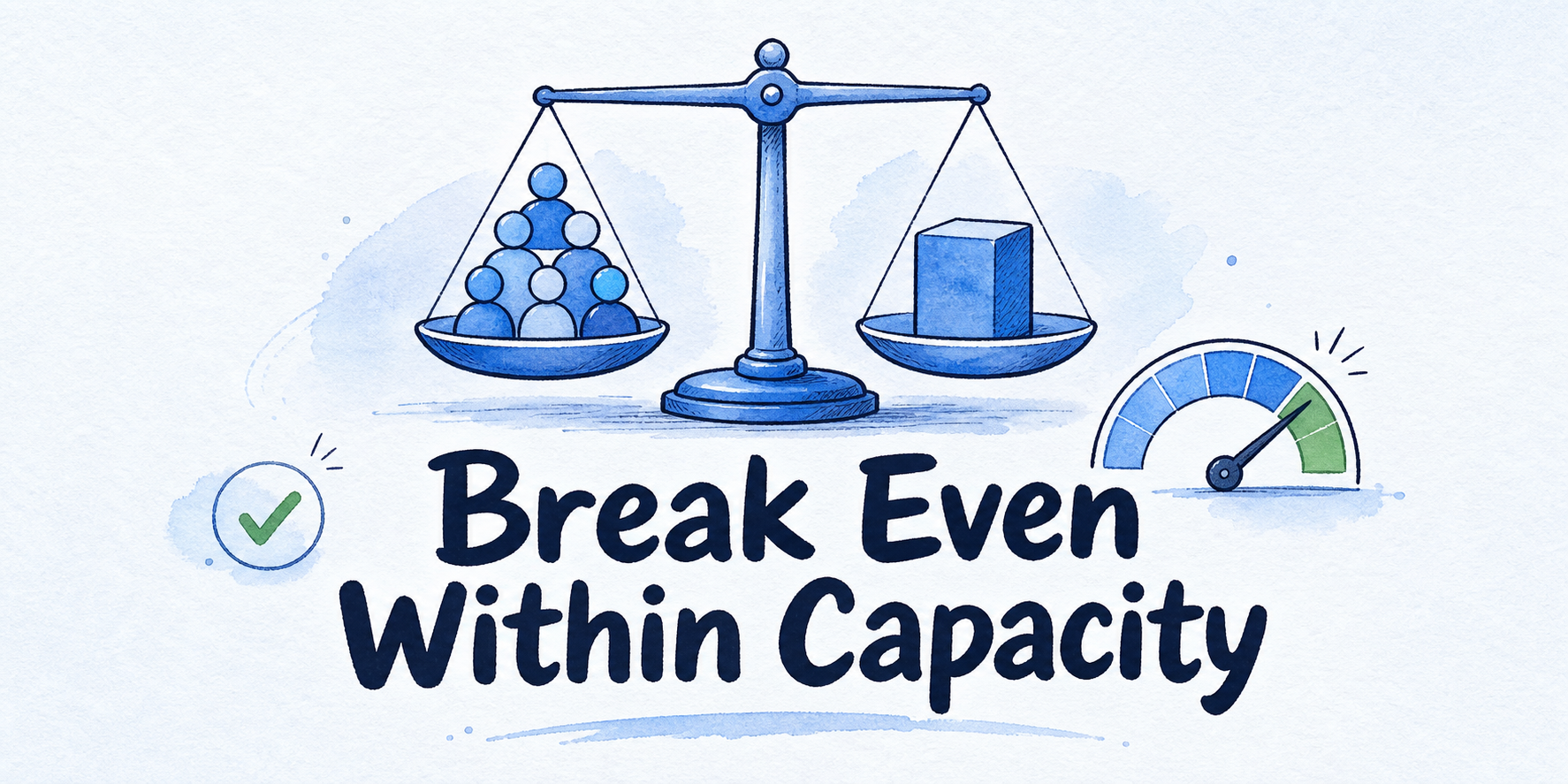
Break-even matters only when contribution per account is positive and the workload associated with the required accounts fits measured capacity. It can show how much contribution must cover a fixed cost, but it cannot tell you whether content is ready, escalation ownership is clear, or the portfolio can absorb uneven demand.
For the detailed calculation sequence, use the guide to calculate labor-adjusted break-even and capacity. Keep that arithmetic as a supporting checkpoint inside this broader account operating system.
Map InsertChat options to operating responsibility
When evaluating InsertChat for a reseller portfolio, treat every enabled delivery option as both a client capability and an operating obligation. Branded assistants create presentation and configuration work. Approved sources create content ownership and change-control work. Team permissions create access-review work. A conversation inbox creates review, assignment, and escalation responsibilities.
Apply the same logic to analytics, workflows, and tools. Conversation and source-use evidence can support profitability reviews, but someone must inspect the evidence and authorize changes. A booking, payment, order, or connected workflow may increase the value of the account while also adding testing, monitoring, failure handling, and security diligence. Model selection or routing may help control usage cost, but only measured provider and account records can show whether it does so in practice.
Do not base account capacity on an unconfirmed plan limit. Current packaging, assistant allowances, credits, custom-domain entitlement, usage charges, and cancellation terms should be checked before quoting or expanding a client. The operating record should distinguish confirmed entitlements from sales assumptions.
If the workflow, approved content, escalation owner, and measurement plan are already concrete, a bounded trial can provide the first event and usage records. Start for Free with one client job, then expand only after its economics and workload are visible.
FAQ
What belongs in chatbot service unit economics?
Include collected revenue and the full account lifecycle: acquisition, setup, allocated platform cost, usage, maintenance, support, reporting, renewal, and offboarding. Track cash costs and labor demand separately before combining them into a consistent profitability view.
How do resellers review client profitability?
Compare planned revenue, costs, event counts, and labor with observed billing, usage, conversations, changes, QA, escalations, meetings, and outcomes. Identify the variance that changed contribution or capacity demand, then choose the smallest intervention that addresses its cause.
When should a reseller stop adding accounts?
Pause when forecast workload plus the chosen capacity buffer exceeds measured available delivery capacity. Also pause when missing labor, usage, or support records make the forecast too uncertain to defend, even if the subscription spread appears positive.
How should unknown acquisition, labor, support, churn, or lifetime-value inputs be handled?
Leave them marked as missing until your sales, finance, time, ticket, and renewal records can support them. Do not replace them with a supposed typical rate. Contribution and capacity decisions can use the evidence available, but their confidence should reflect what remains unknown.
How is this different from a break-even calculator?
A break-even calculator answers how much positive contribution is needed to cover a defined cost. This operating system also tests readiness, event-driven workload, support burden, capacity, renewal evidence, and intervention choices—factors break-even arithmetic alone cannot settle.