TL;DR
- Run the AI chatbot pilot for your website on one visitor job and one controlled surface.
- Record the baseline and buyer-defined acceptance gates before testing.
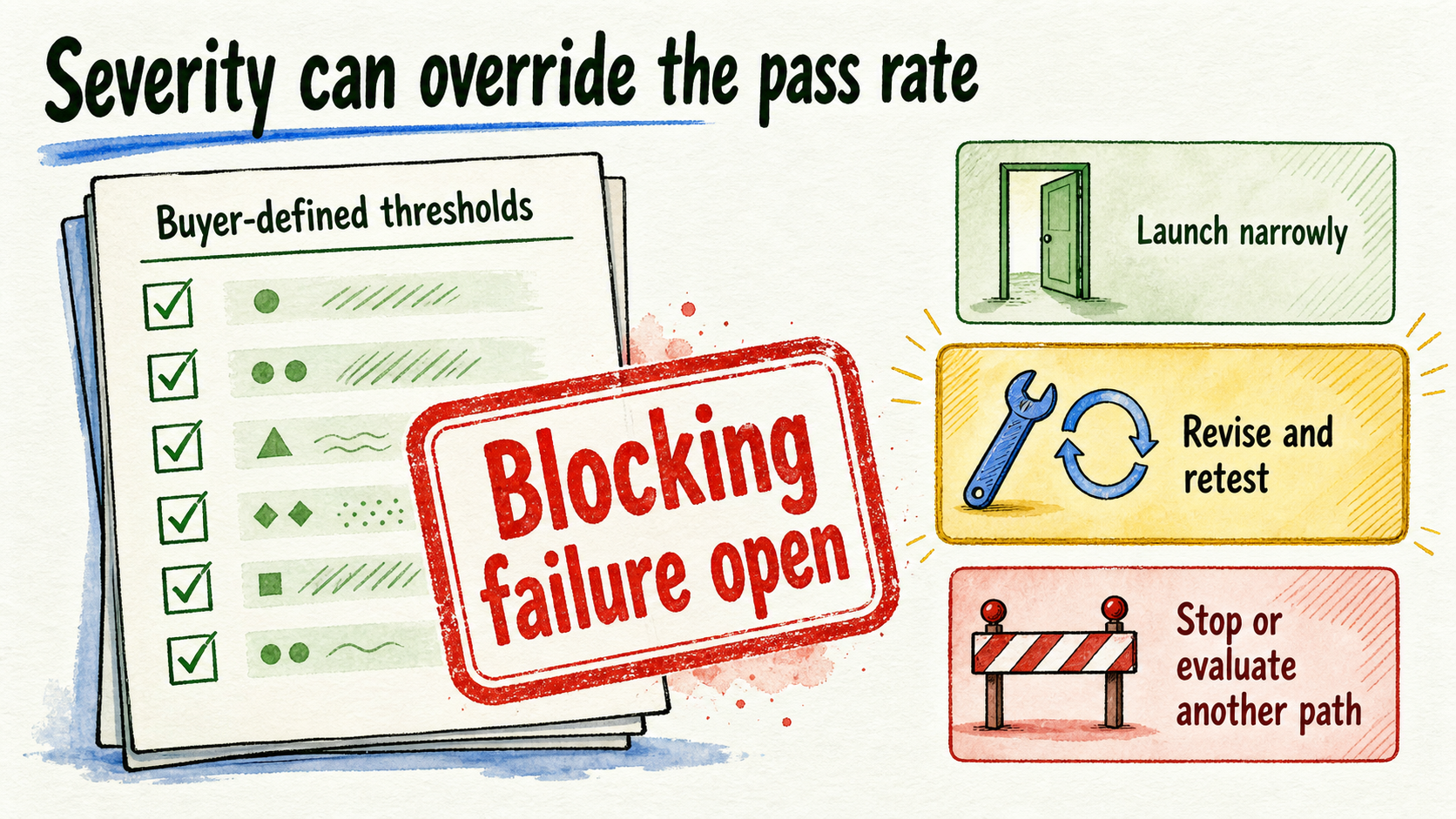
- Let severity override the pass rate when an unsupported answer, source conflict, or broken handoff could cause material harm.
- End with an explicit decision: launch narrowly, revise and retest, evaluate another path, or stop.
A staged assistant may answer routine service questions correctly, then quote an unsupported term from two conflicting pages or send a high-intent visitor to an unmonitored inbox. A bounded pilot turns that exposure into a practical pilot brief and a defensible deployment decision before the assistant reaches a broader audience.
Key Takeaways
- Record the cost of an unsupported answer, missed lead, failed handoff, and added review work before results can influence the thresholds.
- Treat stale, missing, sensitive, or conflicting content as a dependency. Assign each blocking conflict to a named owner.
- Define handoff as observable behavior: when the assistant stops, what it tells the visitor, which context it collects, where that context goes, and who receives it.
- Judge severe failures separately from aggregate success rates. A high pass rate cannot cancel an unresolved failure with serious business consequences.
- Include correction and review effort in the decision. A workflow that answers well but requires excessive supervision may need a narrower scope.
Define the pilot before configuring the assistant
Treat an AI chatbot pilot for a website as a controlled service experiment. It begins after you have selected a candidate platform and ends with an evidence-based deployment decision. It is not a vendor comparison, account setup tutorial, full QA certification, or sitewide release.
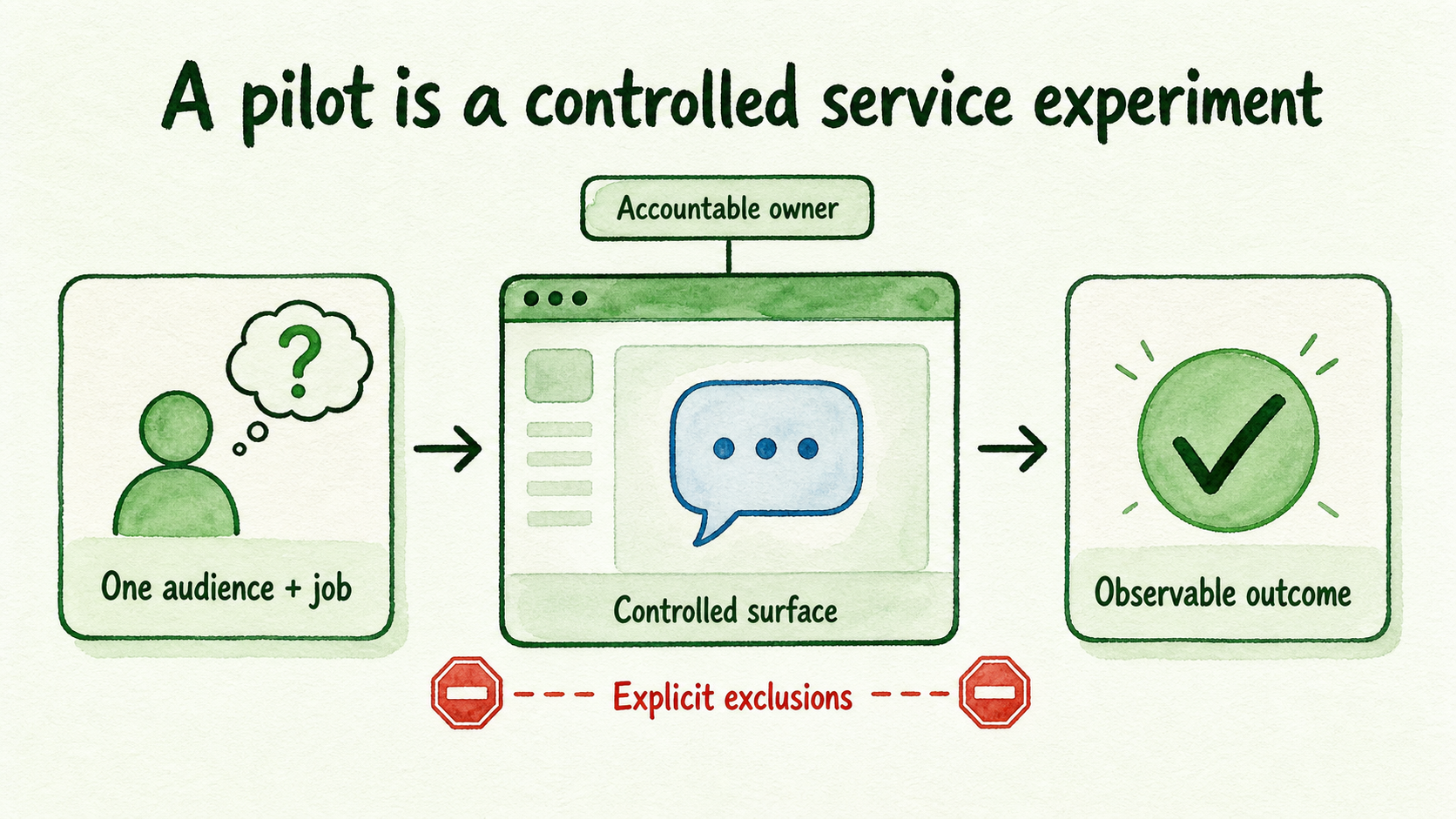
Create a short pilot plan with these fields:
- Audience: One visitor group, such as prospects comparing a specific service or customers seeking general policy information.
- Visitor job: One task the visitor wants to complete, such as checking service fit before requesting contact.
- Business outcome: An observable result, such as a qualified inquiry reaching the sales owner with useful context.
- Controlled surface: One service page, help section, hosted test page, or limited website entry point.
- Exclusions: Topics, decisions, audiences, channels, and actions outside the experiment.
- Owner: The person accountable for sources, corrections, handoffs, and the final decision.
- Review period: A defined test window or evidence checkpoint based on expected traffic and operational risk.
For an illustrative lead-capture pilot, the assistant might answer approved questions about one consulting service, collect contact details after the visitor expresses interest, and route suitable inquiries to sales. It would exclude custom pricing, guaranteed outcomes, availability promises, contract interpretation, and unrelated support questions.
A support pilot needs the same discipline. It could answer general return-policy questions from approved public material while sending account-specific cases, exceptions, disputed charges, and sensitive requests to a person.
The central tradeoff is coverage versus interpretability. Broad coverage may look impressive in a demonstration, but it adds sources, owners, exceptions, and failure paths. A narrow workflow produces evidence you can explain and act on.
Choose one workflow with five eligibility checks
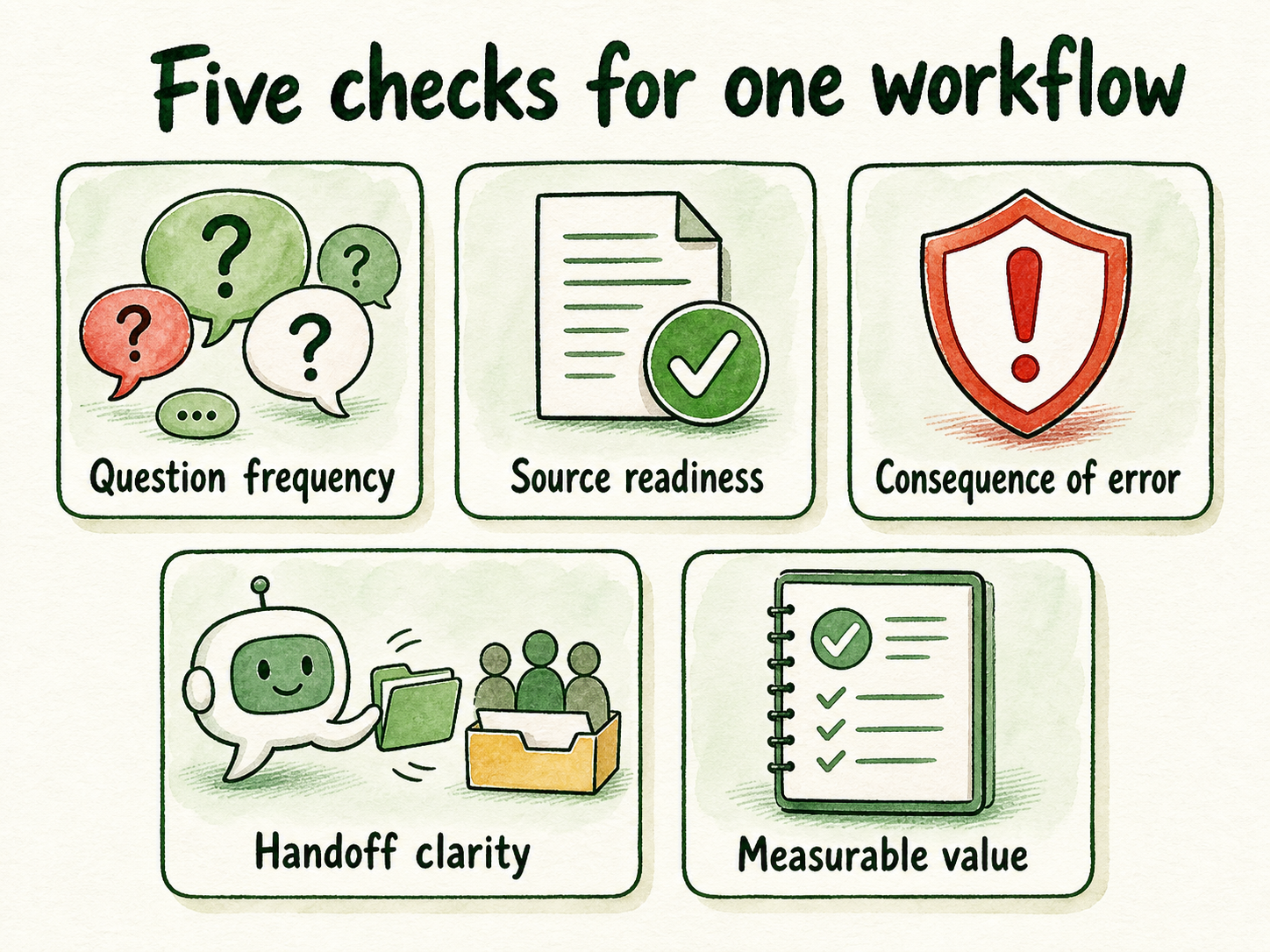
Apply five checks to the proposed workflow:
- Question frequency: Does the intended audience ask this type of question often enough to justify testing it?
- Source readiness: Can the assistant answer from current, approved material?
- Consequence of error: What happens if an answer is unsupported, incomplete, or wrong?
- Handoff clarity: Is there a person or queue that can act when the assistant stops?
- Measurable value: Can you observe a useful answer, completed handoff, qualified next step, or reduction in manual lookup work?
A service-question lead workflow may pass because prospects repeatedly ask about fit, the relevant service pages are approved, and sales can receive the conversation. An account-specific billing workflow may fail because it requires private information, exception handling, and judgment that public website content cannot support.
Higher automation coverage is not always the better choice. Earlier human handoff reduces the share of requests completed by the assistant, but it also limits exposure when errors could affect prices, policies, eligibility, accounts, or contractual expectations.
Do not compensate for weak readiness by adding more instructions. If the approved answer does not exist, narrow the workflow or assign the missing source to a business owner.
InsertChat describes its Assistant Builder as supporting answers from approved pages, documents, videos, product information, and support knowledge. Its Knowledge Base supports website pages, PDFs, documents, videos, FAQs, policies, and structured content. Those capabilities can support a bounded source-backed pilot, but they cannot decide which business statement is authoritative.
Record the baseline and acceptance gates
Measure the starting point before configuring the workflow. Otherwise, a busy conversation log can be mistaken for improvement even when the lead, support, or operating result remains unclear.
Record the buyer-owned inputs relevant to the selected workflow:
- Traffic to the controlled surface
- Current lead volume and the business definition of a qualified inquiry
- Current support volume, resolution behavior, or routing pattern
- Staff time spent answering, reviewing, correcting, or forwarding requests
- The operational or financial consequence of a missed lead, unsupported answer, privacy mistake, broken handoff, or delayed response
Mark estimates as estimates. If sales cannot verify follow-up outcomes or support cannot isolate the relevant request category, the pilot may still proceed. Any later improvement claim must remain limited by that uncertainty.
Next, define the measures and their user-defined thresholds:
- Answer usefulness for the intended visitor job
- Unsupported-answer failures
- Successful required handoffs
- Qualified next steps, such as usable lead records
- Unresolved questions
- Human review and correction work
Thresholds should reflect the workflow's failure cost. A business might tolerate a minor tone issue while refusing to launch with any unresolved unsupported claim about price, eligibility, policy, or availability. Another might require every tested handoff to reach the correct owner because a failed route could lose a high-value inquiry.
Do not lower a gate after seeing disappointing results. Correct the source, boundary, behavior rule, or route, then repeat the affected tests against the original decision rule.
Confirm source and handoff readiness
Create a small approved-source inventory for the selected workflow, not a company-wide content project. For each relevant page or document, record an owner and one status:
- Canonical and approved
- Stale
- Conflicting
- Sensitive
- Missing
- Excluded from the pilot
This inventory is a readiness check. It does not require you to solve every content problem inside the experiment. If two pages disagree about an offer condition, assign the conflict to the appropriate business owner and treat it as a revise or stop signal until one position is approved.
More source coverage can increase apparent breadth while adding contradictions. Fast deployment has little value if the assistant has to choose between competing policies. Canonical content should win that tradeoff.
Keep the handoff specification equally focused. Define:
- When the assistant must stop answering
- What it tells the visitor
- Which minimum context it collects
- Where the case goes
- How the team confirms that the destination received usable information
For a lead workflow, the minimum context might be a name, work email, service of interest, and short project summary. More fields can improve qualification, but each additional question creates visitor effort. Collect only information the receiving team will use.
For a support workflow, the assistant might stop when a request is account-specific, sensitive, disputed, or outside an approved policy. The visitor message should state that a person needs to review the request and explain the next step without making a response-time promise the team cannot support.
InsertChat states that its Assistant Builder can preserve the visitor's question and prior answer during human handoff. The platform can carry context, but the receiving owner, operating hours, and response process still belong to the buyer.
Run a representative conversation sample
There is no universal number of test conversations. Include enough variation to observe every material behavior and risk in the selected workflow:
- Common direct questions
- Natural paraphrases
- Requests with missing information
- Questions affected by conflicting sources
- Out-of-scope requests
- Sensitive or consequential requests
- The required lead or support handoff
For each failure, record the visitor question, observed answer, cited or expected source, failure type, severity, owner, correction, and retest result. Keep the record tied to the pilot decision. Broader pre-launch testing may require additional categories and release checks.
Severity matters more than raw volume. A harmless wording issue may need correction without blocking the experiment. An invented price, false policy statement, exposure of sensitive information, or broken required handoff may block launch immediately.
A large sample does not compensate for missing risk categories. Twenty variations of a common question tell you little about a workflow that has never faced missing information, a source contradiction, or an account-specific request.
Use a severity-based launch scorecard
A raw pass rate hides the difference between awkward wording and a false policy answer. Use a scorecard that combines buyer-defined thresholds with severity overrides.
| Decision area | Buyer-defined threshold | Observed result | Severity override | Decision |
|---|---|---|---|---|
| Useful in-scope answers | Set from workflow and baseline | Record pilot observation | Consequential unsupported answer remains open | Launch, revise, or stop |
| Unsupported-answer failures | Set from failure cost | Record count and examples | Any prohibited claim may block launch | Launch, revise, or stop |
| Required handoffs | Define destination and required context | Record delivery and usability | Broken required route may block launch | Launch, revise, or stop |
| Qualified next steps | Define a usable lead or support outcome | Record observed result | Misleading qualification may require narrowing | Launch, revise, or stop |
| Unresolved questions | Define tolerated categories | Record themes and owners | Material source conflict remains open | Launch, revise, or stop |
| Review workload | Define available owner capacity | Record review and correction effort | Required work exceeds available ownership | Launch, revise, or stop |
Apply three gates:
- Launch narrowly when required paths meet the buyer's thresholds, no blocking failure remains, and an owner can support the limited deployment.
- Revise and retest when failures have identifiable source, boundary, behavior, or routing corrections.
- Stop or evaluate another path when consequential behavior remains unreliable, required capabilities do not fit the workflow, or operating effort exceeds the value being tested.
Consider the illustrative service lead pilot. The assistant answers common service questions and captures the buyer-selected fields: name, work email, service of interest, and a short project summary. It routes the record to sales without promising price, timing, availability, or results.
During testing, a visitor asks whether the service includes expedited delivery. One service page says it does, while another says availability requires review. The assistant gives an uncertain answer based on the first page. The lead reaches sales correctly, but the contradiction affects what the visitor may expect before contact.
The scorecard decision is revise, not launch. The content owner must approve one statement, correct or exclude the conflicting page, and repeat the original test plus close paraphrases. A successful handoff does not cancel a consequential factual failure.
Review limited live use and choose the next state
If the scorecard supports launch, keep the first release on the controlled surface for the agreed review period. Review conversations, source use, unresolved questions, handoff outcomes, qualified next steps, and the work required from the owner.
InsertChat's Visitor Analytics is described as capturing questions, answer outcomes, source use, handoff events, repeated questions, weak answers, unanswered moments, and content gaps. Its Launch Channels page describes reusing approved sources and answer behavior across hosted pages and website embeds. A team can therefore start on a limited surface before considering broader deployment.
At the checkpoint, choose one state:
- Expand when the workflow is stable, evidence is sufficient, and added coverage has ready sources and ownership.
- Maintain when the current scope works but expansion has not earned priority.
- Narrow when repeated failures cluster around a topic, audience, or action that should leave the workflow.
- Stop when serious failures, weak demand, broken handoffs, or review workload make the workflow unsuitable.
Low traffic requires caution. Use observed conversations and tested behavior rather than strong trend claims. Analytics may reveal a missing answer, but a business owner must supply and approve the underlying guidance.
Before acting on a commercial offer, verify InsertChat's current capabilities, pricing, limits, and trial terms on the evaluation date. If the available self-serve trial fits a narrow, non-sensitive web pilot, Start for Free and test only the defined workflow. Integration-heavy, phone, security-reviewed, procurement-led, or enterprise deployments may require a separately agreed evaluation path.
The experiment should end in a clear state: launch narrowly, revise sources or rules and retest, evaluate another path, or pause deployment. Do not expand the assistant merely because it can answer additional questions. Expand only when the next workflow has approved sources, an accountable owner, measurable value, and acceptable failure exposure.
FAQ
Is a free trial enough for a website chatbot pilot?
It can be enough for a narrow, non-sensitive workflow when sources, reviewers, and acceptance gates are ready before the trial begins. It may not provide enough live traffic or review time for a reliable trend, and it does not replace security, integration, or procurement review. InsertChat currently advertises a free trial on its homepage, but trial length, pricing, limits, and included capabilities can change. Verify them on the evaluation date before fixing the pilot window.
Should low website traffic stop a pilot?
No. Low traffic still permits controlled conversation testing and limited observation of real interactions. It does restrict claims about conversion, improvement, or recurring behavior. If the decision depends on stable rates, extend the evidence window or withhold that conclusion. Do not lower acceptance gates merely because the sample is small.
Can lead capture and customer support be tested together?
Usually not in the first pilot. They often use different sources, owners, destinations, failure costs, and success measures. Pick one visitor job and route the other outside scope. Combine them only when both share approved content, one accountable owner, a clear handoff boundary, and compatible acceptance gates.
Which current platform capabilities are relevant to the controlled test?
For InsertChat, the supplied current feature descriptions support testing answers from approved content through the Assistant Builder and source types listed for the Knowledge Base. They also support reviewing questions, answer outcomes, source use, handoffs, weak answers, unanswered moments, and content gaps through Visitor Analytics, plus reusing approved answer behavior across hosted and embedded surfaces through Launch Channels. Recheck these pages on the evaluation date because capabilities can change. Do not assume workflow routing, tool integrations, or conversation-inbox fields until their current product pages have been reviewed directly.
When should security or procurement review precede public testing?
Complete that review first when visitors may submit sensitive data, the assistant connects to private systems, deployment depends on particular hosting or retention terms, or the workflow creates contractual or regulatory obligations. Collect only the fields required for the defined outcome. Confirm how prompts and related context are handled by the selected model provider before exposing the assistant to public traffic.