TL;DR
- AI chatbot client offboarding is the controlled renewal, transfer, pause, or closure of an assistant service and its operational dependencies.
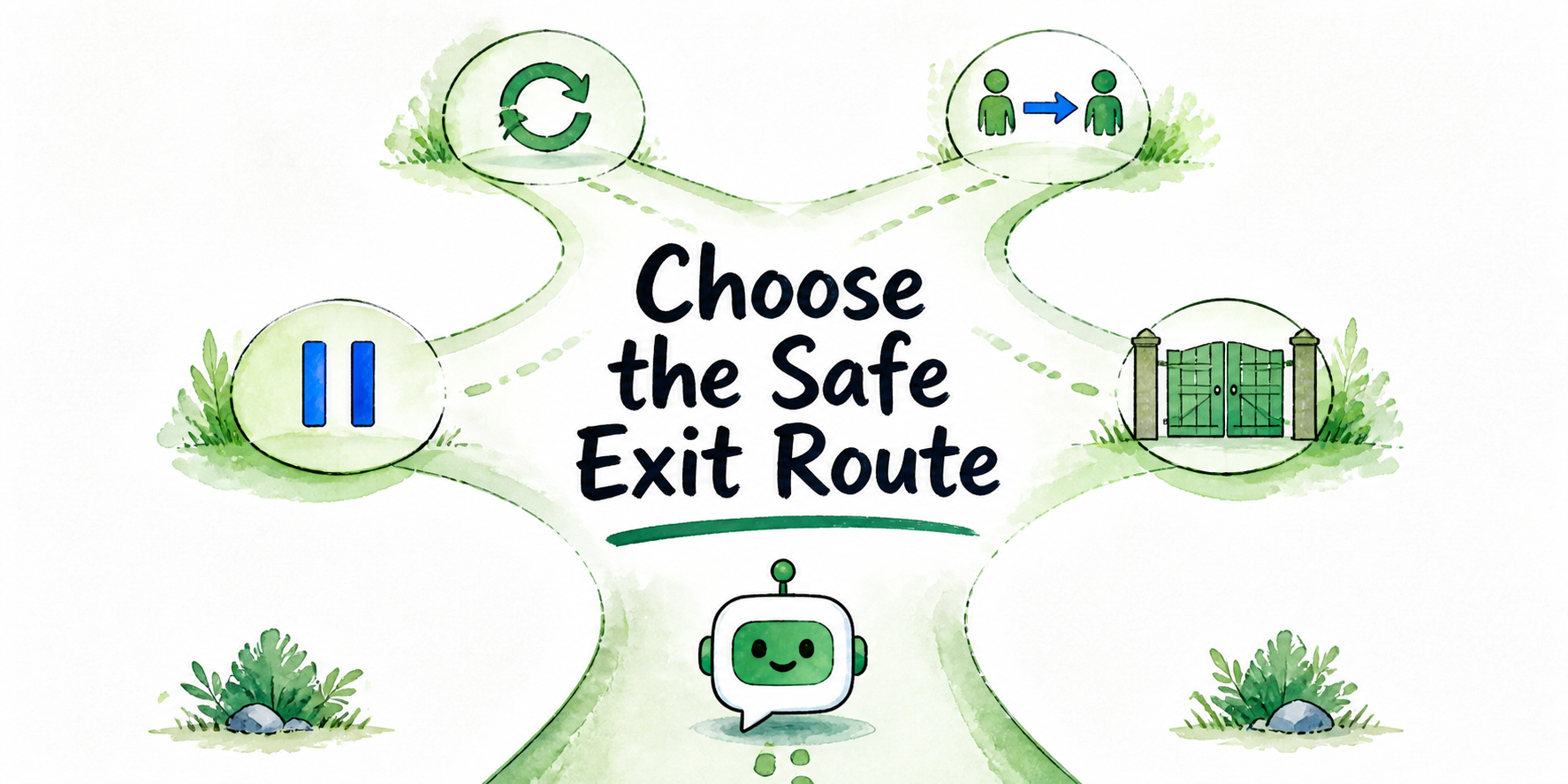
- Choose the route before changing access, data, domains, integrations, deployments, credentials, or billing.
- Inventory every dependency and distinguish verified facts from unresolved questions.
- Record the owner, authority, downstream impact, recovery consequence, evidence, approval, and confirmation method for each proposed change.
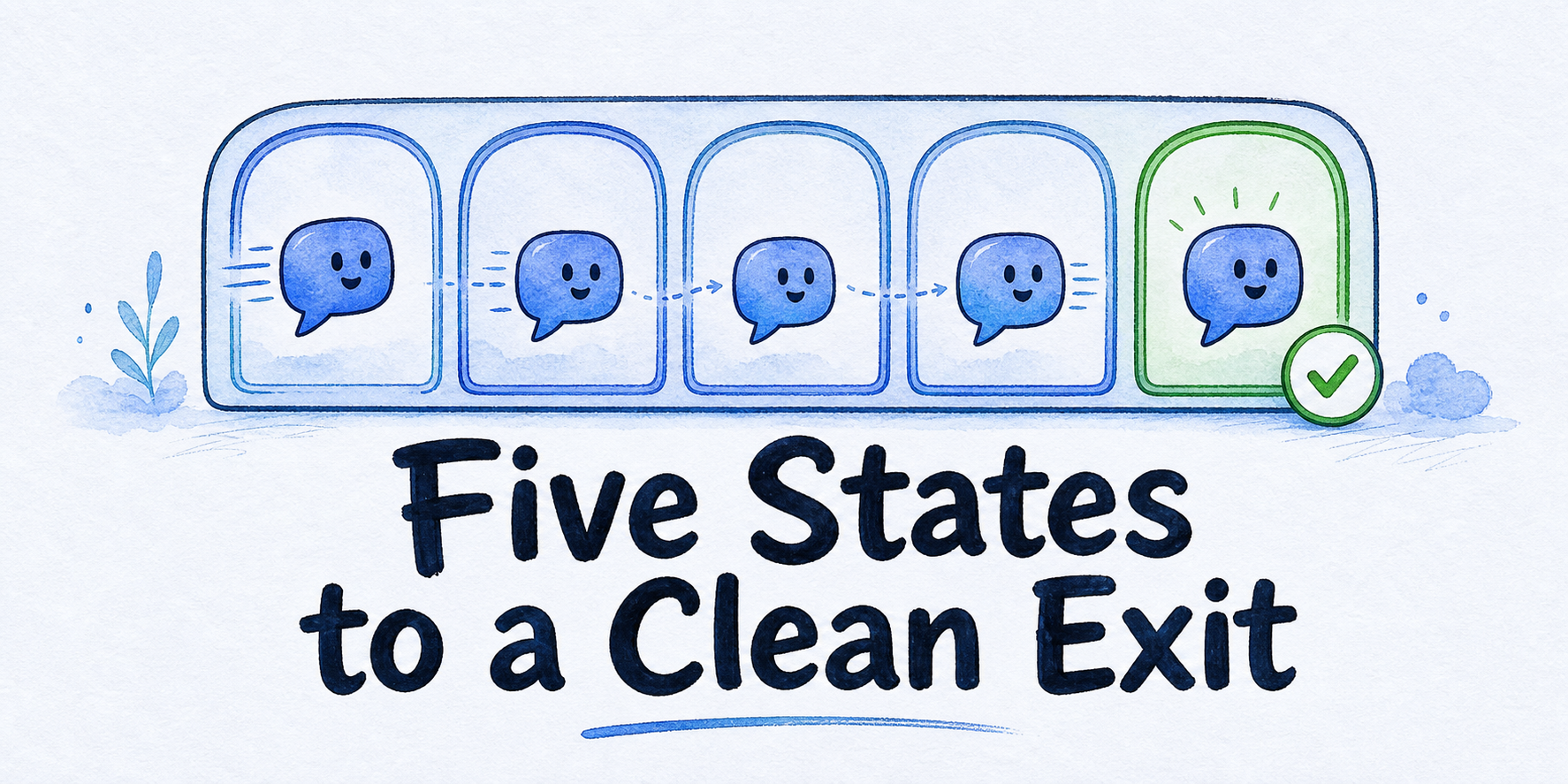
- Finish with explicit written acceptance that defines completed work, exceptions, remaining risks, owners, and the new service boundary.
A request to “cancel the chatbot” may affect a public assistant, custom domain, CRM handoff, conversation records, credentials, and future charges at once. A fast exit can break a customer journey or discard useful evidence, while an unmanaged delay can leave stale answers and unsupported workflows in public. The safe response is a dependency-first route decision that preserves continuity where required without implying that the client did anything wrong.
Key Takeaways
- Choose the route before acting. Renewal, transfer, pause, and closure require different instructions, owners, and acceptance conditions.
- Require evidence before promising portability. Export, transfer, retention, recovery, domain continuity, and post-cancellation access must be verified for the specific account.
- Pause unresolved critical changes. Missing authority, ownership, recovery information, or approval is a stop condition.
- Establish replacement ownership first. Confirm that the successor can perform accepted duties before reducing agency access.
- Use written acceptance to define the boundary. Silence, contract expiry, or disabling an assistant does not establish who owns unfinished work.
Choose the Route: Renew, Transfer, Pause, or Close
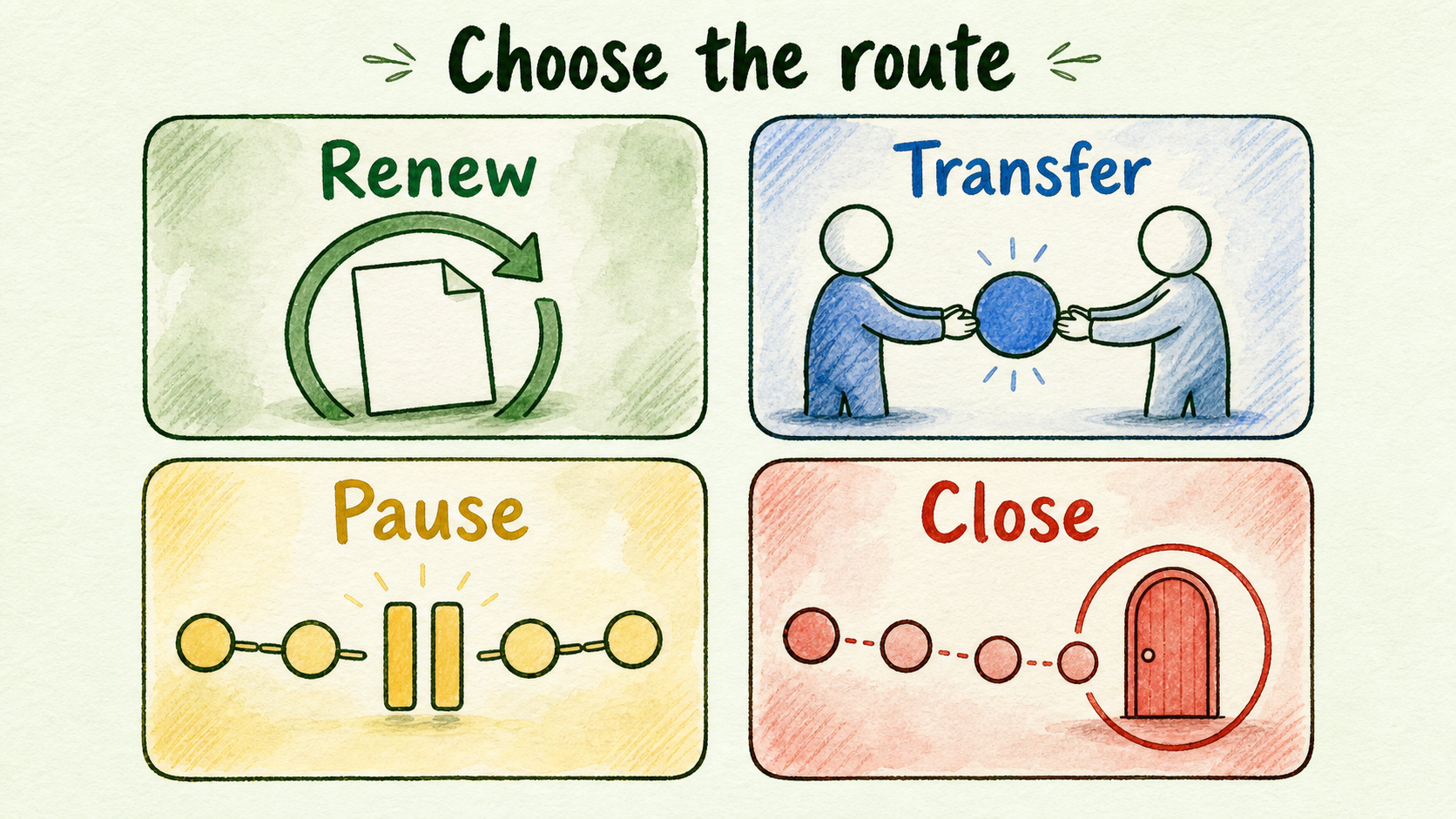
AI chatbot client offboarding is the controlled decision to renew, transfer, pause, or close an assistant service together with its operational dependencies. It is broader than termination: a handover moves accepted responsibilities to another operator, while closure ends an authorized service boundary after dependencies have been addressed.
Begin with the signed client agreement, statement of work, amendments, data-processing terms, approved disposition instructions, notice requirements, ownership clauses, and transition obligations. Record missing documents or disputed interpretations as open items for the appropriate legal, privacy, security, finance, or technical owner. The register should not substitute for their decisions.
| Route | Select it when | Evidence required before authorization |
|---|---|---|
| Renew | The client still needs the service under a confirmed scope | Revised scope, exclusions, service owner, effective term, billing responsibility, and acceptance criteria |
| Transfer | The assistant will continue under a client or successor operator | Intended owner, accepted duties, verified access path, credential readiness, operating information, and handover acceptance |
| Pause | A required decision or dependency is missing and immediate closure would create avoidable risk | Reason, temporary owner, interim public state, restricted work boundary, review date, and escalation owner |
| Close | The service should end and authorized owners have cleared its dependencies | Written closure instruction, dependency clearance, data decisions, staged access plan, financial checks, platform checks, and final acceptance criteria |
Renewal does not mean continuing every previous activity. Define what remains active, what leaves scope, who owns maintenance, and how future changes will be approved. Review the pre-exit maintenance history for unresolved answer gaps, incidents, source changes, and client decisions that may affect the revised boundary.
Transfer requires more than creating a login. The intended operator must accept responsibility for the assistant, approved sources, prompts, integrations, records, billing relationships, and future operating decisions. Verify that the required role and access path work in the specific account before promising continuity.
Pause is safer than close when the agency lacks a required owner, written instruction, verified capability, recovery path, or dependency clearance. Define whether the assistant remains public, becomes restricted, or enters another approved interim state. If it remains available, assign responsibility for stale sources, incidents, open handoffs, and unsupported answer areas.
Closure requires client authority and operational readiness. Confirm cancellation authority, invoice status, paid-term end date, nonrefundable obligations, provider charges, usage exposure, and who will receive future charges. Service closure, subscription cancellation, and the end of agency support may occur on different dates, so record each boundary separately.
Build the Live-Service Inventory
The inventory establishes what is live now. It should not become an onboarding guide or a list of abandoned ideas.
For every item, record an identifier, current owner, intended owner, status, evidence location, connected dependencies, and unresolved question. Include:
- Assistants, their intended visitor jobs, public or private state, unsupported answer areas, and enabled tools.
- Approved sources, source owners, freshness status, prompts, answer rules, fallback behavior, and brand assets.
- Website widgets, embeds, hosted pages, product surfaces, custom domains, and API-backed deployments.
- SMTP settings, sending identities, DNS records, and domain registrars.
- CRM, support, commerce, calendar, automation, webhook, and human-handoff connections.
- API authentication, endpoints, event types, downstream destinations, and custom interfaces.
- Model-provider keys, other credentials, their owners, and associated billing responsibility.
- Conversations, leads, feedback, analytics, reports, incidents, and unresolved handoffs.
- Workspace owners, agency teammates, client-scoped roles, permissions, seats, private-assistant access, and billing relationships.
Do not collapse these elements into a single row called “website chatbot.” A custom domain may belong to the client, its DNS may be managed by a developer, the assistant configuration may be operated by the agency, and the subscription may sit with a finance owner. Each is a separate control point.
Record account-specific questions rather than assuming answers. Verify export availability and format for assistants, sources, prompts, conversations, leads, analytics, reports, feedback, and configuration. Also verify whether ownership can be transferred, which successor roles are available, what happens to access after cancellation, what recovery options exist, and how retention, deletion, backups, and deletion confirmation work for the relevant account.
Run the Dependency-First Shutdown Test
Before changing any deployment, domain, integration, credential, record, permission, or billing relationship, complete one dependency row with these fields:
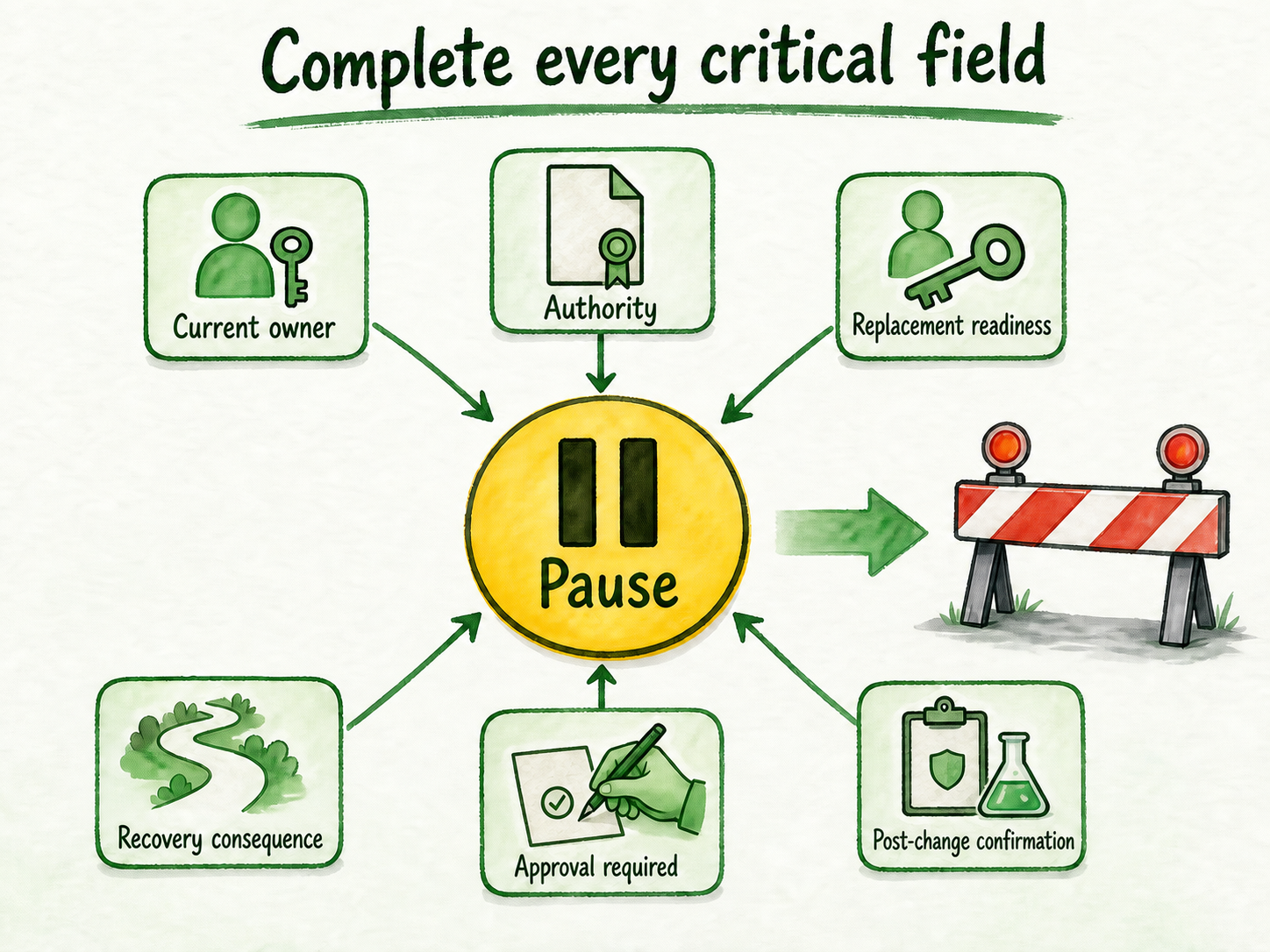
- Current owner: Who can control or change it now?
- Intended owner: Who will control or monitor it after the route takes effect?
- Authority: Which agreement, instruction, account role, or approval permits the change?
- Downstream impact: Which customer journey, team, record, or system could be affected?
- Recovery consequence: Can the prior state be restored, by whom, and with what uncertainty?
- Evidence needed: Which account record, contract reference, test result, or written confirmation supports the action?
- Approval required: Who must authorize execution?
- Replacement readiness: Does the successor have the necessary role, credential, documentation, and billing arrangement?
- Post-change confirmation: Which test or record will prove the intended result?
Consider a webhook that sends qualified inquiries to a CRM. Before altering its credential, record who owns the current secret, which events it sends, where the records land, what downstream activity depends on them, whether the successor has a replacement credential, how rollback would work, who approves the change, and which test event will confirm success. Removing the old credential first could silently interrupt follow-up.
Apply the same test to domain and SMTP changes. A domain transfer changes control of the relevant domain or DNS configuration; it does not by itself transfer the assistant, subscription, email service, or data. An integration shutdown stops an approved connection or event path; it should occur only after downstream effects, record treatment, recovery consequences, and authority are known.
An unresolved critical dependency forces a pause. Do not proceed when a row lacks its owner, authority, replacement readiness, recovery consequence, approval, or confirmation method.
Set Data Disposition and Stage Access Changes
Define the terms used in the register:
- Assistant owner: The party authorized to control the operational assistant.
- Source owner: The party authorized to approve and maintain the business material used by the assistant.
- Data disposition: The authorized outcome for specified data, such as return, retention, restriction, export, or deletion.
- Access revocation: Removal of a person’s or system’s permission to use an account, workspace, assistant, credential, or resource.
- Integration shutdown: An authorized stop to a connection or event path.
- Domain transfer: A change in control of the relevant domain or DNS configuration.
A data-disposition row should keep these matters separate:
- The agency’s instruction and authority.
- The client’s instruction and approving person.
- The applicable contract or data-processing requirement.
- The verified capability of the specific account or provider.
- The unresolved legal, privacy, security, financial, or technical question and its named owner.
Create separate rows for assistants, approved sources, prompts, conversations, leads, feedback, analytics, reports, configuration, and relevant backups or downstream copies. Do not assume that a deletion request proves deletion is available for every object, that an export includes every required field, or that deleted material can be recovered. Obtain account-specific confirmation before promising any outcome.
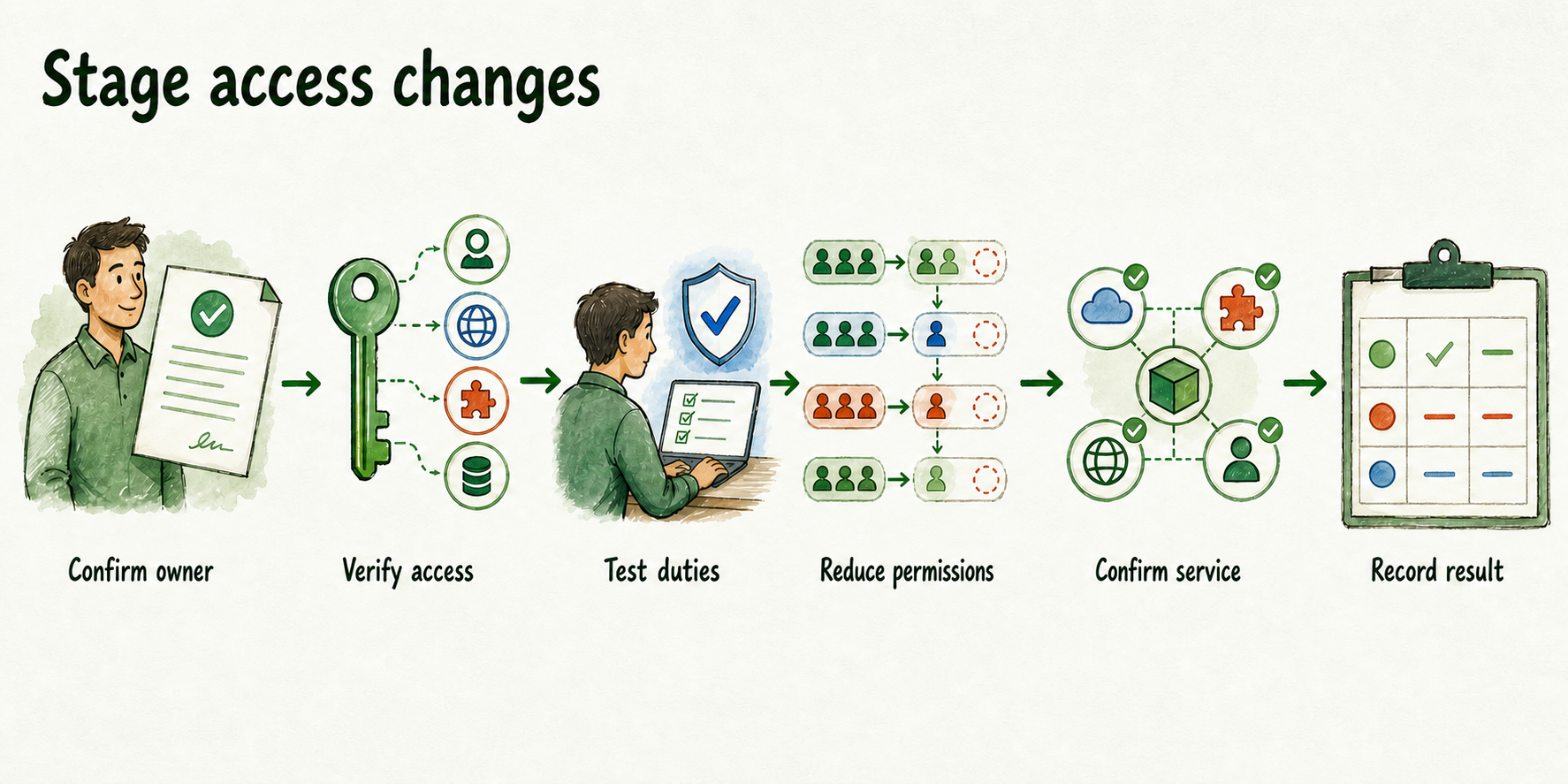
Stage access changes in this order:
- Confirm the intended owner and the duties that person or team accepts.
- Add or verify the appropriate workspace role, private-assistant access, account authority, credential, provider key, integration access, domain control, SMTP control, and billing access.
- Test whether the successor can perform the accepted duties without shared personal credentials.
- Reduce permissions for agency teammates who no longer need them, one dependency group at a time.
- Confirm private-assistant visibility, integrations, domains, deployments, and customer journeys after each stage.
- Record the result, exception, and recovery action before proceeding.
Roles can differ across assistants, sources, conversations, leads, handoffs, integrations, and billing. Verify actual permissions in the client’s workspace rather than relying on a role label. Escalate gaps to named legal, privacy, security, finance, platform, or technical owners before continuing.
Apply the Register: Renewal, In-House Transfer, and Closure
These examples illustrate register use. A real engagement must rely on its signed agreement, current inventory, account records, invoices, verified capabilities, and written approvals.
Renewal with a narrower scope
Inputs: The client wants continued maintenance for its website assistant but no longer wants a booking workflow. The register identifies the workflow’s pages, calendar connection, prompts, handoff rules, records, credential owner, and billing effect.
Sequence: Confirm the revised scope, retire or transfer only the approved workflow dependencies, preserve the remaining assistant controls, assign owners, and test the retained public experience.
Acceptance condition: The client approves the active scope, exclusions, owners, billing responsibility, effective date, and checks for the remaining service.
Outcome: The engagement renews without leaving an ambiguous obligation to support the removed workflow.
In-house transfer
Inputs: The client wants its team to operate a branded website assistant and its approved sources. The inventory covers assistant settings, source responsibilities, prompt rules, brand assets, deployments, domain dependencies, integrations, workspace roles, conversations, open handoffs, credentials, and billing.
Sequence: Verify the intended successor role and required capabilities, establish replacement access, test routine operating duties, resolve or assign exceptions, provide bounded operating information, and then reduce agency permissions in stages.
Acceptance condition: The named client operator acknowledges accepted duties, demonstrated access, account-specific limitations, open answer gaps, unresolved dependencies, and the date agency operation ends.
Outcome: Operating responsibility moves to the client without an unsupported promise about exports, ownership transfer, custom-domain continuity, or post-cancellation access.
Closure with connected systems
Inputs: The assistant uses a branded domain, sends CRM events through a webhook, contains client-scoped access, retains operational records, and sits within an agency-managed billing relationship.
Sequence: Finance confirms charges and paid-term boundaries. Technical owners approve the domain, SMTP, integration, and deployment sequence. The client supplies authorized data instructions. Workspace owners establish the access-reduction order. Each dependency is changed only after its evidence and approval fields are complete.
Acceptance condition: The authorized sequence is confirmed as complete, while exceptions and deferred items are assigned to named owners with dates.
Outcome: The service closes with evidence, continuity decisions, and responsibility boundaries preserved.
Across all three routes, distinguish a fast exit from a verified transition. Speed may reduce short-term delivery burden, but it cannot justify removing access before successor readiness or making portability promises without evidence. Likewise, small goodwill tasks should not create indefinite unpaid operation. Quote substantial transition work as a bounded service with defined deliverables, owners, dates or hours, exclusions, and acceptance criteria.
Every route should produce a final service report covering:
- Active scope and public deployment state.
- Known answer gaps and unsupported areas.
- Open handoffs and unresolved incidents.
- Source freshness and source owners.
- Enabled tools, integrations, and channels.
- Recent changes and their confirmation records.
- Outstanding dependencies and assigned owners.
- Recommended next actions.
Use available conversations, feedback, analytics, reports, and account records to describe operational facts. Do not turn them into unsupported claims about return on investment, savings, lead growth, or support deflection.
Close with a Written Acceptance Record
The acceptance record is the final operating boundary. It should state:
- The selected route and effective date.
- Completed checklist items and their evidence references.
- Exceptions, deferred items, and incomplete or failed checks.
- Responsibilities retained by the agency, if any.
- Unresolved risks and the consequence of leaving them open.
- The exact service boundary after acceptance.
- Named client, agency, platform, finance, privacy, security, integration, and technical owners as applicable.
- Confirmation references for permissions, deployments, credentials, domains, integrations, data instructions, and billing.
- The next review, decision, or escalation date for every open item.
The record should distinguish chatbot handover, where accepted operating duties move to a successor, from service termination, where the agency stops providing defined work. Neither event proves that data was deleted, a domain was transferred, an integration was portable, or access will continue after cancellation.
Obtain explicit written acceptance from the required approvers. Silence is not acceptance. If critical matters remain unresolved, document what can proceed safely, what remains paused, and who must make the next decision.
FAQ
What belongs in an AI chatbot client offboarding checklist?
It should identify the selected route—renew, transfer, pause, or close—then inventory the live assistants, sources, prompts, brand assets, deployments, domains, SMTP, integrations, APIs, webhooks, credentials, records, permissions, seats, and billing relationships. Each proposed change also needs an owner, authority, downstream impact, recovery consequence, approval, evidence, and confirmation method.
Who owns the chatbot after an agency engagement ends?
Ownership and operating authority depend on the signed agreement, account structure, applicable platform roles, and written acceptance. Name an assistant owner for operational control and separate source owners for business content. Do not infer ownership solely from invoice payment, account access, or password knowledge.
What should be verified before deleting or transferring access?
Verify written authority, contract and data-processing requirements, replacement ownership, account-specific capabilities, export needs, downstream dependencies, credential readiness, recovery consequences, billing effects, and the post-change test. Pause the change if any critical element remains unresolved.
When should an agency pause rather than close the service?
Pause when there is no authorized instruction, successor owner, safe interim public state, verified data outcome, understood recovery consequence, or dependency clearance. Assign a temporary owner, restricted service boundary, escalation path, and review date so the pause does not become unattended operation.
What is the difference between chatbot handover and service termination?
Handover moves accepted operating duties to a named successor. Service termination defines when the agency stops providing agreed work. They may happen together, on different dates, or not at all when the engagement renews or pauses.
What should a final report and acceptance record contain?
The final report should cover active scope, answer gaps, handoffs, incidents, source freshness, enabled tools, recent changes, dependencies, and next actions. The acceptance record adds completed work, exceptions, retained responsibilities, unresolved risks, effective boundaries, dates, named owners, evidence references, and the next review or escalation for open items.